
American Pennyroyal (Hedeoma pulegioides)
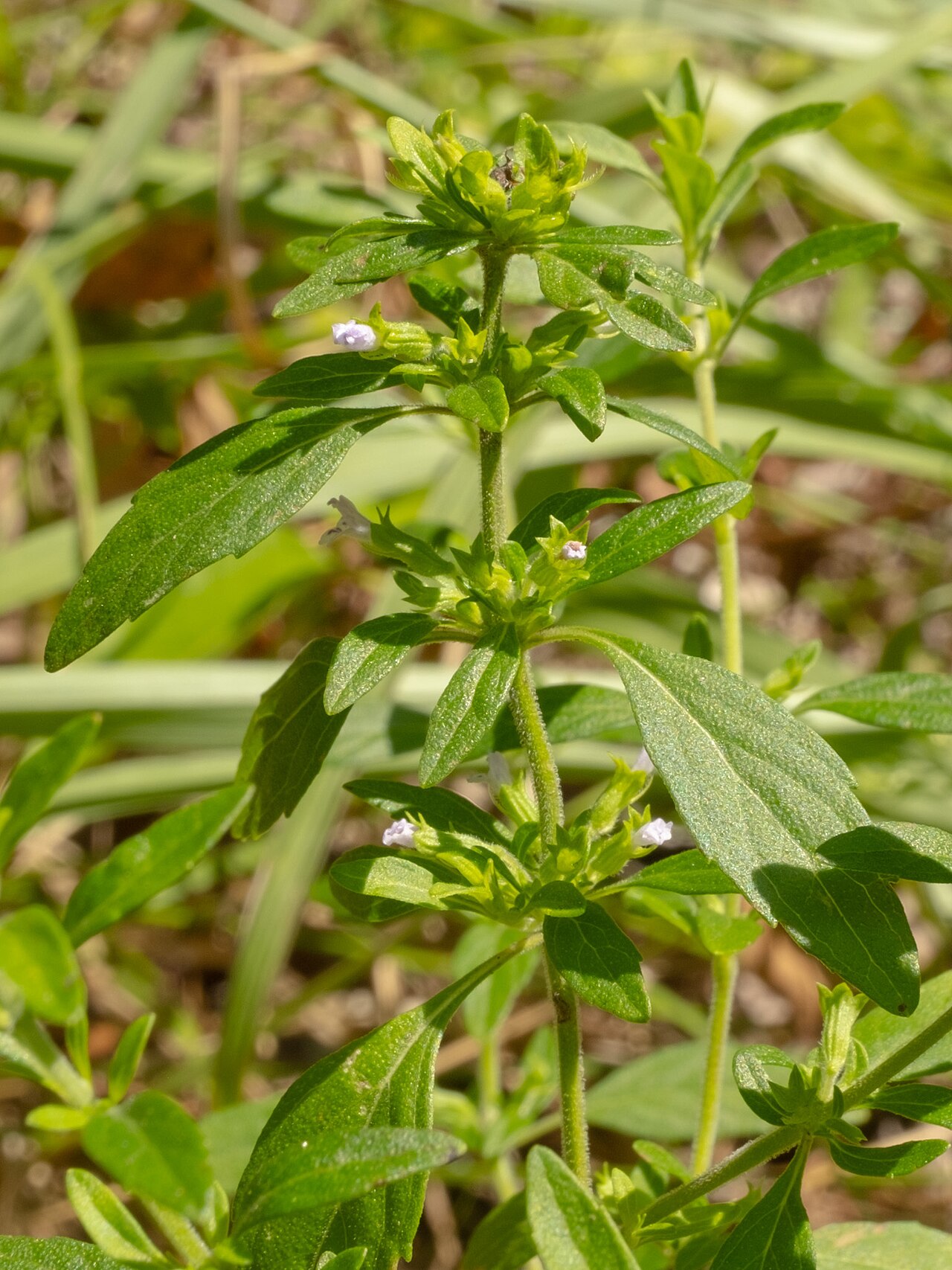
Hedeoma pulegioides, American Pennyroyal (also called American false pennyroyal, mock pennyroyal or squaw mint in older books), is a small native annual of the mint family with a strong, sweet, minty scent. It grows only about 4 to 16 inches tall, with square, finely hairy stems, small paired leaves, and tiny pale lavender flowers in the leaf axils from midsummer to fall. Brush against a patch on a dry, rocky hillside or a woodland path and the air fills with the sharp fragrance of pennyroyal.
The plant is named for its resemblance in smell to European pennyroyal (Mentha pulegium); pulegioides means “like pulegium.” Both get their odor largely from the same compound, pulegone, and both were once used as folk insect repellents and medicines. That shared chemistry is also why pennyroyal is a plant to respect. Safety note: Pennyroyal oil, distilled from this plant and from European pennyroyal, contains pulegone and is toxic. Never swallow pennyroyal oil or put it on the skin undiluted; it has caused severe liver damage and deaths. Never use pennyroyal in any form during pregnancy, and keep the oil away from children and pets.
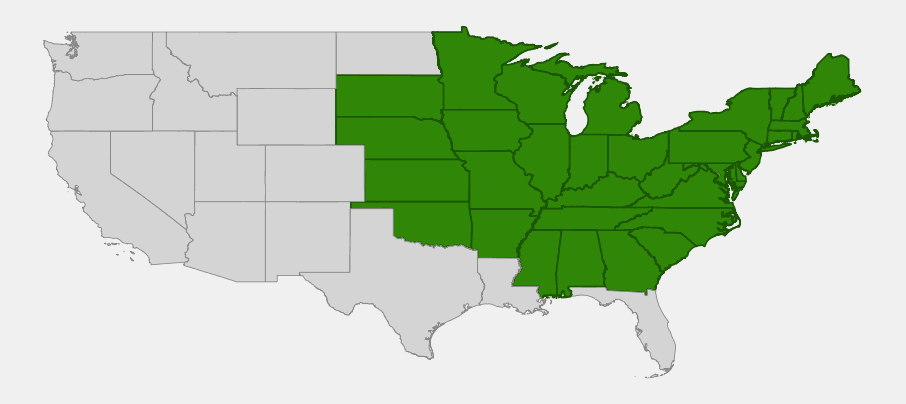
American pennyroyal is native across most of the eastern and central United States, from Maine and Minnesota south to Georgia and Alabama and west to South Dakota, Kansas and Oklahoma. It is a modest plant for dry, sunny, thin-soil spots in a native garden, where it fills gaps and reseeds itself. This guide covers identification, range, growing, wildlife value and its long and cautionary history as a medicinal herb.
Identification
American pennyroyal is easy to recognize by smell. Few small plants in dry eastern woods and fields give off such a strong pennyroyal-mint scent when crushed. The other key features are its annual habit, tiny flowers and two-lipped, ribbed calyx.
Stems
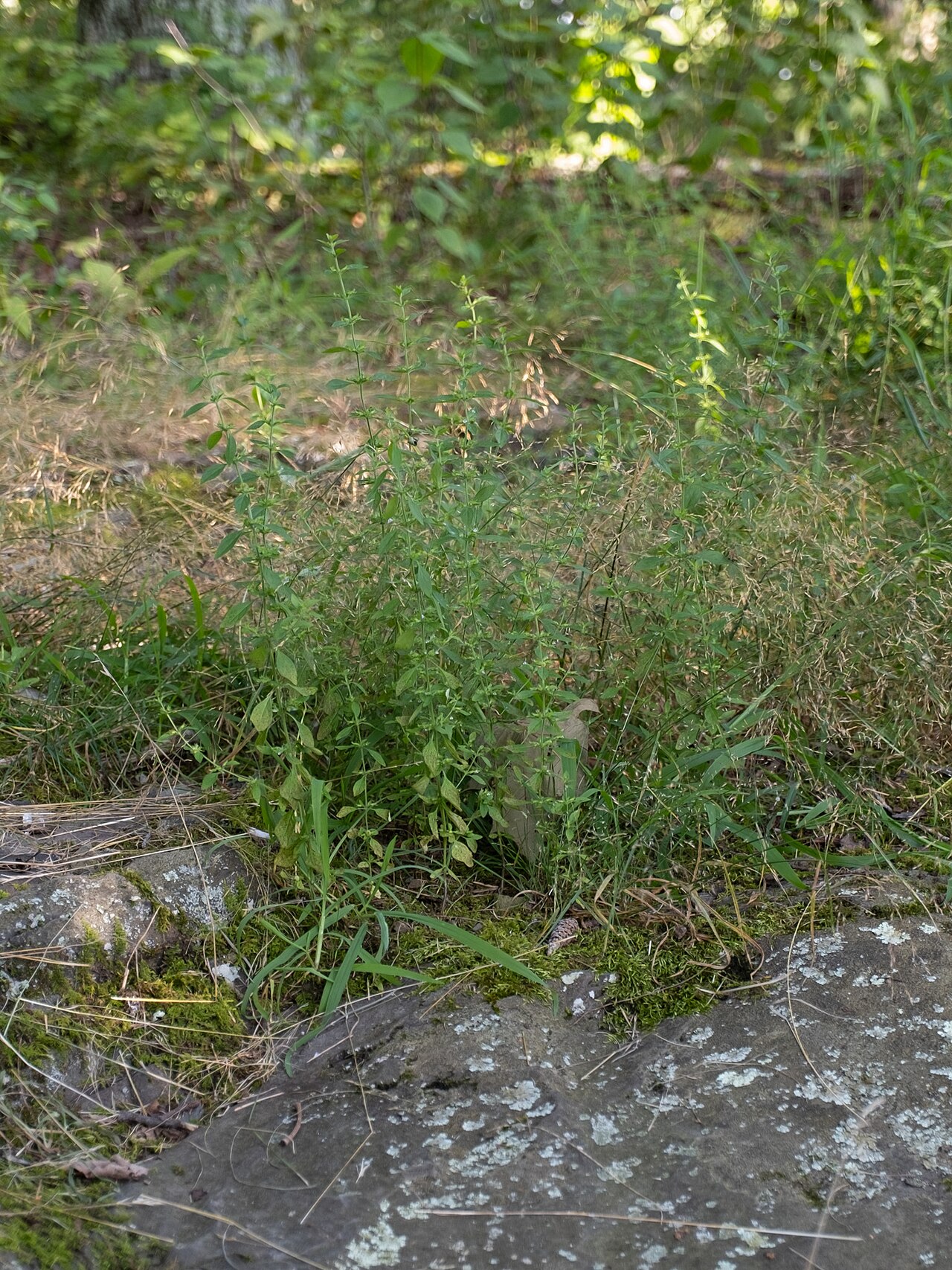
It is an annual with a slender taproot and a single erect stem that branches freely, often forming a little bushy plant 4 to 16 inches tall. As in most mints, the stems are square in cross-section. They are covered with short, fine, downward-pointing hairs.
Leaves
The leaves are opposite, short-stalked, and oval to elliptic, about 1/2 to 1 1/4 inches long, with a few shallow teeth or nearly smooth edges. They are thin, slightly hairy and dotted with tiny glands that hold the aromatic oil. Leaves near the top of the stem are smaller.
Flowers
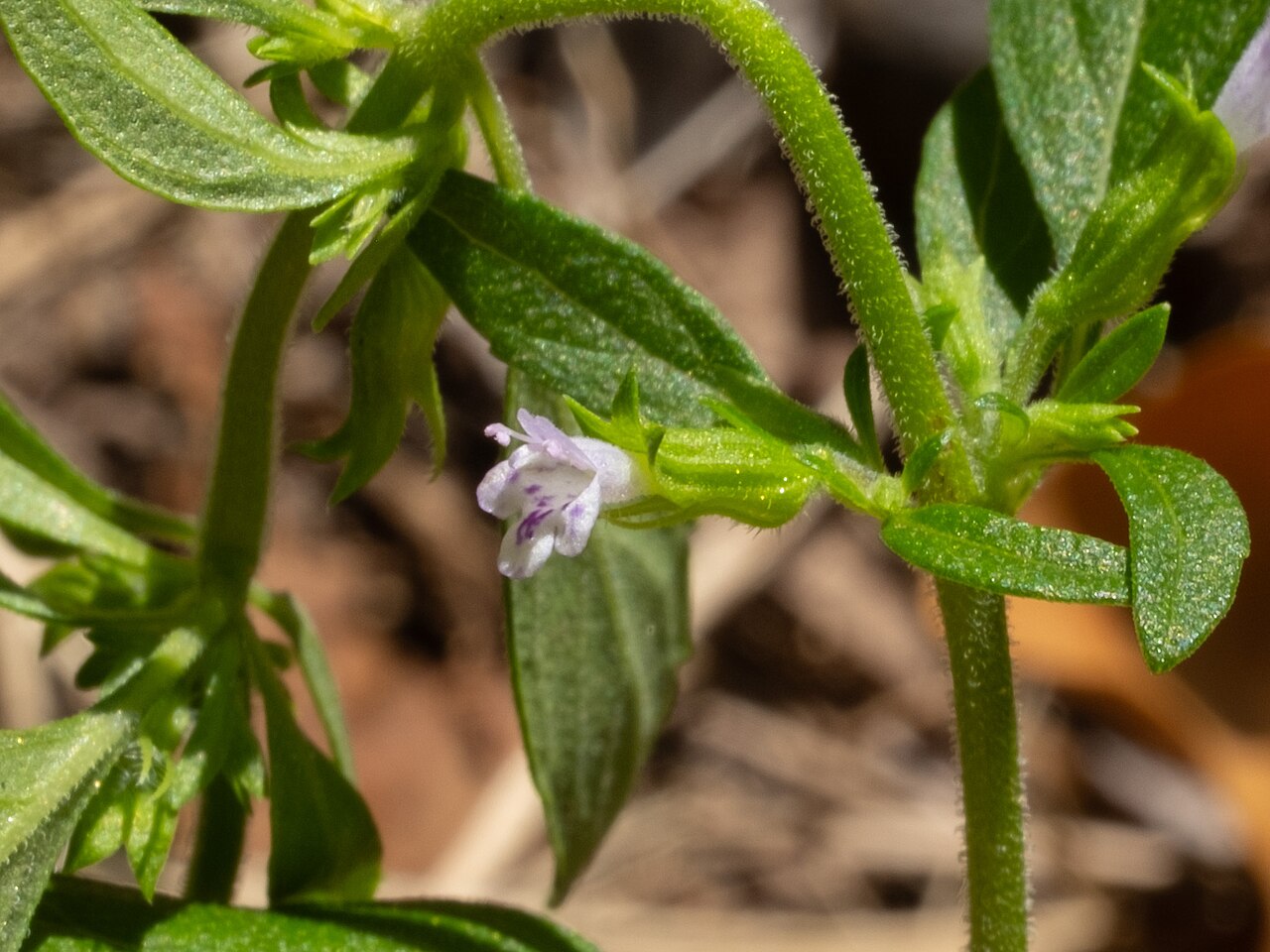
From about July to September, small clusters of two to several flowers appear in the axils of the upper leaves. Each flower is only about 1/4 inch long, two-lipped and pale blue to lavender, often with darker spots on the lower lip. The calyx is tubular, ribbed and hairy, with two lips: three short, triangular upper teeth and two longer, bristly lower teeth. The calyx stays on the plant after flowering and holds the seeds.
Fruit & Seeds
Each flower produces up to four tiny, smooth, dark brown nutlets inside the persistent calyx. The dry, brown plants with their old calyces often stay standing into winter, still faintly fragrant when crushed.
Look-alikes
European pennyroyal (Mentha pulegium) is a creeping perennial with flowers in dense whorls around the stem, and it is not native. American Dittany is a perennial with wiry stems and clusters of lavender flowers at the stem tips. Rough false pennyroyal (Hedeoma hispida) of the Midwest and Great Plains has narrow, almost linear leaves. American Wild Mint is a larger perennial of moist ground with a different, more spearmint-like scent.
Quick Facts
| Scientific Name | Hedeoma pulegioides |
| Family | Lamiaceae (mint family) |
| Plant Type | Aromatic herbaceous annual |
| Mature Height | 4–16 in |
| Mature Spread | 4–12 in |
| Growth Rate | Fast |
| Sun Exposure | Full sun to partial shade |
| Water Needs | Low to medium; dry to moderately moist, well-drained soil |
| Soil Type | Thin, rocky, sandy or gravelly soils; also loam |
| Soil pH | About 5.0–7.5 |
| Bloom Time | July–September |
| Flower Color | Pale blue to lavender |
| Fall Color | None; plants turn brown and die after seeding |
| Fruit | Tiny brown nutlets inside the persistent calyx |
| Deer Resistant | Yes; the strong scent deters browsing |
| USDA Hardiness Zones | 3–8 (annual; reseeds) |
Native Range
American pennyroyal is native to eastern and central North America. USDA PLANTS records it from 33 states and the District of Columbia: throughout New England and the Mid-Atlantic, across the Ohio Valley and Great Lakes states to Minnesota and South Dakota, south through the Appalachians and Piedmont to Georgia, Alabama and Mississippi, and west to Nebraska, Kansas, Oklahoma and Arkansas. In Canada it is native in southern Ontario and Quebec and in New Brunswick and Nova Scotia.
It is a plant of dry, open, often disturbed ground: rocky and sandy woods, open oak and pine woodlands, glades, ledges, old fields, pastures, trail edges and roadsides. It does best where competition is light, so it often appears on thin soils over rock, on eroded banks and along paths where the ground is regularly scuffed.
Because it is an annual, populations come and go with the amount of open, sunny ground available. It may be abundant for a few years after a disturbance and then fade as taller perennials and shrubs close in. It is common in much of its range but less frequent at its western and southern edges.
📋 Regional plant lists featuring American Pennyroyal: Alabama, Georgia & Mississippi · Arkansas, Louisiana, Eastern Oklahoma & Eastern Texas · Connecticut, Massachusetts & Rhode Island · New Hampshire, Maine & Vermont · Delaware, Southern New Jersey & Long Island · New York, Pennsylvania & Northern New Jersey · Illinois, Iowa & Missouri · Ohio & Indiana · Nebraska, Kansas & Eastern Colorado · Kentucky & Tennessee · Maryland, Virginia & West Virginia · Michigan, Wisconsin & Eastern Minnesota · North & South Carolina · North Dakota, South Dakota & Western Minnesota
Growing & Care Guide
American pennyroyal is a small, unfussy annual for dry, sunny spots. Grow it for its fragrance and its place in native plant communities, not as a medicinal herb.
Light
Full sun to partial shade. It flowers and stays compact best in sun, and it tolerates the light shade of open oak woods.
Soil & Water
Plant it in lean, well-drained soil: sandy, gravelly or rocky ground, or the thin soil around stones and paths. Rich, moist garden soil gives tall, floppy plants and lets other plants crowd it out. Once established it needs no watering except in long droughts. No fertilizer is needed.
Planting Tips
Sow seed on the soil surface in fall or early spring and press it in lightly, since tiny seeds need light to germinate. Bare or sparsely vegetated ground is best. Use it to fill gaps between stepping stones, along a dry path, at the front of a rock garden, or among low prairie and glade plants.
Pruning & Maintenance
No pruning is needed. Leave the dry plants standing in fall so they can drop seed, then rake lightly in spring to expose a little bare soil for the next generation. Keep taller, aggressive plants from shading it out.
Propagation
Grow it from seed only. Seed can be collected in fall by shaking or rubbing the dry calyces over a paper bag. A short cold, moist period over winter improves germination. Once established, it reseeds itself where conditions suit it.
Landscape Uses
- Rock gardens and path edges: fills gaps and releases fragrance when brushed
- Dry, thin-soil restoration: glades, rocky openings and sandy fields within its native range
- Native herb and fragrance gardens: as a historical and aromatic plant, labeled as not for internal use
- Pollinator gardens: late-summer flowers for small bees
- Deer-browsed sites: its strong scent makes it unpalatable to deer
Wildlife & Ecological Value
American pennyroyal is small, but it fills a niche on dry, open ground where few other plants are flowering in late summer.
For Pollinators
The tiny flowers are visited by small bees, including sweat bees and small carpenter bees, and by small flies and wasps. They are too small and shallow for most butterflies.
For Birds
The tiny nutlets are of minor importance to birds. Seed-eating sparrows may pick some from the dry calyces in fall and winter.
For Mammals
Its strong scent discourages deer, rabbits and other browsers, so it is rarely eaten.
Ecosystem Role
As a quick-growing annual, it covers bare, eroded or disturbed soil on dry sites and helps hold it until perennials move in. Some gall-making insects form swellings in its calyces.
Cultural & Historical Uses
American pennyroyal was one of the best-known native medicinal herbs of eastern North America. Many Native American nations used it, often as a tea for colds, headaches and stomach complaints, and as an insect repellent. European settlers adopted it as a substitute for European pennyroyal, and the distilled oil was included in the United States Pharmacopeia in the nineteenth century. Bunches of the herb were hung in houses or rubbed on skin and clothing to repel fleas, mosquitoes and ticks.
Pennyroyal’s most notorious use was as an abortifacient, especially the concentrated oil. It does not work safely in any dose: the oil is a potent liver and kidney toxin, and many cases of poisoning and some deaths have been reported, mostly in women who took the oil to end a pregnancy. Pulegone and its breakdown products are responsible. Modern toxicology resources warn against any internal use of pennyroyal oil, and against pennyroyal products for children, pregnant or breastfeeding people, and pets.
Today American pennyroyal is mainly appreciated as a fragrant native wildflower and a window into the history of folk medicine. If you grow it, enjoy the scent of the fresh leaves in the garden, but do not make teas or oils from it. If you want it in your garden, grow it from seed rather than digging wild plants.
Frequently Asked Questions
Is American pennyroyal poisonous?
The concentrated oil is. Pennyroyal oil contains pulegone, which can cause serious liver damage and has caused deaths. Never swallow the oil, never use pennyroyal in any form during pregnancy, and keep pennyroyal oils and products away from children and pets. Brushing against or smelling the fresh plant in the garden is not a concern.
Is American pennyroyal the same as European pennyroyal?
No. American pennyroyal (Hedeoma pulegioides) is a small native annual. European pennyroyal (Mentha pulegium) is a creeping perennial mint from Europe. They smell similar because both contain pulegone, and both are toxic as concentrated oils.
Does American pennyroyal repel mosquitoes?
It has long been used as a folk insect repellent, and the crushed leaves are strongly scented. However, its oil is toxic and can be absorbed through the skin, so it is not a safe substitute for tested repellents. Enjoy it in the garden instead.
Is American pennyroyal an annual or a perennial?
It is an annual. It germinates in spring, flowers from midsummer into fall and dies after setting seed. It returns from seed each year where there is open, dry ground.
Where should I plant American pennyroyal?
In a sunny or lightly shaded spot with dry, lean, well-drained soil, such as a rock garden, a gravelly path edge or a dry meadow. Sow seed on bare soil in fall and let it reseed.

Looking for a nursery that carries American Pennyroyal?
Browse our native plant nursery directory: Alabama & Arkansas · Connecticut, Delaware & Georgia · Illinois, Indiana, Iowa & Kansas · Kentucky, Maine, Maryland, Massachusetts, Michigan, Minnesota, Mississippi & Missouri · Nebraska, New Hampshire, New Jersey, New York, North Carolina, Ohio & Oklahoma · Pennsylvania, Rhode Island, South Carolina, South Dakota, Tennessee, Vermont & Virginia · West Virginia & Wisconsin

