
American Yellowrocket (Barbarea orthoceras)
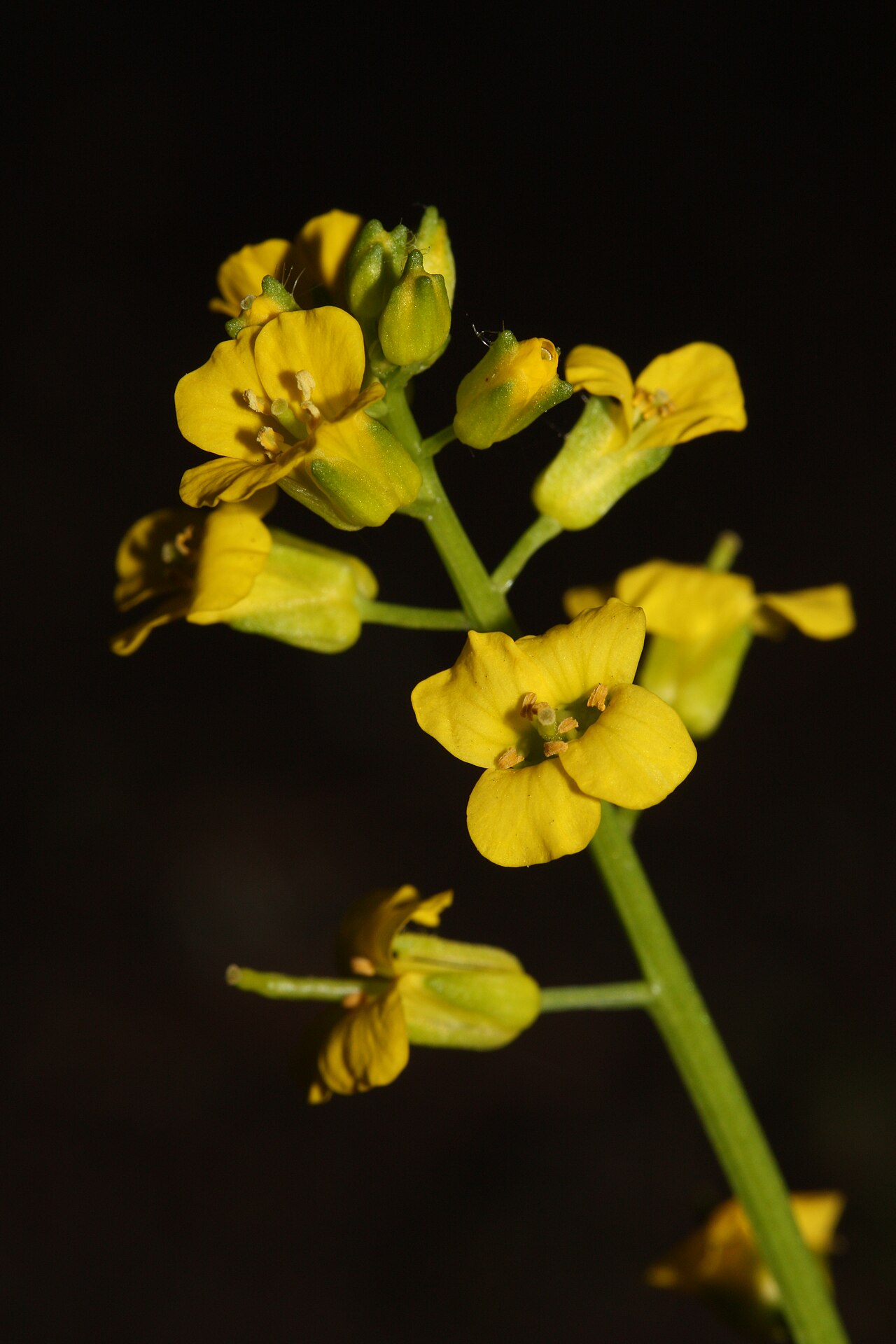
Barbarea orthoceras, known as American Yellowrocket or American wintercress, is a native member of the mustard family that grows in wet meadows, along streams and around springs across western and northern North America. It has glossy, lobed leaves and clusters of small, bright yellow, four-petaled flowers from spring into summer, followed by slender, upright seed pods.
It is the native cousin of the much more familiar garden yellowrocket or wintercress (Barbarea vulgaris), a European plant that has spread across nearly all of the United States as a weed of fields, roadsides and lawns. The two look alike at a glance, and many people who see a Barbarea in the East are looking at the introduced species. American yellowrocket is the common one in western mountain wetlands and the North.
This page explains how to tell the two apart, where the native species grows, how to grow it in a wet-meadow or rain garden, its value to wildlife, and its use as a wild green. The species name orthoceras means “straight horn,” a reference to its straight, upright pods.
Identification
American yellowrocket is a smooth, leafy plant 1 to 2 feet tall with yellow mustard flowers. To be sure you have the native species and not the introduced Barbarea vulgaris, look closely at the flowers and the tips of the seed pods.
Size & Form
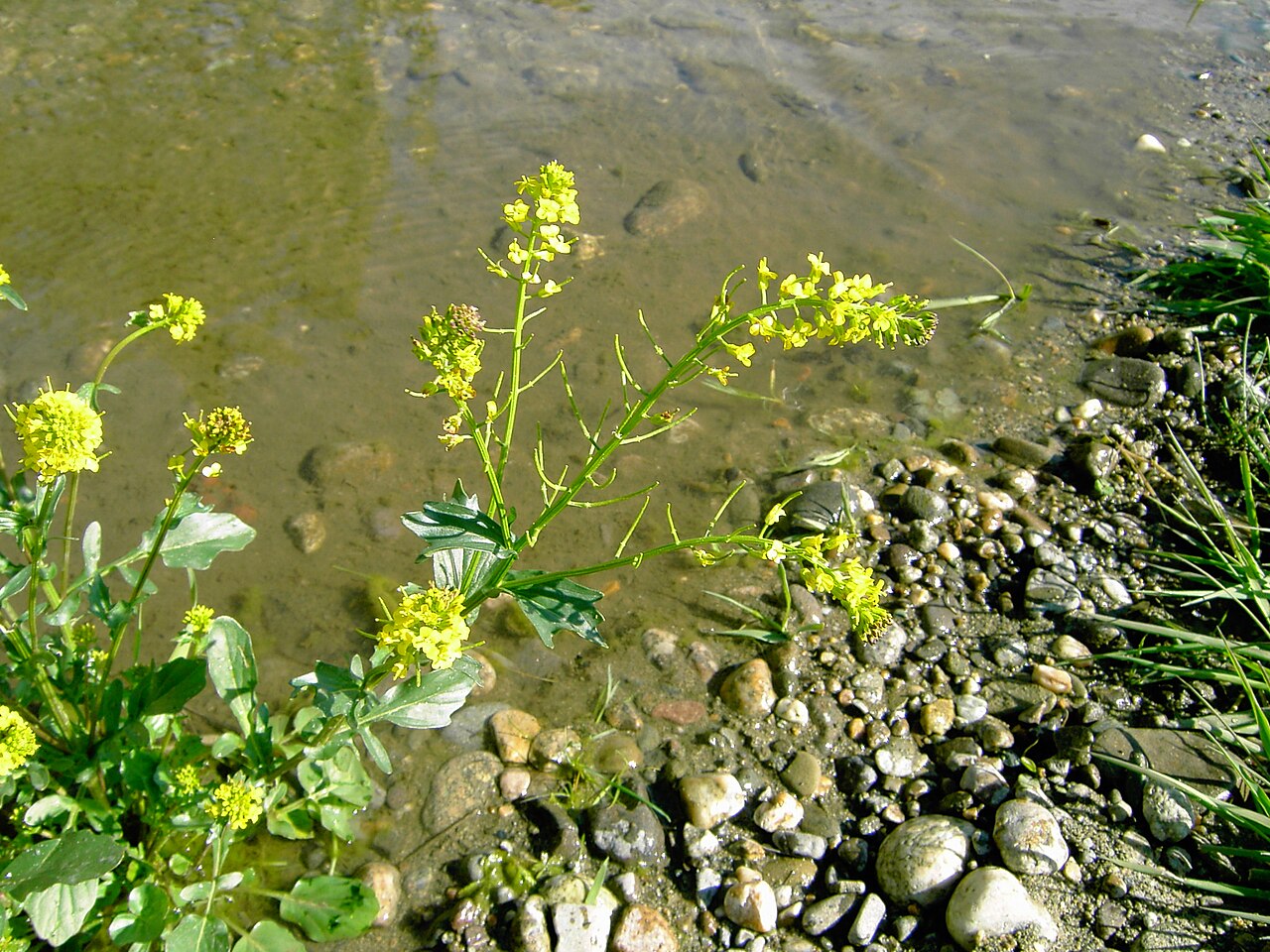
It is a biennial or short-lived perennial. In its first year it forms a rosette of glossy leaves; the next spring it sends up one or more stiff, branching stems about 4 to 24 inches tall. The plant is usually hairless.
Leaves
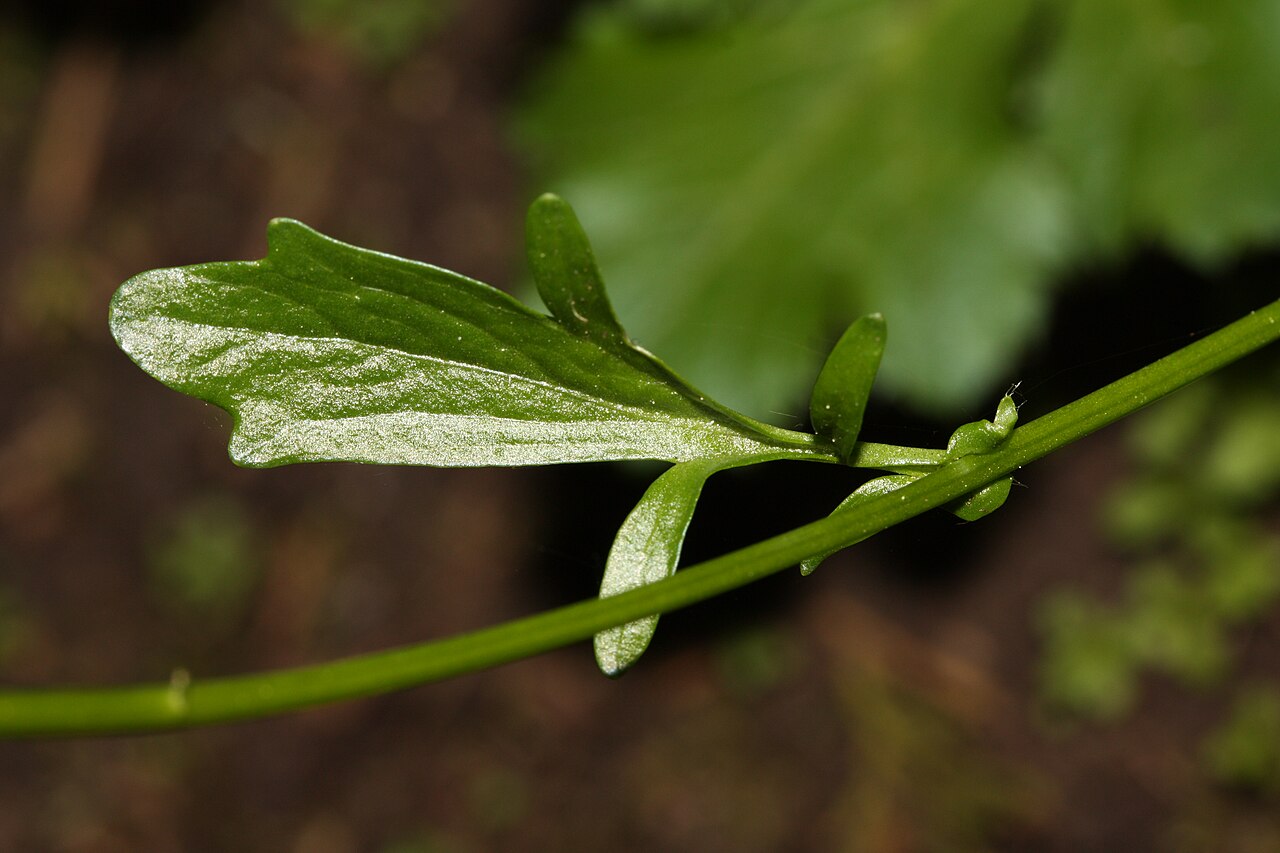
Basal leaves are divided into a large, rounded or oval end lobe and one to several pairs of much smaller side lobes. Stem leaves become smaller upward, and their bases wrap partly around the stem with two small ear-like lobes. The leaves are dark green and somewhat shiny, and they stay green late into fall.
Flowers
The flowers have four bright yellow petals in a cross shape, typical of the mustard family, and are about 1/4 inch across, with petals roughly 1/8 to 1/5 inch long. They are crowded in clusters at the tips of the stems and bloom mainly from late spring to midsummer, earlier at low elevations and later in the mountains.
Seed Pods
The fruits are slender, four-sided pods (siliques) about 1 to 2 inches long that point upward or spread at an angle. Each pod ends in a very short, stubby style, usually less than 1/25 inch long. The pods split open to release small brown seeds.
Similar Species
Introduced garden yellowrocket (Barbarea vulgaris) has larger flowers, with petals usually more than 1/5 inch long, and its pods end in a distinct beak-like style about 1/12 to 1/8 inch long. It grows mainly in disturbed ground: fields, roadsides, gardens and lawns. American yellowrocket has smaller flowers, pods with a tiny style, and usually grows in natural wet places. Native marsh yellowcress (Rorippa palustris) has smaller, paler flowers and short, plump pods. Watercress (Nasturtium officinale), which also grows in streams, has white flowers.
Quick Facts
| Scientific Name | Barbarea orthoceras Ledeb. |
| Family | Brassicaceae (mustard family) |
| Plant Type | Biennial or short-lived perennial herb |
| Mature Height | 4–24 in |
| Mature Spread | 6–12 in |
| Growth Rate | Fast |
| Sun Exposure | Full sun to part shade |
| Water Needs | High; wet to moist soil |
| Soil Type | Moist to wet loam, sand or gravel; stream banks and seeps |
| Soil pH | About 5.5–7.5 |
| Bloom Time | April–August (mainly May–July) |
| Flower Color | Bright yellow |
| Fall Color | None; leaves stay green late |
| Fruit | Slender, upright pod (silique) 1–2 in long |
| Deer Resistant | Moderate |
| USDA Hardiness Zones | 2–8 |
Native Range
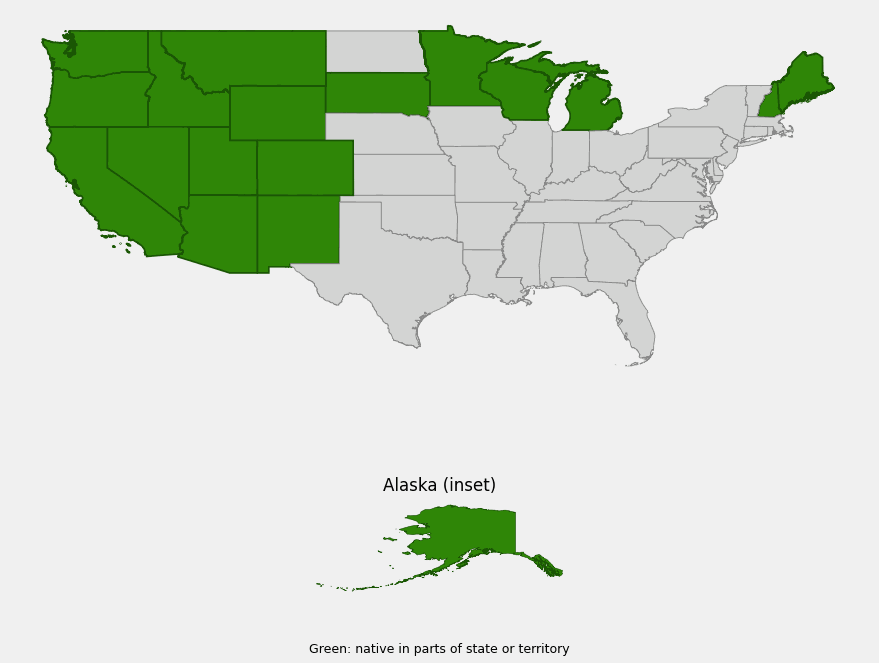
USDA PLANTS lists American yellowrocket as native in Alaska, Arizona, California, Colorado, Idaho, Maine, Michigan, Minnesota, Montana, Nevada, New Hampshire, New Mexico, Oregon, South Dakota, Utah, Washington, Wisconsin and Wyoming. It is most common in the mountains and coastal wetlands of the West and in Alaska. East of the Rockies it is scattered across the northern Great Lakes region and northern New England, and in South Dakota it is mainly found in the Black Hills.
In Canada it ranges from the Yukon and British Columbia east to Quebec, New Brunswick, Newfoundland and Labrador. It also grows in northeastern Asia, including the Russian Far East, Japan and Korea, which is why it was first described by a Russian-German botanist, Carl Friedrich von Ledebour.
It grows in wet meadows, along streams and rivers, on gravel bars, around springs and seeps, in moist woods and on lake shores, from near sea level in the Pacific Northwest and Alaska to high mountain meadows in the Southwest.
📋 Regional plant lists featuring American Yellowrocket: Alaska · Arizona & New Mexico · California & Nevada · North Dakota, South Dakota & Western Minnesota · Idaho, Eastern Oregon & Eastern Washington · Michigan, Wisconsin & Eastern Minnesota · Montana & Wyoming · New Hampshire, Maine & Vermont · Western Oregon & Western Washington · Utah & Western Colorado
Growing & Care Guide
American yellowrocket is rarely sold by nurseries, but it is easy to grow from seed collected with permission or bought from native seed suppliers in the West. It suits naturalistic plantings at the edge of a pond, stream or rain garden, where it will reseed.
Light
Grow it in full sun to part shade. In hot, low-elevation gardens it does best with afternoon shade.
Soil & Water
It needs constantly moist to wet soil and tolerates seasonal flooding. Sand, gravel or loam all work. It is not drought tolerant and will die back if the soil dries out in summer.
Planting Tips
Sow seed on the surface of moist soil in fall, or in early spring after a few weeks of cold, moist stratification. Plants form rosettes the first year and flower the second. Let some plants set seed so new rosettes replace the old ones.
Pruning & Maintenance
Little care is needed. Cut back spent flowering stems if you do not want reseeding. Watch for cabbage-family pests such as flea beetles and aphids, which rarely do serious harm.
Propagation
Grow it from seed. Collect pods as they turn tan and begin to split, dry them in a paper bag and store the seeds cool and dry until sowing.
Landscape Uses
- Rain gardens and pond edges: a fast native filler for wet, sunny or lightly shaded soil
- Wetland restoration: a pioneer of stream banks, gravel bars and wet meadows
- Pollinator gardens: early-summer yellow flowers for small bees and flies
- Edible landscaping: young leaves can be eaten as a bitter green, used sparingly
- Native alternative: a native replacement for weedy introduced yellowrocket
Wildlife & Ecological Value
As one of the early-flowering mustards of western wetlands, American yellowrocket supports a set of insects that specialize on the mustard family.
For Pollinators
Small native bees, including mining bees and sweat bees, and hover flies visit the flowers for nectar and pollen. Like other mustards it is a host plant for white and orangetip butterflies (family Pieridae), whose caterpillars feed on mustard-family plants.
For Birds
Seed-eating birds such as finches and sparrows eat the small seeds, and birds forage for insects among the stems.
For Mammals
Deer, elk and small mammals graze the leaves to some extent, but the bitter mustard oils limit browsing.
Ecosystem Role
It quickly colonizes newly exposed gravel bars and wet ground after floods, helping hold soil until longer-lived plants take over.
Cultural & Historical Uses
Like garden yellowrocket and watercress, American yellowrocket is edible. Several Indigenous peoples of the West and North ate the young leaves as a green, and some sources report the roots have a sharp, horseradish-like flavor.
The genus Barbarea is named for Saint Barbara. European yellowrocket was once called “herb of Saint Barbara” and was grown as a winter salad green, because its leaves stay green and can be picked in cold weather, which is also the origin of the name “wintercress.”
Caution: the leaves are strongly bitter, especially once the plant flowers, and like other mustards they contain glucosinolates. Eat only small amounts of young leaves, cooked or raw, and be sure of your identification. Never harvest from roadside ditches or polluted water.
Frequently Asked Questions
How do I tell American yellowrocket from common yellowrocket?
Look at the flowers and pods. Introduced common yellowrocket (Barbarea vulgaris) has larger flowers and pods that end in a beak-like style about 1/12 inch or longer. American yellowrocket has smaller flowers and pods with a tiny, stubby style. Habitat helps too: the native plant grows in natural wet places, while the introduced one prefers fields, roadsides and gardens.
Is American yellowrocket edible?
Yes. The young leaves are edible raw or cooked, but they are bitter, especially after flowering. Eat them in small amounts, like other bitter mustard greens, and only when you are sure of the identification and the water is clean.
Is American yellowrocket invasive?
No. It is a native wildflower of western and northern North America. The weedy species is the European Barbarea vulgaris, which has spread widely across the United States.
Where does American yellowrocket grow?
It grows in wet meadows, along streams, on gravel bars and around springs across the western United States and Alaska, the northern Great Lakes and northern New England, Canada, and northeastern Asia.
Can I grow American yellowrocket in my garden?
Yes, if you have consistently moist or wet soil. Sow seed in fall or stratify it for spring sowing. It flowers in its second year and reseeds to keep itself going.

Looking for a nursery that carries American Yellowrocket?
Browse our native plant nursery directory: Alaska & Arizona · California · Colorado · Idaho · Maine, Michigan, Minnesota & Montana · Nevada, New Hampshire & New Mexico · Oregon · South Dakota & Utah · Washington · Wisconsin & Wyoming

