
Barbara’s Buttons (Marshallia caespitosa)
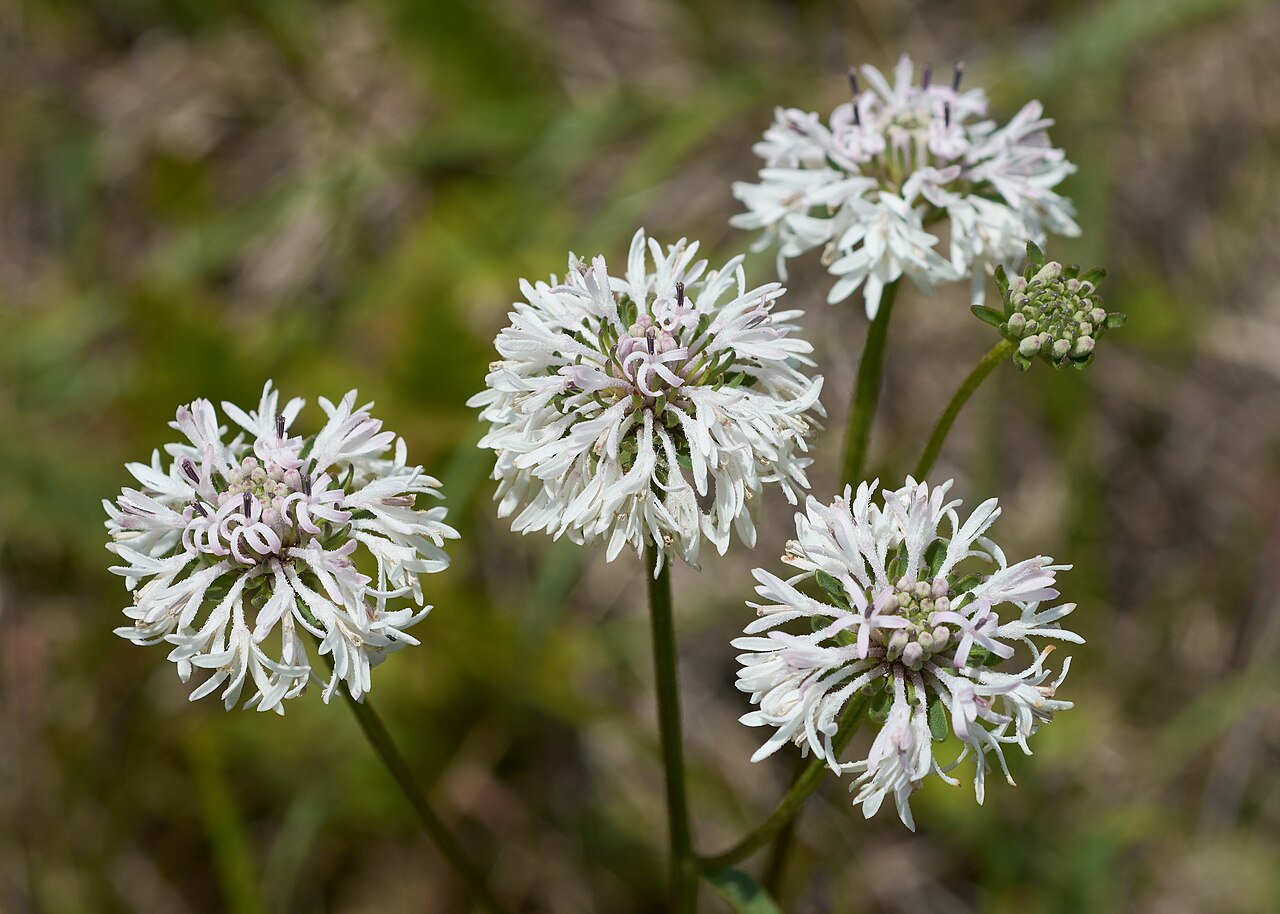
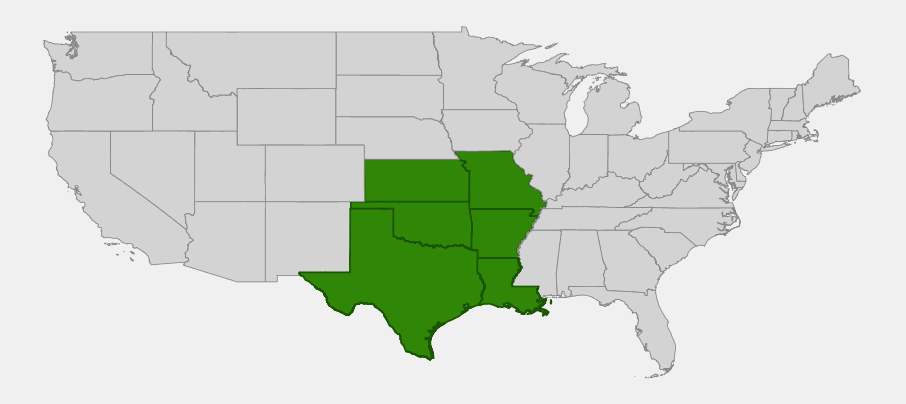
Marshallia caespitosa, known as Barbara’s Buttons, or puffballs (the USDA name), is a charming spring wildflower of the aster family (Asteraceae). It is native to the south-central United States, from southeastern Kansas and southwestern Missouri south through Oklahoma and Arkansas to Louisiana and Texas. It grows in prairies, limestone glades, rocky hillsides and open, sandy woodlands.
From a tuft of narrow, grass-like leaves, slender, nearly leafless stalks 8 to 20 inches tall rise in spring, each topped by a single round, fluffy head about an inch across. The heads have no ray petals; instead, they are made of dozens of small tubular flowers with long, narrow lobes, white to pale pink or lavender, giving a lacy, pincushion look. The flowers are sweetly fragrant and popular with butterflies and bees.
Barbara’s buttons is an excellent, well-behaved native for sunny rock gardens, prairie plantings and pollinator gardens in its region. It is drought tolerant once established, grows in sandy, loamy, clay or limestone soils, and blooms from April to June. It is related to grassleaf Barbara’s buttons of the Southeast’s wet pinelands.
Identification
Look for tufts of narrow, grass-like leaves and slender stalks topped by single, round, white to pinkish pincushion heads without ray petals, in sunny prairies and glades in spring.
Growth Habit
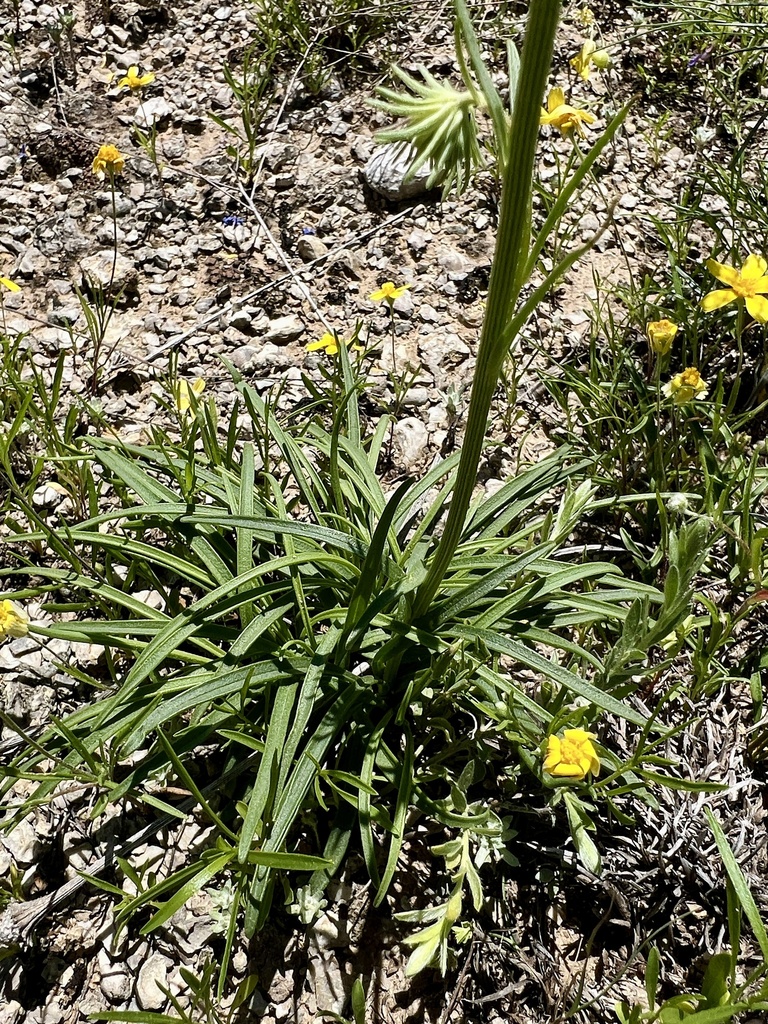
Barbara’s buttons is a clump-forming perennial with a short, thick rootstock. Each plant produces one to several unbranched stems 8 to 20 inches tall (occasionally up to about 30 inches). The leaves are mostly in a basal tuft, which is the meaning of the species name caespitosa (“tufted”).
Leaves
The basal leaves are narrow, linear to narrowly lance-shaped, 2 to 8 inches long and usually less than 1/2 inch wide, smooth, with three faint parallel veins. Stem leaves are few and small, mostly on the lower part of the stem.
Flowers
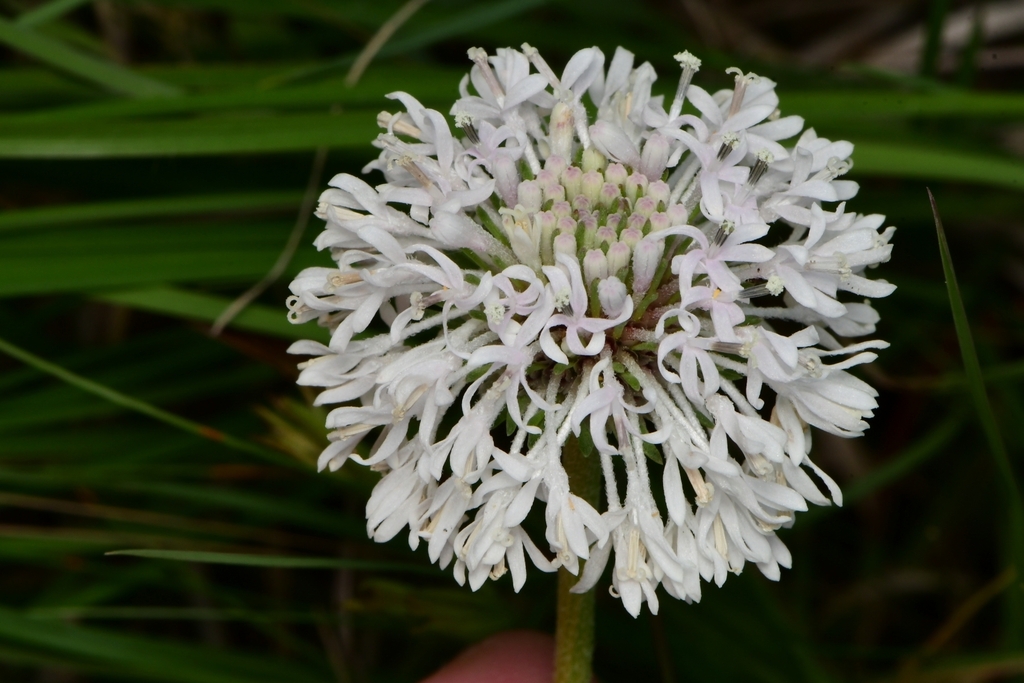
From April to June, each stem carries a single, rounded flower head about 3/4 to 1 1/4 inches across. There are no ray flowers. The head is made of many tubular disc florets, each with five long, narrow, spreading lobes, white to pale pink or lavender. Narrow green bracts surround the head, and stiff, narrow scales (paleae) sit among the florets. The flowers have a sweet fragrance.
Varieties
Two varieties are often recognized, var. caespitosa and var. signata. They differ mainly in how far up the stem the leaves extend and in small details of the leaves and heads, and not all botanists separate them.
Look-alikes
Grassleaf Barbara’s buttons (M. graminifolia) grows in wet pinelands of the Southeast coastal plain and blooms in summer and fall. Other Marshallia species of the Southeast have broader leaves or leafier stems. Wild onions and crow poison may have similar round, white heads, but their flowers have six tepals and they smell of onion.
Quick Facts
| Scientific Name | Marshallia caespitosa |
| Family | Asteraceae (aster family) |
| Plant Type | Herbaceous perennial wildflower |
| Mature Height | 8–20 in |
| Mature Spread | 6–12 in |
| Growth Rate | Moderate |
| Sun Exposure | Full sun to part shade |
| Water Needs | Low to medium |
| Soil Type | Sand, loam, clay or limestone; well-drained |
| Soil pH | Slightly acidic to alkaline (about 6.0–8.0) |
| Bloom Time | April–June |
| Flower Color | White to pale pink or lavender |
| Fall Color | None notable |
| Fruit | Small ribbed achenes with scale-like pappus |
| Deer Resistant | Moderately |
| USDA Hardiness Zones | 5–9 |
Native Range
Barbara’s buttons is native to the south-central United States. USDA PLANTS lists it in Arkansas, Kansas, Louisiana, Missouri, Oklahoma and Texas. In Kansas and Missouri it is found mainly in the southeastern and southwestern corners, respectively, near the Ozarks and the Cherokee Prairies.
In Texas it grows across the eastern half of the state, west to Taylor, Val Verde and DeWitt counties, including the Blackland Prairie, Cross Timbers, the Pineywoods and the Edwards Plateau, where it is common on limestone in the Hill Country around Austin, San Antonio and Uvalde. In Louisiana and East Texas it grows in sandy, open pine and oak woodlands and prairies.
Typical habitats are tallgrass and limestone prairies, rocky glades and barrens, open hillsides, roadsides, shale barrens and sandy open woodlands, on well-drained sand, loam, clay or limestone soils.
📋 Regional plant lists featuring Barbara’s Buttons: Nebraska, Kansas & Eastern Colorado · Illinois, Iowa & Missouri · Arkansas, Louisiana, Eastern Oklahoma & Eastern Texas · South & West Texas
Growing & Care Guide
Barbara’s buttons is easy to grow in sunny, well-drained sites and stays in neat clumps. It is sold by native plant nurseries in Texas and the southern Plains and is a fine choice for small gardens where a big, spreading wildflower would be too much.
Light
Full sun for the best flowering; it tolerates light or part shade, such as the edge of a woodland or a spot with afternoon shade.
Soil & Water
It grows in sandy, loamy, clay or limestone-based soils as long as they drain well. Water regularly during its first season; established plants tolerate drought and need water only in long dry spells. Avoid soggy soil in winter.
Planting Tips
Plant in fall or early spring, 8 to 12 inches apart, in groups of three or more so the round heads make a show. It suits rock gardens, prairie and meadow plantings, the front of a sunny border and pollinator gardens, and combines well with short native grasses and spring wildflowers.
Pruning & Maintenance
Little care is needed. Remove the spent stalks after seeds have dropped, or leave them to self-sow. Keep taller, aggressive plants from crowding the clumps.
Propagation
Sow fresh seed in fall outdoors, or cold-stratify seed for about 60 days before spring sowing. Established clumps can be carefully divided in fall or early spring.
Landscape Uses
- Pollinator gardens: fragrant spring flowers for butterflies and bees
- Rock gardens and glades: thrives on well-drained limestone and gravel
- Prairie plantings: a delicate accent among short grasses
- Small gardens: compact clumps that do not spread
- Cut flowers: long-stemmed, fragrant button-like heads
Wildlife & Ecological Value
Barbara’s buttons is a spring favorite of butterflies on the prairies and glades of the south-central states.
For Pollinators
The fragrant flowers attract many butterflies, including swallowtails, sulphurs, skippers and hairstreaks, as well as native bees, bee flies and beetles. The open, pincushion-shaped heads make nectar easy to reach for many kinds of insects.
For Birds
Seed-eating birds such as sparrows and finches may pick at the seeds in early summer, and the insects attracted to the flowers provide food for songbirds.
For Mammals
Rabbits and deer may nibble the foliage, but it is not a preferred food.
Ecosystem Role
As a long-lived prairie and glade perennial, Barbara’s buttons is part of the diverse native plant community of open, fire-maintained habitats. It is sensitive to overgrazing and to invasion by woody plants and aggressive grasses, so it is a good indicator of healthy prairie and glade remnants.
Cultural & Historical Uses
The genus Marshallia honors the American botanists Humphry Marshall (1722–1801), a Pennsylvania Quaker who wrote one of the first books on American trees and shrubs, and his nephew Moses Marshall, who collected plants for him. Thomas Nuttall named this species, and it was published by Augustin de Candolle in 1836.
The origin of the common name “Barbara’s buttons” is uncertain. The rounded heads do look much like old-fashioned cloth-covered buttons, and the name is shared by the other members of the genus. The USDA name “puffballs” also refers to the fluffy, round heads.
All Marshallia species are native to the southeastern and south-central United States, and several are rare. Botanists continue to study the genus, and new species have been described in recent decades.
Frequently Asked Questions
Where does Barbara’s buttons grow?
It is native to Kansas, Missouri, Oklahoma, Arkansas, Louisiana and Texas, where it grows in prairies, limestone glades, rocky hillsides and sandy open woods.
Is Barbara’s buttons fragrant?
Yes. The white to pale pink flower heads have a sweet scent, especially noticeable on warm days.
When does Barbara’s buttons bloom?
Usually from April to June, with a peak in May.
Is Barbara’s buttons drought tolerant?
Yes. Once established in well-drained soil, it tolerates dry periods well.
Does Barbara’s buttons spread?
No. It forms neat, slowly enlarging clumps and may self-sow lightly, but it does not spread aggressively.

Looking for a nursery that carries Barbara’s Buttons?
Browse our native plant nursery directory: Arkansas · Kansas · Louisiana & Missouri · Oklahoma · Texas

