
Black Hickory (Carya texana)
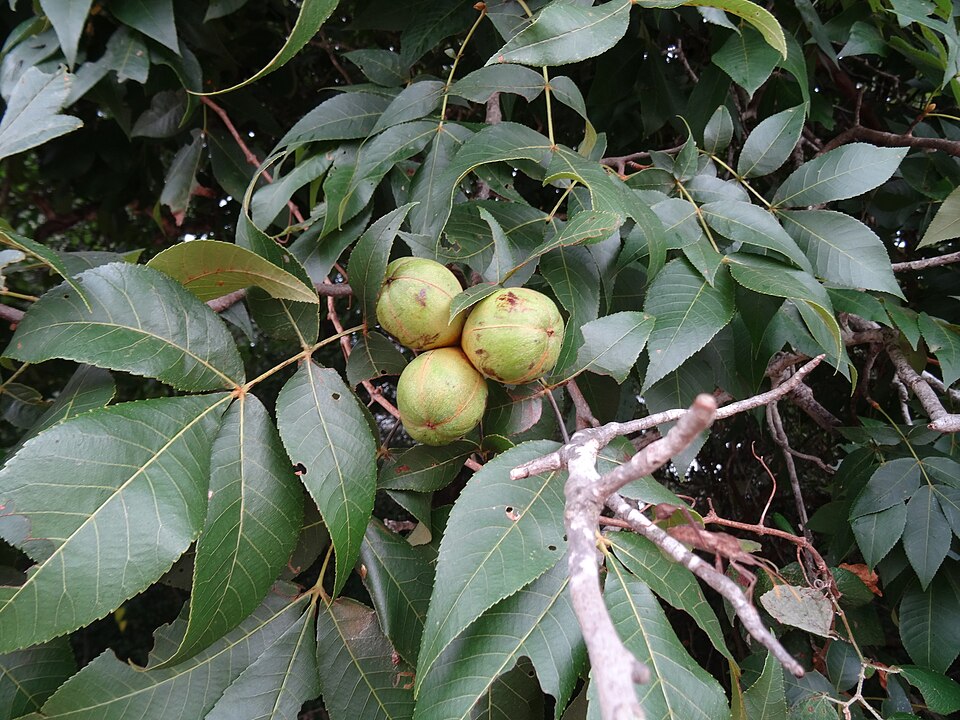
Carya texana, commonly called Black Hickory or Texas Hickory, is the toughest, most drought-hardened member of its genus found across the southern Great Plains and Lower Mississippi Valley. Named for its dark, almost black bark, Black Hickory thrives on rocky, shallow, infertile upland soils — the kind of ground where post oaks, blackjack oaks, and little else manage to survive. It is often one of the dominant trees of the “cross timbers” and dry upland oak-hickory forests of Texas, Oklahoma, and Arkansas, a hardy and underappreciated native for difficult sites.
In the open, rocky woodlands it favors, Black Hickory typically reaches 40 to 70 feet, occasionally much taller on better sites, with dark, tightly diamond-patterned bark and a dense coating of rusty-brown scales on the young leaves and twigs. Its nuts are sweet and edible, though shell thickness and flavor vary considerably from tree to tree — a trait long noted by foragers across its range. The species is listed as endangered in Indiana, where it reaches the very edge of its range in the state’s southwestern corner, a reminder that even a tough, widespread species can be vulnerable at the margins.
Like all true hickories, Black Hickory develops a deep taproot that makes larger nursery specimens difficult to establish. It is best planted as a small seedling or grown from direct-seeded nuts. For landowners and restoration projects on thin, rocky, drought-prone upland soils across its range, Black Hickory is one of the most reliable native shade and mast trees available.
Identification
Black Hickory is a medium to large deciduous tree, usually 40 to 70 feet tall but capable of reaching over 100 feet on favorable sites, with a trunk 1 to 2.5 feet in diameter. The crown is rounded to irregular, often narrower and more open on the dry, rocky sites where the tree is most common.
Bark
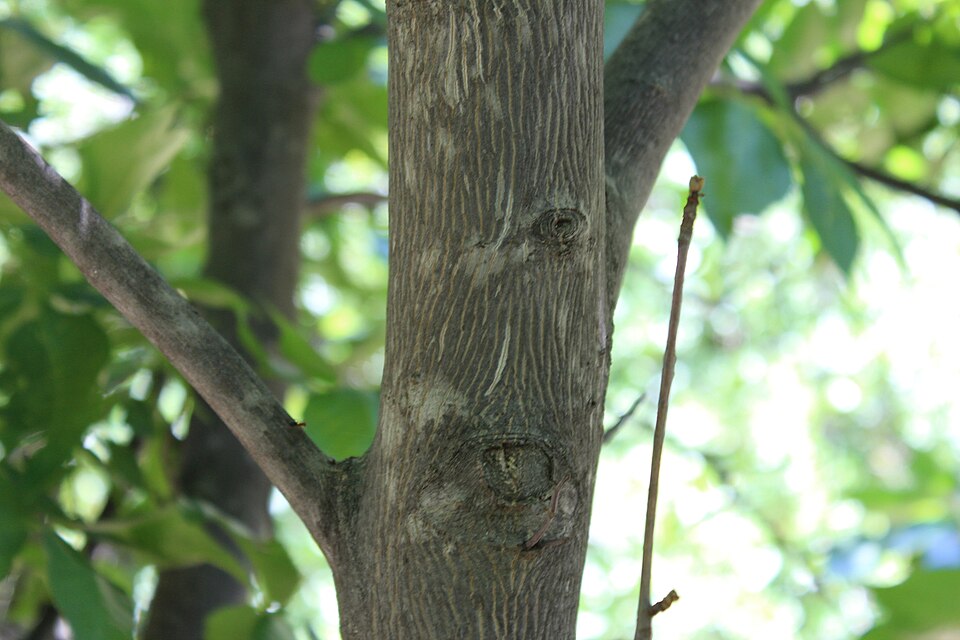
The bark is the tree’s signature feature: dark gray to nearly black, developing a tight, distinctive diamond-shaped ridge pattern with age — considerably darker than most other hickories, which tend toward lighter gray-brown. This dark, “black” bark is the source of the common name and a reliable field mark once you know to look for it.
Leaves
Leaves are pinnately compound, 8 to 14 inches long, typically with 7 leaflets (sometimes 5 or 9). New growth and the leaf rachis carry a dense coating of rusty brown scales, giving young foliage a distinctive coppery cast that fades somewhat as leaves mature to glossy dark green above. Leaflets are lance-shaped to elliptic with finely toothed margins.
Flowers & Fruit
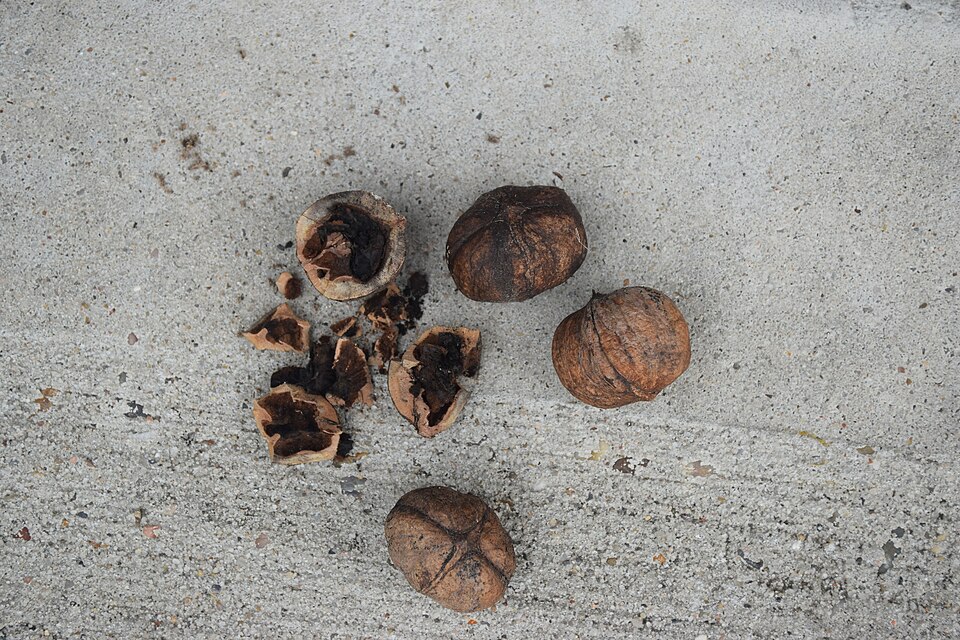
Black Hickory is monoecious, with drooping yellow-green male catkins and small female flower spikes appearing in spring with the new leaves. The nut is bronze to reddish-brown, encased in a husk that splits into four sections at maturity. The kernel is often sweet and edible, though some trees produce noticeably bitter nuts — a variability well documented among foragers who harvest Black Hickory across its range.
Quick Facts
| Scientific Name | Carya texana |
| Family | Juglandaceae (Walnut) |
| Plant Type | Deciduous Tree |
| Mature Height | 40–70 ft (to 100+ ft on good sites) |
| Mature Spread | 30–45 ft |
| Growth Rate | Slow |
| Sun Exposure | Full Sun to Partial Shade |
| Water Needs | Low |
| Soil Type | Dry, rocky, shallow upland soils |
| Soil pH | Acidic to neutral |
| Bloom Time | April – May |
| Fall Color | Golden yellow to brown |
| Fruit | Bronze to reddish-brown nut; kernel sweet to bitter |
| Wildlife Value | High — major nut source on dry upland sites |
| USDA Hardiness Zones | 6–9 |
Native Range
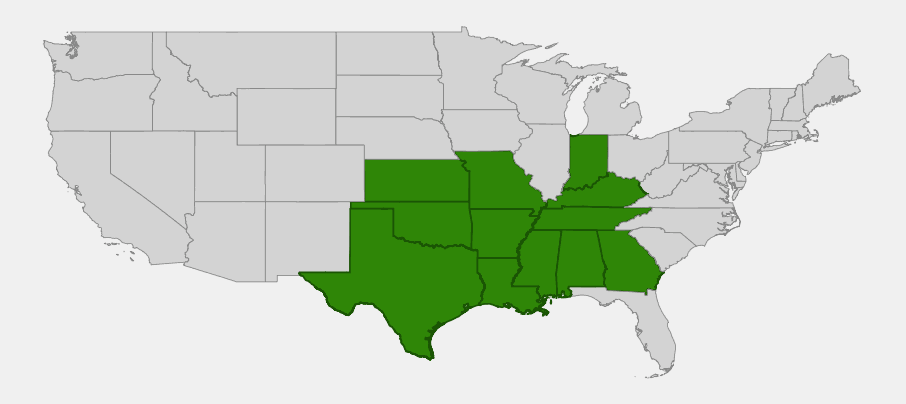
Black Hickory is centered on the southern Great Plains and Lower Mississippi Valley, with its core range running through Texas, Oklahoma, Arkansas, Louisiana, Missouri, and Kansas, extending east through Mississippi, Tennessee, Kentucky, Alabama, and Georgia, with a small, endangered outlier population in southwestern Indiana. It is a defining tree of the “cross timbers” region of Texas and Oklahoma — a band of dry oak-hickory woodland and savanna separating the tallgrass prairie from the shortgrass plains — and is common throughout rocky, upland oak-hickory forest across its broader range.
Black Hickory thrives on dry, rocky, often shallow and infertile soils, including limestone and sandstone-derived upland sites where few other hickories compete well. It is typically found alongside post oak, blackjack oak, and other drought-adapted trees rather than in the richer bottomland forests favored by water hickory or pecan.
📋 Regional plant lists featuring Black Hickory: Georgia, Alabama & Mississippi · Arkansas, Louisiana, Eastern Oklahoma & Eastern Texas · Illinois, Iowa & Missouri · Ohio & Indiana · Kentucky & Tennessee · Nebraska, Kansas & Eastern Colorado
Growing & Care Guide
Black Hickory is built for tough, dry, rocky ground where few other hardwoods compete successfully — an excellent choice for difficult upland sites rather than rich garden soil.
Light
Full sun produces the fullest crown and best nut production, though young trees tolerate partial shade as understory saplings before reaching the canopy. In its native cross timbers habitat, it often grows in open, savanna-like stands with ample light.
Soil & Water
Black Hickory is notably drought-tolerant and prefers dry, rocky, shallow soils over rich, moist ground. It performs well on thin limestone or sandstone-derived soils that would stress most trees, and does not require supplemental irrigation once established. Avoid consistently wet or poorly drained sites.
Planting Tips
As with other hickories, the deep taproot makes larger transplants risky; start with small container seedlings or direct-seed nuts in fall, protected from rodents with wire mesh until germination. Select the planting site with care, since Black Hickory does not transplant well once its root system is established. Allow 30 to 45 feet of eventual spread.
Pruning & Maintenance
Minimal pruning is required beyond removing dead or damaged branches during dormancy. Black Hickory has no major pest or disease issues beyond the general hickory bark beetle risk during prolonged drought stress, and its slow growth rate reflects its adaptation to resource-poor sites rather than any underlying weakness.
Landscape Uses
Black Hickory is best suited to large properties and restoration contexts with challenging soil:
- Dry upland woodland restoration, especially cross timbers and oak-hickory plant communities
- Rocky or thin-soil sites where few other shade trees will establish
- Wildlife plantings paired with Post Oak and Blackjack Oak
- Low-water landscaping on drought-prone residential or rural sites across the southern Plains
Wildlife & Ecological Value
For Mammals
Black Hickory nuts are a significant fall and winter food source for fox squirrels, gray squirrels, and other mammals across the cross timbers and southern Plains oak-hickory forests, which cache far more nuts than they retrieve and help the species regenerate. White-tailed deer browse foliage and young saplings.
For Birds & Insects
Wild turkeys forage on fallen nuts, and the dense, rounded crown provides cover and nesting habitat. Like other hickories, Black Hickory hosts various native moth and butterfly larvae that support breeding songbirds.
Ecosystem Role
As one of the dominant trees of the cross timbers and dry upland oak-hickory forests of the southern Plains, Black Hickory plays an outsized role in a habitat type that has been substantially reduced by land conversion. Its tolerance of thin, rocky soils makes it a stabilizing presence on slopes and ridges where erosion risk is otherwise high.
Cultural & Historical Uses
Black Hickory wood shares the dense, strong, shock-resistant qualities typical of the genus, historically used for tool handles and other applications requiring durability. Like other hickories, the wood remains popular for smoking meat. Indigenous peoples throughout its range used hickory nuts as a significant food source, pounding and boiling them to extract a nutritious oil and liquid used in cooking. This reflects historical practice rather than a foraging recommendation — proper identification and preparation are essential, and nut flavor varies considerably between individual trees, with some producing distinctly bitter kernels.
Frequently Asked Questions
How do I identify Black Hickory?
Look for dark gray to nearly black bark with a tight, diamond-shaped ridge pattern — darker than most other hickories. Young leaves and twigs are coated with rusty brown scales, and the tree is usually found on dry, rocky upland soil rather than moist bottomland.
Are Black Hickory nuts good to eat?
Often, yes — many trees produce sweet, edible kernels — but flavor varies considerably from tree to tree, and some individuals produce noticeably bitter nuts. Confirm correct identification and sample cautiously before relying on a particular tree’s nuts.
Why is Black Hickory endangered in Indiana?
Indiana sits at the far northeastern edge of the species’ range, where it is known only from a small area in the southwestern corner of the state. Peripheral populations like this are naturally more vulnerable to habitat loss and climatic limits than populations closer to the core range.
Can Black Hickory grow in clay soil?
It is best adapted to dry, rocky, well-drained soils and does not perform as well in heavy, poorly drained clay. If your site holds water after rain, consider a different native tree better suited to moist conditions.
How fast does Black Hickory grow?
Slowly, which reflects the resource-poor, rocky sites it typically occupies in the wild. Growth can improve somewhat in cultivation on better soil, but hickories as a group are never fast-growing trees.

Looking for a nursery that carries Black Hickory?
Browse our native plant nursery directory: Alabama & Arkansas · Georgia · Indiana & Kansas · Kentucky, Louisiana, Missouri & Mississippi · Oklahoma · Tennessee & Texas

