
Common Moonwort (Botrychium lunaria)
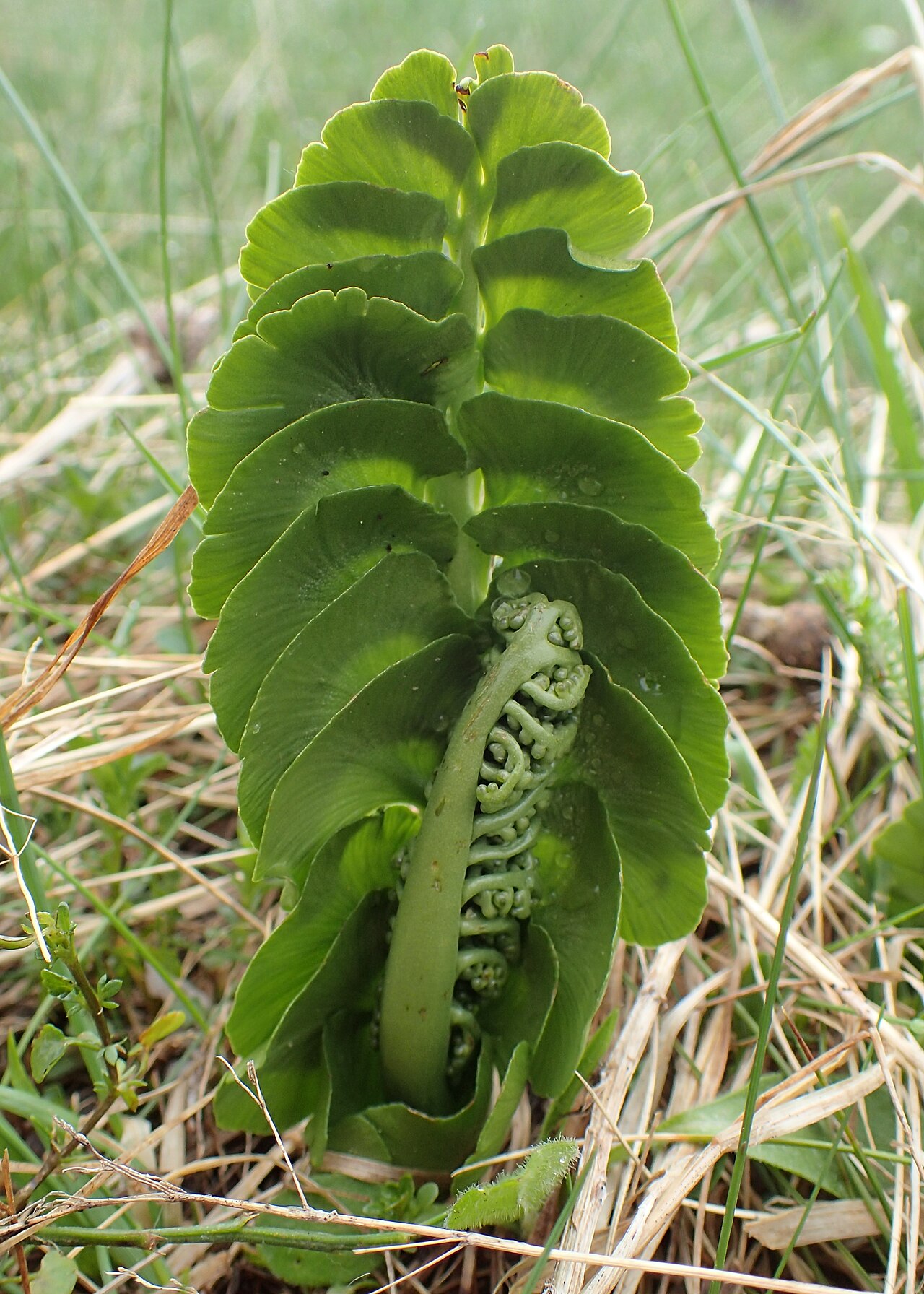
Botrychium lunaria, the Common Moonwort, is a tiny, fleshy fern of mountain meadows, grassy slopes and northern fields. It produces just one leaf a year, usually 2 to 6 inches tall, divided into two parts: a short, ladder-like blade of fan-shaped leaflets shaped like half-moons, and an upright, branched stalk carrying clusters of round, grape-like spore cases. It belongs to the adder’s-tongue family (Ophioglossaceae), an ancient group of ferns.
Moonworts spend most of their lives underground and depend on soil fungi for food, especially when young. That is why common moonwort cannot be grown from nursery stock and almost never survives being dug up. This page is an identification and appreciation guide: if you find one, enjoy it and leave it where it is.
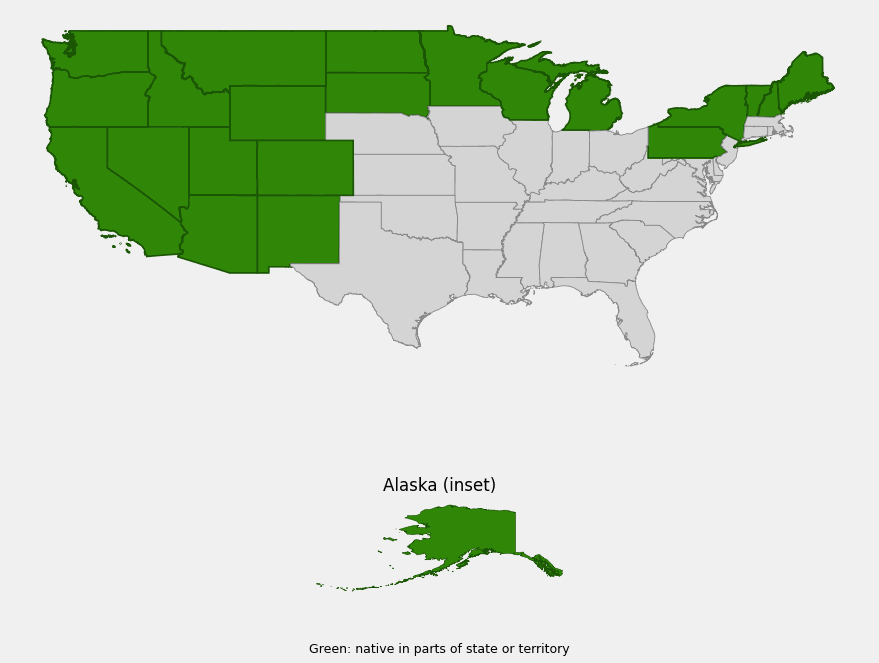
USDA PLANTS lists common moonwort as native across Alaska and much of the northern and western United States, from the Pacific states and the Rockies to the Great Lakes and northern New England. DNA studies have shown that what was long called Botrychium lunaria in North America includes more than one species; most moonworts of this type in the lower 48 are now often called Botrychium neolunaria, while true B. lunaria is mainly a northern plant.
Identification
Look for a single, small, fleshy, gray-green to yellow-green leaf, with a short blade of overlapping, fan- or half-moon-shaped leaflets and an upright spore stalk with grape-like clusters, in grassy, open places from late spring to late summer.
Plant Structure
Each plant has a short, upright underground stem with thick, fleshy roots, and sends up one leaf each year. The leaf splits into two parts above the ground: a sterile, leafy blade (the trophophore) and a fertile, spore-bearing stalk (the sporophore). Plants are usually 2 to 6 inches tall, occasionally up to about 10 inches. Some years a plant may stay dormant underground and not appear at all.
Leaf Blade
The sterile blade is oblong, about 1 to 4 inches long, and divided once into 2 to 9 pairs of leaflets (pinnae). The leaflets are broadly fan-shaped or half-moon-shaped, with smooth or slightly wavy outer edges, and often overlap one another. The blade is thick, smooth and slightly glossy, gray-green to yellow-green.
Spore Stalk
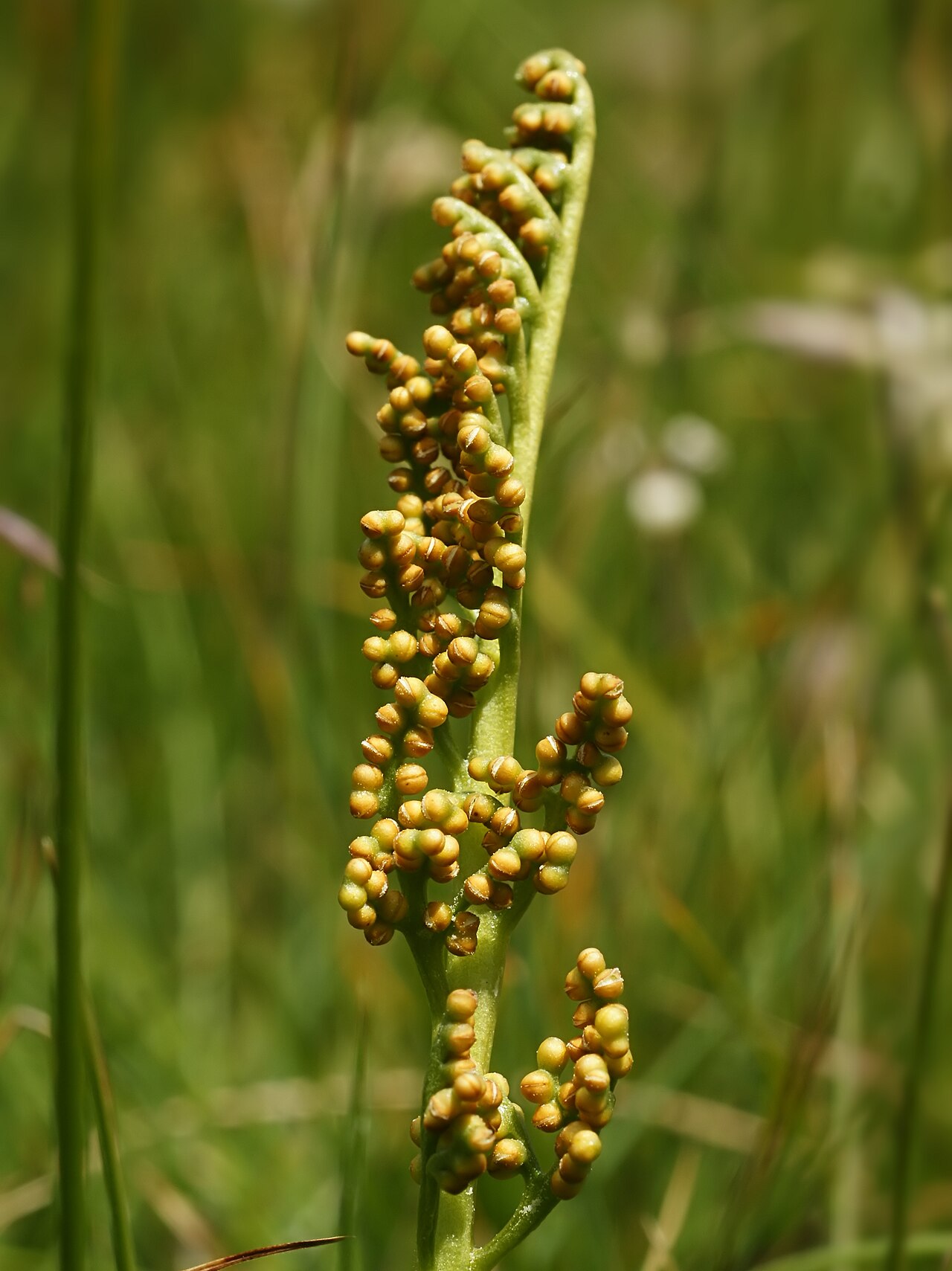
The fertile stalk rises above the blade and is branched once or twice, with clusters of round spore cases (sporangia) that look like tiny bunches of grapes. They ripen from green to yellow and then brown, releasing yellowish, dust-like spores in early to midsummer, roughly June to August depending on elevation. By late summer the leaf withers.
Similar Species
Moonworts are notoriously hard to tell apart, and North America has about 30 species. Mingan moonwort (Botrychium minganense) has narrower, more spaced leaflets that don’t overlap; lanceleaf moonwort (B. lanceolatum) has a triangular, more deeply cut blade. Rattlesnake fern is much larger, with a lacy, finely divided blade, and cutleaf grapefern has a broad, triangular, evergreen blade. Experts often need to examine leaflet shape and venation closely, and sometimes DNA, to identify moonworts with confidence.
Quick Facts
| Scientific Name | Botrychium lunaria (L.) Sw. |
| Family | Ophioglossaceae (adder’s-tongue family) |
| Plant Type | Small perennial fern; one leaf per year; depends on mycorrhizal fungi |
| Mature Height | 2–6 in (rarely to 10 in) |
| Mature Spread | 1–2 in; single leaf |
| Growth Rate | Very slow |
| Sun Exposure | Full sun to light shade |
| Water Needs | Moderate; moist to fairly dry |
| Soil Type | Undisturbed grassy, gravelly or rocky soils, often over limestone |
| Soil pH | Slightly acid to alkaline (about 6.0–8.0) |
| Bloom Time | Does not flower; spores shed about June–August |
| Flower Color | None; spore clusters yellow to brown |
| Fall Color | Withers by late summer |
| Fruit | None; spores in round, grape-like clusters |
| Deer Resistant | Not applicable; rarely noticed by grazers |
| USDA Hardiness Zones | 2–7 (wild only) |
Native Range
In the broad sense, common moonwort is circumboreal, found across northern Europe, Asia and North America, and in mountains farther south. In North America, plants of this type range across Canada from Newfoundland and Labrador to British Columbia, Yukon and Nunavut, and through Alaska.
USDA PLANTS lists it as native in Alaska, Washington, Oregon, California, Nevada, Idaho, Montana, Wyoming, Utah, Colorado, Arizona, New Mexico, North Dakota, South Dakota, Minnesota, Wisconsin, Michigan, New York, Pennsylvania, Vermont, New Hampshire and Maine. In the West it grows mainly in the mountains; in the East it is rare and scattered. NatureServe treats most lower-48 plants as Botrychium neolunaria and ranks it as rare in several states, including New York, Idaho and California, and as historical in Vermont. Pennsylvania records are outlying ones, and the mountains of Arizona and New Mexico mark the southern edge of its range.
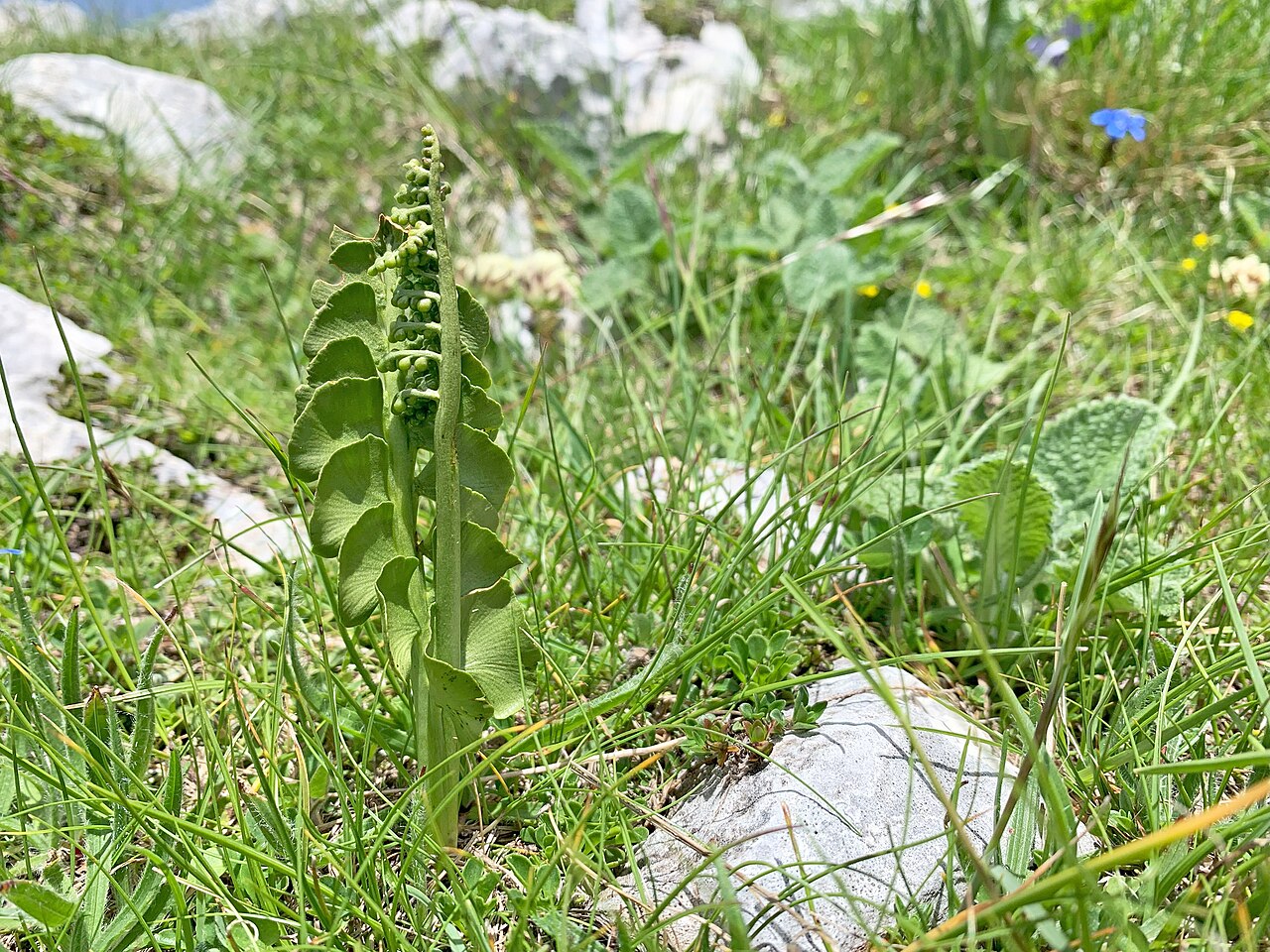
It grows in open, grassy places: subalpine and alpine meadows, grassy slopes and ridges, rocky and gravelly ground, old fields and pastures, roadsides, lakeshores and sand dunes. It often favors lime-rich soils and sites with a little disturbance that keeps taller plants from crowding it out.
📋 Regional plant lists featuring Common Moonwort: Alaska · Arizona & New Mexico · California & Nevada · Idaho, Eastern Oregon & Eastern Washington · Western Oregon & Western Washington · Montana & Wyoming · Utah & Western Colorado · Michigan, Wisconsin & Eastern Minnesota · North Dakota, South Dakota & Western Minnesota · New York, Pennsylvania & Northern New Jersey · Delaware, Southern New Jersey & Long Island · New Hampshire, Maine & Vermont
Can You Grow It?
No. Common moonwort is not sold as nursery stock and cannot realistically be grown in gardens. Its spores germinate underground into tiny gametophytes with no green color that live entirely on soil fungi, and even mature plants rely on those fungi for much of their food. Dug plants almost always die, and in several states it is a rare plant.
Light
In the wild it grows in full sun to light shade in open meadows and grassy slopes where tall plants don’t shade it out.
Soil & Water
It needs undisturbed soil with its fungal partners intact, usually moist in spring and drier by late summer. Plowing, heavy compaction and herbicides destroy both the plants and the fungi.
Planting Tips
Don’t plant it, and never transplant it. If moonworts appear on your land, in a meadow, an old field or even a lawn edge, protect that spot from digging and heavy traffic.
Pruning & Maintenance
Where it grows on your property, mow that area only after the leaves wither in late summer. Light grazing or occasional mowing can help by keeping taller plants from crowding it, but avoid disturbing the soil.
Propagation
It spreads only by spores and, rarely, by small buds on the roots. Spores take years to produce a visible plant underground, so propagation is not practical. Never dig, pick or collect wild plants.
Where to See It
- Mountain meadows: look in grassy subalpine meadows of the Rockies, Cascades and Sierra in early summer
- Alaska and the North: roadsides, gravel bars and grassy slopes in Alaska
- Great Lakes and New England: rare; old fields, dunes and limestone grasslands
- Fern walks: botanical club outings are the best way to learn moonworts and see them without harm
Wildlife & Ecological Value
Moonworts are small and easy to miss, but they are among the more ancient members of the fern lineage and are tied closely to the health of the soil.
For Pollinators
Being a fern, it has no flowers and offers nothing to pollinators. Its spores are carried by the wind.
For Birds
It has no known importance as food for birds.
For Mammals
Grazing animals may eat it along with grasses, but it is too small to matter as forage. Light grazing can actually help it by keeping taller plants down.
Ecosystem Role
Moonworts are part of an underground partnership with arbuscular mycorrhizal fungi, which also connect to the roots of surrounding plants. Through this network, the moonwort receives sugars and nutrients, especially in its long underground early life. Where moonworts grow, the soil and its fungal life have usually been left undisturbed for many years.
Cultural & Historical Uses
The genus name Botrychium comes from the Greek botrys, a bunch of grapes, from the clusters of spore cases. The epithet lunaria and the common name moonwort both refer to the half-moon shape of the leaflets.
In European folklore, moonwort was a magical plant. It was said to open locks and to pull the shoes from horses that stepped on it, and it was gathered by moonlight for charms and alchemy. Herbalists of the 1500s and 1600s, such as Nicholas Culpeper, wrote about it.
Moonworts are a modern botanical puzzle. Since the 1980s, botanists using careful field study and DNA have recognized dozens of moonwort species in North America, including Botrychium neolunaria, described in 2017 for most North American plants formerly called B. lunaria.
Frequently Asked Questions
Is common moonwort a fern?
Yes. It belongs to the adder’s-tongue family, an ancient group of ferns. It has no flowers and reproduces by spores borne on a separate stalk.
Why is it called moonwort?
Its leaflets are shaped like half-moons. Wort is an old English word for plant.
Can I buy or grow common moonwort?
No. It isn’t sold as nursery stock and depends on soil fungi throughout its life. Dug plants almost always die, so never dig wild ones.
Where can I find common moonwort?
In open, grassy places: mountain meadows and slopes in the West, grassy roadsides and gravel in Alaska, and rarely old fields and dunes in the Great Lakes and Northeast. Look in early to midsummer.
Is it Botrychium lunaria or Botrychium neolunaria?
USDA still uses B. lunaria for all North American plants, but many botanists now call most lower-48 plants B. neolunaria and reserve B. lunaria for a mostly northern species.

Looking for a nursery that carries Common Moonwort?
Browse our native plant nursery directory: Alaska & Arizona · California · Colorado · Idaho · Maine, Michigan, Minnesota & Montana · Nevada, New Hampshire, New Mexico, New York & North Dakota · Oregon · Pennsylvania, South Dakota, Utah & Vermont · Washington · Wisconsin & Wyoming

