
Coyote Tobacco (Nicotiana attenuata)
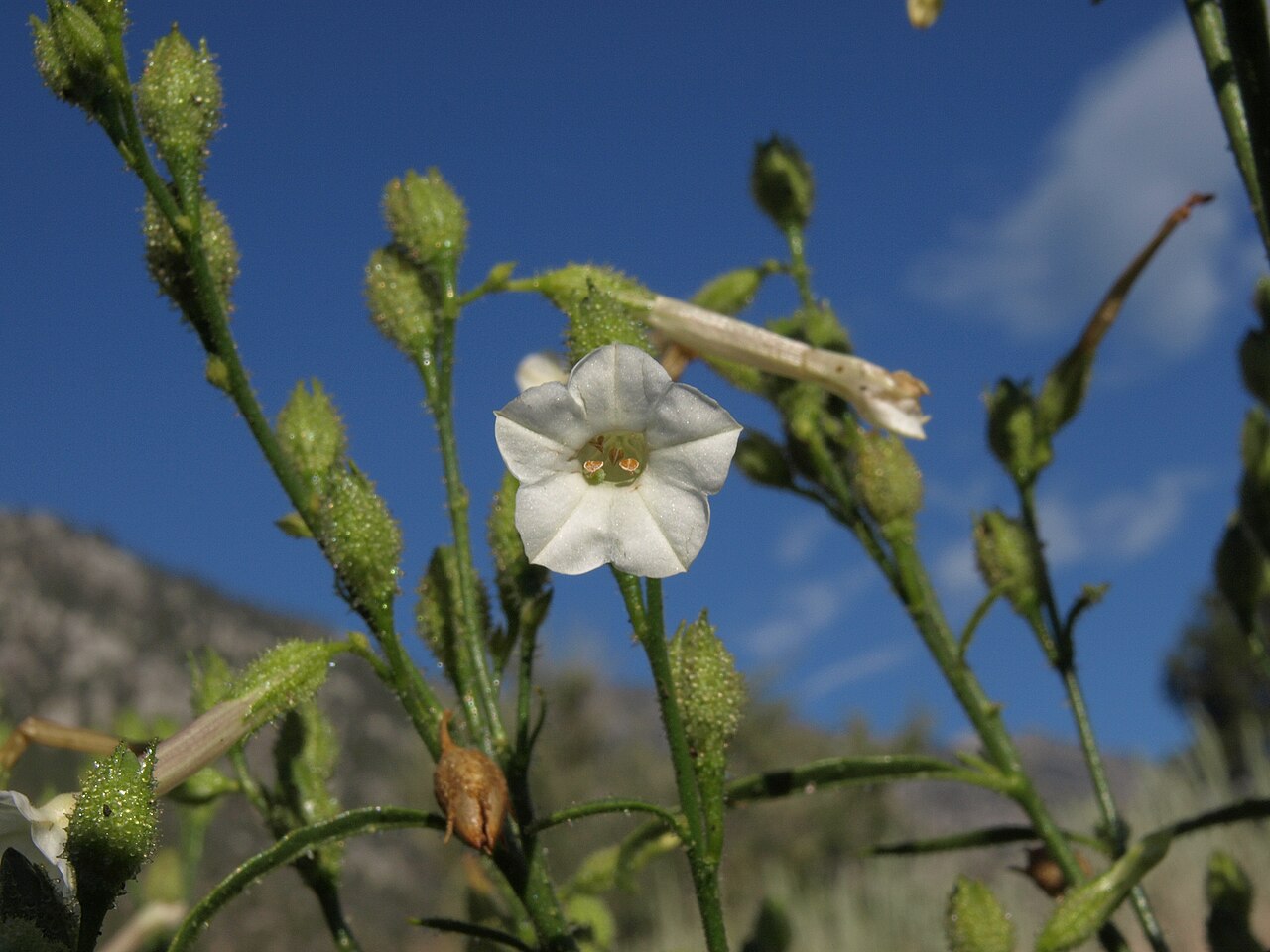
Nicotiana attenuata, the Coyote Tobacco, is a wild annual tobacco in the nightshade family (Solanaceae), native to the deserts, sagebrush steppe and dry foothills of the western United States and southern British Columbia. It grows 1 to 3 feet tall, with sticky, hairy stems and leaves and slender, white, trumpet-shaped flowers that open in the evening and give off a sweet scent at night.
Coyote tobacco is a classic fire follower. Its tiny seeds can wait in the soil for many years and germinate in huge numbers after a wildfire, cued by chemicals in smoke and the removal of the old plant litter. It also springs up on other bare ground, such as washes, roadsides and disturbed sites, from low deserts up into pinyon-juniper and ponderosa pine country.
It is one of the best-studied wild plants in the world: scientists use it as a model for how plants defend themselves against insects. It was also an important traditional tobacco for many Native peoples of the Great Basin, California and the Plateau. Like all tobacco, every part of the plant contains nicotine and is poisonous if eaten.
Identification
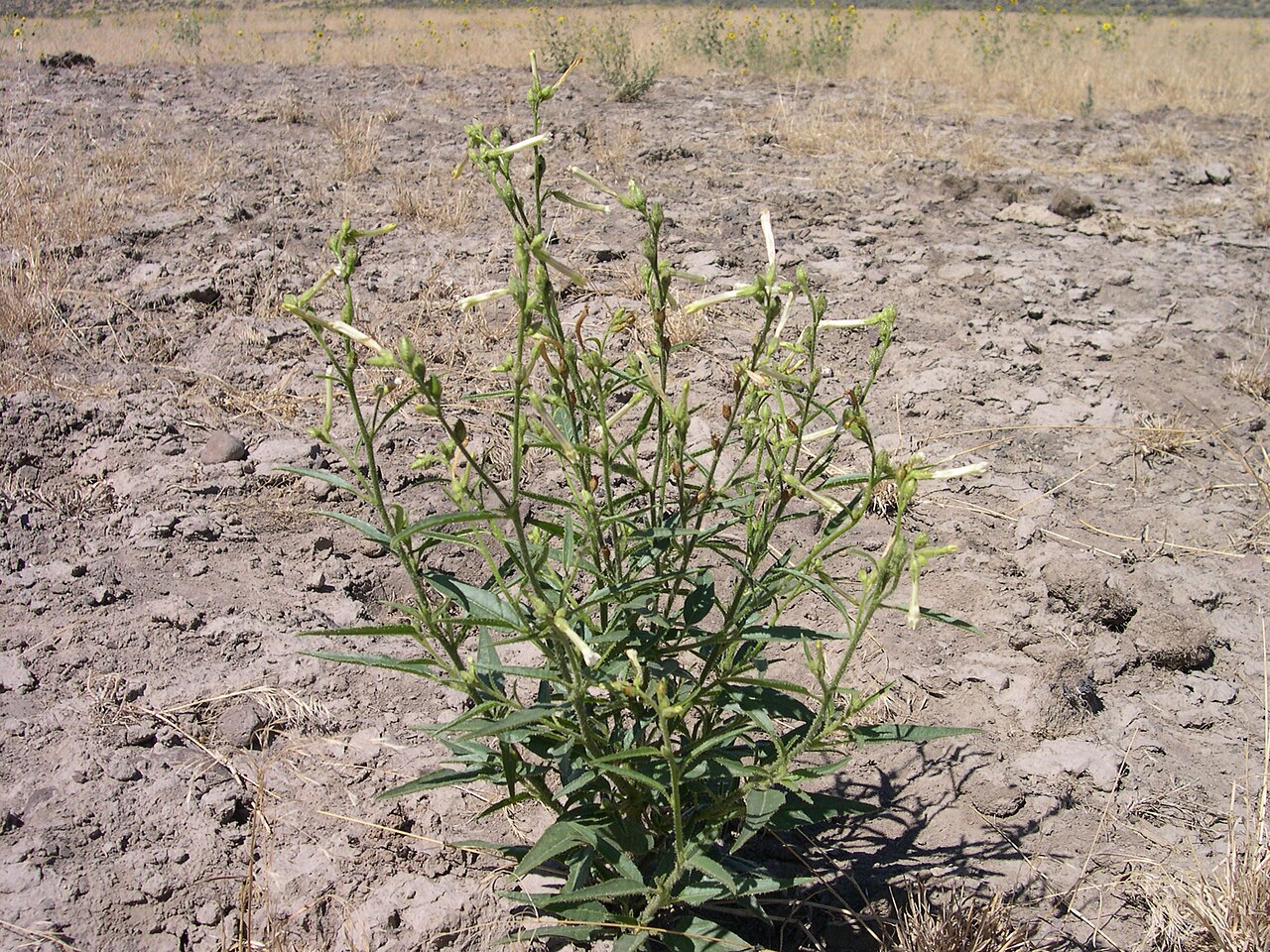
Look for a sticky, grayish-green annual 1 to 3 feet tall with a basal rosette of stalked, oval leaves, narrower leaves up the stem, and slender white flowers 1 to 1 1/2 inches long, growing on bare, sunny ground in the West, often after a fire.
Growth Habit
Coyote tobacco is an annual (occasionally behaving as a short-lived biennial) that starts as a flat basal rosette of leaves and then sends up one or more erect, branching flowering stems, usually 1 to 3 feet tall and sometimes taller. The whole plant is covered with sticky glandular hairs and has a strong, rank tobacco smell.
Leaves
The lower leaves are oval to lance-shaped, 2 to 4 inches long or more, on distinct stalks. The upper stem leaves are smaller, narrower and often nearly stalkless. All are grayish to dull green and sticky.
Flowers
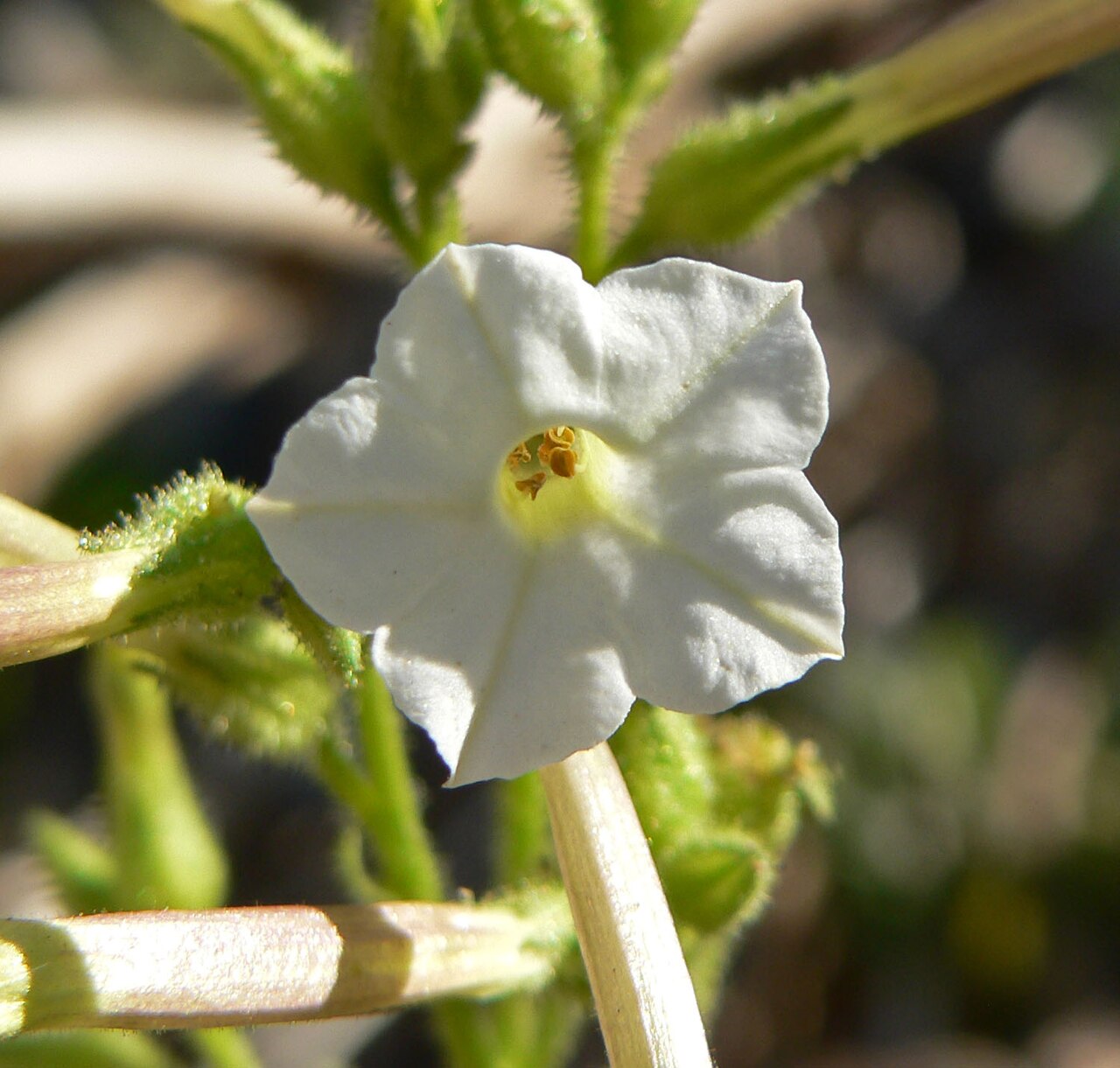
The flowers grow in loose clusters along the upper branches. Each has a long, slender greenish-white to dingy white tube, 1 to 1 1/2 inches long, opening into five short, pointed lobes about 1/2 inch across, sometimes tinged pink or purplish on the outside. The calyx has short, triangular lobes. The flowers open in the evening and stay partly open into the next morning, when they are fragrant. Flowering is long, from about May into fall, depending on rain and elevation.
Fruit & Seeds
The fruit is a small, oval, two-celled capsule about 1/2 inch long, partly enclosed by the calyx. It splits at the top to release hundreds of tiny brown seeds that are scattered near the parent plant.
Look-alikes
Desert tobacco (Nicotiana obtusifolia, sometimes also called coyote tobacco) is a short-lived perennial of hot deserts with smaller flowers and leaves that clasp the stem. Indian tobacco (Nicotiana quadrivalvis) has larger, wider, more flaring flowers. Tree tobacco (Nicotiana glauca) is a non-native, invasive shrub with yellow tubular flowers. Sacred datura, a much larger nightshade relative, has huge white trumpet flowers and spiny fruit.
Quick Facts
| Scientific Name | Nicotiana attenuata |
| Family | Solanaceae (nightshade family) |
| Plant Type | Annual herb |
| Mature Height | 1–3 ft |
| Mature Spread | 1–2 ft |
| Growth Rate | Fast |
| Sun Exposure | Full sun |
| Water Needs | Low; drought tolerant |
| Soil Type | Sandy, gravelly or disturbed soil; well-drained |
| Soil pH | Neutral to alkaline (about 6.5–8.5) |
| Bloom Time | May–October |
| Flower Color | Greenish-white to dingy white |
| Fall Color | None notable |
| Fruit | Small capsule with many tiny seeds |
| Deer Resistant | Yes; toxic and rarely browsed |
| USDA Hardiness Zones | Annual; grows in zones 4–9 |
Native Range
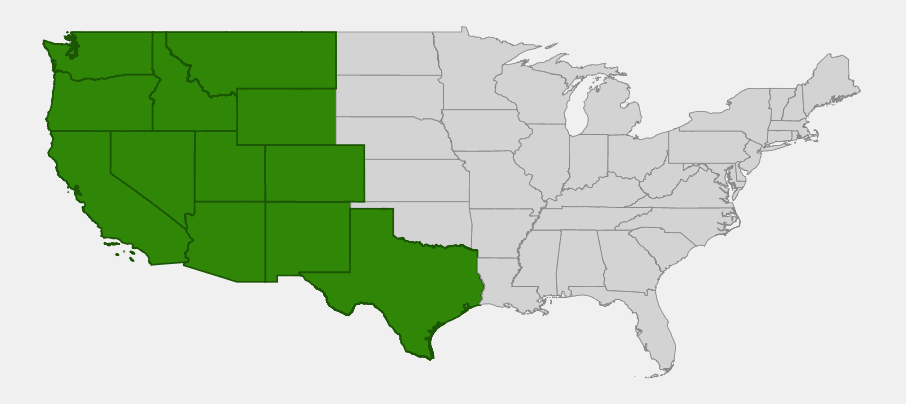
USDA PLANTS lists coyote tobacco as native to Arizona, California, Colorado, Idaho, Montana, New Mexico, Nevada, Oregon, Texas, Utah, Washington and Wyoming, and to British Columbia in Canada. It also grows south into Baja California and northern Mexico.
Its core range is the Great Basin, the Columbia Plateau east of the Cascades, the Colorado Plateau and the deserts and foothills of California and Arizona. Montana, Wyoming and Texas are at the edges of its range; the Texas record is from the far west of the state, an outlying record.
It grows in dry, open, sunny places: sagebrush steppe, desert scrub, pinyon-juniper and open pine woodland, sandy washes, gravel bars, roadsides and disturbed ground, from low deserts up to about 8,000 feet. It is most abundant in the first years after a wildfire.
📋 Regional plant lists featuring Coyote Tobacco: Idaho, Eastern Oregon & Eastern Washington · California & Nevada · Utah & Western Colorado · Montana & Wyoming · Arizona & New Mexico · South & West Texas
Growing & Care Guide
Coyote tobacco is rarely sold as a garden plant, but it is easy to grow from seed in a sunny, dry spot. Grow it for its night-scented flowers and the hawkmoths they attract, and only where children and pets will not eat it.
Light
Full sun. It grows on open, bare ground and does poorly in shade or crowded beds.
Soil & Water
Plant in lean, sandy or gravelly, well-drained soil. Water seedlings until they form a rosette, then little or not at all. Rich, moist soil makes plants floppy.
Planting Tips
Sow the tiny seeds on the surface of bare soil in late fall or early spring; do not bury them, because they need light. Germination is often poor without the cues of fire. Gardeners and researchers improve it by soaking the seed in liquid smoke or a smoke-water solution before sowing. Thin seedlings to about 12 inches apart.
Pruning & Maintenance
No pruning is needed. Wear gloves when handling the sticky plants, since nicotine can be absorbed through the skin, and wash your hands afterward. Pull plants at the end of the season; they may reseed in open soil.
Propagation
Grow from seed only. Collect ripe capsules in late summer or fall and store the seeds dry; they remain viable for years. Keep seed and plants away from children and pets.
Landscape Uses
- Moon gardens: white flowers that open and scent the air at night
- Hawkmoth gardens: attracts sphinx moths at dusk
- Post-fire restoration: a natural first colonizer of burned ground
- Dry, sunny gravel gardens: thrives in lean, well-drained soil
- Ethnobotanical gardens: a traditional tobacco of Western Native peoples
Wildlife & Ecological Value
Coyote tobacco is famous among scientists for its complex relationships with the animals that pollinate and eat it.
For Pollinators
The night-opening, fragrant flowers are pollinated mainly by hawkmoths, such as the tobacco hornworm moth and the white-lined sphinx. Hummingbirds also visit the flowers in the morning. Research shows the plants can shift toward opening their flowers in the morning when hornworm caterpillars attack, favoring hummingbirds instead of the moths whose larvae eat the leaves.
For Birds
Hummingbirds feed on the nectar. Few birds eat the plant itself, but the insects on it, including hornworm caterpillars, are food for birds.
For Mammals
Because it contains nicotine, mammals rarely eat it. It is poisonous to livestock, pets and people if eaten.
Ecosystem Role
Coyote tobacco is one of the first plants to appear after fire in Great Basin shrublands, often in dense stands, before perennial plants recover. Its defenses are a textbook example of plant-insect interactions: when caterpillars feed, the plant increases nicotine and other defenses and releases scents that attract predatory bugs that eat hornworm eggs and larvae. It is the host plant for the larvae of the tobacco hornworm and tomato hornworm moths (Manduca).
Cultural & Historical Uses
Many Native peoples of the West, including Paiute, Shoshone, Washoe and numerous California and Plateau tribes, gathered and smoked coyote tobacco in pipes and in ceremonies. Some groups encouraged it by burning patches of ground, sowing seed or tending wild stands, a form of plant management that echoes the plant’s natural response to fire.
Since the 1990s, Ian Baldwin and colleagues at the Max Planck Institute for Chemical Ecology in Germany have studied coyote tobacco at field sites in Utah, including the Lytle Ranch Preserve. Their work has revealed how the plant detects insect attack, raises its nicotine levels, calls in predators with scents, and manages its pollinators, making it one of the most important wild model plants in ecology.
Safety note: all parts of coyote tobacco contain nicotine and other alkaloids. Eating the leaves can cause nicotine poisoning, with vomiting, sweating, rapid heartbeat and, in severe cases, seizures and death. Handling wet leaves for long periods can also cause “green tobacco sickness.” Keep it away from children, pets and livestock, and never use it as a food or herbal remedy.
Frequently Asked Questions
Is coyote tobacco poisonous?
Yes. Like all tobacco, every part of coyote tobacco contains nicotine and is toxic if eaten by people, pets or livestock. Wear gloves when handling it and keep it away from children and animals.
Why does coyote tobacco appear after wildfires?
Its seeds can survive in the soil for many years. Chemicals in smoke, together with the loss of the litter layer, trigger germination, so large stands often appear in the first years after a fire.
Is coyote tobacco the same as desert tobacco?
No. Desert tobacco (Nicotiana obtusifolia) is a different, perennial species of hot deserts, though both are sometimes called coyote tobacco. Nicotiana attenuata is an annual with longer, slender white flowers.
Did Native Americans smoke coyote tobacco?
Yes. It was a traditional tobacco for many tribes of the Great Basin, California and the Plateau, gathered from wild stands and sometimes tended or sown.
What pollinates coyote tobacco?
Mainly night-flying hawkmoths, drawn by the evening scent of the white flowers, as well as hummingbirds in the morning.

Looking for a nursery that carries Coyote Tobacco?
Browse our native plant nursery directory: Arizona · California · Colorado · Idaho · Montana · Nevada & New Mexico · Oregon · Texas & Utah · Washington · Wyoming

