
Cuckooflower (Cardamine pratensis)
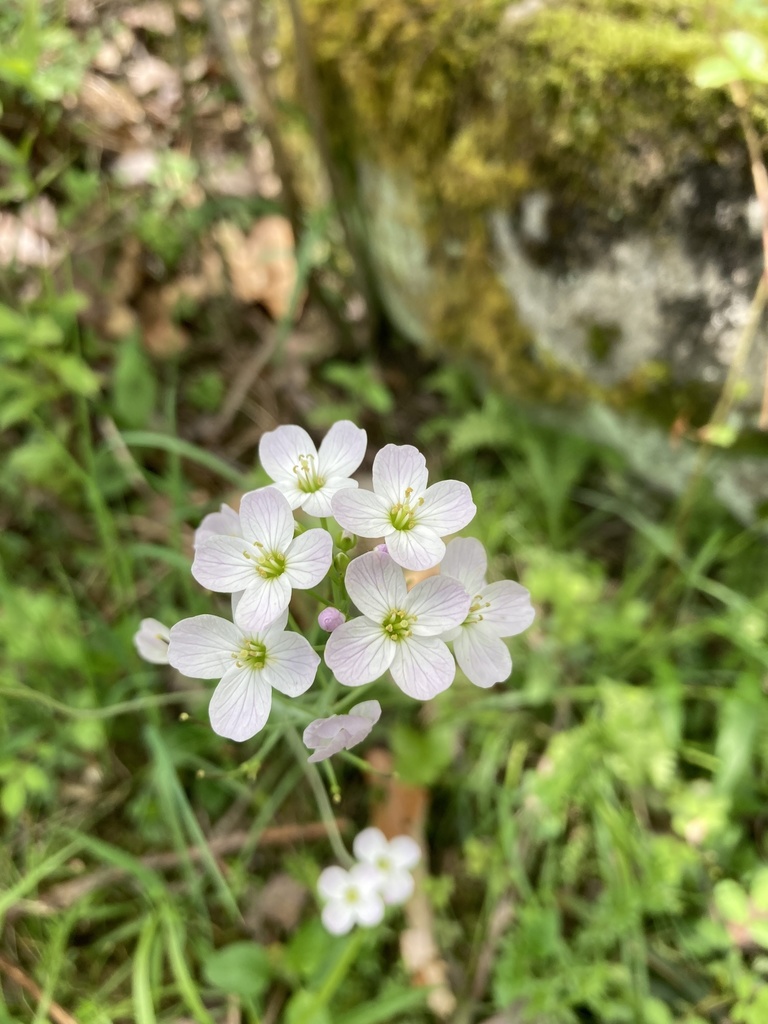
Cardamine pratensis, known as Cuckooflower, lady’s smock, meadow bittercress or milkmaids, is a spring-blooming perennial of the mustard family (Brassicaceae). From a low rosette of divided leaves it sends up stems 8 to 20 inches tall that carry loose clusters of four-petaled flowers, white to pale lilac-pink, from April into June. It grows where the ground stays wet: wet meadows, swamps, fens, floodplain forests, stream banks and the edges of ponds.
Cuckooflower is a circumboreal plant, native across much of Europe and northern Asia as well as northern North America, and it is one of the best-loved wildflowers of the British Isles. The name comes from its flowering just as the first cuckoos arrive in spring. That wide range brings a complication for American gardeners. Native North American plants exist, but European cuckooflower has also been grown in gardens here and has escaped, especially in New England, where botanists regard most plants as introduced.
This guide explains how to recognize cuckooflower, which North American plants are considered native, where it grows naturally, and how to grow it in a wet garden or rain garden. If you want to plant it for native habitat, look for plants or seed grown from local wild stock rather than the double-flowered European garden forms.
Identification
Cuckooflower is easy to recognize in bloom as a spring mustard of wet ground with pinnately divided leaves and fairly large, four-petaled flowers. The basal leaves, the small leaflets of the stem leaves and the long, slender seed pods help separate it from the other bittercresses.
Leaves
The basal leaves form a rosette and are pinnately divided into 3 to 15 leaflets. On the basal leaves the leaflets are rounded and stalked, with the end leaflet largest, a little like watercress. The stem leaves are quite different: their leaflets are narrow and linear to oblong. Leaflets that touch wet ground can root at the base and grow into new plantlets, an unusual way of spreading that helps cuckooflower form colonies.
Stems
Flowering stems are upright, usually unbranched, smooth and hollow, about 8 to 20 inches tall and occasionally taller. They rise from a short underground stem that persists from year to year.
Flowers
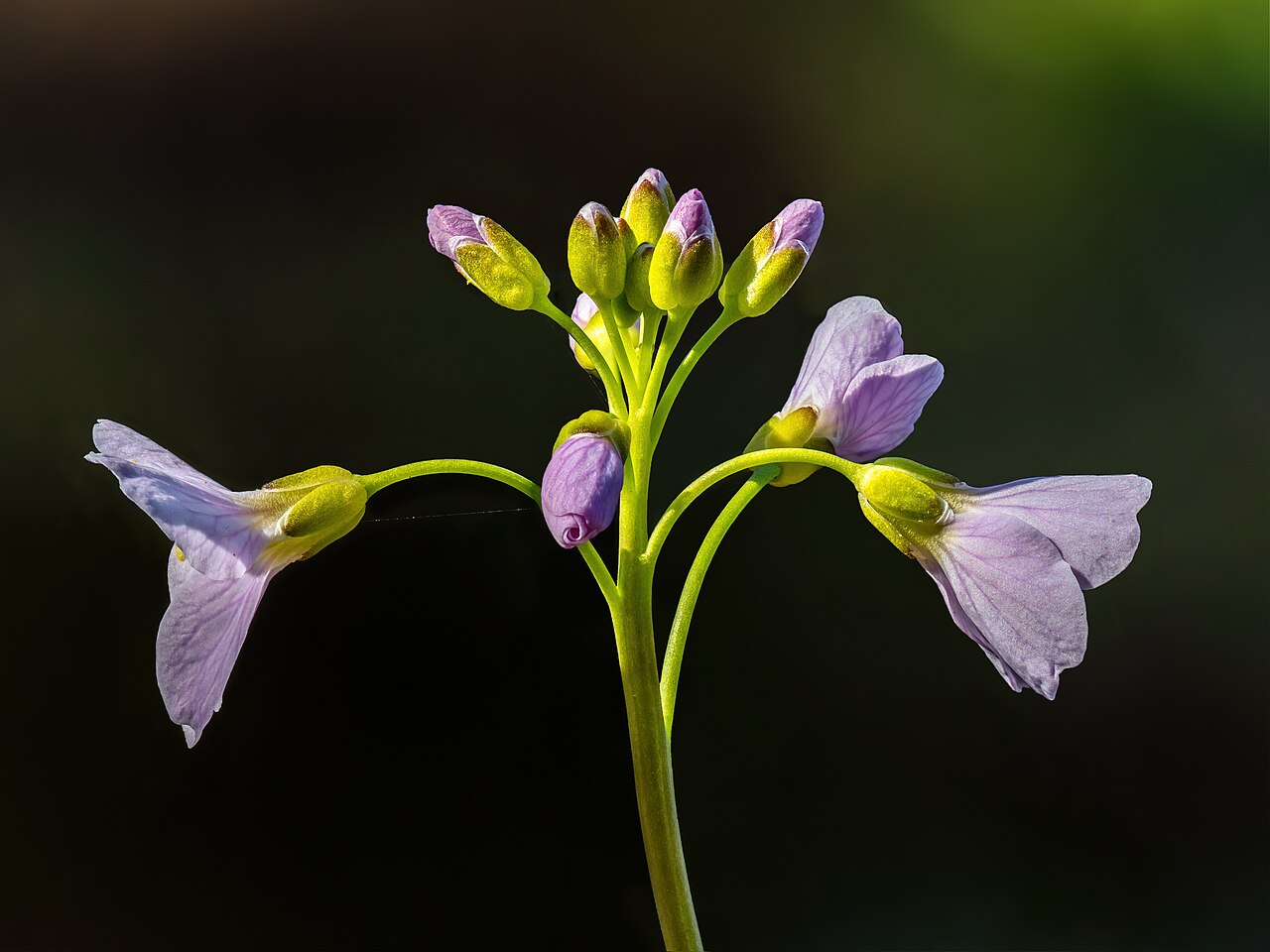
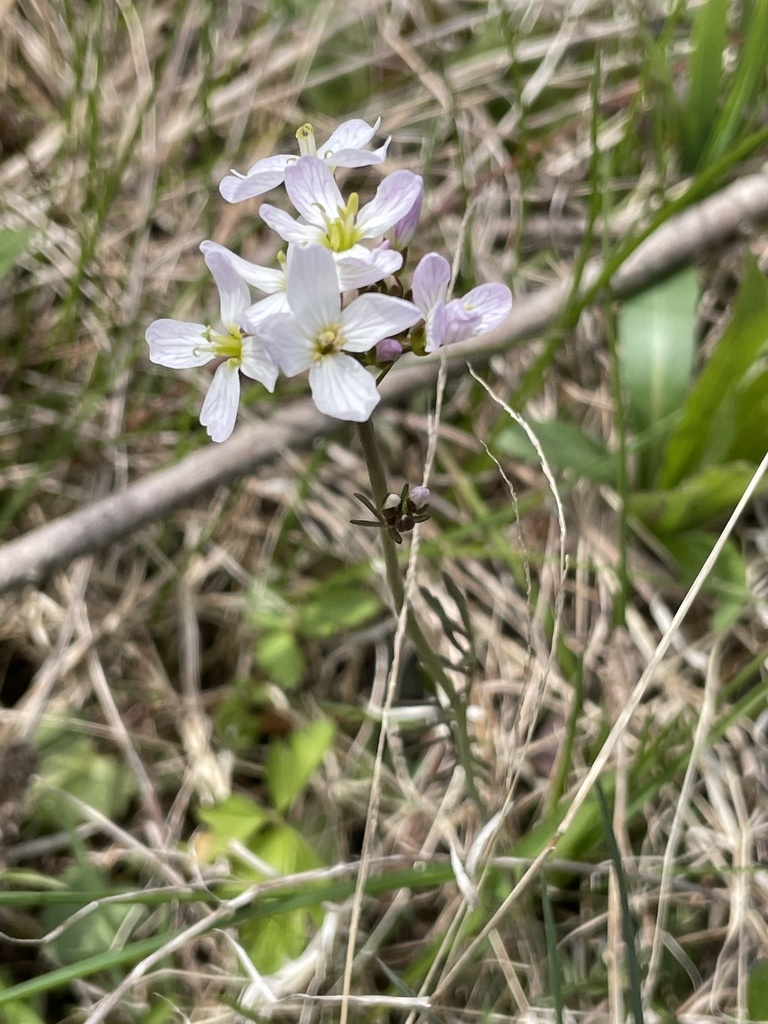
The flowers are carried in a loose, rounded cluster (raceme) at the top of the stem, opening from the bottom up. Each is about ½ to ¾ inch across with four broad petals and six stamens with yellow anthers. Color ranges from pure white to pale lilac or lavender-pink, often with darker veins. Native North American wetland plants are usually white or nearly so, while European plants and garden forms tend to be lilac-pink. It blooms from April to June, depending on latitude.
Fruit & Seeds
After flowering it forms slender, upright pods (siliques) about 1 to 2 inches long. When ripe, the pod walls coil back suddenly and fling the small seeds a short distance, as in other bittercresses.
Look-alikes include the native purple cress (C. douglassii) and spring cress (C. bulbosa), which both have simple, undivided leaves, and the many small, weedy bittercresses, whose flowers are much smaller.
Quick Facts
| Scientific Name | Cardamine pratensis (North American native plants are often treated as var. angustifolia and var. palustris, or as C. dentata) |
| Family | Brassicaceae (mustard family) |
| Plant Type | Herbaceous perennial wildflower |
| Mature Height | 8–20 in (occasionally to about 2½ ft) |
| Mature Spread | 6–12 in; slowly forms colonies |
| Growth Rate | Moderate |
| Sun Exposure | Full sun to part shade |
| Water Needs | High; moist to wet soil, tolerates shallow flooding in spring |
| Soil Type | Wet loam, muck, peat or silt |
| Soil pH | About 5.5–7.5 |
| Bloom Time | April–June |
| Flower Color | White to pale lilac-pink |
| Fall Color | None; foliage dies back after seeding, rosettes may persist |
| Fruit | Slender upright pod (silique) that coils open to throw seeds |
| Deer Resistant | Moderately; not a preferred browse plant |
| USDA Hardiness Zones | 3–8 |
Native Range
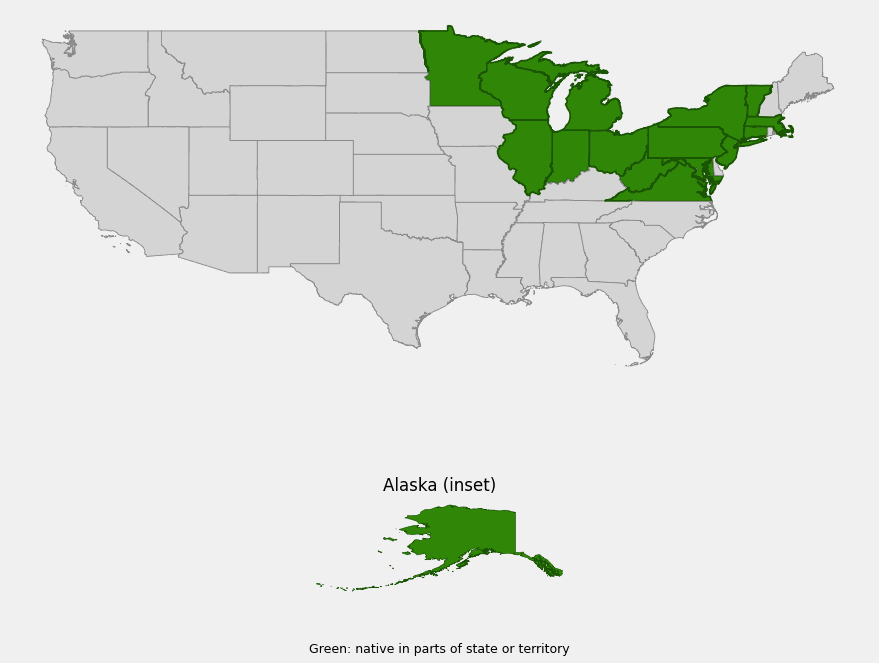
As a species, cuckooflower ranges around the Northern Hemisphere, from Europe and western Asia to Siberia, Korea and Japan, Greenland and northern North America. USDA PLANTS lists it as native in Alaska and in a band of states from Minnesota and Wisconsin east through the Great Lakes and the Northeast and south to Maryland, Virginia and West Virginia, as well as in much of Canada.
Not every cuckooflower in that area is native. North American botanists recognize two native forms: an arctic and subarctic plant (var. angustifolia) of Alaska and northern Canada, and a white-flowered plant of swamps, fens and wet woods in the Great Lakes region and the Northeast (var. palustris, treated by some botanists as the separate species C. dentata). European cuckooflower, grown in gardens for its pink flowers, has escaped into lawns, wet meadows and roadsides. NatureServe treats cuckooflower as introduced in Maine, New Hampshire and Rhode Island, and Native Plant Trust’s Go Botany treats New England C. pratensis as European, with the native plants separated as C. dentata. The map on this page therefore leaves out Maine, New Hampshire and Rhode Island and keeps the states where native plants are documented.
The native wetland form is uncommon to rare in much of the eastern United States. NatureServe ranks C. dentata as critically imperiled (S1) in Massachusetts, Vermont, Pennsylvania, Ohio, Illinois and Virginia and as historical in Connecticut, and ranks cuckooflower as imperiled (S2) in Minnesota. In Alaska and New York it is ranked secure (S5).
📋 Regional plant lists featuring Cuckooflower: Alaska · Connecticut, Massachusetts & Rhode Island · New Hampshire, Maine & Vermont · New York, Pennsylvania & Northern New Jersey · Delaware, Southern New Jersey & Long Island · Maryland, Virginia & West Virginia · Ohio & Indiana · Illinois, Iowa & Missouri · Michigan, Wisconsin & Eastern Minnesota
Growing & Care Guide
Cuckooflower is an easy, long-lived plant for a wet spot. It flowers early, then fades back as taller plants grow up around it, so it fits well among sedges, ferns and later-blooming wetland perennials. For native plantings, choose stock grown from North American wild plants. Garden-center plants, especially the double-flowered ‘Flore Pleno’, are usually of European origin.
Light
Full sun to part shade. In the wild it grows in open wet meadows and under the light shade of swamp forests before the trees leaf out. In hot summer climates it appreciates afternoon shade.
Soil & Water
Give it constantly moist to wet, humus-rich soil: the edge of a pond, a rain garden, a seep or a low spot that stays wet in spring. It tolerates brief spring flooding. It will not thrive in dry soil, although established plants can go dormant through a dry midsummer if spring was wet.
Planting Tips
Plant in fall or early spring, about 8 to 12 inches apart, in groups so the flowers make a show. Combine it with marsh marigold, skunk cabbage, golden ragwort, sedges and blue flag iris, which flower in sequence and cover the ground after cuckooflower fades.
Pruning & Maintenance
Little care is needed. Leave the seed stalks to ripen if you want it to spread, or cut them after flowering to keep it tidy. Do not mow wet meadows until the seed has ripened in early summer. Keep the soil wet and keep vigorous invaders such as reed canary grass out of the planting.
Propagation
Sow fresh seed in fall on the surface of moist soil; it germinates the following spring. Clumps can be divided after flowering. You can also lay healthy basal leaves on wet soil or moss, where the leaflets often form plantlets that can be potted up.
Landscape Uses
- Rain gardens and bioswales: an early-spring bloomer for the wettest zone
- Pond and stream edges: naturalizes along wet banks with sedges and marsh marigold
- Wet meadows: adds early flowers to a meadow that is mowed only after seed set
- Woodland swamp gardens: under deciduous trees with skunk cabbage, ferns and violets
- Pollinator gardens: early nectar for bees, flies and spring butterflies
Wildlife & Ecological Value
Cuckooflower flowers early, when bees and butterflies are just emerging and little else is in bloom in wet places, and its mustard-family chemistry makes it a host for specialized insects.
For Pollinators
The flowers attract small native bees, hover flies, bee flies and early butterflies, which come for nectar and pollen. In Europe it is the classic food plant of the orange-tip butterfly. In North America, white and orangetip butterflies in the family Pieridae lay their eggs on native mustards, including Cardamine species, and their caterpillars feed on the leaves and seed pods.
For Birds
The small seeds are eaten in modest amounts by sparrows and other ground-feeding birds. The wet meadows and swamps where cuckooflower grows are important nesting habitat for many marsh and woodland birds.
For Mammals
Deer and rabbits browse it occasionally. Its leaves have the peppery taste of other cresses, which may discourage heavy browsing.
Ecosystem Role
Cuckooflower is a spring ephemeral of wetlands. It grows while the canopy is open, then fades back as taller plants grow up. Its ability to root from leaflets and to throw seeds from coiling pods lets it slowly colonize wet ground. Where native populations survive, they help mark intact, undrained wetlands.
Cultural & Historical Uses
The name cuckooflower is old. The herbalist John Gerard wrote in 1597 that the plants flower “for the most part in Aprill and May, when the Cuckow begins to sing her pleasant notes.” Another name, lady’s smock, probably refers to the pale flowers spread across spring meadows like linen laid out to dry. The species name pratensis means “of meadows.”
In British folklore the plant was sacred to fairies and considered unlucky to bring indoors, so it was left out of May Day garlands. It is the county flower of Cheshire in England. The leaves are edible and have a peppery, watercress-like taste, and they have been eaten as a spring green. Only harvest a few leaves, where the plant is abundant and the identification is certain. Never take them from small native populations.
In North America the story is more about botany than folklore. Since Linnaeus named the species in 1753, botanists have debated how the native American plants relate to the European ones. Some treat the native white-flowered wetland plants as varieties of C. pratensis, and others as a separate species, C. dentata. Gardeners who want truly native stock should look for local-origin plants from native plant nurseries.
Frequently Asked Questions
Is cuckooflower native to North America?
Yes, in part. Native forms grow in Alaska and northern Canada and in wetlands of the Great Lakes region and the Northeast. European cuckooflower has also escaped from gardens, and in New England most plants are considered introduced. For native plantings, buy stock of North American origin.
Is cuckooflower edible?
Its leaves are edible and taste peppery, like watercress. Eat only a small amount, harvest only where the plant is plentiful, and avoid plants from polluted water or roadsides.
What is the difference between cuckooflower and other bittercresses?
Cuckooflower has much larger flowers (½ to ¾ inch across), pinnately divided leaves with narrow stem leaflets, and grows in wet meadows and swamps. Weedy bittercresses have tiny white flowers, and purple cress and spring cress have undivided leaves.
Will cuckooflower spread in my garden?
Slowly, in wet soil. It spreads by seed, which the pods throw a short distance, and by plantlets that form where leaflets touch wet ground. It is not aggressive in a mixed planting and fades back in summer.
Why is it called cuckooflower?
In Britain it blooms in April and May, at about the time the first cuckoos return and start to call. The name was already in use by the 16th century.

Looking for a nursery that carries Cuckooflower?
Browse our native plant nursery directory: Alaska · Connecticut · Illinois & Indiana · Maryland, Massachusetts, Michigan & Minnesota · New Jersey, New York & Ohio · Pennsylvania, Vermont & Virginia · West Virginia & Wisconsin

