
Dense-Flowered Owl’s-Clover (Castilleja densiflora)
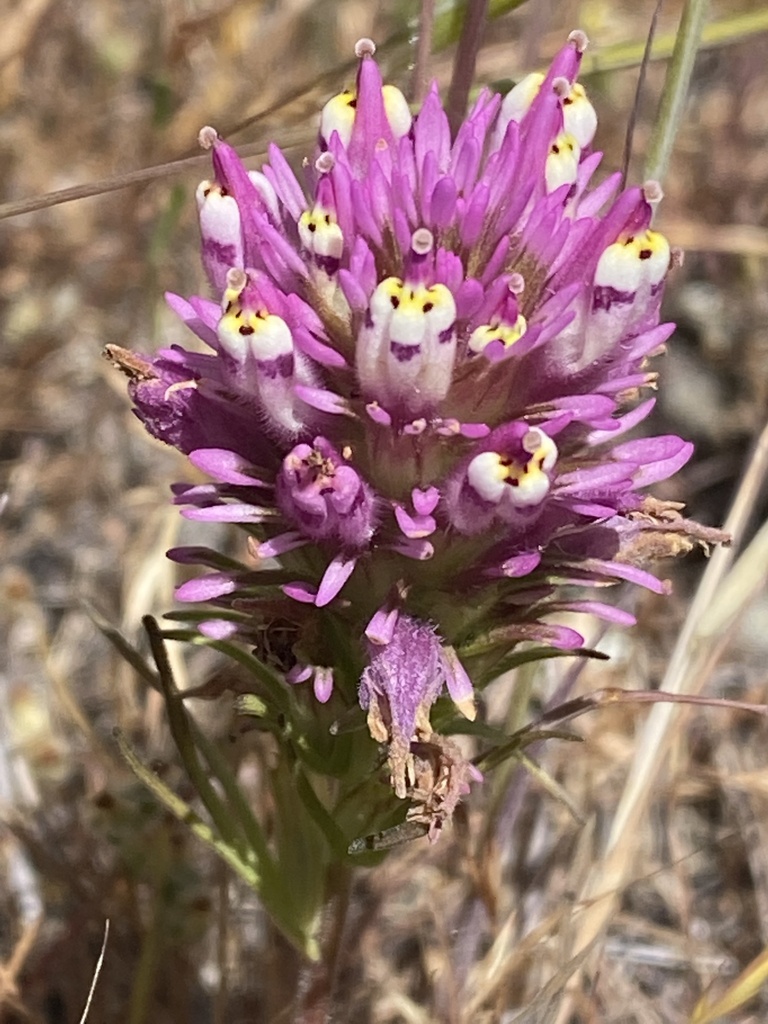
Castilleja densiflora, known as Dense-Flowered Owl’s-Clover or denseflower Indian paintbrush, is a small spring annual wildflower of California’s grasslands, coastal prairies and open woodlands. In March to May it produces short, dense spikes of pink-purple to white bracts and small, two-lipped flowers whose white or yellowish pouches, dotted with purple, look like tiny owl faces peering out of the spike. Plants are usually only 4 to 16 inches tall.
It belongs to the broomrape family (Orobanchaceae), together with the paintbrushes, and was long known as Orthocarpus densiflorus before botanists moved most owl’s-clovers into Castilleja. Like other paintbrushes and owl’s-clovers, it is a root hemiparasite: it has green leaves and makes its own food, but it also taps into the roots of neighboring grasses and wildflowers for water and nutrients.
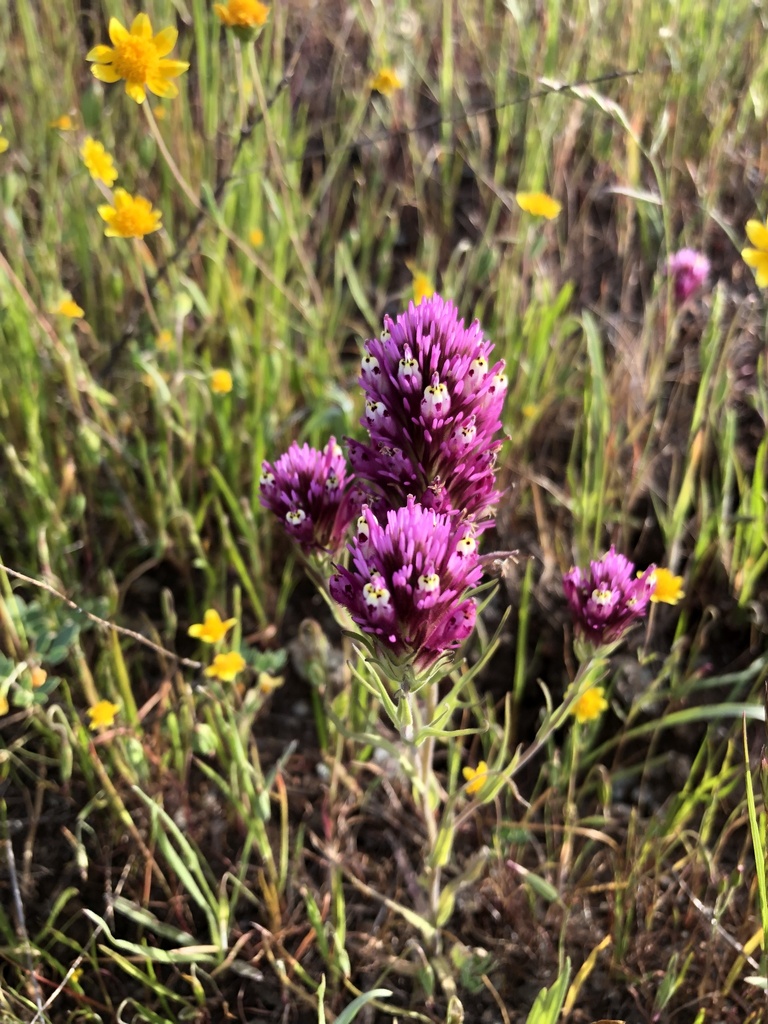
Dense-flowered owl’s-clover is one of the classic wildflowers of California’s spring grassland displays, often blooming with goldfields, tidy tips, lupines and purple owl’s-clover. It is also a food plant for the caterpillars of the threatened Bay checkerspot butterfly. Because it depends on host plants and grows as an annual, it is not a conventional garden plant, and it is best sown from seed in a meadow setting or enjoyed in the wild. This guide covers how to identify it, where to see it, and its ecological role.
Identification
Dense-flowered owl’s-clover is easy to recognize as an owl’s-clover by its short, bushy spikes of colorful bracts and small pouched flowers. Separating it from the similar purple owl’s-clover takes a closer look at the flowers and bracts.
Growth Habit
It is an erect annual, 4 to 16 inches tall, with a single stem or a few branches from the base. The stems are often reddish-purple and finely hairy. It germinates with the fall and winter rains, flowers in spring and dies by early summer after setting seed.
Leaves
The leaves are alternate, narrow and linear, 1 to 2 inches long, and either entire or divided into a few thread-like lobes toward the top of the stem. They are green to purplish and finely hairy, and they are easily overlooked among the grasses until the plant flowers.
Bracts & Flowers
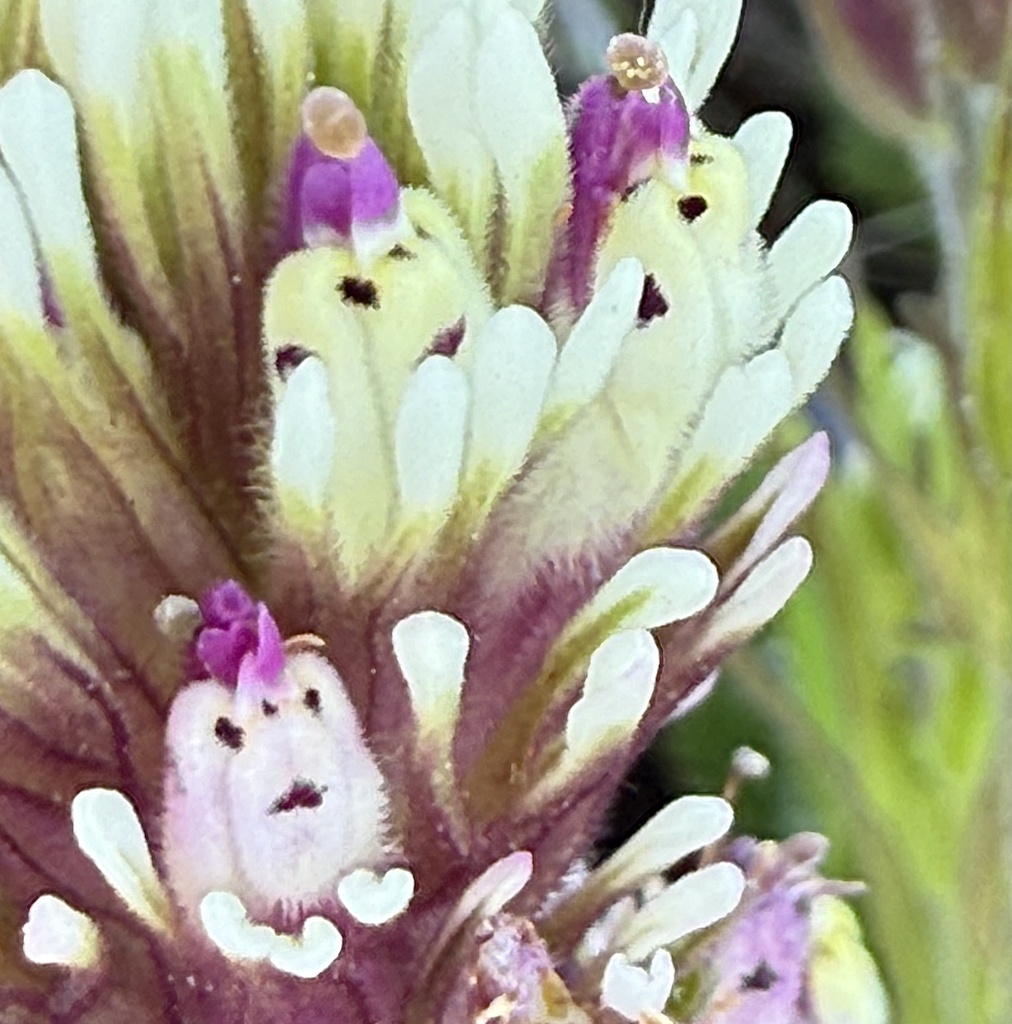
The flowers are packed into a dense, cylindrical spike at the top of the stem, each flower tucked behind a bract with narrow lobes. The bract tips are pink to purple, sometimes pale or white, and provide most of the color. The flowers themselves are about 1/2 to 1 inch long and two-lipped. The upper lip forms a narrow, straight, purple beak, and the lower lip is inflated into three small, white to pale yellow pouches spotted with purple. Bloom time is mainly March to May.
Fruit & Seeds
Each flower produces a small, egg-shaped capsule containing many tiny seeds with a netted seed coat. The capsules ripen in late spring as the plant dries, and the seeds fall near the parent plant or are scattered by wind.
Look-alikes & Subspecies
Purple owl’s-clover (Castilleja exserta) is the most similar species. Its spikes are generally looser, with longer, more deeply divided bracts, and its upper beak is hooked at the tip and covered with long, velvety hairs; in dense-flowered owl’s-clover the beak is straight and less hairy. Three subspecies are recognized: the widespread subsp. densiflora, subsp. gracilis of southern California, and the rare subsp. obispoensis of San Luis Obispo County. Butter-and-eggs (Triphysaria eriantha) is a related hemiparasite with mostly yellow-and-white flowers.
Quick Facts
| Scientific Name | Castilleja densiflora (Benth.) T.I. Chuang & Heckard |
| Family | Orobanchaceae (broomrape family) |
| Plant Type | Annual root hemiparasite |
| Mature Height | 4–16 in |
| Mature Spread | 2–6 in |
| Growth Rate | Fast (annual) |
| Sun Exposure | Full sun |
| Water Needs | Low; winter-spring rain only |
| Soil Type | Grassland soils, including clay, loam and serpentine |
| Soil pH | About 6.0–7.5 |
| Bloom Time | March–May |
| Flower Color | Pink-purple bracts; white to pale yellow flowers with purple spots |
| Fall Color | None; annual, dies by early summer |
| Fruit | Small capsule with many tiny seeds |
| Deer Resistant | Not well documented |
| USDA Hardiness Zones | 8–10 (grows as a cool-season annual) |
Native Range
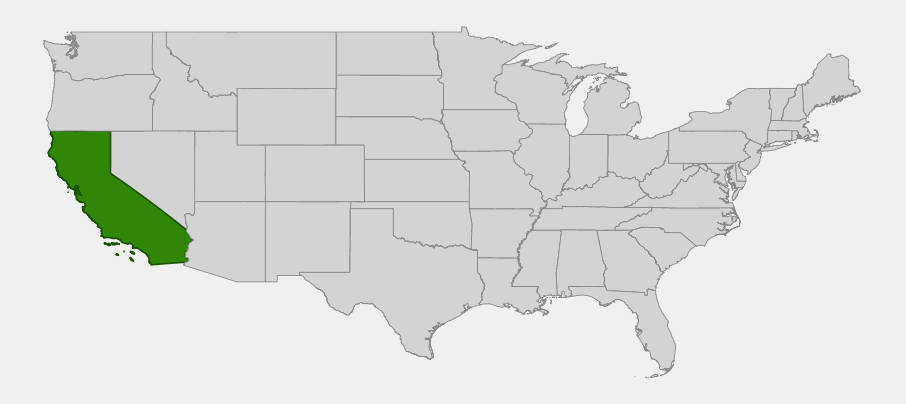
Dense-flowered owl’s-clover is native to California, and USDA PLANTS lists it only from California in the United States. The southern subspecies extends a short way into northern Baja California, Mexico.
It grows mainly in the Coast Ranges, from the North Coast and the San Francisco Bay Area south through the Central Coast to southern California, and in the foothills around the Central Valley. The widespread subsp. densiflora is common in the Bay Area and Central Coast, subsp. gracilis occurs in southern California, including San Diego County, and subsp. obispoensis is limited to coastal San Luis Obispo County, where it is tracked as rare by the California Native Plant Society.
Typical habitats are open grasslands, coastal prairie and coastal scrub openings, oak savanna and woodland clearings, usually at low elevations. It grows on many soil types, including heavy clay and serpentine, and serpentine grasslands, where invasive annual grasses are less dominant, often support some of its densest displays.
📋 Regional plant lists featuring Dense-Flowered Owl’s-Clover: California & Nevada
Can You Grow It?
Dense-flowered owl’s-clover is not a typical garden plant. It is an annual hemiparasite that needs living host plants, usually grasses and other annuals, to grow well, and it does not transplant. Plants are rarely sold in nurseries. It can be grown, with some patience, by sowing seed into a meadow or grassland planting where suitable hosts are already growing. Never dig plants from the wild; they will not survive, and collecting seed from wild populations should be left to restoration projects with permission.
Light
It needs full sun. In the wild it grows in open grasslands and prairies, and it declines quickly where shrubs or tall grasses shade it.
Soil & Water
It grows in ordinary grassland soils, from clay to sandy loam, and on serpentine. It relies on winter and spring rains and needs no summer water, since it completes its life cycle by early summer. Rich, irrigated garden soil encourages weeds and tall grasses that crowd it out.
Planting Tips
Sow seed in fall, before the first rains, onto bare or lightly raked soil among host plants such as native bunchgrasses, plantains, goldfields and lupines; do not cover the tiny seeds deeply. Owl’s-clovers form root connections with many kinds of hosts, so a diverse native meadow or a mix of annual wildflowers works best. Results vary from year to year, and seedlings without hosts often stay small or fail.
Pruning & Maintenance
Keep invasive annual grasses under control, since they shade and crowd out owl’s-clovers. Mowing or grazing timed for after seed set, and avoiding fertilizer, help keep a grassland open. Let the plants dry and drop their seed in place; established patches can reseed for years.
Propagation
It is grown only from seed. Seed of some owl’s-clovers is offered by California native seed suppliers, often as part of wildflower mixes. Store seed dry and sow it in fall; no special treatment beyond the natural winter rains is usually needed.
Where to See It
- San Francisco Bay Area serpentine grasslands: Edgewood Park & Natural Preserve in San Mateo County and Ring Mountain in Marin County are known for spring displays
- Central Coast: coastal prairies and grasslands such as Fort Ord National Monument in Monterey County
- Southern California: grasslands and vernal pool areas in San Diego County, where subsp. gracilis grows
- Spring wildflower walks: look for it from March to May in open grassland on established trails
- Meadow and restoration plantings: sown from seed with native grasses and annual wildflowers
Wildlife & Ecological Value
Dense-flowered owl’s-clover is small, but it plays an outsized role in California grasslands, especially for butterflies and bees.
For Pollinators
The pouched flowers are pollinated mainly by bees, especially bumble bees and other native bees that push into the flowers to reach nectar and pollen. Owl’s-clover displays are a significant spring resource for bees in open grassland.
For Butterflies
Dense-flowered owl’s-clover and purple owl’s-clover are secondary larval food plants of the Bay checkerspot butterfly (Euphydryas editha bayensis), a federally threatened butterfly of Bay Area serpentine grasslands. The caterpillars feed mainly on dot-seed plantain, and owl’s-clovers provide food for larvae later in the spring, when plantains have dried. Other checkerspots also use owl’s-clovers and paintbrushes as host plants.
For Birds & Mammals
Seed-eating birds and small rodents eat some seeds, and grazing animals may eat the plants in spring. The plants are too small and short-lived to be important as cover.
Ecosystem Role
As a root hemiparasite, it draws water and nutrients from neighboring plants. Hemiparasites can reduce the vigor of dominant grasses and so help other wildflowers persist, adding to grassland diversity. Its displays are a sign of healthy native grassland, and it is threatened where invasive grasses, development or lack of grazing or fire allow dense thatch to build up.
Cultural & Historical Uses
The genus Castilleja honors the Spanish botanist Domingo Castillejo. The species name densiflora means densely flowered, referring to the tightly packed spikes. The plant was described by George Bentham as Orthocarpus densiflorus, and it was moved to Castilleja in 1991 by T.I. Chuang and Lawrence Heckard, who showed that most owl’s-clovers are closely related to the paintbrushes.
The name owl’s-clover comes from the small, spotted pouches of the flowers, which resemble owl faces peering out of the spike, and from the clover-like heads of color the plants form in grasslands. USDA uses the name denseflower Indian paintbrush, reflecting its current genus.
Owl’s-clovers have long been part of California’s famous spring wildflower fields, and photographs of hillsides colored purple and gold by owl’s-clovers and goldfields are a spring tradition. Enjoy and photograph them in place, and stay on trails, since trampling crushes the small annuals before they set seed.
Frequently Asked Questions
Is dense-flowered owl’s-clover a parasite?
It is a hemiparasite. It has green leaves and photosynthesizes, but its roots attach to the roots of nearby plants, mainly grasses and other wildflowers, to take water and nutrients.
Can I grow dense-flowered owl’s-clover in my garden?
Only in a sunny meadow-style planting with host plants. Sow seed in fall among native grasses and annual wildflowers. It is not sold as nursery plants and cannot be transplanted. Never dig it from the wild.
How is it different from purple owl’s-clover?
Dense-flowered owl’s-clover has denser spikes and a straight, less hairy beak on each flower. Purple owl’s-clover has a hooked beak covered in velvety hairs and longer, more deeply divided bracts.
Where can I see dense-flowered owl’s-clover?
Look in spring grasslands of the Coast Ranges, such as Edgewood Park in San Mateo County, Ring Mountain in Marin County, Fort Ord National Monument and grasslands in San Diego County.
Why is it important for butterflies?
It is a larval food plant for the Bay checkerspot, a threatened butterfly of Bay Area serpentine grasslands, and for other checkerspot butterflies.

Looking for a nursery that carries Dense-Flowered Owl’s-Clover?
Browse our native plant nursery directory: California

