
Early Meadow-Rue (Thalictrum dioicum)
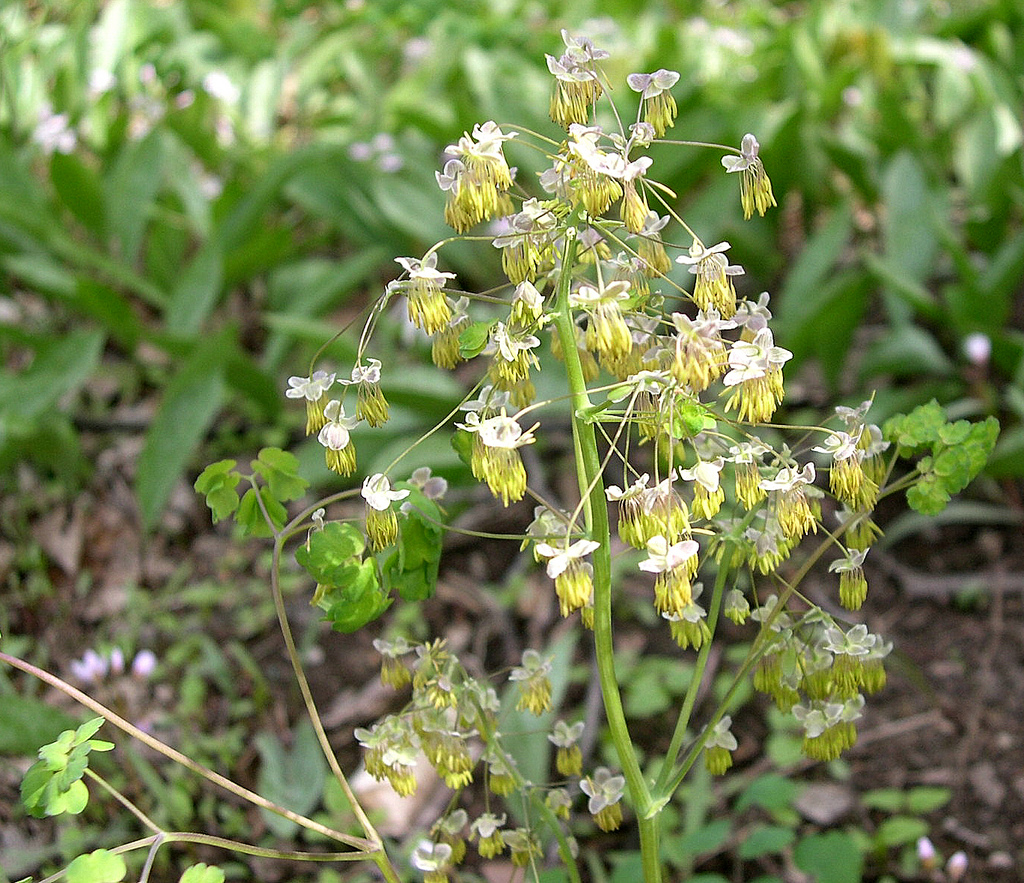
Thalictrum dioicum, known as Early Meadow-Rue, is a graceful native woodland perennial of eastern North America and a member of the buttercup family (Ranunculaceae). In April and May, often while the forest canopy is still opening, it raises airy clusters of nodding, petal-less flowers above lacy, blue-green foliage that looks much like columbine. Plants usually grow 1 to 2 feet tall.
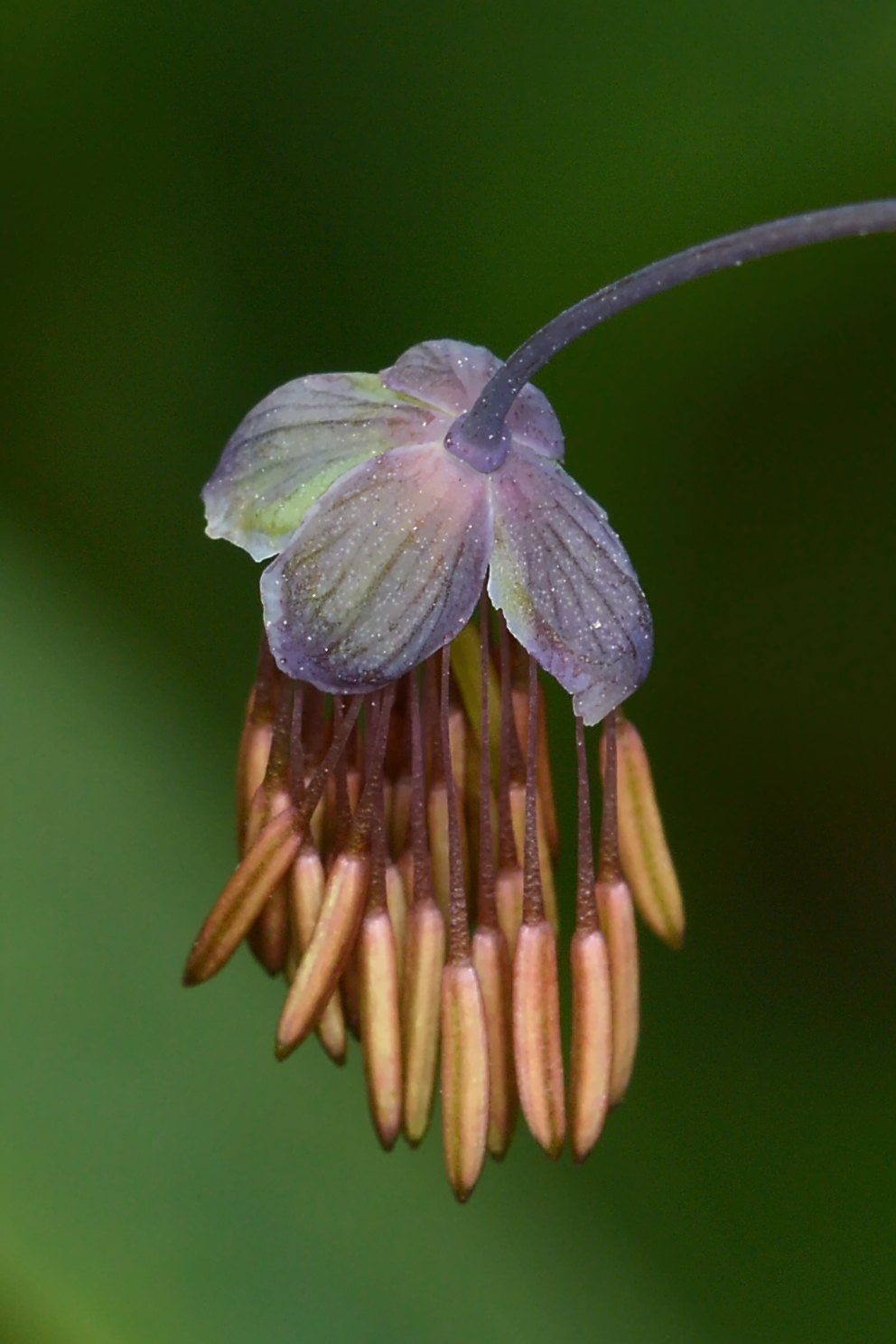
As the species name dioicum says, it is dioecious: each plant is either male or female. Male plants are the showier ones, with dangling tassels of yellowish to purplish stamens that tremble in the slightest breeze. Female plants carry small clusters of purplish pistils that develop into ribbed seeds. Early meadow-rue is wind-pollinated, which is why its flowers have no bright petals and why the stamens hang loosely where the wind can shake out their pollen.
Early meadow-rue is easy to grow in a shaded woodland garden with rich, moist soil. Its delicate foliage stays attractive well after flowering and makes a soft, fern-like texture under trees and shrubs. It is the earliest of the native meadow-rues to bloom, flowering weeks before the tall meadow-rues of summer.
Identification
Early meadow-rue is best recognized by its combination of columbine-like leaves, spring bloom time and drooping, petal-less flowers on plants that are either all male or all female.
Growth Habit
Plants grow 1 to 2 feet tall (occasionally to 30 inches) from a short, knotty rootstock with fibrous roots. Stems are smooth, slender and often purplish, and plants form small clumps. The foliage usually remains through summer in moist shade, but may yellow and die back early in dry years.
Leaves
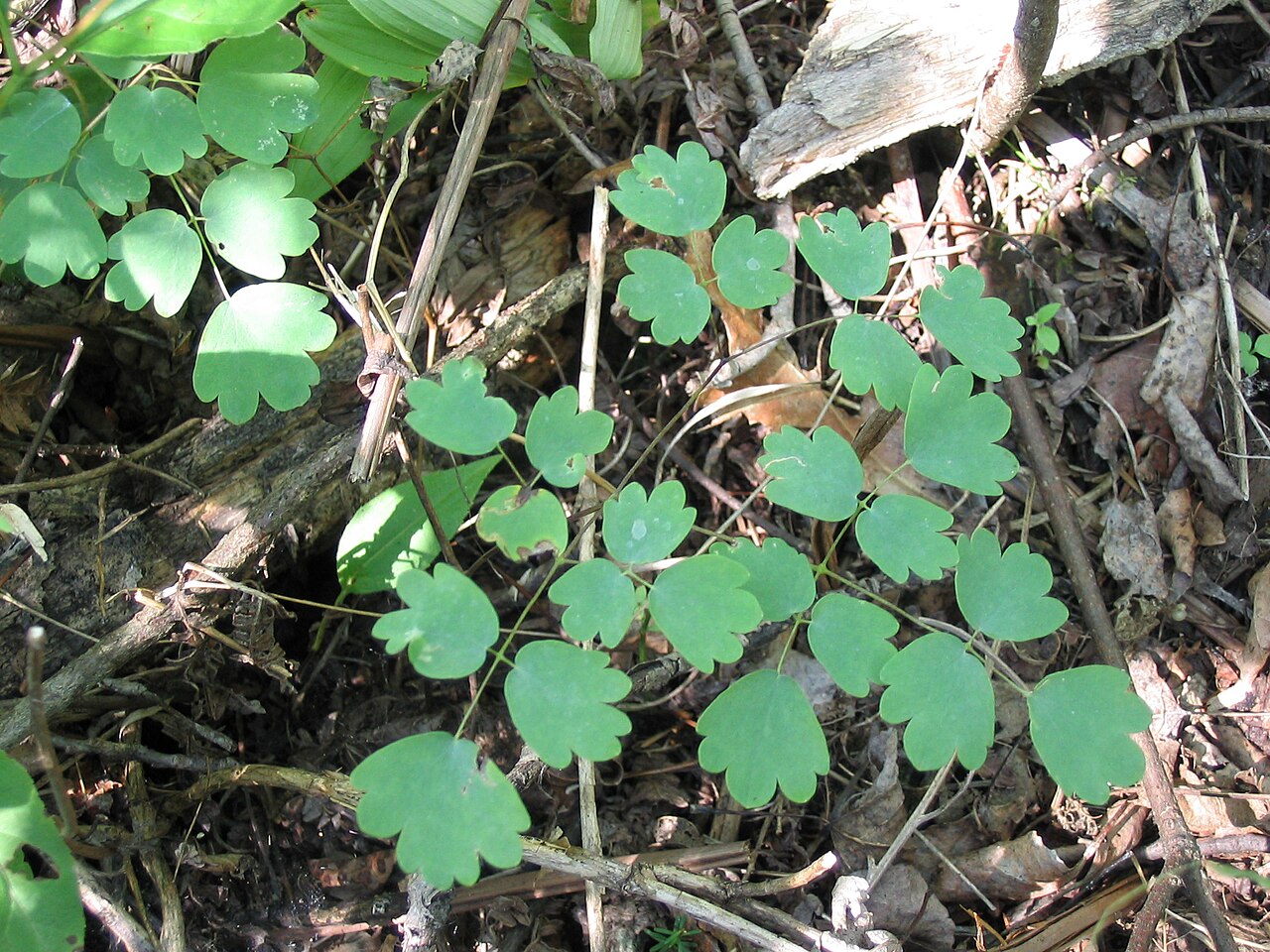
Leaves are alternate and compound, divided two or three times into groups of three, with long stalks on the lower leaves. Each leaflet is small (about 1/2 to 1 1/4 inches), rounded, and has three to nine shallow, rounded lobes at the tip. Leaflets are thin, smooth, dull blue-green above and paler beneath. The upper leaves on the flowering stem usually have stalks, which helps separate it from some other meadow-rues.
Flowers
Flowers open in April and May, often as the leaves are still expanding, in loose, branching clusters at the top of the stem. They have no petals, only four or five small greenish to purplish sepals that soon drop. Male flowers carry a drooping tassel of 15 to 30 stamens with long, slender, yellowish anthers on thread-like filaments. Female flowers have a small cluster of 4 to 14 purplish pistils with slender styles.
Fruit & Seeds
Pollinated female flowers develop into clusters of small, dry, egg-shaped achenes about 1/4 inch long with prominent ribs. They ripen in early summer, turning from green to brown, and fall near the parent plant.
Look-alikes
Its leaves are very similar to those of wild columbine, but columbine has showy red and yellow spurred flowers. Rue anemone blooms at the same time but has white, cup-shaped flowers. Tall meadow-rue (T. pubescens) and purple meadow-rue (T. dasycarpum) are much taller plants of moist meadows and wetlands that bloom in summer with upright, fluffy white stamens. Waxy meadow-rue (T. revolutum) has leaflets with glands beneath and blooms later.
Safety
Like many plants in the buttercup family, meadow-rues contain alkaloids and other compounds that can be harmful if eaten in quantity. Early meadow-rue is not a food plant; do not eat it, and keep children and pets from chewing the foliage. Handling the plant is generally safe.
Quick Facts
| Scientific Name | Thalictrum dioicum |
| Family | Ranunculaceae (buttercup family) |
| Plant Type | Herbaceous perennial; dioecious woodland wildflower |
| Mature Height | 1–2 ft |
| Mature Spread | 1–2 ft |
| Growth Rate | Moderate |
| Sun Exposure | Part shade to full shade |
| Water Needs | Medium; evenly moist soil |
| Soil Type | Rich, humusy loam |
| Soil pH | About 5.5–7.5 (slightly acidic to slightly alkaline) |
| Bloom Time | April–May |
| Flower Color | Greenish to purplish sepals; yellowish to purplish dangling stamens |
| Fall Color | Foliage yellows; may die back by late summer in dry years |
| Fruit | Clusters of small ribbed achenes (female plants only) |
| Deer Resistant | Yes; usually avoided by deer |
| USDA Hardiness Zones | 3–8 |
Native Range
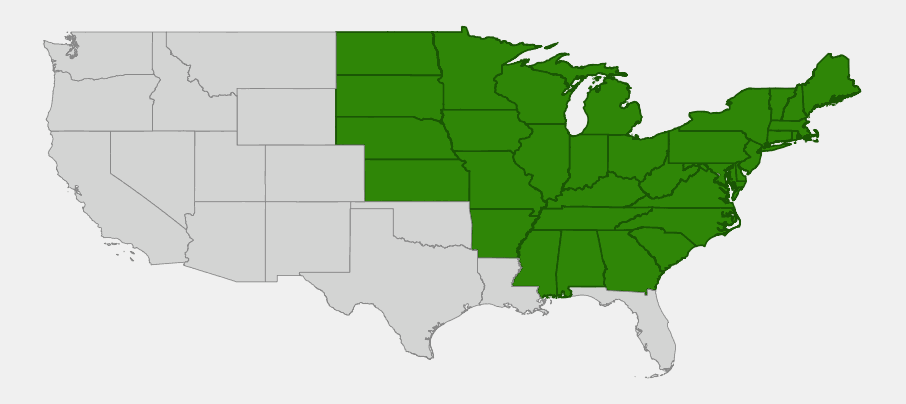
Early meadow-rue is native to eastern North America, from Quebec and Ontario (and Saint Pierre and Miquelon) south through the eastern United States. USDA PLANTS records it in 33 states plus the District of Columbia, from Maine and Vermont west to Minnesota and the eastern Dakotas, and south to Georgia, Alabama, Mississippi and Arkansas.
It is most common in the Northeast, the Great Lakes states, the Ohio Valley and the Appalachians. On the western edge of its range it follows wooded river valleys and ravines into eastern North Dakota, South Dakota, Nebraska and Kansas. In the South it is mostly found in the mountains and Piedmont and becomes scarce on the Coastal Plain.
Its habitat is rich, moist deciduous woods: wooded slopes and ravines, the base of bluffs, rocky hillsides, streambanks and floodplain terraces, often on soils over limestone or other calcium-rich rock. It grows in partial to fairly deep shade under maples, basswood, oaks and other hardwoods.
📋 Regional plant lists featuring Early Meadow-Rue: New York, Pennsylvania & Northern New Jersey · Ohio & Indiana · Michigan, Wisconsin & Eastern Minnesota · Kentucky & Tennessee · Nebraska, Kansas & Eastern Colorado · Connecticut, Massachusetts & Rhode Island · New Hampshire, Maine & Vermont · Maryland, Virginia & West Virginia · Delaware, Southern New Jersey & Long Island · Illinois, Iowa & Missouri · Alabama, Georgia & Mississippi · North & South Carolina · Arkansas, Louisiana, Eastern Oklahoma & Eastern Texas · North Dakota, South Dakota & Western Minnesota
Growing & Care Guide
Early meadow-rue is a reliable, low-maintenance woodland perennial. Given shade and rich, moist soil, it settles in quickly and asks for little care. To get seeds, you need both a male and a female plant; for the showiest flowers, include some male plants.
Light
Part shade to full shade, such as under deciduous trees or on the north side of a building. Morning sun is fine where the soil stays moist. In hot afternoon sun the foliage scorches and goes dormant early.
Soil & Water
Plant it in rich, loose, humusy soil that stays evenly moist. It tolerates a range of pH and does especially well in neutral to slightly alkaline woodland soils. Water during long dry spells in the first year. Established plants tolerate brief dryness but may go dormant early in drought.
Planting Tips
Plant in spring or fall, 12 to 18 inches apart, in groups of three or more so you are likely to get both male and female plants. Its fine texture contrasts well with broad-leaved woodland plants such as wild ginger, hostas and trilliums, and it pairs nicely with ferns and spring ephemerals.
Pruning & Maintenance
Little care is needed. Leave fallen leaves in place as a natural mulch. If the foliage becomes ragged or yellow in late summer, cut it back; the plant will return next spring. Clumps rarely need division.
Propagation
Sow fresh seed in fall outdoors, or give it 60 days of cold, moist stratification before spring sowing. Germination can be slow and uneven. Mature clumps can be divided carefully in early spring or fall. Seedlings take two to three years to flower, and you will not know the sex of a seedling until it blooms.
Landscape Uses
- Woodland gardens: fine, columbine-like foliage and early, airy flowers
- Shade borders: a delicate textural contrast with broad-leaved perennials
- Spring wildflower plantings: with trilliums, hepaticas, wild geranium and columbine
- Woodland restoration: a common groundlayer species of rich deciduous forests
- Naturalized slopes and ravines: tolerates rocky, shaded hillsides
Wildlife & Ecological Value
Early meadow-rue is wind-pollinated, but it still plays a part in the spring woodland food web.
For Pollinators
The flowers produce no nectar and rely on wind for pollination. Still, small bees and syrphid flies visit the male flowers to collect or eat the abundant pollen in early spring, when other food is scarce.
For Birds
Birds make little use of the plant directly, though ground-feeding birds may pick up fallen seeds, and the insects that live in woodland leaf litter around it feed spring migrants.
For Mammals
Deer and rabbits generally avoid meadow-rue foliage, probably because of its bitter compounds. This makes it a useful plant where browsing is heavy.
Ecosystem Role
Early meadow-rue is part of the rich herbaceous layer of eastern deciduous forests. Its foliage feeds a variety of leaf-chewing insects, which in turn feed spiders, birds and other predators. Because it often grows on rich, lime-influenced soils, it can be a useful indicator of high-quality woodland.
Cultural & Historical Uses
The genus name Thalictrum is an ancient Greek name used by Dioscorides for a plant of this type. The common name meadow-rue refers to the resemblance of the leaves to those of the herb rue (Ruta), which is not related, and to the meadow habitats of many species. Early meadow-rue was also known by the old name quicksilver-weed.
Meadow-rues have a long history of use in the traditional medicine of several Native American peoples and of European herbalists, mostly involving the roots. These uses belong to traditional knowledge and are not a recommendation: the plants contain alkaloids and other potentially harmful compounds and should not be used as home remedies.
Early meadow-rue is a good example of a wind-pollinated wildflower in a group, the buttercup family, that is mostly insect-pollinated. Its petal-less flowers, long dangling stamens and separate male and female plants are all adaptations that help move pollen on the breeze in open spring woods before the trees leaf out.
Frequently Asked Questions
Why does my early meadow-rue not set seed?
It is dioecious, so only female plants produce seed, and they need a male plant nearby to supply pollen. A lone plant, or a group of only males, will not produce seed.
How can I tell male and female plants apart?
In bloom, male plants have drooping tassels of long, yellowish stamens. Female plants have small clusters of purplish, thread-like pistils and later produce small ribbed seeds. Out of bloom they look the same.
Is early meadow-rue the same as tall meadow-rue?
No. Tall meadow-rues are much larger plants (3 to 8 feet) of moist meadows and wetlands that bloom in summer. Early meadow-rue is a small woodland plant that blooms in spring.
Is early meadow-rue deer resistant?
Generally yes. Deer and rabbits tend to avoid it, which makes it useful in shady gardens with heavy browsing.
Can early meadow-rue grow in full sun?
It does best in part to full shade. In full sun, especially with dry soil, its leaves scorch and the plant goes dormant early.

Looking for a nursery that carries Early Meadow-Rue?
Browse our native plant nursery directory: Alabama & Arkansas · Connecticut, Delaware & Georgia · Illinois, Indiana, Iowa & Kansas · Kentucky, Maine, Maryland, Massachusetts, Michigan, Minnesota, Mississippi & Missouri · Nebraska, New Hampshire, New Jersey, New York, North Carolina, North Dakota & Ohio · Pennsylvania, Rhode Island, South Carolina, South Dakota, Tennessee, Vermont & Virginia · West Virginia & Wisconsin