
Emory’s Crucifixion-thorn (Castela emoryi)
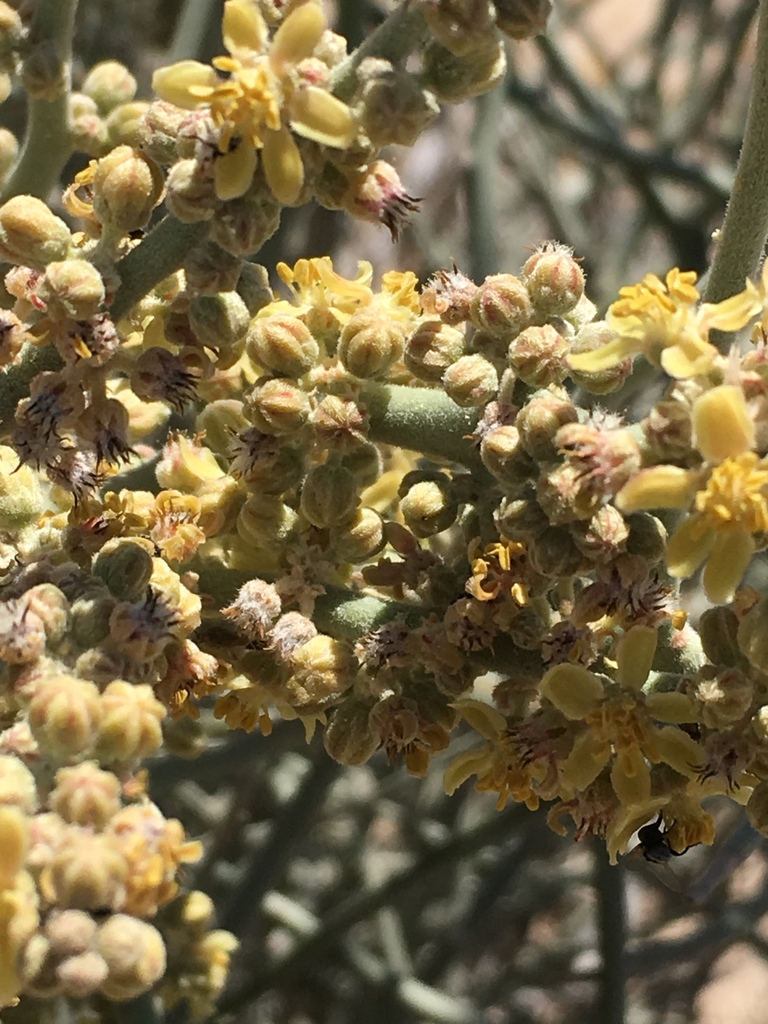
Castela emoryi, known as Emory’s Crucifixion-thorn or simply crucifixion thorn (in Spanish, chaparro amargoso), is a dense, leafless, intensely thorny shrub of the Sonoran and Mojave Deserts in Arizona, southeastern California and northwestern Mexico. Its rigid green branches end in sharp spines and do the work of leaves, and it is famous for its clusters of dried fruits, which can stay on the plant for years.
Several unrelated desert shrubs share the name crucifixion thorn because their stiff, spine-tipped branches cross at right angles, recalling a cross. This species is a member of the quassia family (Simaroubaceae) and was long known as Holacantha emoryi. The others include Canotia (Canotia holacantha) of central Arizona and Allthorn (Koeberlinia spinosa) of the Chihuahuan Desert.
Crucifixion-thorn is uncommon and scattered, and in California it is rare enough to be included in the California Native Plant Society’s Inventory of Rare and Endangered Plants. This guide covers how to identify it, where it grows, whether it can be grown, and its role in the desert.
Identification
Look for a gray-green, leafless thicket of rigid, spine-tipped branches, often carrying dark, persistent fruit clusters.
Leaves & Growth Habit
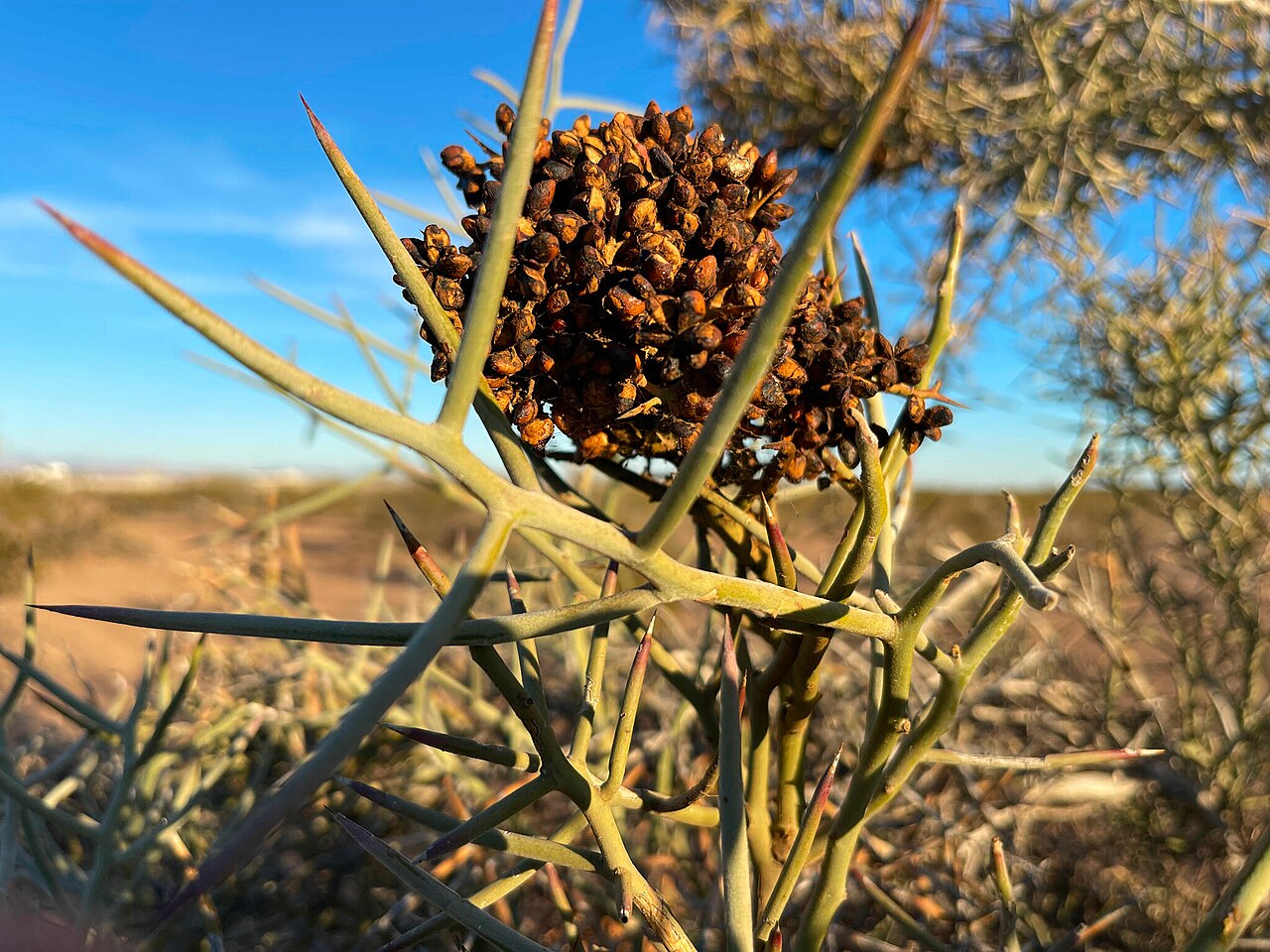
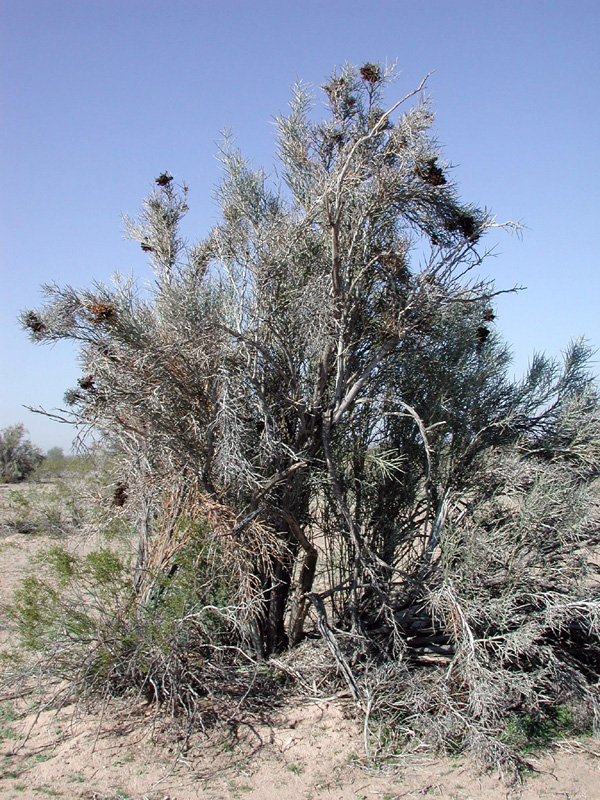
A dense, rounded, much-branched shrub, usually 3 to 6 feet tall, sometimes a small tree to 12 feet or more. The stems are smooth, pale green to gray-green and photosynthetic. Every twig ends in a stout, sharp spine, and the branches often grow at wide angles to each other. Leaves are tiny, scale-like and soon fall, so the plant appears leafless most of the year.
Flowers
The plant is dioecious, with male and female flowers on separate plants. Flowers appear in June and July, in the hottest part of the year, in dense clusters along the branches. Each flower is small, with 7 or 8 pale yellow to yellow-green petals, often tinged reddish, and the clusters can cover the shrub with a yellowish haze.
Fruit
Female plants produce dense, rounded clusters of small, dry fruits. Each flower yields a ring of 5 to 10 small, flattened, one-seeded fruits, so the clusters look like little rosettes. Green or reddish at first, they dry tan to brown and finally turn black, and they can persist on the branches for several years, giving the shrub a distinctive speckled look.
Look-alikes
Canotia is a taller, broom-like shrub or small tree with fewer, less rigid spines and woody, five-valved capsules; it grows at higher elevations in central Arizona. Allthorn has darker green stems and small black berries. The related Goatbush (Castela erecta) of South Texas has small, leathery leaves and bright red fruits. Smoke Tree is also spiny and nearly leafless but has softer, silvery-gray branches and purple pea flowers.
Quick Facts
| Scientific Name | Castela emoryi (syn. Holacantha emoryi) |
| Family | Simaroubaceae (quassia family) |
| Plant Type | Leafless, thorny desert shrub or small tree |
| Mature Height | 3–12 ft (rarely more) |
| Mature Spread | 4–10 ft |
| Growth Rate | Slow |
| Sun Exposure | Full sun |
| Water Needs | Very low; extremely drought tolerant |
| Soil Type | Sandy, gravelly or silty desert soils; washes, flats and playas |
| Soil pH | Neutral to alkaline |
| Bloom Time | June–July |
| Flower Color | Pale yellow to yellow-green, often reddish-tinged |
| Fall Color | None; green stems all year |
| Fruit | Persistent clusters of small dry fruits, tan to black |
| Deer Resistant | Yes; thorny and bitter |
| USDA Hardiness Zones | 8–11 |
Native Range
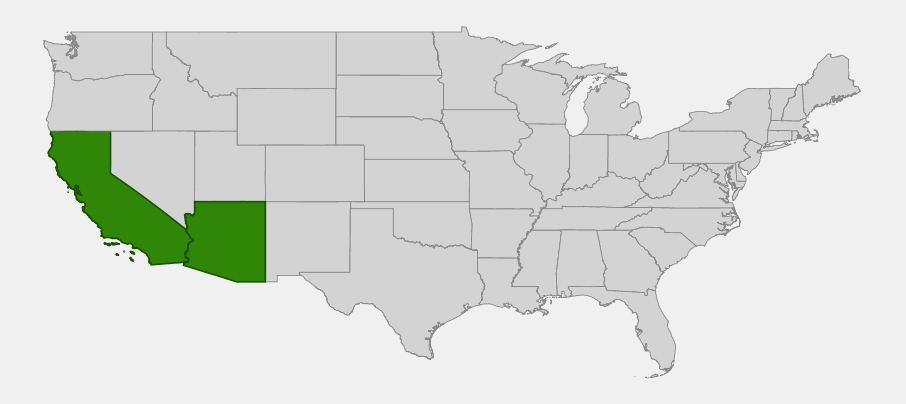
Emory’s crucifixion-thorn is native to the Sonoran and Mojave Deserts. USDA PLANTS lists it in Arizona and California, and it also grows in northwestern Sonora, Mexico. In Arizona it is scattered across the low deserts of the western and south-central parts of the state. In California it is known from a limited number of sites in the eastern Mojave Desert and the Colorado Desert of the southeastern corner of the state.
It grows on desert flats, along the edges of washes, on alluvial plains and around playas, often on fine silty or sandy soils where runoff collects. It tends to occur in the moister spots of the hottest, driest desert lowlands, typically below about 2,000 feet.
In California it is on the California Native Plant Society’s Inventory of Rare and Endangered Plants, and the Bureau of Land Management protects a stand in Imperial County as the Crucifixion Thorn Natural Area. Threats there include solar energy development and military and off-road vehicle activity. In Arizona it is protected from unauthorized collection under the state’s native plant law.
📋 Regional plant lists featuring Emory’s Crucifixion-thorn: Arizona & New Mexico · California & Nevada
Growing & Care Guide
Crucifixion-thorn is rarely grown in gardens. It is slow, extremely thorny and difficult to propagate, and seed germination is poor. A few desert native nurseries and botanical gardens in Arizona occasionally offer it. Buy only nursery-propagated plants: never dig or collect it from the wild. Wild plants are protected from collection in Arizona and rare in California.
Light
Full sun and intense heat. It is adapted to the hottest desert lowlands.
Soil & Water
Plant it in deep, well-drained sandy, gravelly or silty soil. Water young plants occasionally during the first summer or two, then let natural rainfall sustain it. Avoid regular irrigation, rich soil and fertilizer.
Planting Tips
Use it only where its thorns are an asset: as a barrier or wildlife hedge at the edge of a large desert property, in a natural desert garden, or in a botanical collection. Keep it well away from paths, play areas and pool decks.
Pruning & Maintenance
Little or no pruning is needed; if you must prune, wear heavy gloves and eye protection. Leave the persistent fruit clusters, which are one of its most interesting features.
Propagation
Propagation is difficult. Fresh seed from female plants can be sown in warm weather after soaking or scarification, but germination rates are low. Both male and female plants are needed to produce fruit.
Landscape Uses
- Desert habitat gardens: cover and summer flowers for insects and birds
- Barrier planting: an impenetrable thorny hedge on large desert properties
- Botanical and educational collections: a rare and unusual desert shrub
- Desert restoration: in washes and flats within its native range
Wildlife & Ecological Value
Crucifixion-thorn plays an outsized role for desert wildlife because it blooms when almost nothing else does.
For Pollinators
It is one of the few plants in its habitat that blooms in the midsummer heat. Its flowers attract many insects: wasps and bees, including bumblebees, are the main pollinators, and ants collect the nectar. A blooming shrub can hum with insects.
For Birds
Its dense, thorny branches give birds such as verdins, cactus wrens and sparrows safe perches, roosts and nest sites protected from predators.
For Mammals
The bitter, thorny stems are rarely browsed, but the shrubs shelter small mammals and reptiles from predators and the midday sun.
Ecosystem Role
Its green stems photosynthesize year-round without leaves, an adaptation that reduces water loss. Its bitter compounds, called quassinoids, deter insects and other plant-eaters, and its persistent canopy creates small islands of shade and shelter on otherwise open desert flats.
Cultural & Historical Uses
The species is named for William H. Emory, the U.S. Army officer and surveyor who led the U.S.-Mexican boundary survey in the 1850s. Asa Gray described it as Holacantha emoryi, from the Greek for “all thorns,” and it was later moved to the genus Castela.
The Yavapai people used the sap of its buds medicinally as a skin treatment, and its bitterness is reflected in the Spanish name chaparro amargoso, “bitter shrub.” Chemists have studied its quassinoids, such as glaucarubolone glucoside, for their antifeedant effect on termites and possible use against grape downy mildew.
The name “crucifixion thorn” is applied to several thorny desert shrubs, an example of why scientific names matter. In California, the Bureau of Land Management’s Crucifixion Thorn Natural Area in Imperial County was set aside to protect a stand of this species.
Frequently Asked Questions
Why is it called crucifixion thorn?
Its stiff, sharply pointed branches often cross at angles, suggesting a cross, and its thorns recall the crown of thorns. The name is shared by several unrelated desert shrubs, including Canotia and Allthorn.
Does crucifixion thorn have leaves?
Only tiny scale-like leaves that fall early. Its green stems carry out photosynthesis instead, which helps it save water in the desert.
Why does it keep old fruit for years?
The dry fruit clusters on female plants are not readily shed, so they accumulate and turn black over several years, giving the shrub its characteristic speckled appearance.
Is Emory’s crucifixion-thorn rare?
It is uncommon and scattered across its range. In California it is on the California Native Plant Society’s rare plant inventory, and in Arizona it is protected from unauthorized collection.
Can I grow crucifixion thorn?
It is rarely available and difficult to propagate. In the low desert it can be grown from nursery-propagated stock in full sun and well-drained soil with little water. Never collect it from the wild.

Looking for a nursery that carries Emory’s Crucifixion-thorn?
Browse our native plant nursery directory: Arizona · California

