
Prairie Willow (Salix humilis)
Salix humilis, the Prairie Willow (also called upland willow), is a native shrub found across most of eastern and central North America, from Newfoundland and Quebec west to Manitoba and the Dakotas and south to Texas and Florida. Unlike most willows, it is a plant of dry, open uplands: prairies, oak savannas, sandy barrens, rocky ridges and open woods.
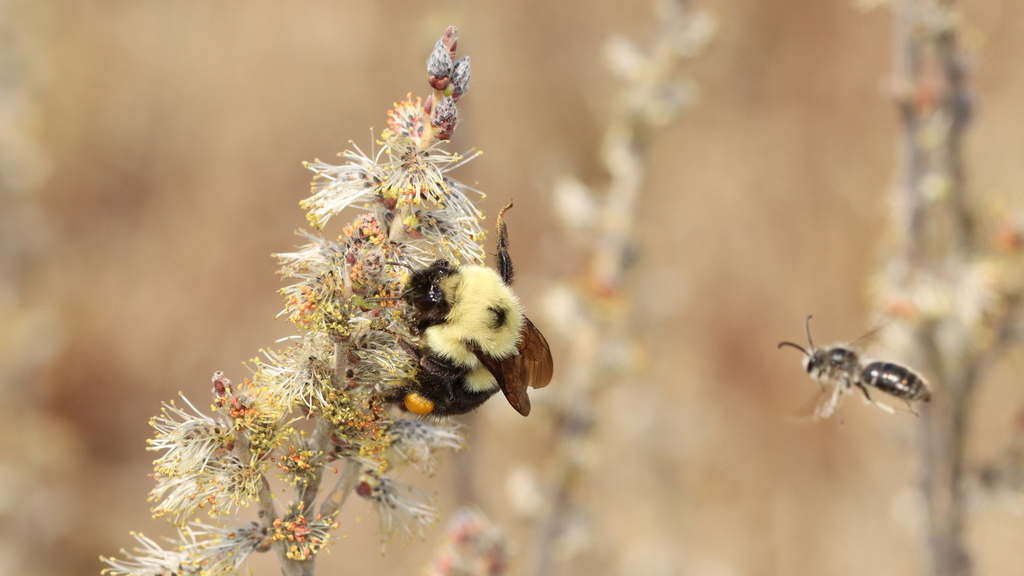
It is a small to medium shrub with narrow leaves that are dull green above and pale, grayish and hairy beneath. In early spring, before the leaves open, its branches are covered with fuzzy catkins, the classic “pussy willow” look, which turn golden with pollen on male plants and are among the first flowers of the year for bees.
Prairie willow is a tough, drought-tolerant native shrub for prairie and savanna restorations, dry banks, pollinator plantings and naturalistic gardens. A dwarf form, often called dwarf prairie willow (var. tristis), grows only 1 to 3 feet tall. This guide covers how to identify it, where it grows, how to grow it and its value to wildlife.
Identification
Prairie willow is a shrubby willow of dry ground with narrow leaves that are pale and hairy beneath, fuzzy early-spring catkins that open before the leaves, and hairy seed capsules.
Growth Form
It is a multi-stemmed, often suckering shrub, usually 3 to 8 feet tall (occasionally to 10 feet) in the typical variety, and only 1 to 3 feet in the dwarf var. tristis. The twigs are brown to yellowish and often finely hairy, and older stems have gray bark. It can form small clonal patches.
Leaves
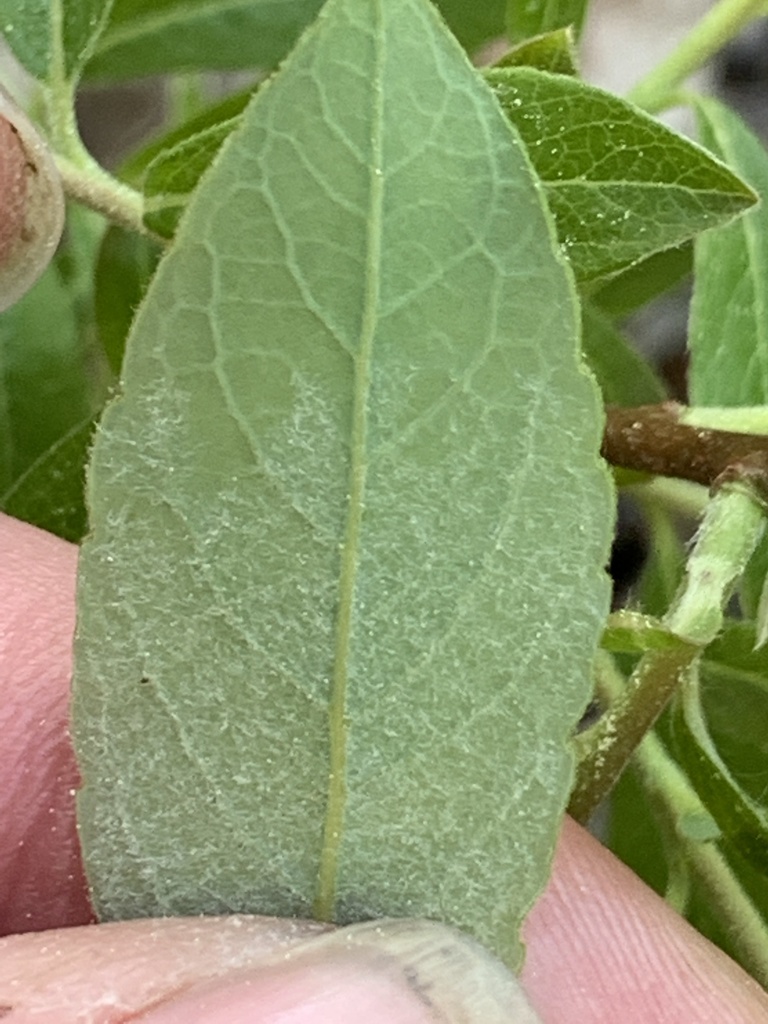
The leaves are alternate, narrowly oblong to lance-shaped or widest above the middle, about 1½ to 4 inches long, with smooth or slightly wavy edges that are often rolled under. They are dull, dark green and somewhat wrinkled above, and pale, whitish and covered with soft gray hairs beneath. The leaves of the dwarf variety are smaller and crowded.
Flowers
Like all willows, it has separate male and female plants. From about March to May, before or as the leaves open, the stems bear many stalkless, oval catkins about ½ to 1½ inches long, covered in silky gray hairs. Male catkins turn bright yellow as the stamens shed pollen, with red-tipped anthers before they open; female catkins are greenish.
Fruit & Look-alikes
Female catkins mature into clusters of small, hairy, beaked capsules that split in late spring to release tiny seeds with cottony tufts. Pussy Willow is a larger shrub of wet ground with broader leaves that are hairless and whitish beneath. Silky Willow grows along streams and has leaves with shiny, silky hairs beneath. Bebb Willow has long-stalked capsules and grows in moister places.
Quick Facts
| Scientific Name | Salix humilis Marshall |
| Family | Salicaceae (willow family) |
| Plant Type | Deciduous shrub |
| Mature Height | 3–8 ft (dwarf var. 1–3 ft) |
| Mature Spread | 3–6 ft; can sucker into patches |
| Growth Rate | Moderate to fast |
| Sun Exposure | Full sun to partial shade |
| Water Needs | Low to moderate; drought tolerant |
| Soil Type | Dry to moist sandy, gravelly, rocky or loamy soil |
| Soil pH | About 4.5–7.5 |
| Bloom Time | March–May, before the leaves |
| Flower Color | Silvery-gray catkins turning yellow (male) |
| Fall Color | Yellowish |
| Fruit | Hairy capsule with cottony seeds |
| Deer Resistant | Low; browsed by deer and rabbits |
| USDA Hardiness Zones | 3–8 |
Native Range
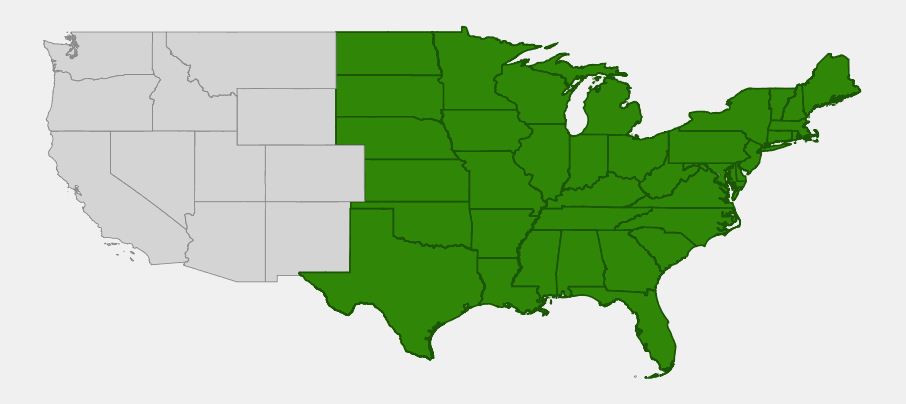
Prairie willow has one of the broadest ranges of any eastern willow. In Canada it grows from Newfoundland and Labrador, Nova Scotia and Quebec west through Ontario to Manitoba. In the United States, USDA PLANTS lists it from Maine to Minnesota and the Dakotas, south to Kansas, Oklahoma and eastern Texas, and east to Georgia and northern Florida.
It is most common in the Great Lakes region, the Northeast and the upper Midwest prairie and savanna country, and becomes scattered toward the south. The dwarf variety, var. tristis, is mostly found in sandy barrens and dry, rocky places in the East and Midwest. In Texas it is limited to the eastern part of the state.
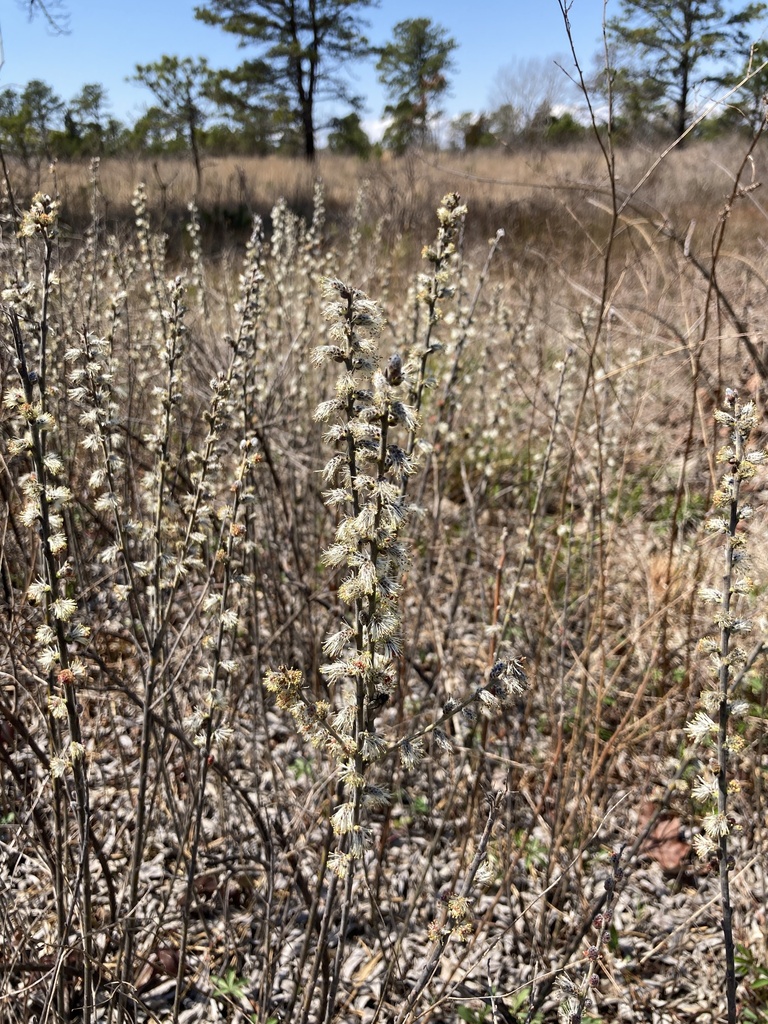
It grows in dry to moderately moist, open places: upland prairies and oak savannas, sand plains and pine barrens, rocky ridges and bluffs, open oak and pine woods, heathlands, old fields and roadsides, and sometimes also at the edges of wetlands. It is fire-adapted and resprouts readily after burning.
📋 Regional plant lists featuring Prairie Willow: North & South Florida · Alabama, Georgia & Mississippi · North & South Carolina · Maryland, Virginia & West Virginia · Kentucky & Tennessee · Arkansas, Louisiana, Eastern Oklahoma & Eastern Texas · Illinois, Iowa & Missouri · Ohio & Indiana · Nebraska, Kansas & Eastern Colorado · North Dakota, South Dakota & Western Minnesota · Michigan, Wisconsin & Eastern Minnesota · New York, Pennsylvania & Northern New Jersey · Delaware, Southern New Jersey & Long Island · Connecticut, Massachusetts & Rhode Island · New Hampshire, Maine & Vermont
Growing & Care Guide
Prairie willow is available from some native plant nurseries, especially in the Midwest and Northeast, and is used in prairie and savanna restoration. It is one of the few willows suited to dry, sunny sites, and it is easy to grow, tolerant of poor soils and very valuable to early bees.
Light
Full sun is best for dense growth and heavy flowering. It tolerates partial shade at woodland edges but becomes leggy and flowers less in deep shade.
Soil & Water
It grows in sandy, gravelly, rocky or loamy soils, from dry to moist, and tolerates acidic, nutrient-poor ground. Water new plantings through the first summer; once established, it is drought tolerant and needs no supplemental water in most of its range.
Planting Tips
Plant in spring or fall, 3 to 5 feet apart, on a dry bank, prairie edge, savanna planting or informal hedge. Plant both male and female shrubs if you want seed, but male plants give the showiest golden catkins and the most pollen for bees.
Pruning & Maintenance
It needs little care. To renew old, leggy shrubs, cut a few of the oldest stems to the ground in late winter after flowering, or coppice the whole plant every few years; it resprouts vigorously. In prairie plantings it tolerates periodic burning. Willow leaf beetles and galls are common but rarely harm it.
Propagation
Willows root easily from cuttings. Take dormant hardwood cuttings 8 to 12 inches long in late winter and stick them in moist soil, or root softwood cuttings in early summer. Seed is viable only for a few days and must be sown immediately on moist soil without stratification.
Landscape Uses
- Prairie and savanna restoration: native shrub layer for dry uplands
- Pollinator gardens: very early pollen and nectar for bees
- Dry banks and erosion control: drought-tolerant, suckering shrub for slopes
- Wildlife hedgerows: cover and food for birds and caterpillars
Wildlife & Ecological Value
Prairie willow is a keystone early-spring plant for pollinators and a host for many caterpillars.
For Pollinators
Its catkins open in early spring, when few other flowers are available, and are visited heavily by queen bumble bees, mining bees, sweat bees and other native bees, as well as flies and early butterflies. Several mining bees (Andrena) specialize on willow pollen. Willows are host plants for the caterpillars of the viceroy, mourning cloak, red-spotted purple and many moths.
For Birds
Warblers, vireos and other songbirds feed on the many insects it supports, and grouse, quail and other birds eat its buds and catkins. Its thickets provide nesting and escape cover in open habitats.
For Mammals
Deer, rabbits and hares browse the twigs and leaves, especially in winter, and beavers and small mammals use it where it grows near water.
Ecosystem Role
It is a characteristic shrub of fire-maintained prairies, savannas and barrens, where it resprouts after burning. Its spreading roots help stabilize sandy and rocky soils, and its early flowers sustain pollinator populations at the start of the season.
Cultural & Historical Uses
Humphry Marshall, a Pennsylvania botanist and cousin of John Bartram, named Salix humilis in 1785 in his Arbustum Americanum, one of the first books on American trees and shrubs. The name humilis means “low,” for its shrubby growth.
The dwarf prairie willow, var. tristis, has sometimes been treated as a separate species, Salix tristis. The name tristis means “sad,” perhaps for its gray, drooping leaves.
Willows were widely used by Indigenous peoples. The bark of many willows contains salicin, a natural relative of aspirin, and was used to treat pain and fever, and the flexible stems were used for baskets and frames.
Frequently Asked Questions
Where does prairie willow grow?
Across most of eastern and central North America, from Maine and Quebec to the Dakotas, Texas and Florida, on dry prairies, oak savannas, sandy barrens, rocky ridges and open woods.
Does prairie willow need wet soil?
No. Unlike most willows, it grows on dry to moderately moist upland soils and is quite drought tolerant once established.
How do I tell prairie willow from pussy willow?
Prairie willow is smaller, grows on dry ground and has narrow leaves that are hairy and grayish beneath. Pussy willow grows in wet places and has broader leaves that are smooth and whitish beneath.
Is prairie willow good for pollinators?
Yes. Its early-spring catkins are one of the first big pollen and nectar sources for bumble bee queens and native bees, and willows host many butterfly and moth caterpillars.
How tall does prairie willow get?
Usually 3 to 8 feet, occasionally to 10 feet. The dwarf variety (var. tristis) stays 1 to 3 feet tall.

Looking for a nursery that carries Prairie Willow?
Browse our native plant nursery directory: Alabama & Arkansas · Connecticut, Delaware, Florida & Georgia · Illinois, Indiana, Iowa & Kansas · Kentucky, Louisiana, Maine, Maryland, Massachusetts, Michigan, Minnesota, Mississippi & Missouri · Nebraska, New Hampshire, New Jersey, New York, North Carolina, North Dakota, Ohio & Oklahoma · Pennsylvania, Rhode Island, South Carolina, South Dakota, Tennessee, Texas, Vermont & Virginia · West Virginia & Wisconsin

