
Lanceleaf Arrowhead (Sagittaria lancifolia)
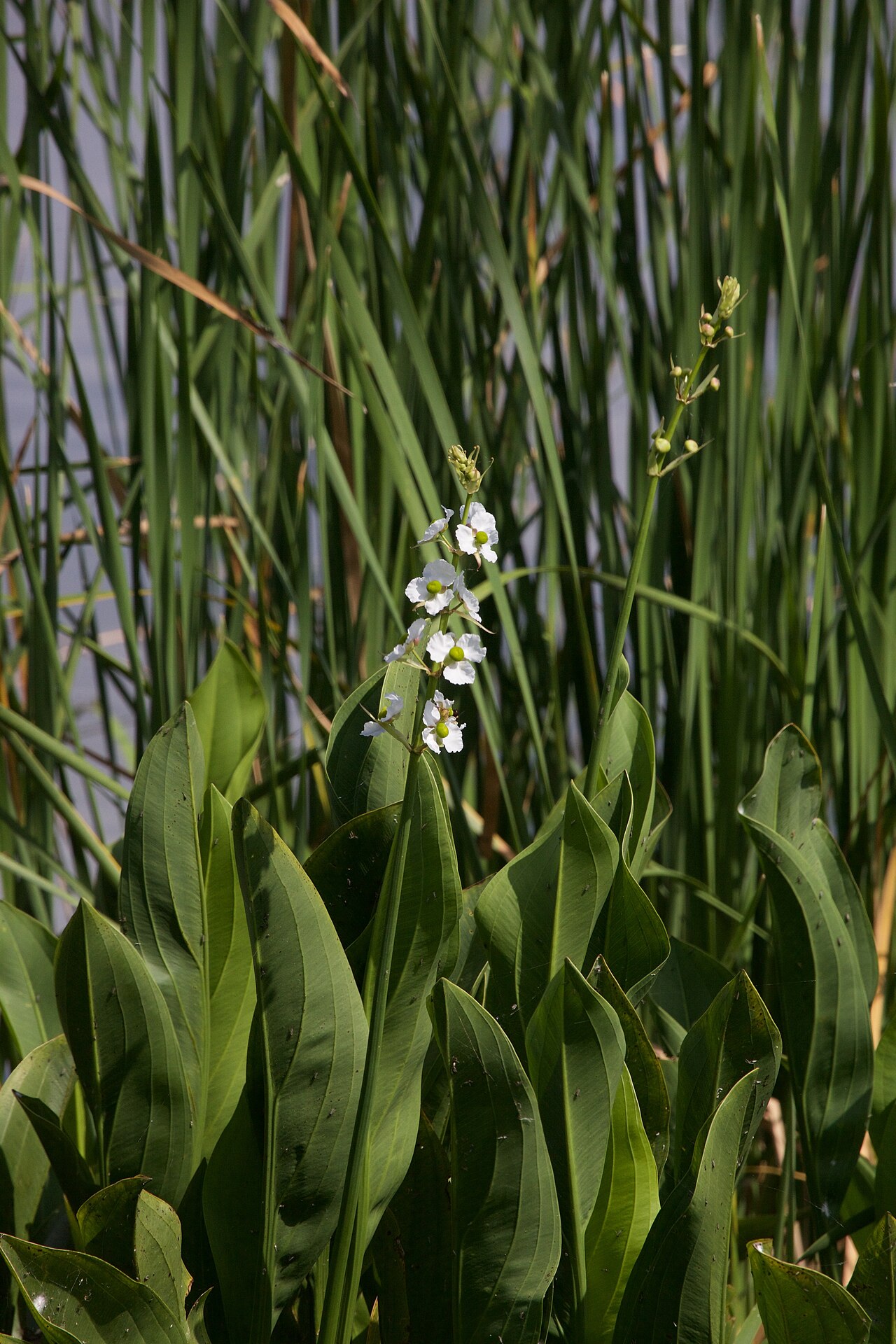
Sagittaria lancifolia, known as Lanceleaf Arrowhead or lance-leaved arrowhead, and also called bulltongue arrowhead (the USDA PLANTS name) and, in Florida, duck potato, is a native emergent wetland plant of the southeastern United States, Puerto Rico and tropical America. It grows in shallow water and wet soil, sending up clumps of thick, upright, lance-shaped leaves 2 to 4 feet tall. From spring into fall, tall stalks rise above the leaves with whorls of white, three-petaled flowers about 1 to 1½ inches across.
Unlike the familiar broadleaf arrowhead or duck potato (Sagittaria latifolia), lanceleaf arrowhead has leaves without the arrow-shaped lobes that give the genus its name. Its blades are smooth, leathery and lance- to elliptic-shaped, tapering at both ends, and they stand stiffly upright on long stalks. It belongs to the water-plantain family (Alismataceae).
Lanceleaf arrowhead is a common plant of freshwater marshes, swamps, ditches, pond and lake edges, and the fresh to slightly brackish tidal marshes of the Atlantic and Gulf coasts. In Louisiana and parts of the Gulf Coast it can dominate whole marshes. It is one of the most useful native plants for water gardens, stormwater ponds and shoreline plantings in warm climates, with clean white flowers, easy care and real value for wildlife.
Identification
Lanceleaf arrowhead is easy to identify in flower by its white, three-petaled blossoms in whorls on a tall stalk. Out of flower, its upright, lance-shaped leaves without basal lobes distinguish it from most other arrowheads.
Leaves
The leaves grow in a basal clump from a short, thick rhizome. Emergent leaves have long, spongy stalks and smooth, thick blades 4 to 16 inches long and 1 to 5 inches wide. The blades are lance-shaped to elliptic, pointed at the tip and tapering at the base, with prominent parallel veins that curve toward the tip. Plants growing in deeper water may produce narrow, strap-like or bladeless underwater leaves (phyllodes).
Flowers
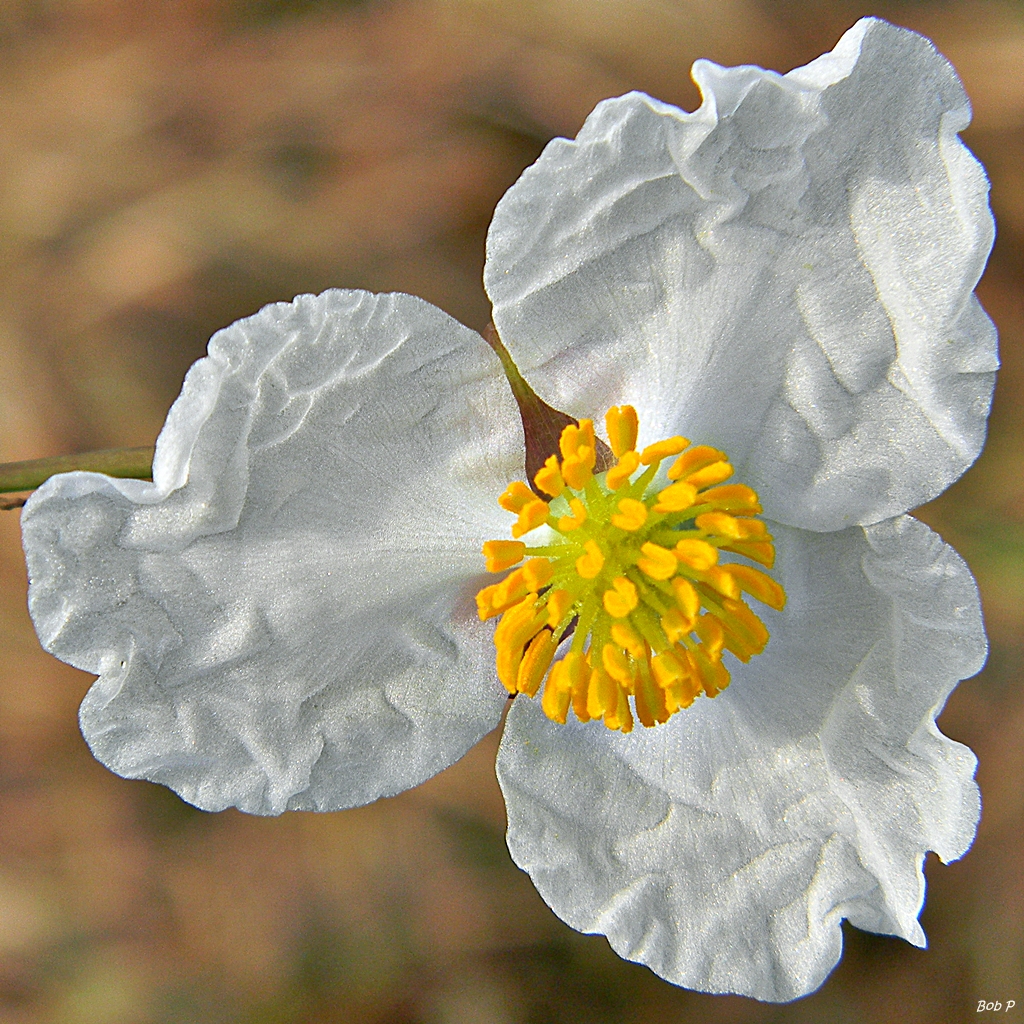
The flowering stalk can reach 3 to 6 feet tall and often stands above the leaves. Flowers are arranged in whorls of three along the upper stalk. Each has three green sepals and three crinkled, rounded white petals, giving a flower 1 to 1½ inches wide. The upper flowers are male, with a ring of many yellow stamens, and the lower flowers are female, with a round green cluster of pistils in the center. In southern Florida and Puerto Rico it can bloom almost year-round, and farther north mostly from late spring through fall.
Fruit & Seeds
After flowering, the female flowers develop into round heads about ½ inch across, packed with small, flattened, winged achenes. The seeds float and are spread by water and by waterfowl.
Varieties
Two subspecies are generally recognized. Subspecies lancifolia grows mainly in Florida, the Caribbean and tropical America. Subspecies media grows along the northern Gulf Coast and the Atlantic Coast north to Delaware and Maryland, often in fresh to slightly brackish tidal marshes.
Similar Species
Broadleaf arrowhead (Sagittaria latifolia) has arrow-shaped leaves with two long basal lobes. Grassy arrowhead (S. graminea) and other narrow-leaved species are smaller with narrower leaves. Pickerelweed (Pontederia cordata) has heart-shaped leaves and spikes of violet-blue flowers.
Quick Facts
| Scientific Name | Sagittaria lancifolia |
| Family | Alismataceae (water-plantain family) |
| Plant Type | Emergent aquatic perennial |
| Mature Height | 2–4 ft leaves; flower stalks to 6 ft |
| Mature Spread | 2–3 ft; spreads by rhizomes to form colonies |
| Growth Rate | Fast |
| Sun Exposure | Full sun to partial shade |
| Water Needs | Very high; wet soil to standing water up to about 1 ft deep |
| Soil Type | Mucky, sandy or loamy wetland soils; fresh to slightly brackish water |
| Soil pH | About 5.5–7.5 |
| Bloom Time | Spring–fall; nearly year-round in South Florida and Puerto Rico |
| Flower Color | White with yellow centers |
| Fall Color | None; leaves persist in mild winters |
| Fruit | Round heads of small, flattened, winged achenes |
| Deer Resistant | Moderate; browsed by deer and eaten by nutria and muskrats |
| USDA Hardiness Zones | 7–11 |
Native Range
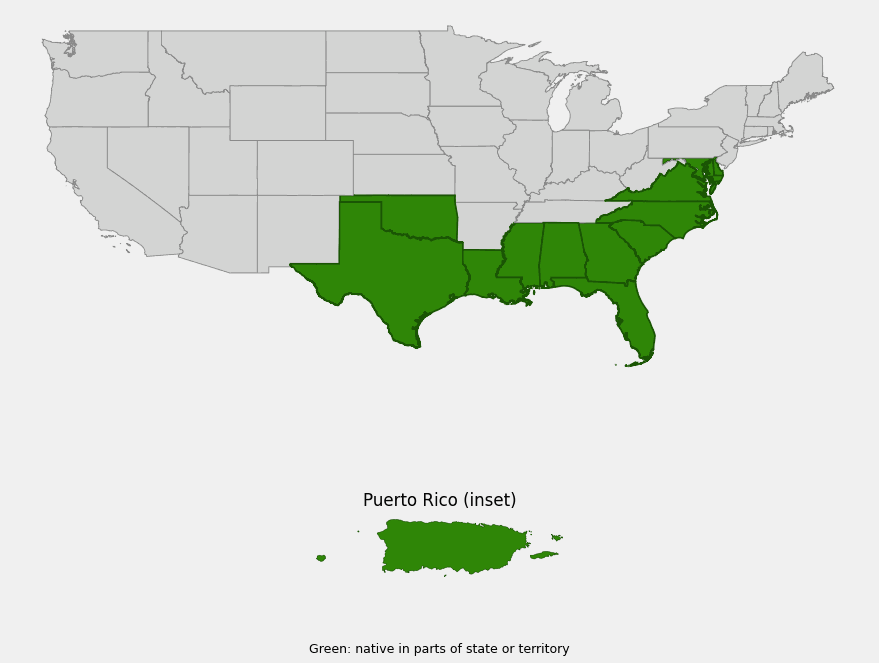
Lanceleaf arrowhead is a plant of the warm Atlantic and Gulf coastal regions. USDA PLANTS records it as native in Delaware, Maryland, Virginia, North Carolina, South Carolina, Georgia, Florida, Alabama, Mississippi, Louisiana, Texas and Oklahoma, and in Puerto Rico. Beyond the United States it ranges through the Caribbean, Mexico and Central America into South America.
It is most abundant in Florida and along the Gulf Coast. In Florida it grows statewide, from the Panhandle to the Everglades. In coastal Louisiana and Texas it is a major component of fresh and intermediate marshes. On the Atlantic Coast it extends north mostly on the Coastal Plain, in tidal freshwater marshes and swamps as far as Delaware and Maryland. In Texas it grows mainly in the eastern part of the state and along the upper coast, and the Oklahoma record is an outlying one.
Typical habitats include freshwater and slightly brackish marshes, the edges of lakes, ponds and slow streams, cypress and hardwood swamps, wet prairies, ditches and canals. It tolerates a wide range of water depths, from saturated soil to about a foot of standing water.
📋 Regional plant lists featuring Lanceleaf Arrowhead: Maryland, Virginia & West Virginia · Delaware, Southern New Jersey & Long Island · Alabama, Georgia & Mississippi · North & South Florida · Puerto Rico · North & South Carolina · Arkansas, Louisiana, Eastern Oklahoma & Eastern Texas
Growing & Care Guide
Lanceleaf arrowhead is one of the easiest native aquatic plants to grow in warm climates. It establishes quickly in shallow water or wet soil, flowers over a long season, and needs very little care. It is widely used in water gardens, stormwater ponds and lake shoreline plantings in Florida and along the Gulf Coast.
Light
Full sun gives the best flowering, but it tolerates partial shade, such as the edges of swamps and shaded ponds.
Soil & Water
Plant it in wet, mucky or sandy soil, or in shallow water up to about 12 inches deep. It does best in 2 to 6 inches of water. It tolerates fluctuating water levels and short dry periods, but the soil should not dry out for long. It grows in fresh water and tolerates slightly brackish conditions.
Planting Tips
Plant bare-root divisions or potted plants in spring or summer, about 2 feet apart, with the crown at or just below the soil surface. In ponds, it can be grown in submerged containers filled with heavy loam or clay soil, which keeps it from spreading too far. For stormwater ponds and shoreline restoration, plant it in the shallow fringe (littoral zone) along with pickerelweed and other natives.
Pruning & Maintenance
Remove dead leaves and spent flower stalks as needed for a tidy look. In small ponds, divide and thin the clumps every few years to keep them from crowding out other plants. It needs no fertilizer in natural soils. In pots, a slow-release aquatic plant fertilizer tablet in spring is enough.
Propagation
The easiest method is to divide clumps or rhizomes in spring. It can also be grown from seed sown on wet, muddy soil, kept constantly moist and warm. Seedlings grow quickly in summer.
Landscape Uses
- Water gardens and ponds: white flowers over a long season, easy to grow in containers
- Stormwater ponds and swales: widely planted in littoral zones to filter runoff and stabilize shorelines
- Wetland and marsh restoration: fresh and slightly brackish marshes along the Atlantic and Gulf coasts
- Lake and pond shorelines: reduces erosion and provides habitat at the water’s edge
- Wildlife ponds: cover and food for waterfowl, wading birds and pollinators
Wildlife & Ecological Value
Lanceleaf arrowhead is an important plant in southeastern wetlands, providing food, cover and nectar for many animals.
For Pollinators
The open, white flowers offer nectar and abundant pollen. They are visited by many insects, especially small native bees such as metallic green and blue sweat bees (Halictidae), as well as flower flies, wasps and butterflies.
For Birds
Ducks and other waterfowl eat the seeds, and the dense stands provide cover and foraging habitat for herons, egrets, rails, common gallinules and other marsh birds. Red-winged blackbirds and other marsh songbirds perch and forage among the leaves.
For Mammals
Muskrats, nutria and white-tailed deer eat the leaves and rhizomes. In Gulf Coast marshes, heavy feeding by invasive nutria can damage stands.
Ecosystem Role
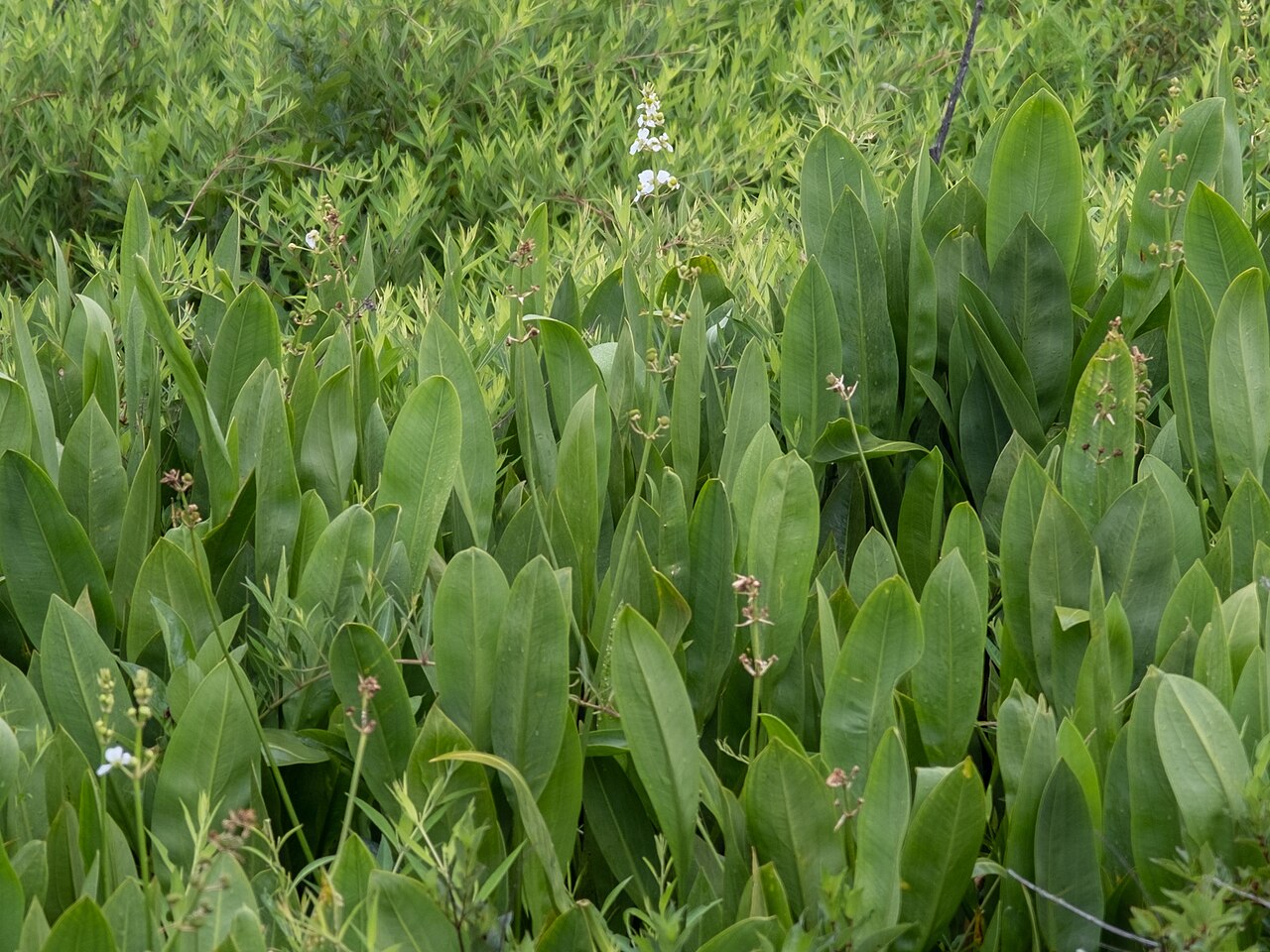
As a dominant plant in many freshwater and intermediate marshes, lanceleaf arrowhead helps build marsh soil, slow water flow, trap sediment and take up nutrients. Its dense stands provide nursery habitat for fish, frogs and aquatic invertebrates in shallow water.
Cultural & Historical Uses
Carl Linnaeus described Sagittaria lancifolia in 1759 from specimens from the West Indies. The genus name comes from the Latin sagitta, arrow, after the arrow-shaped leaves of many species. Lanceleaf arrowhead is one of the exceptions, as its species name, meaning “lance-leaved,” points out.
In Louisiana, where it is widely known as bulltongue, lanceleaf arrowhead is one of the dominant plants of many fresh and intermediate coastal marshes. These marshes are an important part of the Mississippi River delta and coastal wetlands, which provide fisheries, flood protection and wildlife habitat.
In Florida, lanceleaf arrowhead is one of the most frequently planted native aquatic plants. It is widely grown by aquatic nurseries and used in restoration, stormwater treatment and lakefront landscaping, often under the local name duck potato, which can cause confusion with Sagittaria latifolia.
Frequently Asked Questions
How is lanceleaf arrowhead different from duck potato?
Both are arrowheads. Duck potato or broadleaf arrowhead (Sagittaria latifolia) has classic arrow-shaped leaves with two long basal lobes and ranges across most of North America. Lanceleaf arrowhead has lance-shaped leaves without lobes and grows mainly in the Southeast. In Florida, people often call lanceleaf arrowhead “duck potato” as well.
How deep can lanceleaf arrowhead grow?
It grows best in wet soil or water up to about 6 inches deep and tolerates up to about 12 inches. In deeper water it may produce narrow underwater leaves and flower less.
Does lanceleaf arrowhead spread?
Yes, it spreads by rhizomes and by seed and can form large colonies in marshes and shallow ponds. In small water gardens, grow it in containers to control spread.
Is lanceleaf arrowhead good for wildlife?
Yes. Its flowers feed native bees and other pollinators, waterfowl eat the seeds, and its dense stands shelter marsh birds, fish and frogs.
Can I grow lanceleaf arrowhead in a cold climate?
It is hardy mainly in USDA zones 7 to 11. In colder areas, grow it in a container that can be moved to a frost-free location or sunk below the ice line, or choose broadleaf arrowhead, which is hardier.

Looking for a nursery that carries Lanceleaf Arrowhead?
Browse our native plant nursery directory: Alabama · Delaware, Florida & Georgia · Louisiana, Maryland & Mississippi · North Carolina & Oklahoma · South Carolina, Texas & Virginia