
Licorice Bedstraw (Galium circaezans)
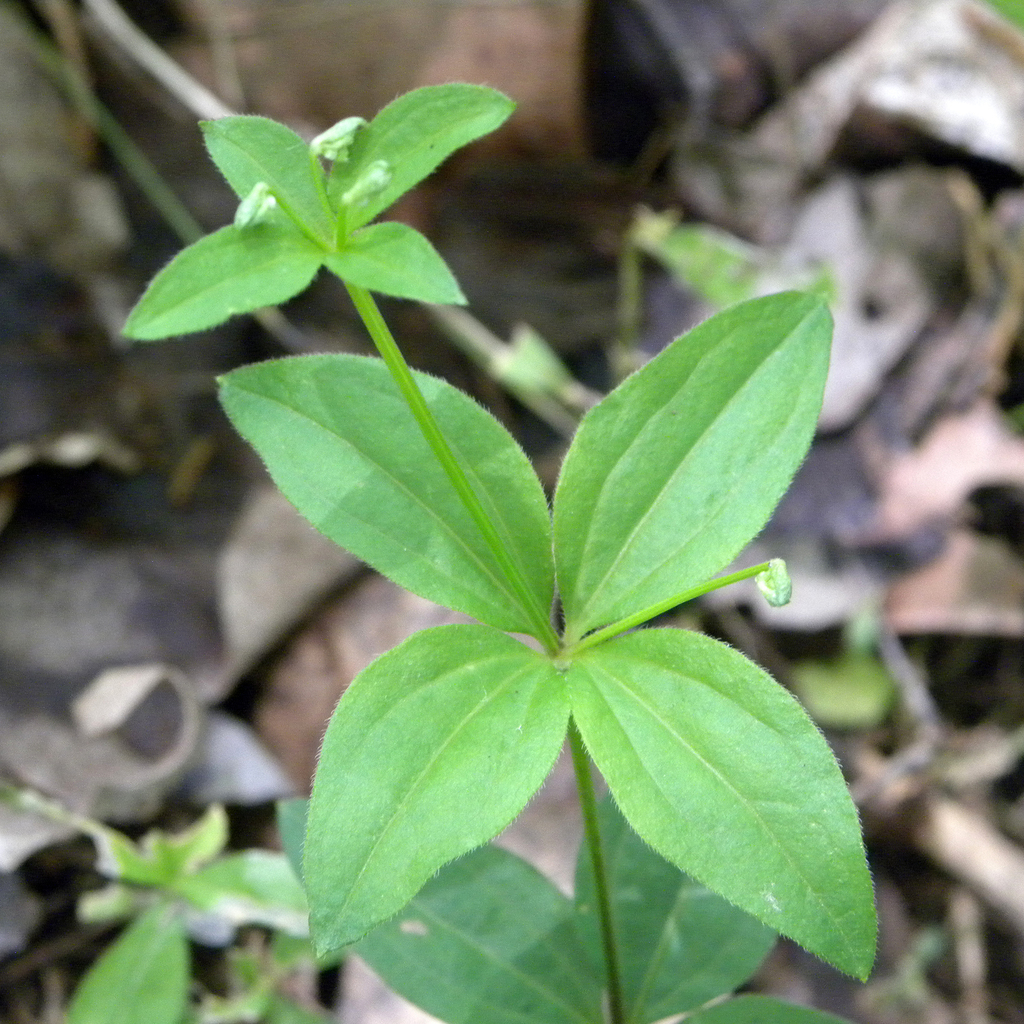
Galium circaezans, known as Licorice Bedstraw or wild licorice, is a native perennial wildflower of dry to moist deciduous woods throughout the eastern United States and southern Ontario and Quebec. It belongs to the madder or coffee family (Rubiaceae), along with the other bedstraws and cleavers. It is unrelated to the true licorice and to the western legume called wild licorice (Glycyrrhiza lepidota).
Plants are low and modest, usually 8 to 20 inches tall, with upright stems carrying whorls of four broad, oval leaves. From late spring to midsummer, a few slender, widely forking branches hold tiny greenish-white flowers, which are followed by small, round fruits covered in hooked bristles that cling to fur and clothing. The name comes from the leaves, which are said to taste faintly sweet, like licorice, when chewed.
Licorice bedstraw is one of the most common bedstraws of eastern woodlands, yet many people never notice it. It is an easy, well-behaved native for shady woodland gardens, where it forms a soft, low groundcover among spring wildflowers and ferns and is not weedy like its cousin cleavers.
Identification
Look for licorice bedstraw in shady deciduous woods from May to August. The whorls of four broad, three-veined leaves, and the few widely spreading flower branches with tiny greenish flowers that droop in fruit, identify it.
Growth Habit
Licorice bedstraw is a low perennial, usually 8 to 20 inches tall, with one to several upright or leaning, square stems from a slender rhizome. Stems are smooth to finely hairy and lack the hooked prickles of cleavers. Plants often grow scattered across the forest floor or in loose patches.
Leaves
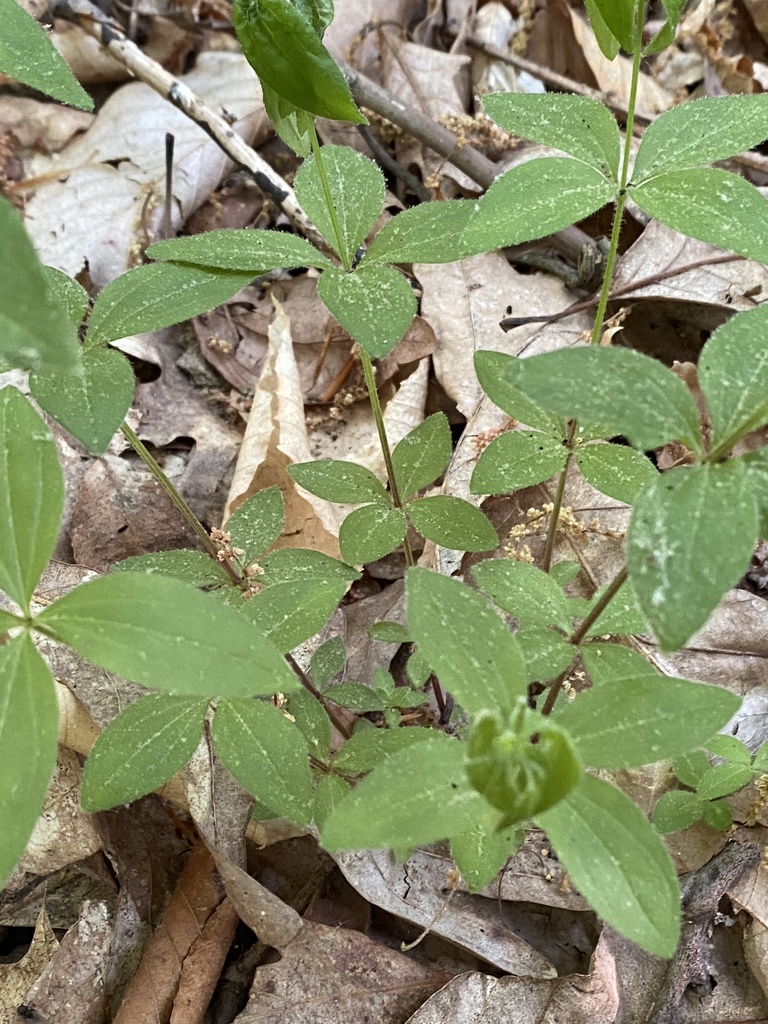
The leaves grow in whorls of four at each node. They are oval to elliptic, about 3/4 to 2 inches long and about half as wide, with blunt or rounded tips, three main veins, and fine hairs, especially along the edges and the veins underneath. They are among the broadest leaves of any eastern bedstraw.
Flowers
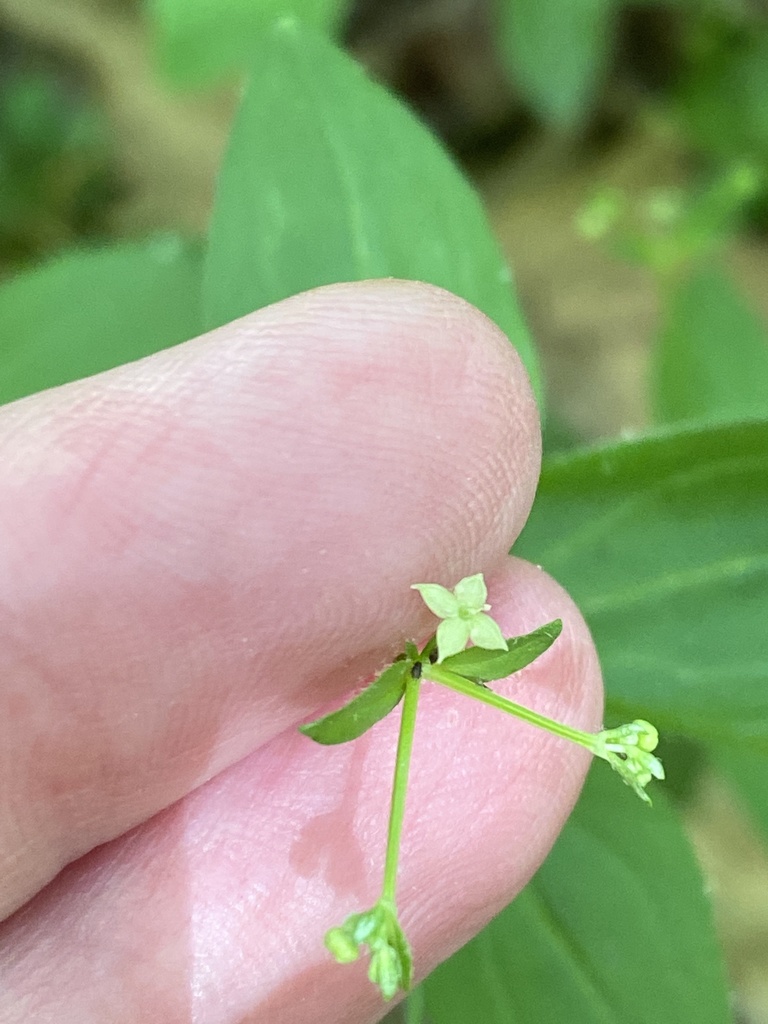
From about May to July, the top of the stem divides into one to three pairs of long, slender, widely spreading branches. Each branch carries a few tiny flowers spaced along it, each about 1/8 inch across, with four pointed lobes. The flowers are greenish white to pale yellowish green. Flower stalks are very short at first and bend downward as the fruit forms.
Fruit & Seeds
Each flower produces a small, round, two-lobed fruit about 1/8 inch across, covered with hooked bristles. The fruits droop on their bent stalks and catch on fur, feathers and clothing, which is how the seeds travel.
Look-alikes
Lance-leaved wild licorice (Galium lanceolatum) of the North is similar but has narrower, tapering leaves and purplish to maroon flowers. Northern bedstraw (Galium boreale) has narrow leaves and dense clusters of white flowers. Sweet-scented bedstraw (Galium triflorum) has leaves in whorls of six and flowers in threes, and smells of vanilla when dried. Cleavers (Galium aparine) has whorls of six to eight narrow leaves and prickly, sprawling stems.
Quick Facts
| Scientific Name | Galium circaezans |
| Family | Rubiaceae (madder or coffee family) |
| Plant Type | Herbaceous perennial wildflower |
| Mature Height | 8–20 in (rarely to 2 ft) |
| Mature Spread | 6–12 in; forms loose patches |
| Growth Rate | Moderate |
| Sun Exposure | Part shade to full shade |
| Water Needs | Low to medium; dry to average soil |
| Soil Type | Loam, sandy loam or rocky woodland soil |
| Soil pH | About 5.0–7.5 (acidic to neutral) |
| Bloom Time | May–July |
| Flower Color | Greenish white to pale yellowish green |
| Fall Color | None notable |
| Fruit | Small round bur covered in hooked bristles |
| Deer Resistant | Not well documented |
| USDA Hardiness Zones | 3–9 |
Native Range
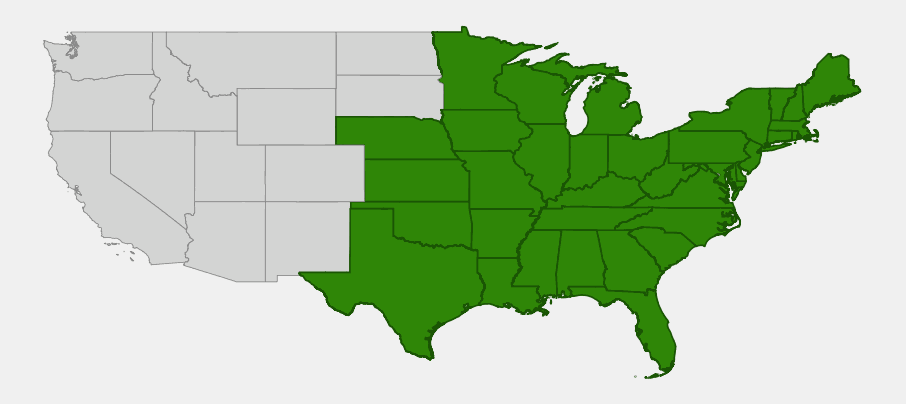
Licorice bedstraw is native to eastern North America. USDA PLANTS lists it as native in the lower 48 states and Canada and records it from 35 states and the District of Columbia, from Maine, New Hampshire and Vermont south to Florida, and west through Michigan, Wisconsin, Minnesota, Iowa, Nebraska and Kansas to Oklahoma, Texas and Louisiana. In Canada it grows in southern Ontario and southern Quebec, where NatureServe ranks it as vulnerable.
It is common through most of its range, especially in the Appalachians, the Ohio Valley and the Piedmont. In Florida it is limited to the northern part of the state, mainly the Panhandle. At the western edge of its range it grows in wooded eastern Nebraska, Kansas and Oklahoma, and in Texas it reaches the eastern woodlands and the Cross Timbers of north-central Texas, not the dry south and west. A southern variety, var. hypomalacum, has softer, hairier leaves.
Typical habitats are dry to moist deciduous and mixed woods, wooded slopes and ravines, rocky hillsides, woodland edges and trails. It grows in light to deep shade and tolerates both rich loam and thinner, rocky soils, as long as there is a layer of leaf litter.
📋 Regional plant lists featuring Licorice Bedstraw: New York, Pennsylvania & Northern New Jersey · Ohio & Indiana · Michigan, Wisconsin & Eastern Minnesota · Kentucky & Tennessee · Nebraska, Kansas & Eastern Colorado · Connecticut, Massachusetts & Rhode Island · New Hampshire, Maine & Vermont · Maryland, Virginia & West Virginia · Delaware, Southern New Jersey & Long Island · Illinois, Iowa & Missouri · Alabama, Georgia & Mississippi · North & South Florida · North & South Carolina · Arkansas, Louisiana, Eastern Oklahoma & Eastern Texas
Growing & Care Guide
Licorice bedstraw is an easy, low-maintenance native for shady gardens, though it is rarely sold. It often arrives on its own in wooded yards. A few native nurseries and seed suppliers offer it; buy from them rather than digging wild plants.
Light
Part shade to full shade under deciduous trees suits it best. It tolerates some morning sun but not hot, open sites.
Soil & Water
It grows in average woodland soil, from rich loam to thin, rocky soil, slightly acidic to neutral. Once established it tolerates dry shade well, but it looks best with some moisture in spring. Leave fallen leaves in place as natural mulch.
Planting Tips
Plant in spring or fall about 12 inches apart, or sow seed directly in fall. Use it as a soft filler between spring ephemerals, ferns and woodland sedges, or along shady paths. Because it is small and fine-textured, plant it in groups so it reads as a groundcover.
Pruning & Maintenance
No pruning is needed. Let the stems die back naturally in fall. It is not aggressive and spreads slowly by rhizomes and seed. The bristly fruits can stick to pets and clothing in summer, so keep it a little away from busy paths if that is a nuisance.
Propagation
Sow ripe seed outdoors in fall, or give it 60 days of cold, moist stratification before spring sowing. Established patches can be divided in early spring.
Landscape Uses
- Woodland gardens: a delicate groundcover among spring wildflowers and ferns
- Dry shade: tolerates dry, rocky soil under trees once established
- Naturalized areas: fills gaps in the forest floor with fine texture
- Wildlife gardens: food for bedstraw hawk moth and other insects
- Woodland restoration: herb layer in eastern deciduous forests
Wildlife & Ecological Value
Licorice bedstraw is a small plant, but it plays a role in woodland food webs, especially for insects that feed on bedstraws.
For Pollinators
The tiny, open flowers are visited by small bees, flies and other small insects. Bedstraws are host plants for the caterpillars of several moths, including the bedstraw hawk moth and some carpet moths.
For Birds
Ground-foraging birds may eat some of the seeds, and the insects that feed on bedstraws provide food for woodland birds.
For Mammals
The hooked fruits stick to the fur of deer, raccoons, foxes and other animals, which carry the seeds to new spots. Deer browse it lightly.
Ecosystem Role
As a widespread herb of eastern forests, licorice bedstraw adds to the diversity of the forest floor and helps hold leaf litter and soil on slopes. Its burs depend on passing animals for dispersal, so it often follows animal trails and paths.
Cultural & Historical Uses
The genus name Galium comes from the Greek word for milk, because a European bedstraw was once used to curdle milk for cheese. The species name circaezans means resembling Circaea, the enchanter’s nightshade, which has similar small flowers and hooked, bristly fruits. Bedstraws got their common name because some dried species were used to stuff mattresses.
The common name licorice bedstraw, and the older name wild licorice, come from the faintly sweet, licorice-like taste reported for the leaves. Traditional uses of the plant as a tea or remedy for coughs and other ailments are reported in older herbal literature, but they are not proven, and the plant should not be used as a home remedy.
Licorice bedstraw is a good example of the many small, overlooked plants that make up the herb layer of eastern woods. A closer look reveals neat whorls of leaves, delicate forking flower stalks and burs designed to hitch a ride.
Frequently Asked Questions
Why is it called licorice bedstraw?
The leaves are said to taste faintly sweet, like licorice, when chewed. It is not related to the true licorice plant.
How do I recognize licorice bedstraw?
Look for whorls of four broad, oval, three-veined leaves on a low stem, and a few long, widely forking branches with tiny greenish-white flowers and bristly, drooping fruits.
Is licorice bedstraw weedy like cleavers?
No. It is a well-behaved native perennial that spreads slowly, unlike the sprawling, prickly annual cleavers.
Does licorice bedstraw grow in dry shade?
Yes. Once established, it tolerates dry, rocky woodland soil under trees, though it looks best with some spring moisture.
Why does it stick to my clothes?
The small round fruits are covered with hooked bristles that cling to fur and fabric, which is how the plant spreads its seeds.

Looking for a nursery that carries Licorice Bedstraw?
Browse our native plant nursery directory: Alabama & Arkansas · Connecticut, Delaware, Florida & Georgia · Illinois, Indiana, Iowa & Kansas · Kentucky, Louisiana, Maine, Maryland, Massachusetts, Michigan, Minnesota, Mississippi & Missouri · Nebraska, New Hampshire, New Jersey, New York, North Carolina, Ohio & Oklahoma · Pennsylvania, Rhode Island, South Carolina, Tennessee, Texas, Vermont & Virginia · West Virginia & Wisconsin