
Livelong Saxifrage (Saxifraga paniculata)
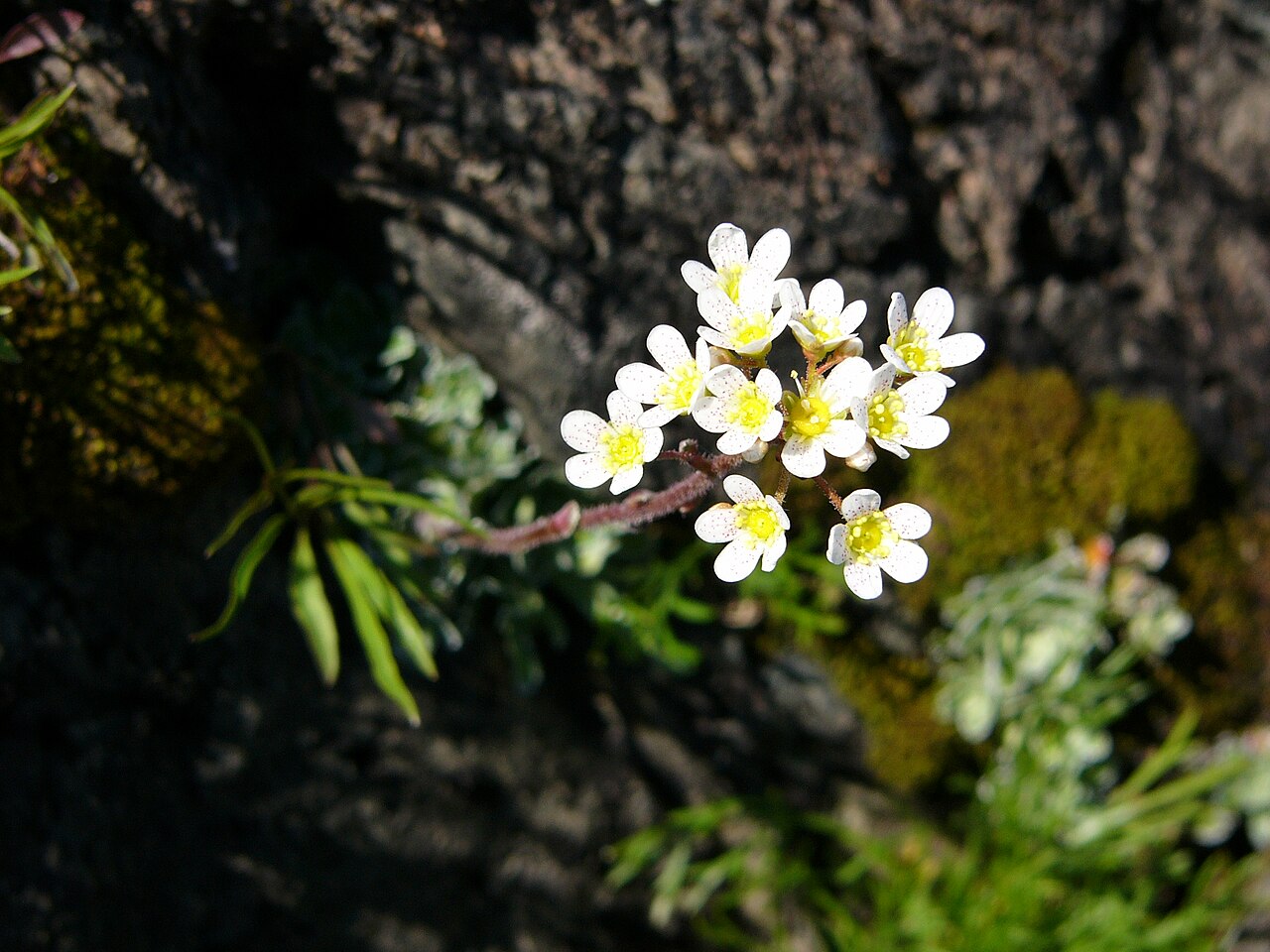
Saxifraga paniculata, known as Livelong Saxifrage, White Mountain saxifrage (the USDA name), encrusted saxifrage or silver saxifrage, is a small, evergreen cliff plant that forms tight rosettes of thick, silvery-green leaves edged with a crust of lime. In early summer each mature rosette sends up a stalk of starry white flowers, sometimes speckled with tiny red dots. It is a true rock plant, growing in crevices and on ledges where little else can survive.
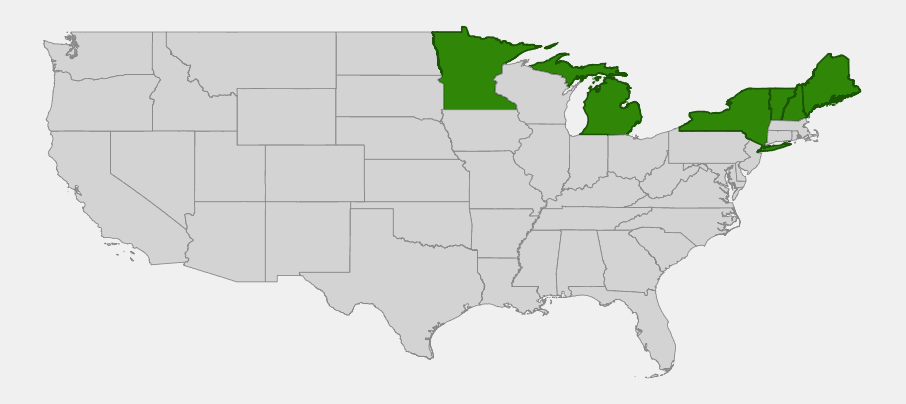
Livelong saxifrage has a wide arctic-alpine range in Europe, Greenland and northeastern North America. In the United States it reaches only the northern edge of the country, on cliffs and shoreline rocks in northern Minnesota and Michigan along Lake Superior, northern New York, Vermont, New Hampshire and Maine. In all of these states it is a rare plant of special places, such as the alpine ravines of the White Mountains and the cold, spray-washed rocks of the Lake Superior shore.
Gardeners know this species well: European forms of Saxifraga paniculata are among the most popular “silver saxifrages” for rock gardens, troughs and walls. This guide covers how to identify it, where the native plants grow, how to grow nursery plants, and why wild plants should never be dug.
Identification
Livelong saxifrage belongs to the encrusted or “silver” group of saxifrages, which secrete lime from small pores along their leaf margins. No other native saxifrage in its eastern range has these silvery, lime-edged rosettes.
Rosettes & Leaves
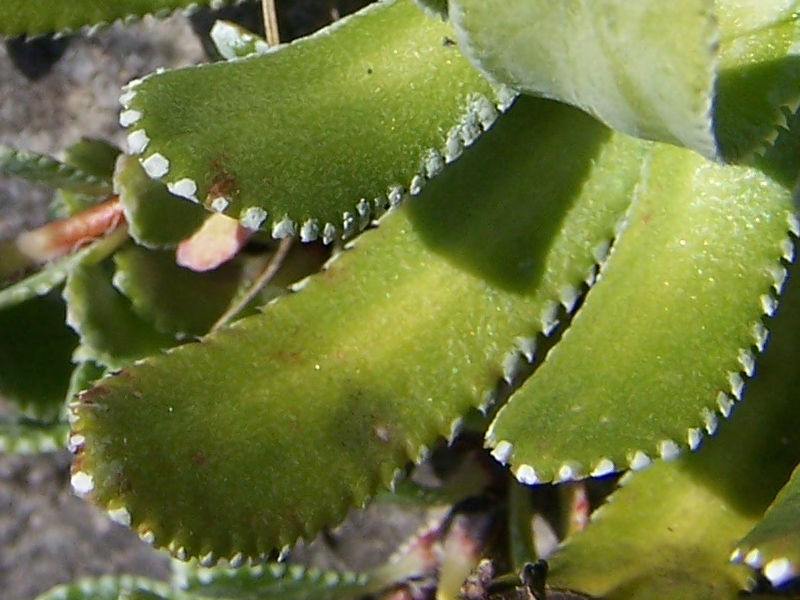
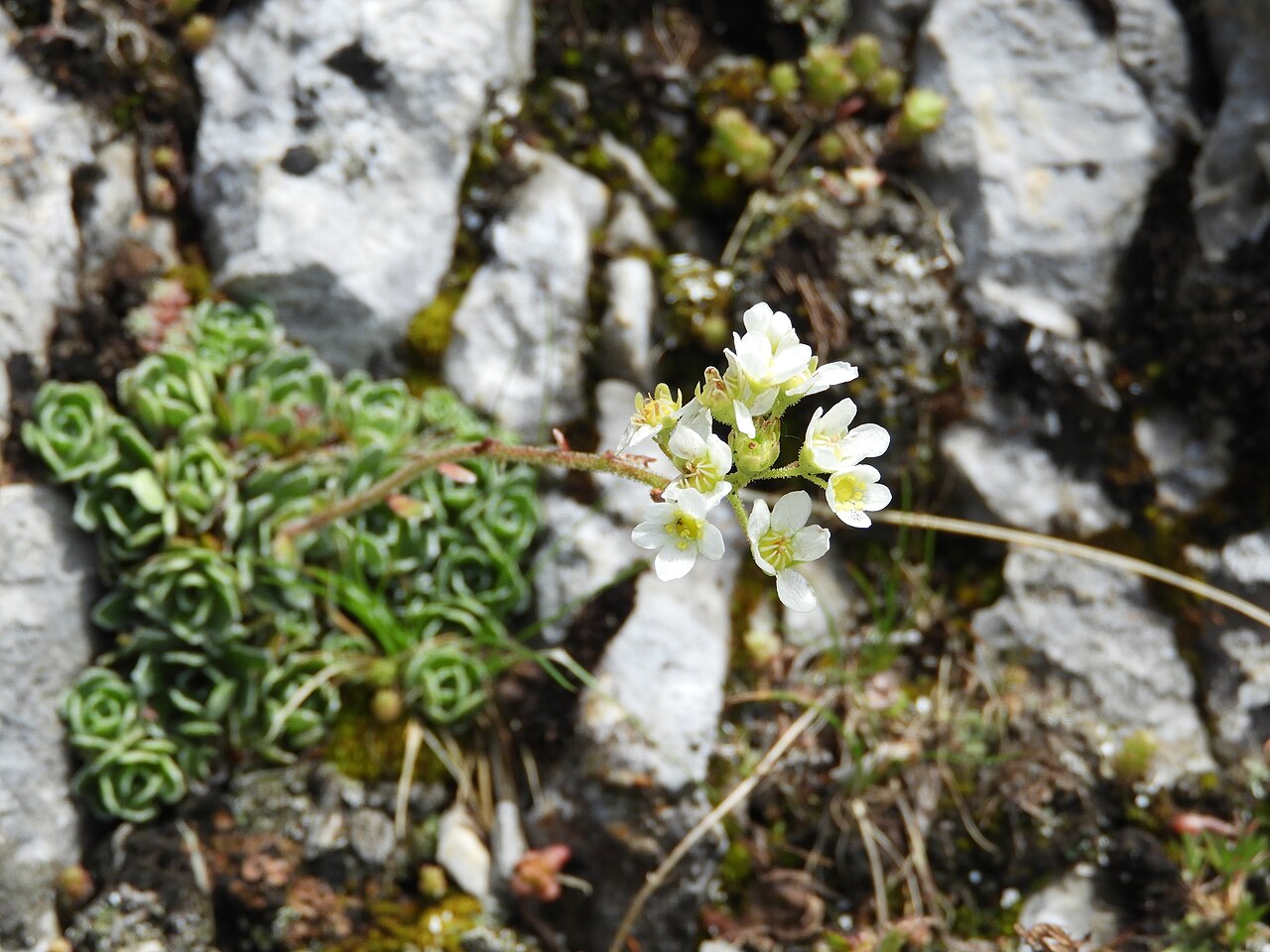
The plant forms dense, cushion-like clusters of rosettes, each about ½ to 2 inches across. The leaves are thick, stiff, spoon-shaped to strap-shaped, gray-green to bluish green, with finely toothed margins. Each tooth bears a tiny pore (hydathode) that releases water containing calcium, leaving a white crust of lime that outlines the leaf edges. Short runners produce new offset rosettes around the parent.
Flower Stalks
In late spring or early summer, a flowering rosette sends up a single stalk, usually 4 to 12 inches tall, often reddish and covered with short, sticky glandular hairs. Its small leaves are alternate. The upper part branches into a narrow, open cluster (panicle) of flowers, which is the meaning of paniculata. After flowering, that rosette dies, but its offsets live on.
Flowers
The flowers are about a third to half an inch across, with five rounded white to cream petals, sometimes dotted with purple or red near the base. Ten stamens surround a two-beaked ovary. In North America the main bloom is in June and July.
Fruit
The fruit is a small, two-beaked capsule containing many tiny brown seeds, which are shaken out by wind.
Similar Species
Several other saxifrages grow on eastern cliffs. Cliff Saxifrage of the southern Appalachians has thin, coarsely toothed, hairy leaves without lime crust. Early saxifrage (Micranthes virginiensis) has flat, hairy rosettes and blooms in early spring. Purple Saxifrage, which shares some of the same cliffs in Vermont, has tiny opposite leaves and purple flowers. Tufted saxifrage (S. cespitosa) has small three-lobed leaves.
Quick Facts
| Scientific Name | Saxifraga paniculata Mill. (syn. Saxifraga aizoon Jacq.) |
| Family | Saxifragaceae (saxifrage family) |
| Plant Type | Evergreen rosette-forming perennial; cushion or mat |
| Mature Height | Rosettes 1–2 in; flower stalks 4–12 in |
| Mature Spread | 6–12 in clumps |
| Growth Rate | Slow |
| Sun Exposure | Full sun to part shade |
| Water Needs | Low to medium; sharp drainage, never waterlogged |
| Soil Type | Rock crevices, gravel and thin mineral soil |
| Soil pH | Neutral to alkaline (about 6.5–8.0); often on limestone or basalt |
| Bloom Time | June–July |
| Flower Color | White to cream, sometimes red-dotted |
| Fall Color | Evergreen; rosettes may blush red in cold |
| Fruit | Small two-beaked capsules with tiny seeds |
| Deer Resistant | Yes |
| USDA Hardiness Zones | 2–7 |
Native Range
USDA PLANTS lists livelong saxifrage as native in six states: Maine, Michigan, Minnesota, New Hampshire, New York and Vermont. In Minnesota and Michigan it grows on the cliffs and shoreline rocks of Lake Superior, including the North Shore in Minnesota and the Lake Superior coast of Michigan. In the Northeast it occurs on a small number of cliffs, ledges and alpine ravines in northern New York, Vermont, the White Mountains of New Hampshire and northern Maine. It is rare in each of these states.
Its habitat is cold, exposed rock: vertical cliff faces, crevices, ledges and talus, often on calcium-rich rock such as limestone, marble or basalt, and often where cold air, spray or seepage keeps summers cool. These sites act as refuges for arctic-alpine plants that were more widespread at the end of the last ice age.
Beyond the United States, livelong saxifrage grows across eastern Canada from Ontario and Manitoba to Quebec, the Maritime provinces, Newfoundland and Labrador and north to Nunavut, and in Greenland and Iceland. It is widespread in the mountains of Europe, from the Pyrenees and Alps to the Carpathians and Caucasus. North American plants are sometimes separated as subsp. neogaea.
📋 Regional plant lists featuring Livelong Saxifrage: Michigan, Wisconsin & Eastern Minnesota · New York, Pennsylvania & Northern New Jersey · Delaware, Southern New Jersey & Long Island · New Hampshire, Maine & Vermont
Growing & Care Guide
Livelong saxifrage is a classic rock garden plant, and it is widely available from nurseries, usually as European selections. Native North American plants are rare and protected in several states. Never dig them from cliffs or shores; buy nursery-propagated plants only. In the garden, the keys to success are sharp drainage, a gritty, limy soil and protection from hot, humid summers.
Light
Give it full sun in cool northern gardens and morning sun with afternoon shade where summers are warm. A north- or east-facing crevice often works best.
Soil & Water
Plant it in a very well-drained, gritty mix, such as equal parts loam, coarse sand or grit, and fine gravel, with some crushed limestone. Water during dry spells while it establishes, then only in long droughts. Wet soil around the crowns, especially in winter, causes rot.
Planting Tips
It is ideal for rock gardens, stone walls, crevice gardens and alpine troughs. Wedge the rosettes into a vertical crack between stones, or plant on a slope and mulch the crown with a collar of gravel so it stays dry. Space plants 6 to 9 inches apart.
Pruning & Maintenance
Remove the flower stalks after bloom unless you want seed. Rosettes that have flowered die, so pick out the dead ones carefully to keep the cushion neat. Remove fallen leaves that settle on the rosettes in autumn. It struggles in the heat and humidity of the Southeast and lower Midwest.
Propagation
Detach offset rosettes in spring or after flowering and root them in gritty mix; this is easy and reliable. Seed is very fine and can be sown on the surface of a gritty mix in fall or winter and left outdoors for cold stratification. Only propagate from garden or nursery plants, never from wild populations.
Landscape Uses
- Rock and crevice gardens: silvery rosettes look good all year, and white sprays of flowers add early summer interest
- Troughs and containers: a long-lived plant for alpine troughs and gravel pots with excellent drainage
- Stone walls: plant into the gaps of dry-stacked walls, where roots stay cool and crowns stay dry
- Green roofs and gravel beds: in cool northern climates, a drought-tolerant groundcover for thin mineral soil
- Where to see it wild: Lake Superior shore cliffs in Minnesota and Michigan; alpine ravines of the White Mountains; cliffs in Vermont
Wildlife & Ecological Value
Livelong saxifrage is a small plant of harsh places, but its flowers support pollinators where few other plants bloom.
For Pollinators
The open, shallow flowers offer nectar and pollen to flies, small bees and other insects. On cold cliffs and shores, flies are often its most important pollinators.
For Birds
The tiny seeds have little value for birds. Its cushions are part of the cliff vegetation where some birds nest.
For Mammals
It is seldom eaten by deer or other mammals, partly because it grows on cliffs out of reach.
Ecosystem Role
Livelong saxifrage is one of the arctic-alpine “relict” plants that survive on cold cliffs and shores south of the main arctic range, left behind as the glaciers retreated. These populations are sensitive to climbing, trampling and warming, and they are important indicators of rare cliff communities.
Cultural & Historical Uses
The genus name Saxifraga means “stone-breaker,” from the Latin saxum (rock) and frangere (to break). It refers to plants that grow in rock crevices, and perhaps to the old belief that they could break up kidney stones.
The name “livelong” refers to the plant’s endurance, since rosettes survive for years on bare rock with almost no soil. In Europe it is also called aizoon saxifrage, from the old name Saxifraga aizoon; aizoon means “always alive” in Greek.
Rock gardeners have grown this species since the 1700s, and dozens of cultivars have been selected for rosette size, silver crust and flower color, including pink and pale yellow forms. Most plants sold in nurseries are of European origin.
Frequently Asked Questions
Is livelong saxifrage native to the United States?
Yes. It is native to a few cold, rocky sites in Minnesota, Michigan, New York, Vermont, New Hampshire and Maine, as well as eastern Canada, Greenland and Europe. In the United States it is rare.
Can I collect livelong saxifrage from the wild?
No. Wild populations are small and rare, and the species is protected in several states. Never dig it from cliffs or shores. Buy nursery-propagated plants, which are easy to find because it is a popular rock garden plant.
Why are the leaves edged in white?
The leaf teeth have tiny pores that release water carrying dissolved calcium. When the water evaporates, it leaves a white crust of lime along the edges. This is why it is called encrusted or lime-encrusted saxifrage.
How do I grow livelong saxifrage?
Grow it in full sun to part shade in a very well-drained, gritty, limy soil, ideally in a crevice, wall or trough. Avoid wet soil and hot, humid sites. It is hardy to about zone 2.
What happens to a rosette after it flowers?
The rosette that flowers dies after setting seed, but the plant survives through the offset rosettes around it, so a clump keeps growing for many years.

Looking for a nursery that carries Livelong Saxifrage?
Browse our native plant nursery directory: Maine, Michigan & Minnesota · New Hampshire & New York · Vermont

