
Sea Clubrush (Bolboschoenus maritimus)
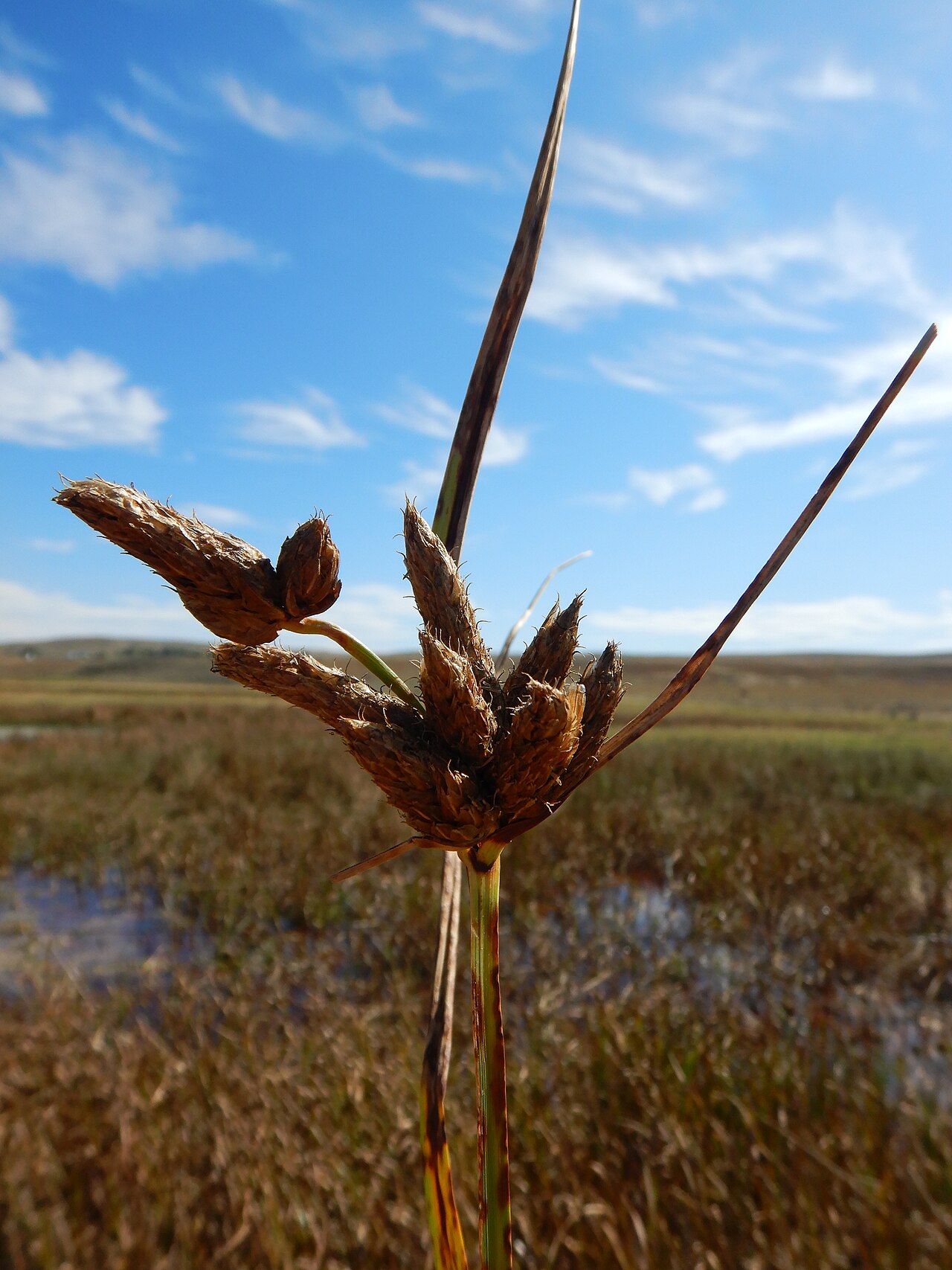
Bolboschoenus maritimus, Sea Clubrush, is a stout, grass-like sedge of salt marshes, alkaline wetlands and brackish shores. In North America it is better known as alkali bulrush or saltmarsh bulrush, and USDA calls it cosmopolitan bulrush, because the species in the broad sense grows on every continent except Antarctica. In Hawaiʻi, where it is indigenous, it is called kaluhā. Its sharply three-angled stems, 1 to 5 feet tall, end in a dense cluster of plump, brown spikelets with long leafy bracts sticking out beyond them.
It is one of the most salt-tolerant tall marsh plants in the country, and its seeds and potato-like tubers are a staple food for ducks, geese and muskrats. That makes it a key plant of western alkali marshes, prairie potholes and coastal brackish marshes, and a workhorse for wetland restoration.
Its classification is unsettled. Most North American plants have been treated as B. maritimus subsp. paludosus (alkali bulrush), while some botanists split the eastern coastal plants as B. robustus (sturdy bulrush) and the inland river species B. fluviatilis (river bulrush) is a separate species. Older books list it as Scirpus maritimus or Schoenoplectus maritimus. This page covers B. maritimus in the broad sense used by USDA PLANTS.
Identification
Sea clubrush is easiest to identify by its combination of triangular, leafy stems, a compact head of large brown spikelets, and its salty or alkaline habitat.
Stems & Leaves
The stems are stiff and sharply three-angled, 1 to 5 feet tall, rising singly or in small groups from long rhizomes that swell into hard, round, corm-like tubers (the “bolbo-” in the name means bulb). Each stem carries several flat, keeled leaves, ⅛ to ⅜ inch wide, with sheaths wrapping the lower stem; the leaves often reach as high as the flower head.
Flowers
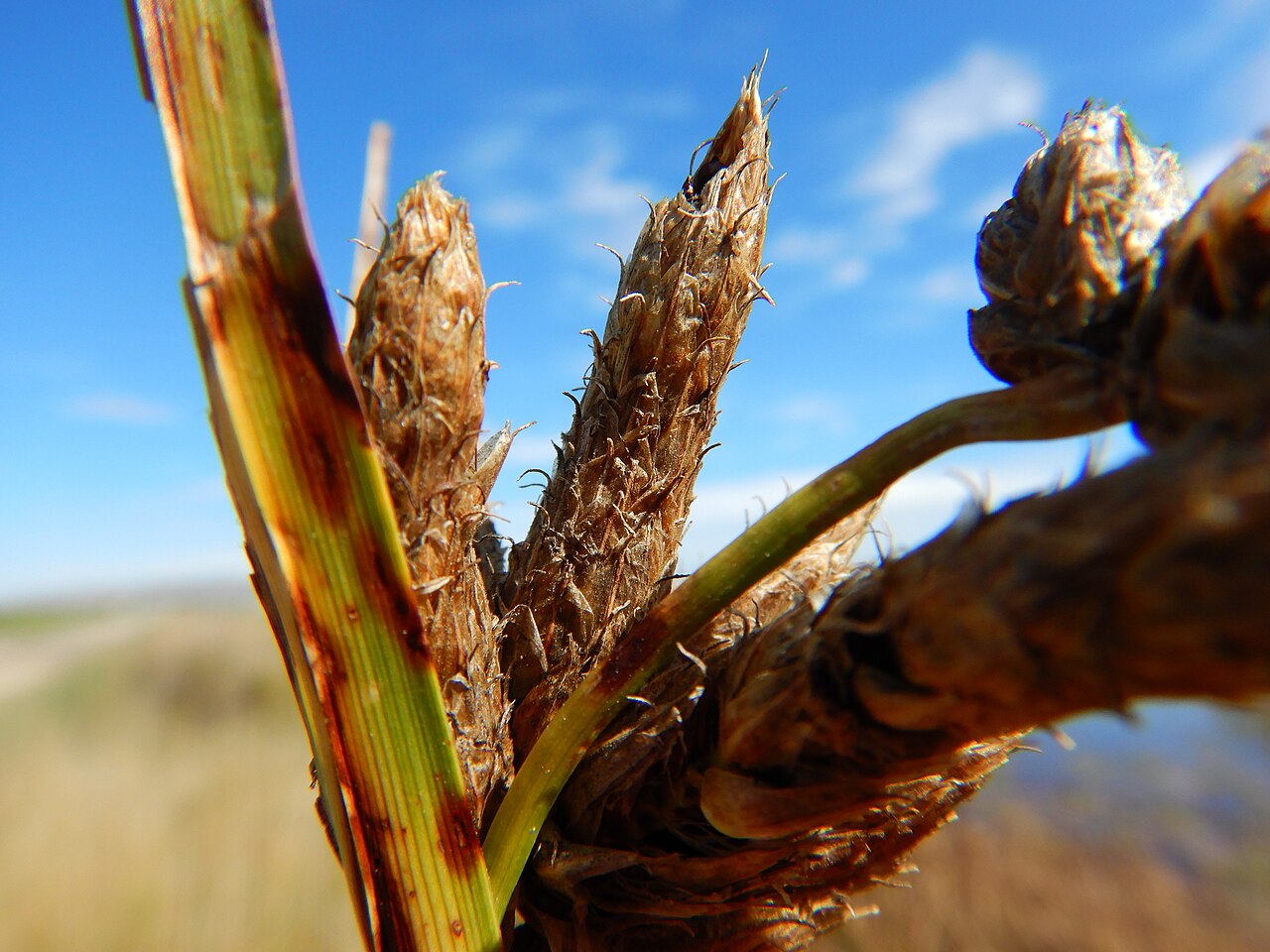
From June to August the stem ends in a single dense cluster of 1 to about 20 spikelets, sometimes with a few more on short stalks. Two to four long, leaf-like bracts spread from the base of the cluster, the longest often several inches past the spikelets. Each spikelet is egg-shaped to cylindrical, about ½ to 1 inch long, made of tightly overlapping brown scales that each end in a short, often curled awn.
Fruit
The fruits are shiny brown to blackish achenes about ⅛ inch long. In alkali bulrush (subsp. paludosus) they are flattened and two-sided; in the eastern coastal plants called B. robustus they are three-sided.
Look-alikes
Hardstem bulrush and softstem bulrush have round, nearly leafless stems. Chairmaker’s bulrush (Schoenoplectus americanus) has a triangular stem but few short leaves and a small cluster of spikelets that appears to come from the side of the stem. River bulrush (B. fluviatilis) is taller, with a more open, branched head, and grows mainly in fresh water.
Quick Facts
| Scientific Name | Bolboschoenus maritimus (syn. Scirpus maritimus, Schoenoplectus maritimus) |
| Family | Cyperaceae (sedge family) |
| Plant Type | Perennial emergent sedge, rhizomatous with tubers |
| Mature Height | 1–5 ft |
| Mature Spread | Spreads by rhizomes into large colonies |
| Growth Rate | Fast in wet sites |
| Sun Exposure | Full sun |
| Water Needs | High; saturated soil to standing water up to about 1–2 ft |
| Soil Type | Wet mud, silt, clay or sand; tolerates saline and alkaline soils |
| Soil pH | About 6.5–9.0; tolerates strongly alkaline soils |
| Bloom Time | June–August |
| Flower Color | Brown spikelets |
| Fall Color | Straw to tan |
| Fruit | Shiny brown achenes; tubers on rhizomes |
| Deer Resistant | Moderately; grazed by livestock and muskrats |
| USDA Hardiness Zones | 3–11 |
Native Range
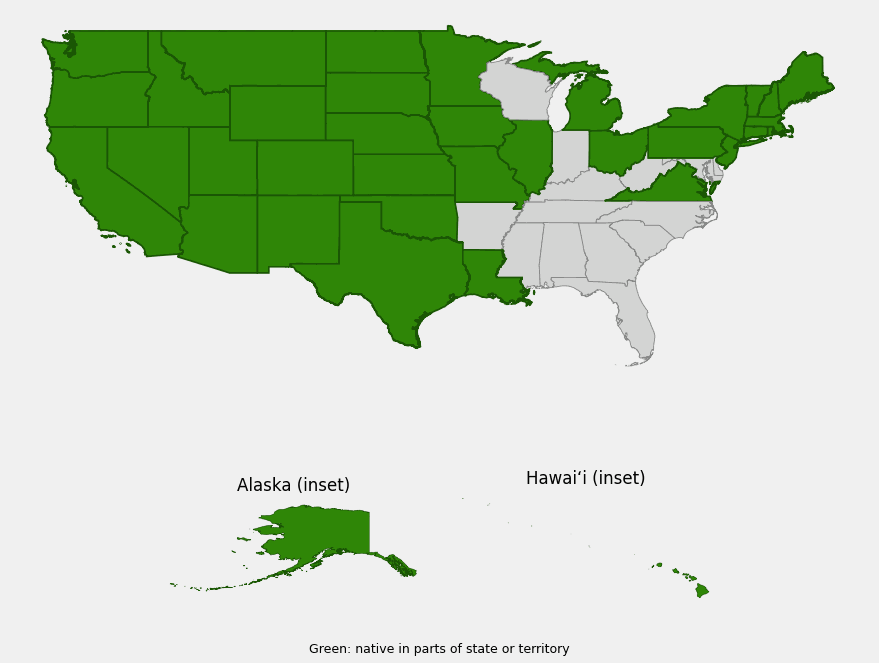
In the broad sense, sea clubrush grows on coasts and in saline inland wetlands around the world. In the United States, USDA PLANTS records it as native in 36 states, from Alaska and Washington to California and Texas, across the Great Plains and Midwest, and along the Atlantic coast from Maine to Virginia, as well as in Hawaiʻi. In Canada it occurs from British Columbia and the Northwest Territories east to the Maritime provinces and Newfoundland.
It is most abundant in the arid and semi-arid West and the northern Great Plains, where it fills alkaline marshes, playas, prairie potholes and the edges of salt lakes such as the Great Salt Lake. In the East it is mainly a plant of brackish tidal marshes along the coast, with scattered inland stations around salt springs and the Great Lakes. In Hawaiʻi it is a native but uncommon plant of coastal ponds and brackish marshes.
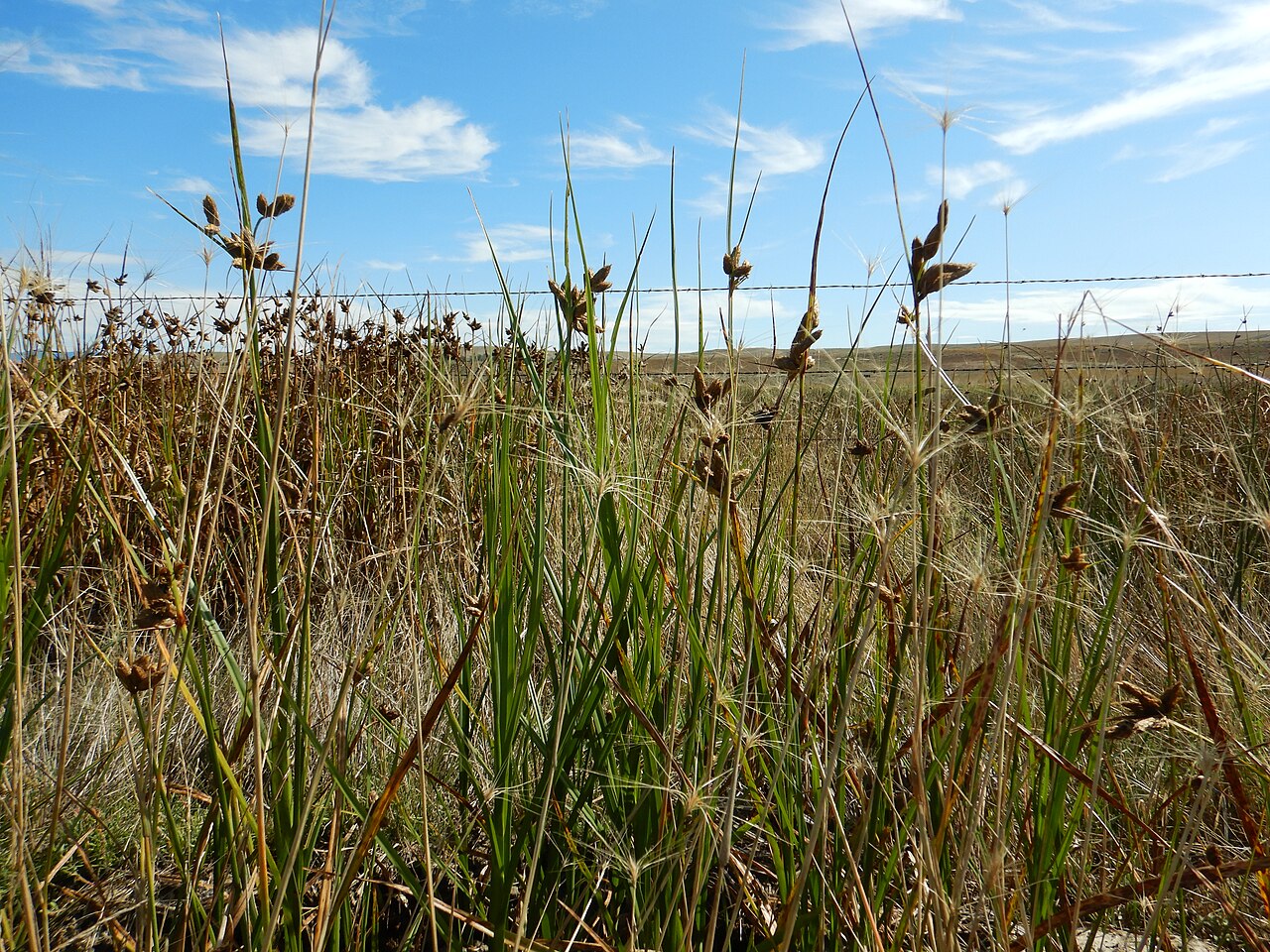
It grows in shallow, often fluctuating water and wet mud: fresh to brackish and saline marshes, alkali flats, the margins of ponds, lakes, ditches and stock ponds, and the upper edges of salt marshes. It tolerates long flooding in spring and partial drying in late summer, a pattern typical of western wetlands.
📋 Regional plant lists featuring Sea Clubrush: California & Nevada · Western Oregon & Western Washington · Idaho, Eastern Oregon & Eastern Washington · Utah & Western Colorado · Montana & Wyoming · Arizona & New Mexico · Nebraska, Kansas & Eastern Colorado · North Dakota, South Dakota & Western Minnesota · Michigan, Wisconsin & Eastern Minnesota · Illinois, Iowa & Missouri · Ohio & Indiana · Arkansas, Louisiana, Eastern Oklahoma & Eastern Texas · South & West Texas · New York, Pennsylvania & Northern New Jersey · Delaware, Southern New Jersey & Long Island · Maryland, Virginia & West Virginia · Connecticut, Massachusetts & Rhode Island · New Hampshire, Maine & Vermont · Alaska · Hawaii
Growing & Care Guide
Sea clubrush is a plant for wet, sunny places, especially where salt or alkali makes other plants struggle. It is used mostly in wetland restoration, constructed wetlands and large ponds rather than in small gardens, because it spreads quickly by rhizomes. Restoration nurseries in the West sell it as plugs, tubers or seed.
Light
Full sun. It thins out quickly in shade.
Soil & Water
Plant it in saturated soil or shallow water, from wet mud to about a foot deep; established stands tolerate deeper spring flooding and some late-summer drying. It grows in fresh water but is at its best where water is brackish or alkaline, and it tolerates salinity well beyond what cattails or most bulrushes can take.
Planting Tips
Set plugs or tubers 1 to 3 feet apart in spring, into moist mud, with the tops at or just above the water line, and keep water shallow until shoots are established. Protect new plantings from geese, muskrats and carp, which can strip them before they spread. Plan for spread: it will colonize any wet edge it can reach.
Pruning & Maintenance
Little maintenance is needed. Leave dead stems standing through winter for wildlife cover, or cut them back in late winter. In a small pond, contain it in large submerged pots or remove spreading rhizomes each year.
Propagation
Divide rhizomes or plant tubers in spring; this is the most reliable method. Seed germinates poorly without treatment: cold, wet stratification for several months, followed by sowing on saturated soil in warm, bright conditions, improves results.
Landscape Uses
- Wetland restoration: a standard species for restoring saline and alkaline marshes and waterfowl habitat in the West
- Constructed wetlands: tolerates nutrient-rich and salty runoff and helps filter water
- Shoreline stabilization: dense rhizomes bind mud on pond, lake and ditch edges
- Large ponds and stock ponds: fast cover and wildlife food in sunny shallows
- Coastal and brackish marsh plantings: including native Hawaiian wetland restoration where it is indigenous
Wildlife & Ecological Value
Few marsh plants are as important to waterfowl as sea clubrush, which feeds birds and mammals both above and below the water line.
For Pollinators
It is wind-pollinated and has little value for bees or butterflies, though its stands shelter many wetland insects that birds and fish feed on.
For Birds
Its seeds are eaten by many ducks, including pintail, mallard, teal and redhead, and by rails, shorebirds and blackbirds. Geese and swans dig up the tubers, which are a valuable winter food. Dense stands provide nesting cover for ducks, coots, rails, yellow-headed and red-winged blackbirds and marsh wrens.
For Mammals
Muskrats eat the stems and tubers and use the plants to build lodges. Livestock graze it in alkaline pastures.
Ecosystem Role
Its rhizomes stabilize soft sediments, its stands trap silt and take up nutrients, and its decaying stems feed the invertebrates at the base of marsh food webs. In alkali marshes it is often the dominant emergent plant, creating habitat where few other tall plants can grow.
Cultural & Historical Uses
Linnaeus named this plant Scirpus maritimus in 1753, after its seaside habitat in Europe. It was moved to Bolboschoenus by Eduard Palla in 1905, a genus name meaning “bulb rush” for its tuberous rhizomes, and was later also placed in Schoenoplectus. Many North American plants are now treated as subspecies paludosus, from the Latin for marsh, or as separate species, and botanists are still sorting out the complex using DNA and fruit characters.
The starchy tubers have been eaten as a famine or staple food in several parts of the world, and bulrush tubers, seeds and stems were among the marsh resources used for food and weaving by Indigenous peoples of western North America. Its seeds and tubers have been a classic waterfowl food for as long as ducks have been studied, and wildlife managers have planted it in western refuges for decades.
In Hawaiʻi, kaluhā is one of the native sedges of coastal wetlands. Much of that habitat has been filled or overrun by introduced plants, so native stands deserve protection, and kaluhā is a natural choice for restoring Hawaiian coastal ponds and marshes.
Frequently Asked Questions
Is sea clubrush the same as alkali bulrush?
Mostly. Alkali bulrush is the usual North American name for Bolboschoenus maritimus subsp. paludosus, which most U.S. plants belong to. Sea clubrush is the European name for the species in the broad sense.
Is sea clubrush native to the United States?
Yes. USDA PLANTS lists it as native in Alaska, Hawaii and 34 states of the lower 48, and it is native across much of Canada.
How tall does sea clubrush grow?
Usually 1 to 5 feet, depending on water depth, salinity and fertility.
Will it take over my pond?
It spreads quickly by rhizomes in shallow water. In small ponds, grow it in submerged containers. In large wetlands its spread is usually welcome.
What eats sea clubrush?
Ducks eat the seeds; geese, swans and muskrats eat the tubers and stems; and livestock graze it in alkaline pastures.

Looking for a nursery that carries Sea Clubrush?
Browse our native plant nursery directory: Alaska & Arizona · California · Colorado, Connecticut & Hawaii · Idaho, Illinois, Iowa & Kansas · Louisiana, Maine, Massachusetts, Michigan, Minnesota, Missouri & Montana · Nebraska, Nevada, New Hampshire, New Jersey, New Mexico, New York, North Dakota, Ohio & Oklahoma · Oregon · Pennsylvania, Rhode Island, South Dakota, Texas, Utah, Vermont & Virginia · Washington · Wyoming

