
Hardstem Bulrush (Schoenoplectus acutus)
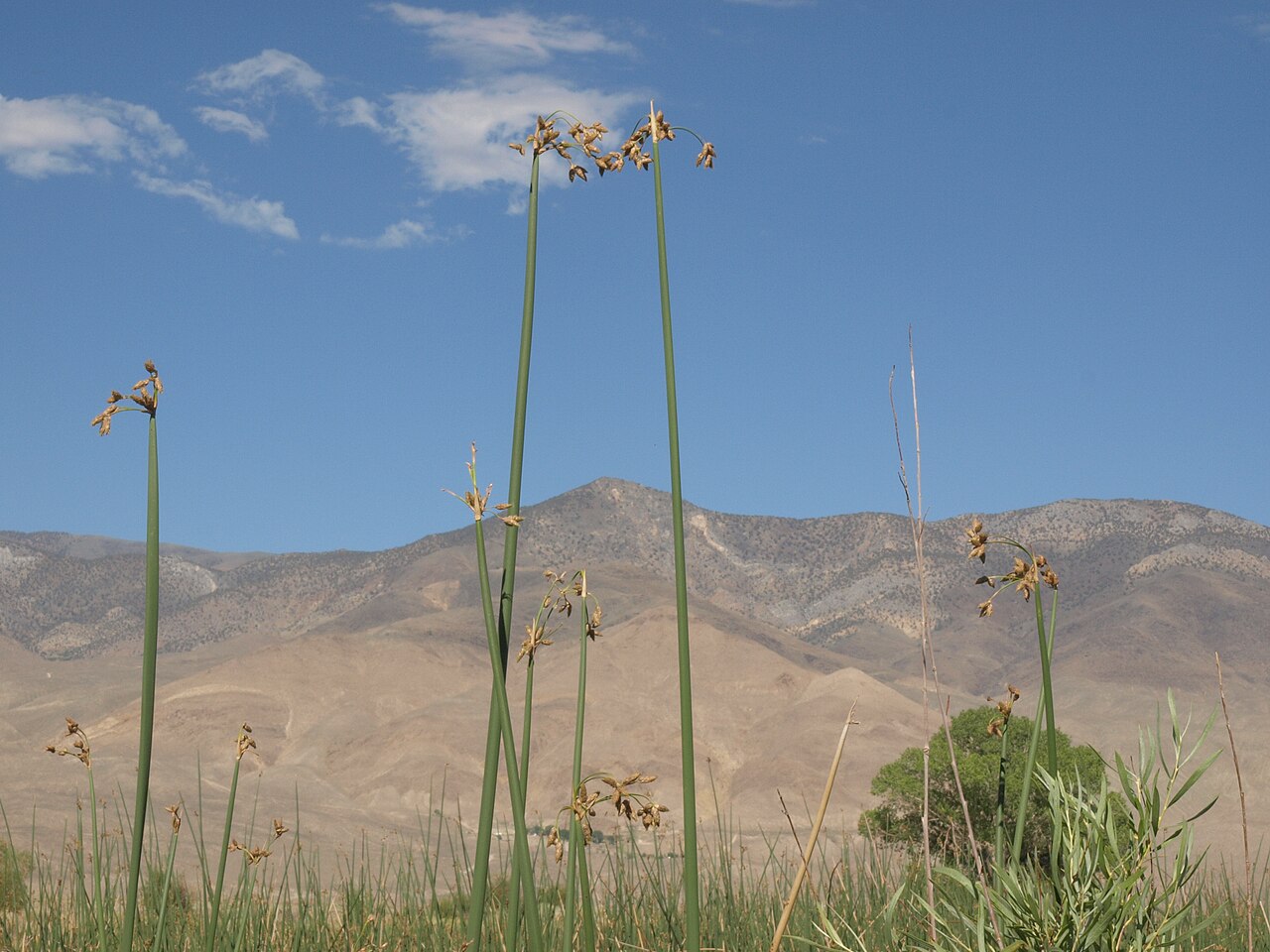
Schoenoplectus acutus, the Hardstem Bulrush, is the tall, round-stemmed sedge that forms dense green walls around lakes, ponds and marshes across much of North America. In the West it is better known as tule (TOO-lee), the plant that gave its name to Tule Lake, the Tule River and California’s winter “tule fog.” Its smooth, leafless-looking stems rise 3 to 10 feet out of shallow water and end in a small cluster of brown, scaly spikelets that appears to sprout from the side of the stem.
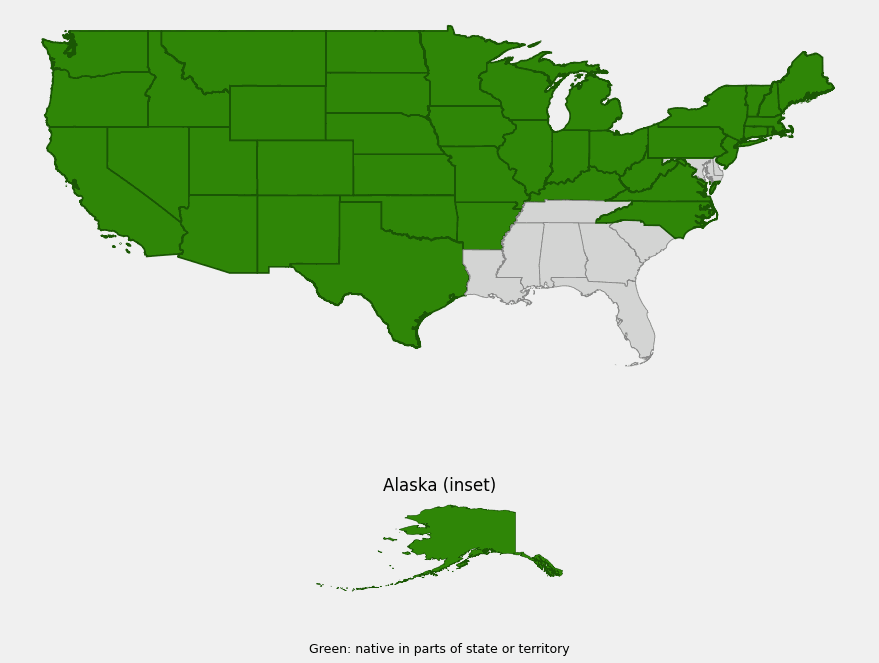
Hardstem bulrush is a sedge (family Cyperaceae), not a grass or a rush. It spreads by thick underground rhizomes into colonies that can cover acres. USDA PLANTS lists it as native in Alaska, Canada and 39 of the lower 48 states, from New England and the Great Lakes across the prairie potholes to the Pacific coast. Older books call it Scirpus acutus, and western plants are often separated as var. occidentalis.
Few wetland plants are as important to wildlife or as useful to people. Tule marshes shelter nesting ducks, grebes, blackbirds and muskrats, and Native peoples of the West wove tule into mats, houses, duck decoys and even boats. This guide covers identification, native range, how to plant it in ponds and restored wetlands, and its value to wildlife.
Identification
Three tall bulrushes are easily confused: hardstem bulrush, Soft-stemmed Bulrush and Giant Bulrush. The squeeze test helps: hardstem bulrush stems are firm and hard to flatten between your fingers, while soft-stemmed bulrush stems are spongy and crush easily.
Stems
The stems are round in cross-section, smooth, dark olive to gray-green, and usually 3 to 10 feet tall and up to about an inch thick at the base. They are filled with firm, spongy pith but feel stiff and solid, and they stand upright even in wind. The stems are the plant’s main green, photosynthetic tissue.
Leaves
Most leaves are reduced to sheaths around the base of the stem. One or two upper sheaths may carry a short, V-shaped blade a few inches long, but from a distance the plant looks completely leafless.
Flower Head
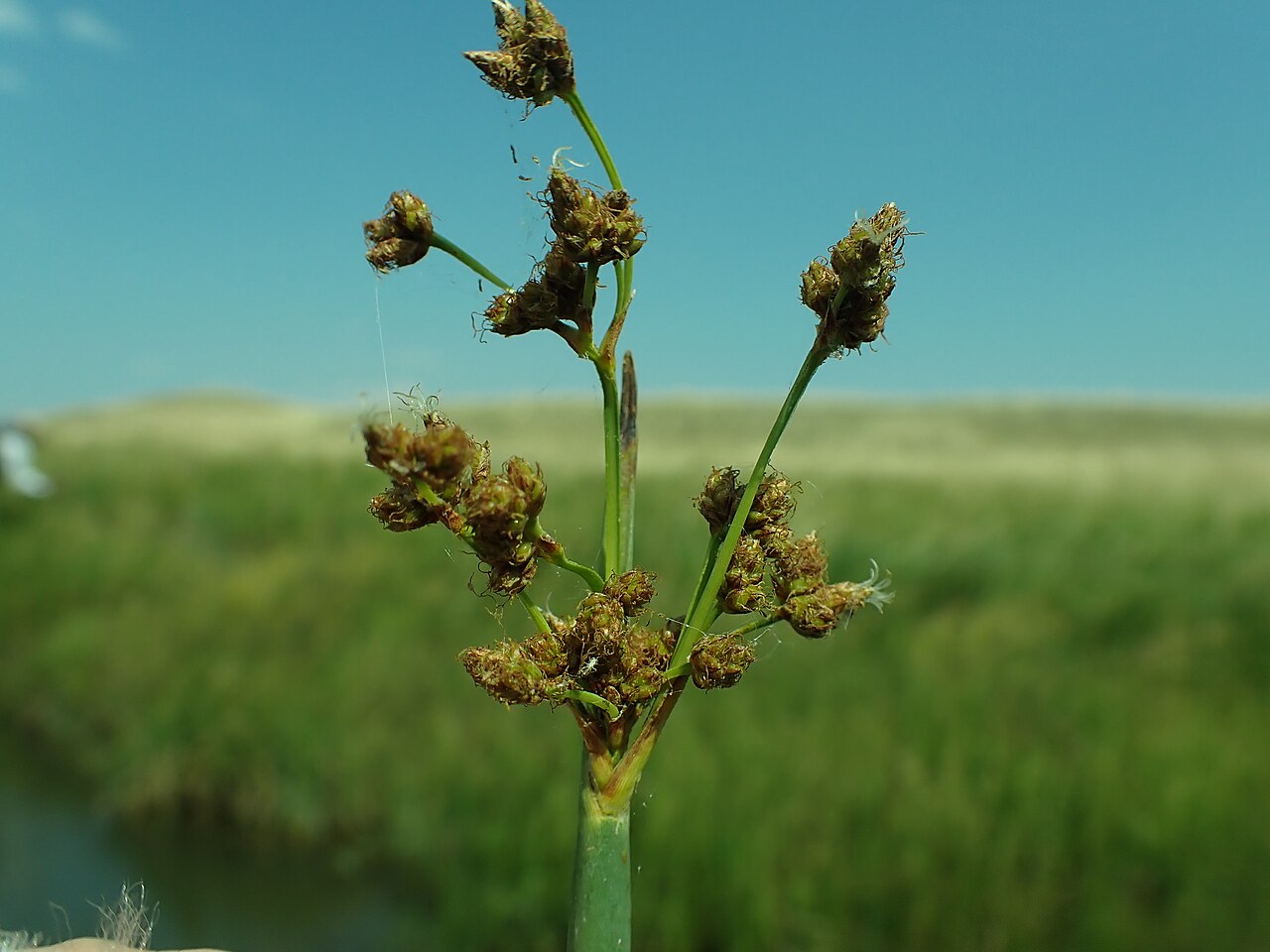
The inflorescence sits near the top of the stem and looks lateral, because a stiff bract continues straight up beyond it like an extension of the stem. It is a cluster of many egg-shaped spikelets, each about a quarter to half an inch long, often bunched in tight groups of two to several on short branches. The scales covering the spikelets are gray-brown, often with reddish lines and spots, and end in a short, slightly twisted awn. Plants flower in early to midsummer and the seeds ripen from late summer into fall.
In soft-stemmed bulrush the spikelets tend to be more spread out, single on longer branches, and the stems are paler green and soft. Giant bulrush, of the far Southwest and Gulf Coast, has stems that are triangular near the top.
Seeds & Rhizomes
Each flower produces a small, dark brown, lens-shaped seed (achene) with several bristles at the base. Below ground, stout reddish-brown rhizomes knit the colony together and send up new stems in rows, which is why tule stands often look like dense green fences.
Quick Facts
| Scientific Name | Schoenoplectus acutus (Muhl. ex Bigelow) Á. Löve & D. Löve; syn. Scirpus acutus |
| Family | Cyperaceae (sedge family) |
| Plant Type | Rhizomatous emergent aquatic perennial (sedge) |
| Mature Height | 3–10 ft |
| Mature Spread | Spreads indefinitely by rhizomes into large colonies |
| Growth Rate | Moderate to fast once established |
| Sun Exposure | Full sun |
| Water Needs | High; standing water or saturated soil, up to about 3 ft deep |
| Soil Type | Mucky, silty, sandy or clay wetland soils; tolerates alkaline and slightly brackish water |
| Soil pH | About 6.0–9.0 |
| Bloom Time | June–August |
| Flower Color | Brown to reddish-brown spikelets |
| Fall Color | Stems turn tan to golden brown |
| Fruit | Small brown achene with basal bristles |
| Deer Resistant | Moderately; muskrats and geese eat it more than deer do |
| USDA Hardiness Zones | 3–10 |
Native Range
Hardstem bulrush is one of the most widespread emergent wetland plants in North America. It grows from Alaska and the Yukon across Canada to Newfoundland, and south through most of the northern and western United States into northern Mexico. USDA PLANTS lists it as native in 39 of the lower 48 states plus Alaska.
It is most abundant in the West and the northern plains: in the prairie pothole marshes of the Dakotas and Minnesota, in the alkaline lakes and marshes of the Great Basin, and in the freshwater marshes of California’s Central Valley and the Pacific Northwest. In the East it is more scattered, growing along the Great Lakes, in New England and New York, and south in the Appalachians. Records from Kentucky, Virginia, West Virginia, North Carolina, Arkansas and Oklahoma are outlying ones at the southern and eastern edge of its range.
It needs permanent or long-lasting shallow water, so within its range it is found wherever there are lakeshores, ponds, slow rivers, reservoirs, sloughs and marshes, including alkaline and slightly brackish water in arid regions where many other wetland plants fail.
📋 Regional plant lists featuring Hardstem Bulrush: New York, Pennsylvania & Northern New Jersey · Idaho, Eastern Oregon & Eastern Washington · Ohio & Indiana · Montana & Wyoming · Michigan, Wisconsin & Eastern Minnesota · Kentucky & Tennessee · Nebraska, Kansas & Eastern Colorado · Utah & Western Colorado · Connecticut, Massachusetts & Rhode Island · New Hampshire, Maine & Vermont · Maryland, Virginia & West Virginia · Delaware, Southern New Jersey & Long Island · Arizona & New Mexico · Illinois, Iowa & Missouri · Alaska · North & South Carolina · Arkansas, Louisiana, Eastern Oklahoma & Eastern Texas · South & West Texas · North Dakota, South Dakota & Western Minnesota · Western Oregon & Western Washington · California & Nevada
Growing & Care Guide
Hardstem bulrush is a workhorse for constructed wetlands, pond edges and shoreline restoration. Once its rhizomes are established it is long-lived and needs little care. Give it room, because it spreads into large colonies.
Light
Plant in full sun. It tolerates light shade at the edge of a marsh, but dense shade from trees weakens the stand and reduces flowering.
Soil & Water
It grows in saturated soil or standing water from a few inches to about 3 feet deep, and it tolerates water levels that rise and fall through the season. Mucky, silty, sandy and clay bottoms all work. It handles alkaline and mildly brackish water better than many marsh plants. During establishment, keep water no deeper than a few inches until new shoots are well above the surface, then let levels rise gradually.
Planting Tips
Plant rhizome divisions or container plugs in spring or early summer, about 1 to 3 feet apart, with the rhizome set 2 to 4 inches into the mud. In ponds with geese or muskrats, protect new plantings with temporary fencing or netting until they are established; grazing can wipe out a new planting. For small water gardens, grow it in a large submerged container so it does not take over the pond.
Pruning & Maintenance
No pruning is needed. Dead stems can be left standing over winter for wildlife cover, or cut back in late winter if you want a tidier look. To control spread, cut rhizomes along the edge of the colony with a sharp spade, or keep it in containers. Avoid herbicides near water, which can harm aquatic life.
Propagation
Division of rhizomes is the easiest and most reliable method. Seed needs cold, wet stratification for several months and often germinates best on wet mud in warm temperatures; it is slower and less predictable than division. Buy plants from native wetland nurseries rather than digging them from wild marshes.
Landscape Uses
- Wetland restoration: a dominant emergent species for marsh, lakeshore and pothole restoration
- Constructed treatment wetlands: used to filter stormwater and wastewater by trapping sediment and nutrients
- Pond and lake shorelines: dense stands break wave action and reduce shoreline erosion
- Large water gardens: a vertical, architectural accent when grown in submerged containers
- Wildlife ponds: nesting cover for waterbirds and habitat for fish and amphibians
Wildlife & Ecological Value
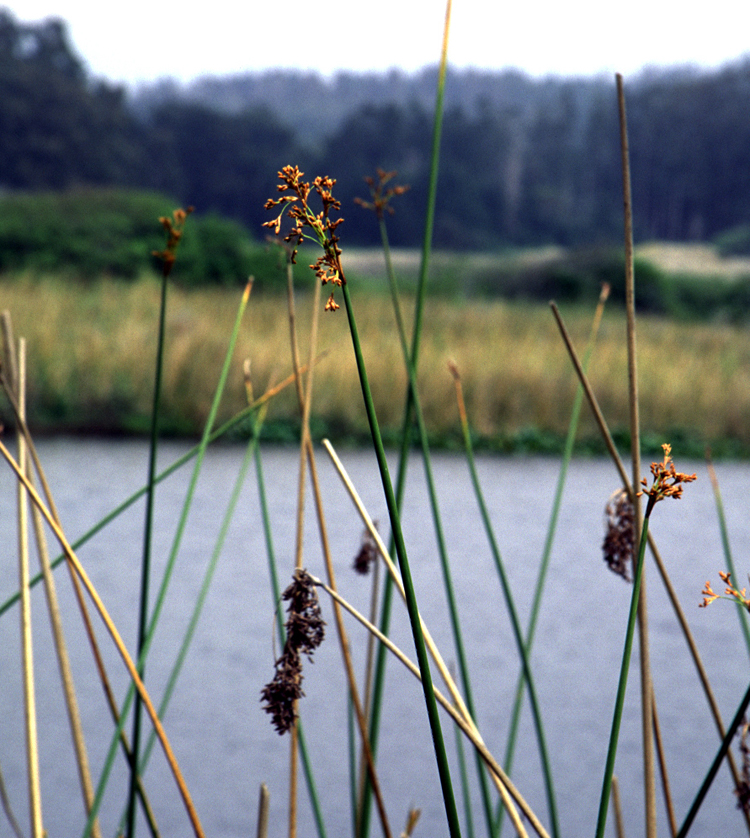
A healthy tule marsh is one of the richest wildlife habitats in the West, and hardstem bulrush supplies both the structure and much of the food.
For Pollinators
Like other sedges, hardstem bulrush is wind-pollinated and offers little nectar. Its value lies in the habitat it creates rather than in its flowers.
For Birds
Ducks, geese, rails, coots and many marsh songbirds eat the seeds. The stems are prime nesting cover: canvasbacks, redheads and ruddy ducks build nests over water among bulrushes, western and Clark’s grebes anchor floating nests to the stems, and marsh wrens and yellow-headed and red-winged blackbirds weave their nests into them. Herons and bitterns hunt along the edges.
For Mammals
Muskrats eat the rhizomes and stems and build their lodges from them. Beavers and moose also feed on bulrushes, and the dense stands hide raccoons, mink and other marsh predators.
Ecosystem Role
The stems slow moving water, trap sediment and take up nutrients, improving water clarity. Below the surface they provide shelter for young fish, aquatic insects and amphibians, and the decaying stems feed the marsh food web. Stands also protect shorelines from wave erosion.
Cultural & Historical Uses
Tule was one of the most important plants in the lives of many Native peoples of California, the Great Basin and the Columbia Plateau. The stems were woven into mats, baskets, house coverings, sandals, clothing and bedding. Bundled tule boats (balsas) were used on San Francisco Bay and lakes throughout the region, and the Northern Paiute and their ancestors made realistic tule duck decoys; examples found in Lovelock Cave, Nevada, are around 2,000 years old. Young shoots, rhizomes, pollen and seeds were also eaten.
The word tule comes from the Nahuatl tollin (or tullin), the word for bulrushes and cattails, carried north by Spanish speakers. Place names such as Tule Lake, the Tule River and Tulare County, and the tule elk of California, all trace back to the vast tule marshes that once covered the Central Valley.
Most of those marshes were drained for farming in the nineteenth and twentieth centuries. Today hardstem bulrush is a key species in restoring wetlands along the Pacific Flyway and in the prairie potholes, where it is planted to bring back waterfowl habitat and to filter runoff.
Frequently Asked Questions
What is the difference between hardstem and softstem bulrush?
Hardstem bulrush (Schoenoplectus acutus) has firm, dark olive-green stems that are hard to crush, with spikelets in tight clusters. Softstem bulrush (S. tabernaemontani) has pale green, spongy stems that flatten easily and spikelets that are more spread out. They sometimes grow together.
Is tule the same as hardstem bulrush?
Yes. In the West, “tule” usually means hardstem bulrush, though the name is also used loosely for California bulrush and other tall bulrushes.
Is hardstem bulrush a grass?
No. It is a sedge in the family Cyperaceae. Its round stems and lack of obvious leaves make it look like a rush, but its flowers and seeds are those of a sedge.
Will hardstem bulrush take over my pond?
In a natural pond with shallow edges it can spread widely by rhizomes, which is good for wildlife but may crowd open water. In small ponds, grow it in submerged containers or plant it only where you want a permanent stand.
How deep can hardstem bulrush grow?
It grows from saturated soil to water roughly 3 feet deep. New plantings establish best in shallow water of a few inches.

Looking for a nursery that carries Hardstem Bulrush?
Browse our native plant nursery directory: Alaska, Arizona & Arkansas · California · Colorado & Connecticut · Idaho, Illinois, Indiana, Iowa & Kansas · Kentucky, Maine, Massachusetts, Michigan, Minnesota, Missouri & Montana · Nebraska, Nevada, New Hampshire, New Jersey, New Mexico, New York, North Carolina, North Dakota, Ohio & Oklahoma · Oregon · Pennsylvania, Rhode Island, South Dakota, Texas, Utah, Vermont & Virginia · Washington · West Virginia, Wisconsin & Wyoming

