
Lyreleaf Rockcress (Arabis lyrata)
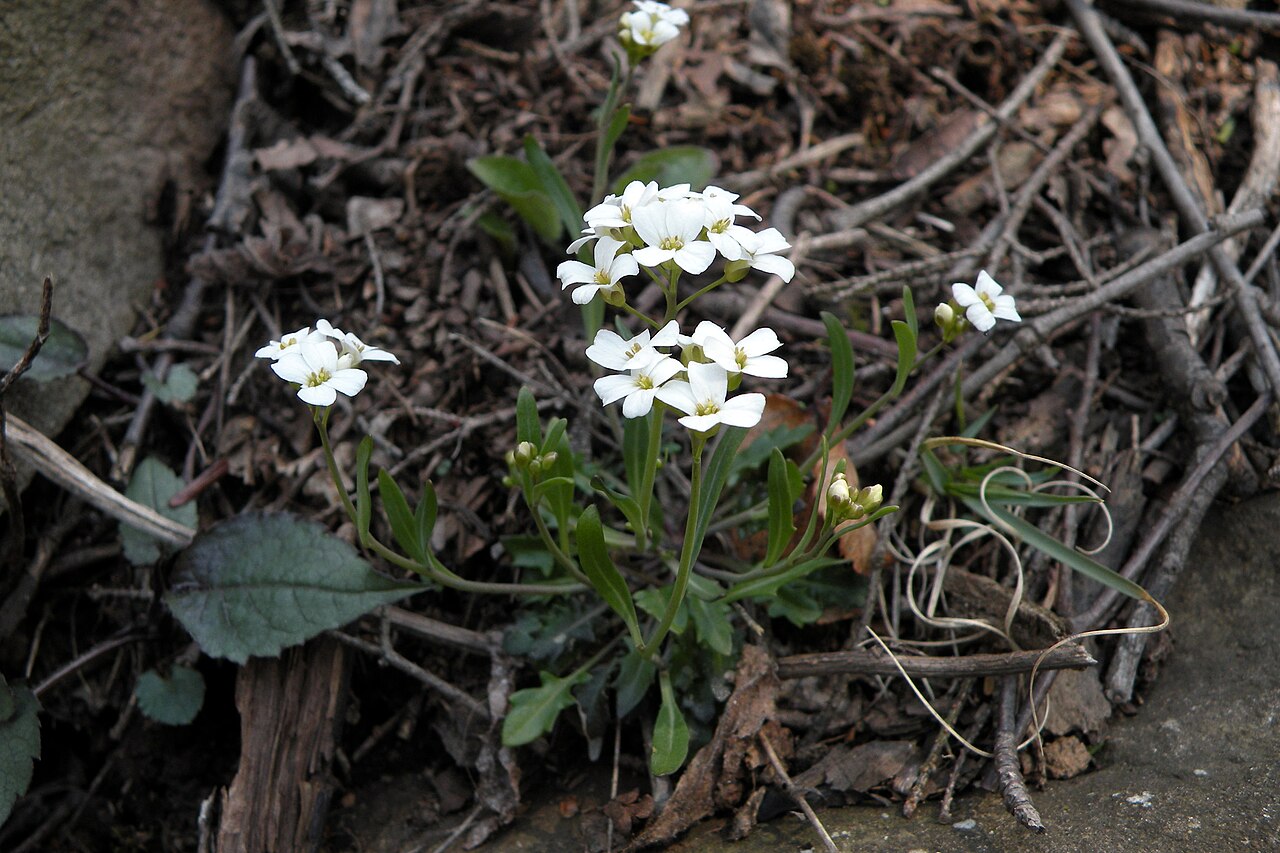
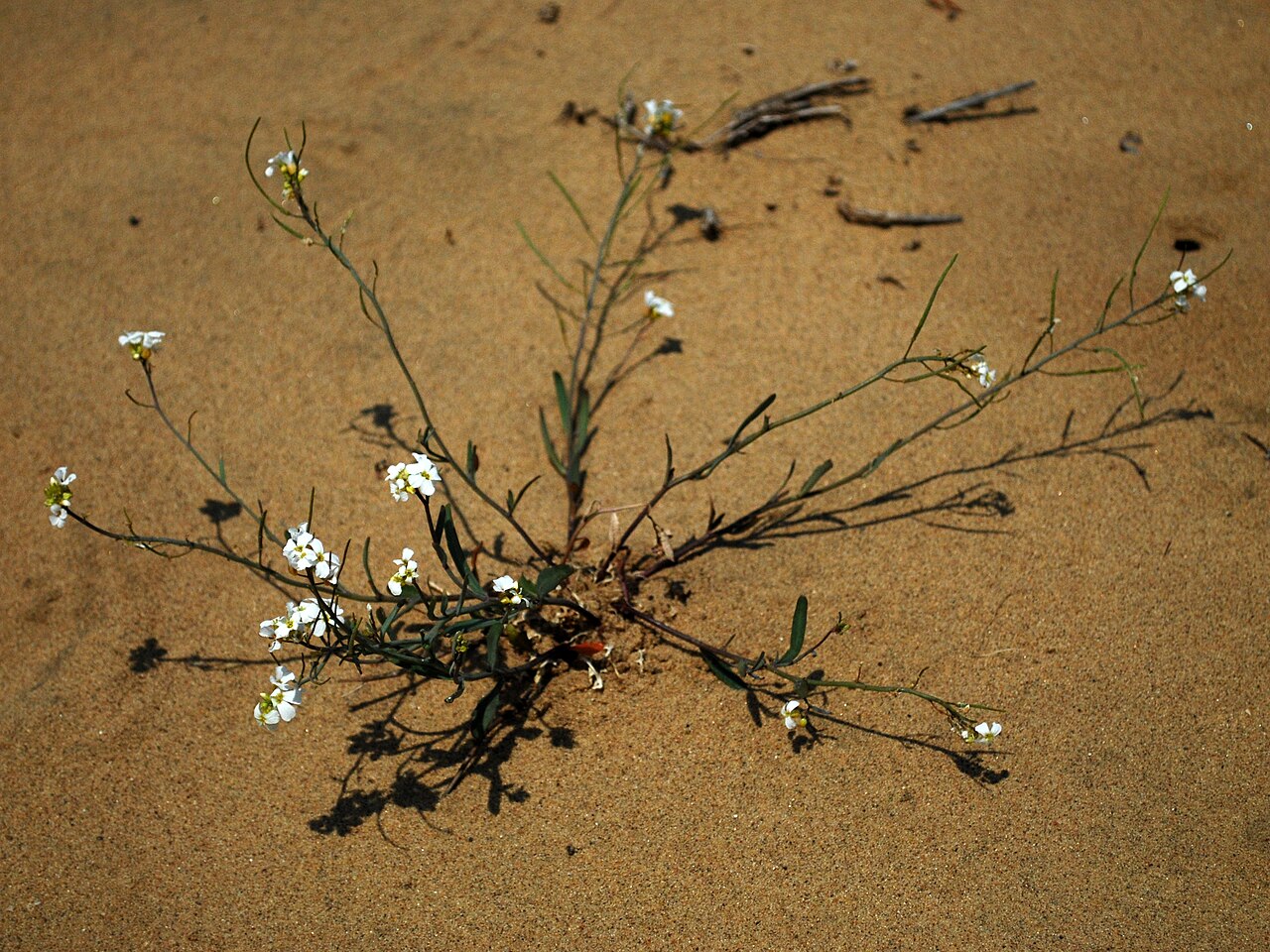
Arabis lyrata, known as Lyreleaf Rockcress (also lyrate or lyre-leaved rockcress), is a small, early-blooming wildflower of the mustard family (Brassicaceae) that makes its home in some of the harshest spots in the eastern landscape: bare sand dunes, gravel bars, limestone and sandstone ledges, cliff faces and thin-soiled barrens. From a flat rosette of lobed leaves it sends up wiry stems 4 to 15 inches tall, topped from April into early summer with loose clusters of bright white, four-petaled flowers.
USDA PLANTS lists the species as Arabis lyrata, but most modern floras, including Flora of North America and many state manuals, place it in Arabidopsis as Arabidopsis lyrata. That makes it a close cousin of thale cress (Arabidopsis thaliana), the most studied plant in biology. Lyreleaf rockcress has become a research plant in its own right: its genome has been sequenced, and scientists use it to study self-incompatibility, adaptation to poor soils and the evolution of perennial life cycles.
For gardeners it is a charming, short-lived perennial for rock gardens, crevice beds, sand gardens and green roofs, where it flowers when little else does and feeds the small bees of early spring. This guide covers how to identify it, where it grows, how to grow it from seed, and what it does for wildlife.
Identification
Lyreleaf rockcress is easy to pass over as just another small white mustard. The best clues are the deeply lobed, lyre-shaped basal leaves, the relatively large white flowers for a plant this small, and its habit of growing on open rock or sand rather than in lawns and fields.
Basal Leaves
The plant starts as a flat rosette of leaves 1 to 2 inches long. Each leaf is lyrate: it has a broad, rounded lobe at the tip and one or more pairs of smaller lobes along the stalk, a little like the outline of a lyre or a fiddle. The leaves are green, often tinged purple in cold weather, and range from nearly smooth to sprinkled with short, stiff hairs. The rosette stays green through most of the winter.
Stems & Stem Leaves
Several slender, wiry stems rise from each rosette, often branching and leaning outward so that larger plants form a loose spray. The few stem leaves are small, narrow and widely spaced, usually without lobes, and do not clasp the stem. This helps separate it from smooth rockcress and other Boechera species, whose stem leaves clasp the stem with ear-like lobes.
Flowers
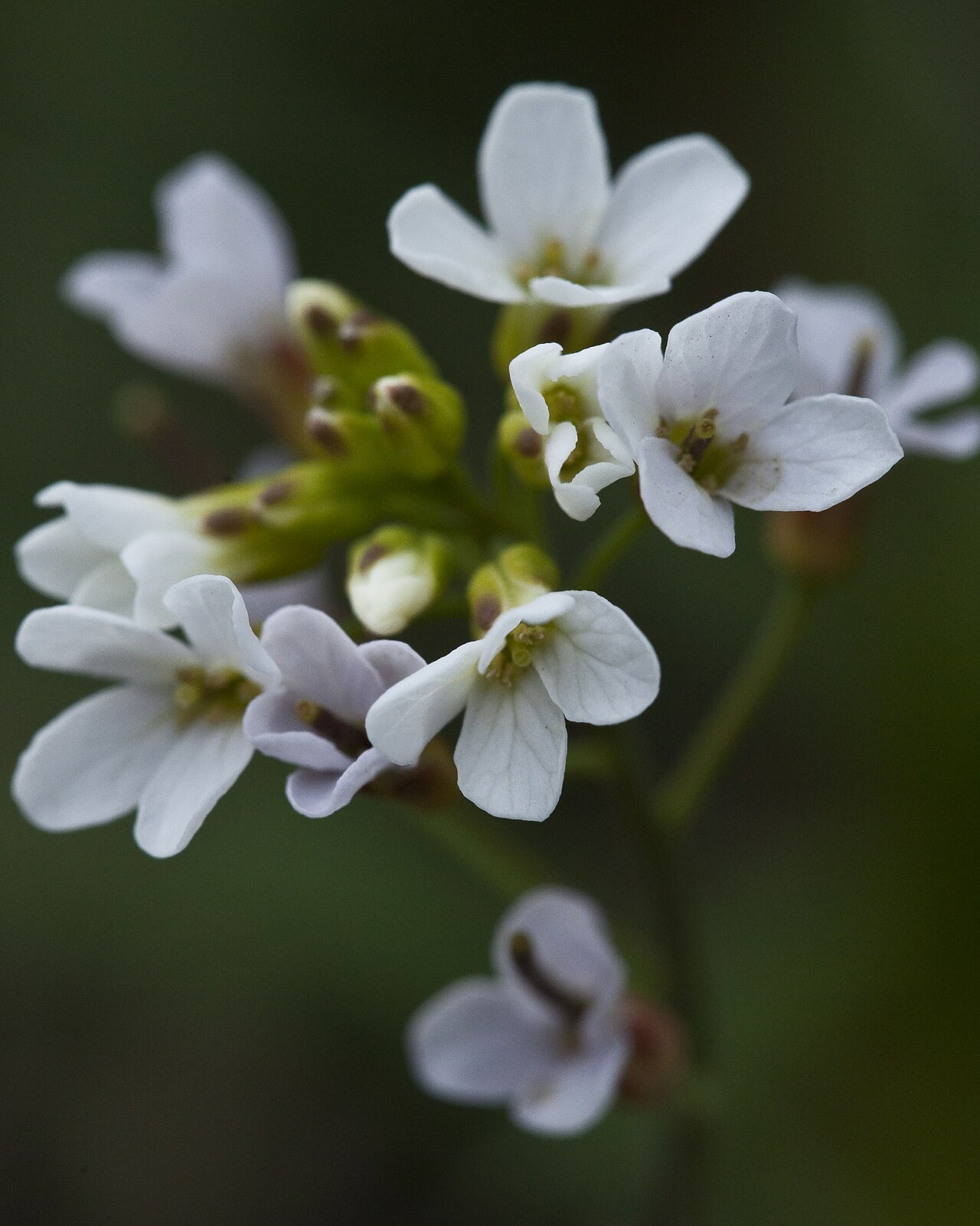
Flowers are borne in loose, elongating clusters at the stem tips. Each is about ¼ to ½ inch across, with four white (occasionally faintly pink) petals arranged in a cross, four short sepals, and six yellow stamens. Bloom begins in April in the South and the lower Midwest and continues into June or later in the North; scattered flowers can appear into late summer. The Alaskan and western form, subsp. kamchatica, has slightly larger flowers and broader leaves.
Fruit & Seeds
After flowering, each blossom becomes a slender, flattened pod (silique) 1 to 1½ inches long, held upward or spreading on a thin stalk. When dry the pod splits along two seams and releases small, brownish seeds in a single row. Plants often flower and set seed in their first or second year.
Look-alikes
Thale cress (Arabidopsis thaliana) is a weedy annual of lawns and disturbed ground with much smaller flowers and unlobed or barely toothed leaves. Tower Mustard (Arabis glabra) is a taller, stiffly upright plant with pale yellowish flowers and long pods pressed against the stem. Hairy rockcress (Arabis hirsuta) has hairy, oblong leaves and stem leaves that clasp the stem.
Quick Facts
| Scientific Name | Arabis lyrata (USDA PLANTS); widely treated as Arabidopsis lyrata |
| Family | Brassicaceae (mustard family) |
| Plant Type | Short-lived herbaceous perennial (sometimes biennial) |
| Mature Height | 4–15 in |
| Mature Spread | 4–10 in |
| Growth Rate | Fast |
| Sun Exposure | Full sun to part shade |
| Water Needs | Low; needs sharp drainage |
| Soil Type | Sand, gravel, rock crevices, thin soil over sandstone or limestone |
| Soil pH | About 5.5–8.0 (acid sand to limestone) |
| Bloom Time | April–June; scattered flowers into summer |
| Flower Color | White |
| Fall Color | Rosettes often turn purplish in cold weather |
| Fruit | Slender, flattened pods 1–1½ in long |
| Deer Resistant | Generally not browsed; too small and sparse to attract deer |
| USDA Hardiness Zones | 2–8 |
Native Range
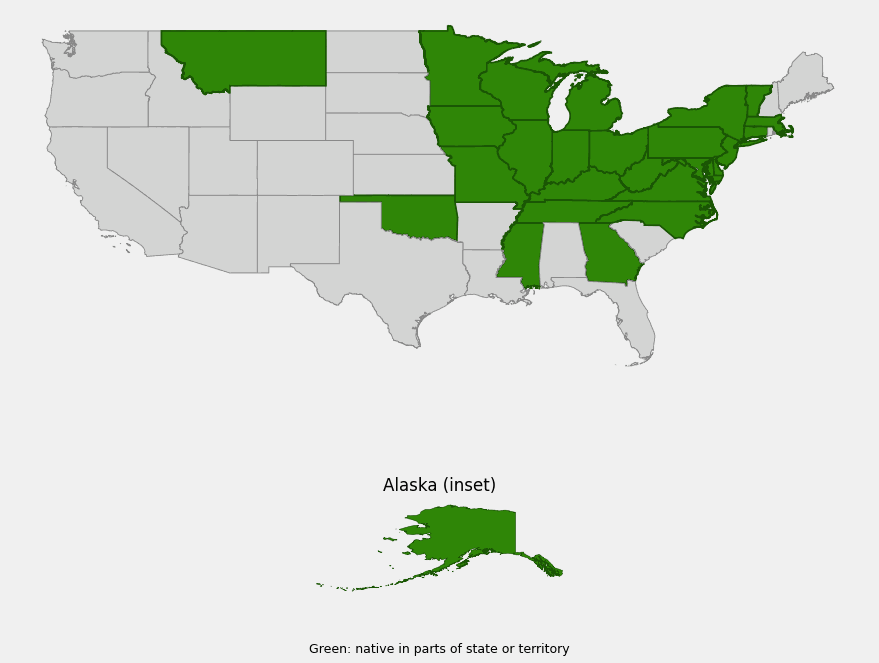
Lyreleaf rockcress has a wide but patchy range in North America. In the lower 48 states USDA PLANTS records it from New England and New York west through the Great Lakes states to Minnesota and Iowa, south through the Appalachians to North Carolina, Tennessee and Georgia, and west to Missouri and Oklahoma, with an isolated record in Montana. In Canada it grows from Quebec and Ontario west through the Prairie Provinces to Alberta, British Columbia and the Northwest Territories, and in Alaska it is represented by subsp. kamchatica, which also ranges across the Bering Strait into eastern Asia.
It is most common in the Great Lakes region and the northern Appalachians, on Lake Michigan and Lake Superior dunes, sand plains, river bluffs and rock outcrops. Farther south it becomes a plant of scattered, specialized habitats: shale and sandstone cliffs, limestone glades and barrens, and granite or sandstone outcrops. Records from Georgia, Mississippi, Delaware and Oklahoma are outlying ones at the southern and western edge of its eastern range, and it is uncommon to rare in those states.
Three subspecies are usually recognized in North America. Subsp. lyrata is the eastern plant described on most of this page. Subsp. kamchatica grows in Alaska, northwestern Canada and northeast Asia, and is now often treated as its own species, Arabidopsis kamchatica; it arose from hybridization between lyreleaf rockcress and a close relative. Related European populations, sometimes called northern rockcress or subsp. petraea, grow on mountain rocks and screes in northern and central Europe.
📋 Regional plant lists featuring Lyreleaf Rockcress: New York, Pennsylvania & Northern New Jersey · Ohio & Indiana · Montana & Wyoming · Michigan, Wisconsin & Eastern Minnesota · Kentucky & Tennessee · Connecticut, Massachusetts & Rhode Island · New Hampshire, Maine & Vermont · Maryland, Virginia & West Virginia · Delaware, Southern New Jersey & Long Island · Illinois, Iowa & Missouri · Alabama, Georgia & Mississippi · Alaska · North & South Carolina · Arkansas, Louisiana, Eastern Oklahoma & Eastern Texas
Growing & Care Guide
Lyreleaf rockcress is not a plant for rich garden beds. It thrives where competition is low and drainage is perfect, which makes it a natural fit for rock gardens, crevice gardens, gravel and sand beds, the cracks of stone walls and shallow green roofs. Individual plants are short-lived, but in the right spot it reseeds and keeps a small colony going on its own.
Light
Give it full sun or light part shade. In the wild it grows on open dunes, sunny ledges and thinly wooded bluffs. In heavy shade it becomes leggy and flowers poorly.
Soil & Water
Use lean, very well-drained soil: coarse sand, gravel, crushed stone, or a gritty mix tucked into the cracks between rocks. It tolerates both acid sand and limestone. Water seedlings and new transplants until they root in, then let rain do the work; established plants handle drought well. Wet, heavy soil and rich compost lead to rot and short lives.
Planting Tips
Plant small, pot-grown plants in spring or early fall, setting the crown slightly above the surrounding grit so water drains away from it. Space plants 6 to 8 inches apart. A topdressing of gravel or coarse sand around the rosette keeps the crown dry and suits the plant better than bark mulch.
Pruning & Maintenance
Little care is needed. Leave some stems to ripen seed if you want new plants to replace the short-lived parents. Hand-pull taller weeds and grasses that would shade the rosettes, and avoid fertilizer, which favors competitors.
Propagation
Grow it from seed. Sow on the surface of a gritty, sandy mix in fall or early spring; the seeds are small and need light, so press them in lightly rather than burying them. Most seed germinates readily without special treatment, and seedlings can flower by their second spring. Collect seed only from plants you have grown or with permission, taking a small share, and never dig plants from cliffs or dunes, where they are often part of rare plant communities.
Landscape Uses
- Rock and crevice gardens: tuck it into gritty pockets between stones for an early wash of white flowers
- Sand and gravel gardens: suits dry, sunny beds of coarse sand or gravel, including dune-style plantings near the Great Lakes
- Green roofs and wall plantings: its shallow roots and drought tolerance suit thin-soil roofs and the joints of dry-stone walls
- Barrens and dune restoration: a natural component of sand savanna, barrens and dune plantings within its native range, from local seed
- Early-season pollinator gardens: flowers in early spring when small native bees are just emerging
Wildlife & Ecological Value
Lyreleaf rockcress is small, but it blooms at a time and in places where few other flowers are available, and it supports several insects that specialize in the mustard family.
For Pollinators
The white flowers offer nectar and pollen to small native bees, including mining bees (Andrena) and sweat bees, as well as small flies and early butterflies. Unlike thale cress, which mostly pollinates itself, lyreleaf rockcress is largely self-incompatible in most of its range: it needs pollen from a different plant to set seed, so insect visits matter to it.
For Birds
Small seed-eating birds such as sparrows and juncos may pick seeds from ripe pods, though the plant is too small to be an important food source.
For Mammals
It has little value to mammals. Rabbits occasionally nibble the rosettes, and the plant is rarely browsed by deer.
Ecosystem Role
Like other mustards, lyreleaf rockcress can serve as a larval host for white and orangetip butterflies, including the falcate orangetip, whose caterpillars feed on flowers and young pods of rockcresses and other wild mustards. On dunes, sand barrens and rock outcrops it is one of the first plants to colonize open ground, and its presence often indicates a high-quality, low-nutrient community that has not been overrun by weeds.
Cultural & Historical Uses
Linnaeus named this plant Arabis lyrata in 1753, the epithet describing its lyre-shaped leaves. In 1997 botanists Steve O’Kane and Ihsan Al-Shehbaz transferred it to Arabidopsis, based on evidence that it is much more closely related to thale cress than to other rockcresses. USDA PLANTS still uses the older name, so gardeners will see both in nursery lists and field guides.
In science, lyreleaf rockcress is famous as the wild perennial counterpart of the lab model Arabidopsis thaliana. Its genome was published in 2011, and researchers compare the two species to learn how genomes shrink or grow, how plants avoid self-pollination, and how a plant adapts to serpentine soils, cold climates or dune sand. Populations in eastern North America, Scandinavia and the Alps have become a natural laboratory for studying adaptation.
There is little recorded traditional use of the plant, which is small and scattered. Like many mustards its leaves are peppery, but it is uncommon in much of its range and should be left in place in the wild.
Frequently Asked Questions
Is lyreleaf rockcress the same as Arabidopsis lyrata?
Yes. USDA PLANTS lists it as Arabis lyrata, while most current floras and scientific papers call it Arabidopsis lyrata. Both names refer to the same plant.
Is lyreleaf rockcress a weed?
No. It is a native perennial of dunes, sand barrens and rock outcrops, and it rarely spreads beyond open, low-competition sites. The weedy little white mustard of lawns and gardens is usually thale cress or hairy bittercress, both of which are introduced.
How long does lyreleaf rockcress live?
Individual plants are short-lived, often only two to four years. In a sunny, gritty spot they reseed, so a colony can persist for many years.
When does lyreleaf rockcress bloom?
Mostly April through June, starting earlier in the South. Plants often keep producing a few flowers into summer.
Can I grow lyreleaf rockcress in a regular garden bed?
It is likely to struggle. It needs very sharp drainage, lean soil and little competition. Grow it in a rock garden, crevice bed, sand bed, container trough or green roof instead.

Looking for a nursery that carries Lyreleaf Rockcress?
Browse our native plant nursery directory: Alaska · Connecticut, Delaware & Georgia · Illinois, Indiana & Iowa · Kentucky, Maryland, Massachusetts, Michigan, Minnesota, Mississippi, Missouri & Montana · New Jersey, New York, North Carolina, Ohio & Oklahoma · Pennsylvania, Tennessee, Vermont & Virginia · West Virginia & Wisconsin

