
Mojave Woodyaster (Xylorhiza tortifolia)
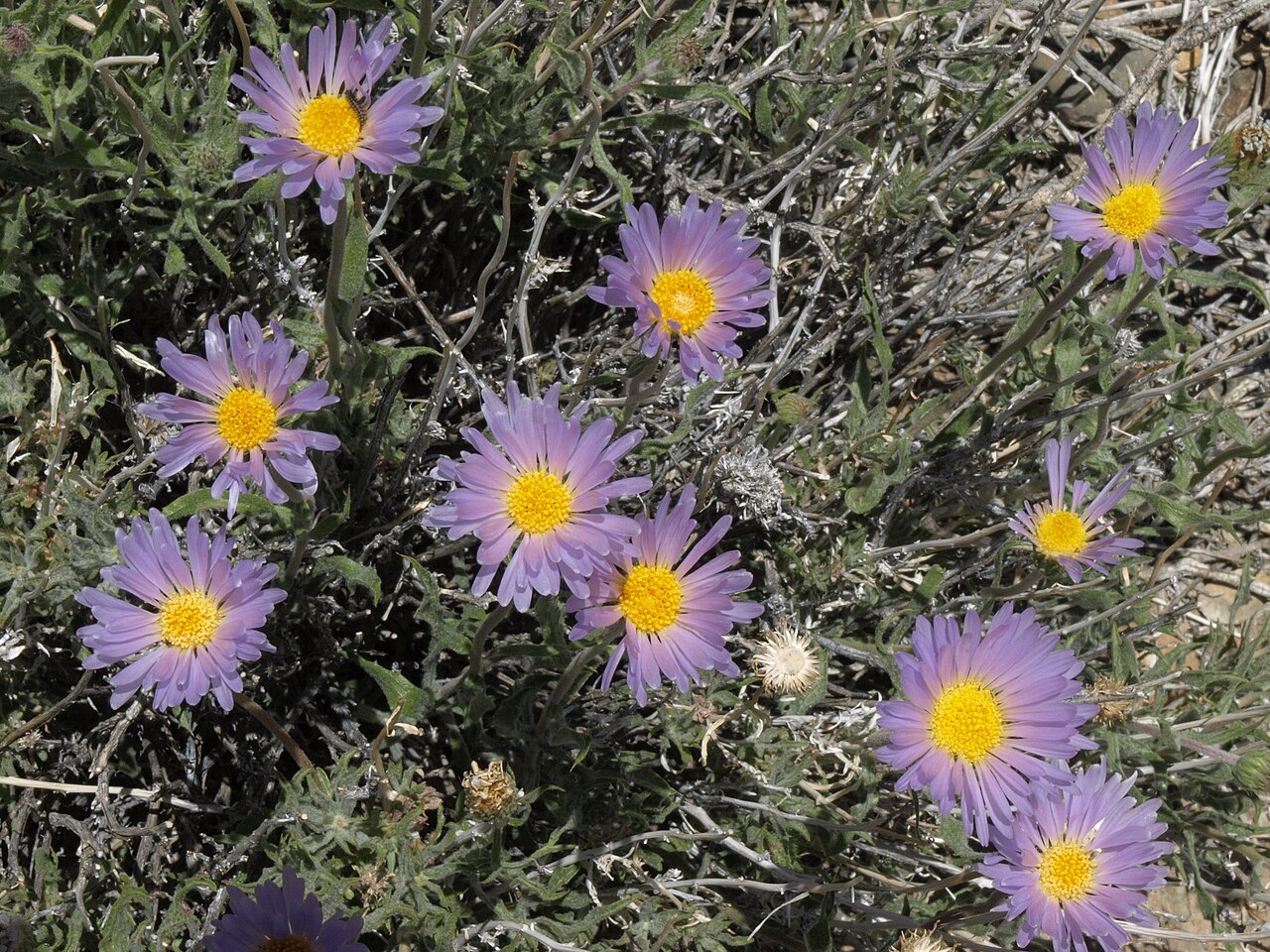
Xylorhiza tortifolia, known as Mojave Woodyaster (USDA: Mojave woodyaster) and often called Mojave aster, is one of the showiest wildflowers of the southwestern deserts. It is a bushy perennial or subshrub in the aster family (Asteraceae), usually 1 to 2 1/2 feet tall, with many gray-green, leafy stems rising from a woody base. In spring, long, nearly leafless stalks hold large, daisy-like flower heads with pale lavender to violet rays around a bright yellow center.
The genus name Xylorhiza means “woody root,” and the species name tortifolia means “twisted leaf,” describing the narrow, often wavy or twisted leaves with spiny-toothed edges. Plants bloom heavily from about March to May after good winter rains, and often bloom again in fall after summer storms.
Mojave woodyaster grows on dry, rocky slopes, washes, desert flats and canyon walls in the Mojave Desert and adjacent Sonoran (Colorado) Desert and Great Basin margins of California, Nevada, Arizona and southwestern Utah. For desert gardeners, it is a drought-tolerant, long-blooming native for rock gardens and xeric plantings, and its flowers are a magnet for native bees and butterflies.
Identification
Mojave woodyaster is the large, lavender “desert daisy” of rocky Mojave slopes. Look for big flower heads on long, bare stalks above a mound of gray, spiny-toothed leaves.
Growth Habit
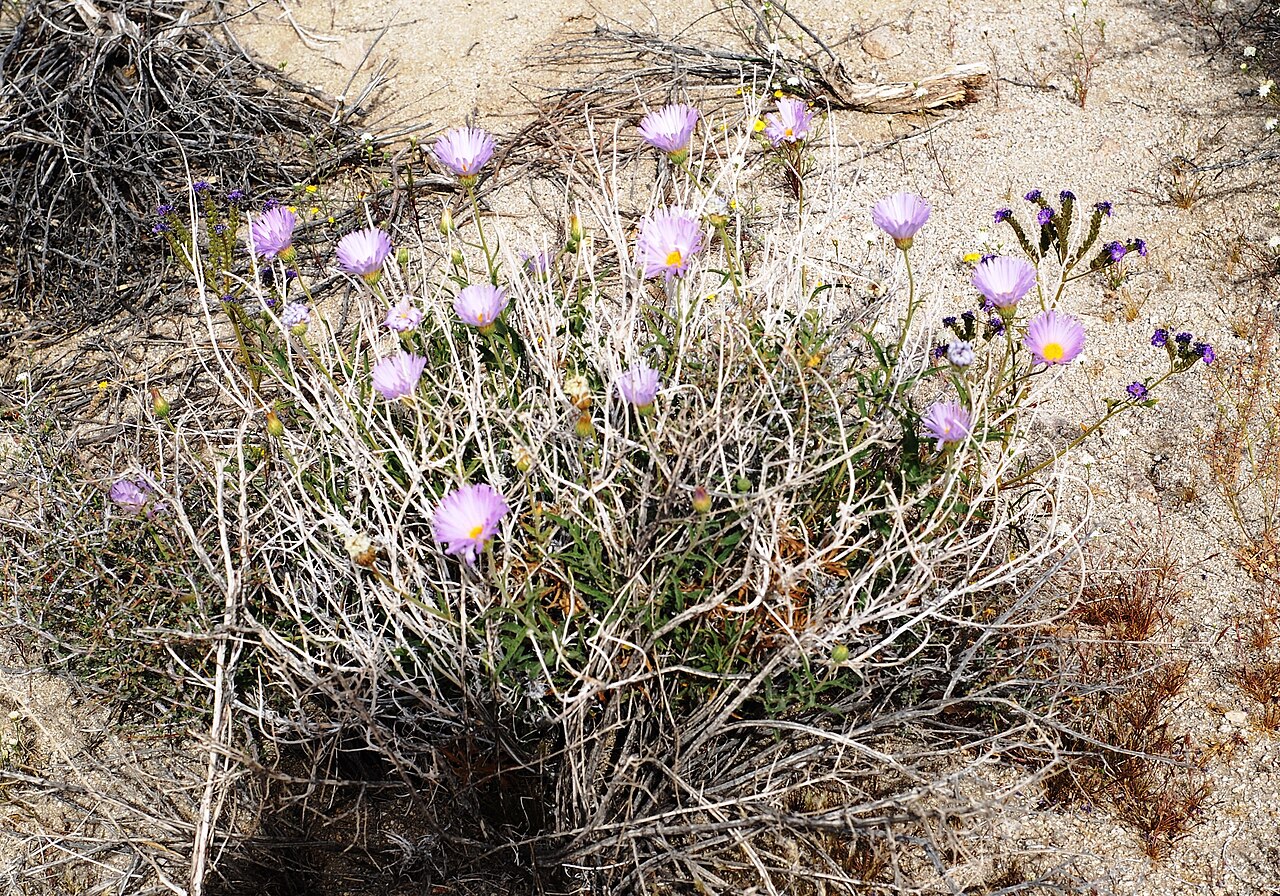
A rounded, many-stemmed perennial or subshrub 1 to 2 1/2 feet tall and about as wide, growing from a thick, woody root and base. Older stems are woody near the ground; the upper stems are herbaceous, gray-green, and often glandular or hairy.
Leaves
Leaves are alternate, narrowly oblong to lance-shaped, 1 to 3 inches long, gray-green and hairy or glandular. The margins have small, spine-tipped teeth, and leaves are often wavy or twisted, the feature behind the name tortifolia. Many leaves drop during summer drought.
Flowers
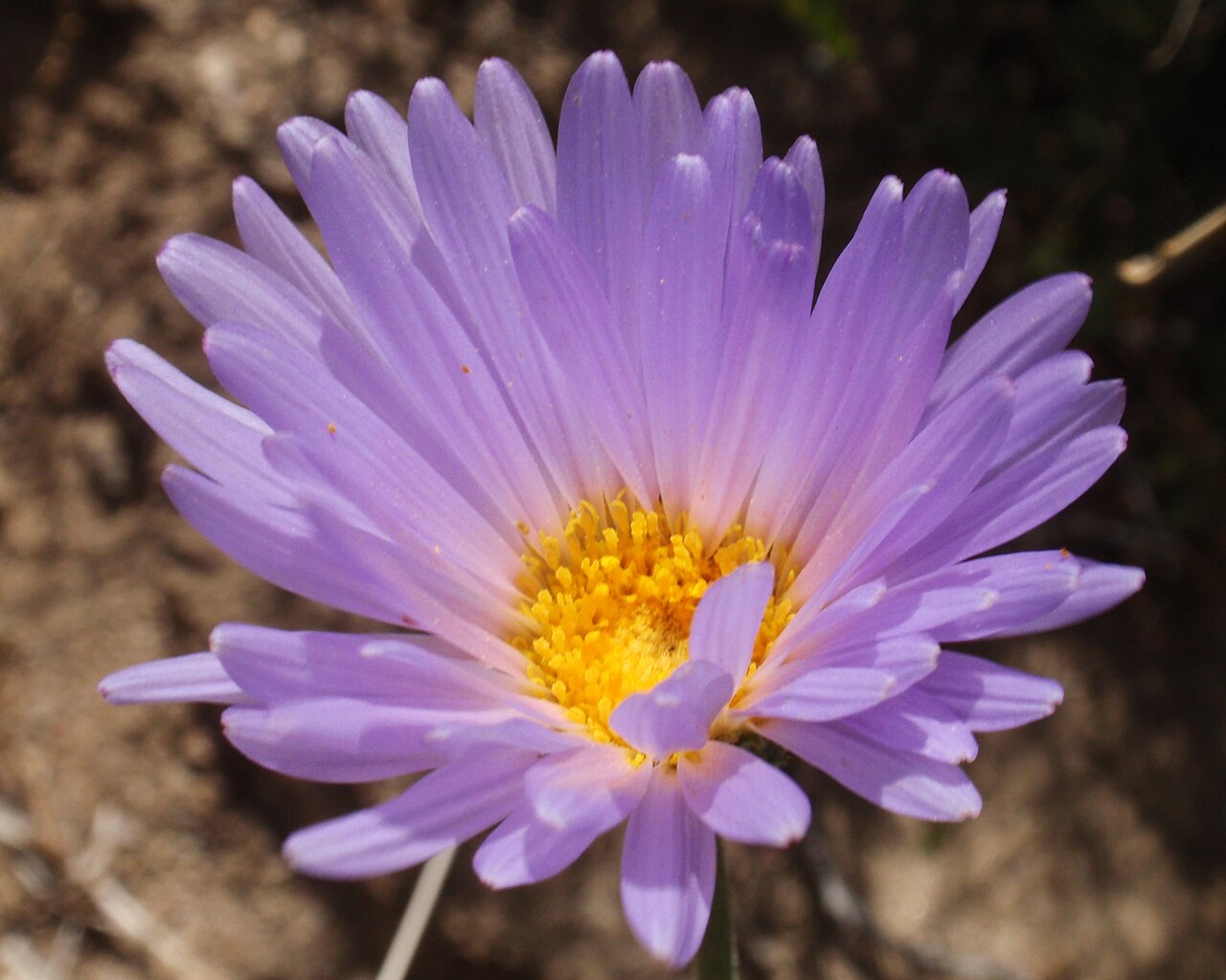
Each long, nearly leafless stalk ends in a single flower head 1 1/2 to 2 1/2 inches across. There are 40 to 60 narrow ray flowers, pale lavender to violet or nearly white, around a large, golden-yellow disk. Bloom peaks from March to May, with a second flush in fall in wet years.
Fruit & Seeds
The flowers produce small, hairy achenes topped with a pappus of bristles that help the seeds blow across the desert.
Look-alikes
Orcutt’s Woodyaster (Xylorhiza orcuttii) of the Colorado Desert is shrubbier, with smooth, hairless, leathery leaves, and is confined to the Colorado Desert of southern California and Baja California. Desert asters such as Dieteria and Machaeranthera species have smaller heads and narrower, softer leaves. Big Bend woodyaster (Xylorhiza wrightii) grows in western Texas and nearby Mexico, far from this species’ range. Two varieties are recognized: var. tortifolia, widespread in the Mojave, and var. imberbis, with smoother herbage, in the Sonoran Desert portion of the range.
Safety
Several woodyasters in the genus Xylorhiza are reported to accumulate selenium when growing on selenium-rich soils, which can make them unpalatable or harmful to livestock that graze them heavily. The plants are not known to be dangerous to touch, but they should not be eaten, and pets and livestock should not browse them.
Quick Facts
| Scientific Name | Xylorhiza tortifolia |
| Family | Asteraceae (aster family) |
| Plant Type | Perennial subshrub with a woody base |
| Mature Height | 1–2 1/2 ft |
| Mature Spread | 1–2 1/2 ft |
| Growth Rate | Moderate |
| Sun Exposure | Full sun |
| Water Needs | Very low; drought tolerant |
| Soil Type | Rocky, gravelly or sandy, well-drained soil |
| Soil pH | About 7.0–8.5 (neutral to alkaline) |
| Bloom Time | March–May; again in fall after rains |
| Flower Color | Pale lavender to violet with yellow center |
| Fall Color | Not significant |
| Fruit | Hairy achene with bristly pappus |
| Deer Resistant | Yes |
| USDA Hardiness Zones | 7–10 |
Native Range
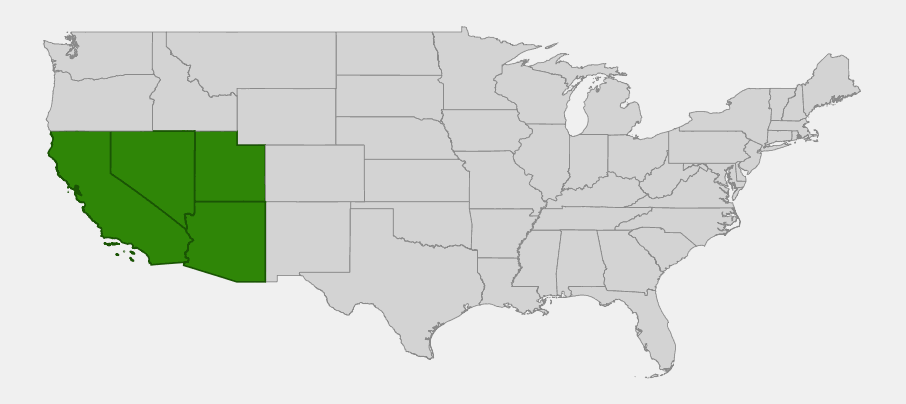
Mojave woodyaster is native to the deserts of the southwestern United States. USDA PLANTS lists it as native in the lower 48 states, with records from Arizona, California, Nevada and Utah. The Lady Bird Johnson Wildflower Center describes its range as southwestern Utah south to western Arizona and southeastern California.
It is most common in the Mojave Desert of southeastern California and southern Nevada, including Death Valley, the Mojave National Preserve and Joshua Tree National Park. It extends into the Great Basin margins of Inyo and Mono counties, California, into the Colorado (Sonoran) Desert of southeastern California and western Arizona, and northeast to the Virgin River region of southwestern Utah and Arizona Strip.
Typical habitats are dry, rocky slopes and hillsides, canyon walls, alluvial fans, gravelly washes and desert flats, often in creosote bush scrub, blackbrush scrub and Joshua tree woodland. It favors well-drained, rocky or gravelly soils.
📋 Regional plant lists featuring Mojave Woodyaster: Utah & Western Colorado · Arizona & New Mexico · California & Nevada
Growing & Care Guide
Mojave woodyaster is a rewarding plant for desert gardens in the Southwest. It needs sun, sharp drainage and very little water. It is offered by some native plant nurseries and seed suppliers in California, Nevada and Arizona.
Light
Full sun. In shade it becomes leggy and flowers poorly.
Soil & Water
Grow it in rocky, gravelly or sandy soil with excellent drainage; it tolerates alkaline soil. Water occasionally during its first year to help it establish, then only during long droughts. Overwatering, especially in summer, and heavy clay soils lead to root rot and short life.
Planting Tips
Plant in fall or late winter so the roots can establish during cooler weather. Give it a sunny spot in a rock garden, on a slope or in a gravel bed with other desert natives. Space plants 2 to 3 feet apart.
Pruning & Maintenance
After the spring bloom, cut back spent flower stalks to tidy the plant. In late summer, plants may look dry and partly leafless; this is normal summer dormancy. Avoid fertilizing.
Propagation
Grow from fresh seed sown in fall or winter on the surface of a sandy mix; germination is often best with fluctuating cool temperatures. Seedlings need excellent drainage and careful watering. Cuttings from young growth can also root in a sandy medium.
Landscape Uses
- Desert and xeric gardens: large lavender daisies with very little water
- Rock gardens and slopes: thrives in rocky, fast-draining soils
- Pollinator gardens: feeds native bees, butterflies and beetles in spring
- Desert habitat restoration: part of creosote bush and Joshua tree communities
- Roadside and wildland revegetation: tough, drought-tolerant native for disturbed desert sites
Wildlife & Ecological Value
In spring, Mojave woodyaster is one of the most visited flowers in the desert, supporting a wide range of pollinators and insects.
For Pollinators
The large flower heads offer abundant pollen and nectar to native bees, including many solitary desert bees, as well as butterflies, bee flies and beetles. Its long bloom in spring makes it an important food source in good wildflower years.
For Birds
Seed-eating birds such as sparrows and finches eat the seeds, and the shrubby clumps provide shelter for small birds and lizards.
For Mammals
Small mammals may nibble the flowers and young leaves. Larger browsers usually avoid it, and it may accumulate selenium on some soils.
Ecosystem Role
As a long-lived perennial on rocky slopes and washes, it helps stabilize desert soils and provides structure and food in desert scrub communities, especially after wet winters.
Cultural & Historical Uses
The species was first described in the 1800s from collections made in the Southwest by early botanical explorers, originally under the genus Aster. Edward Lee Greene later moved it to Xylorhiza, a genus of about eight species of woody asters native to the deserts and dry plateaus of western North America.
Mojave woodyaster is one of the signature flowers of spring wildflower displays in Death Valley, Joshua Tree and Mojave National Preserve, often blooming alongside desert marigold, brittlebrush and globemallows. Its pale lavender color is often noted for looking delicate in such a harsh landscape.
Native plant societies and botanic gardens in the desert Southwest promote Mojave woodyaster as an ornamental for water-wise gardens, and its seed is available from native seed suppliers for habitat restoration in the Mojave.
Frequently Asked Questions
Is Mojave woodyaster the same as Mojave aster?
Yes. Mojave aster is a common name for the same plant. USDA uses the name Mojave woodyaster, and older books list it as Aster tortifolius or Machaeranthera tortifolia.
When does Mojave woodyaster bloom?
Mainly from March to May, with the best displays after wet winters. Plants often bloom again in fall after summer thunderstorms.
Can I grow Mojave woodyaster in my garden?
Yes, in hot, dry climates with full sun and well-drained, rocky or sandy soil. It needs very little water and dislikes rich soil and summer irrigation.
Is it toxic to livestock?
Woodyasters can accumulate selenium on some soils and are reported to be harmful to livestock that eat large amounts. Pets and livestock should not browse it.
Where can I see it in the wild?
Look on rocky slopes and washes in Joshua Tree National Park, Death Valley National Park and Mojave National Preserve in spring, especially after a wet winter.

Looking for a nursery that carries Mojave Woodyaster?
Browse our native plant nursery directory: Arizona · California · Nevada · Utah