
Poke Milkweed (Asclepias exaltata)
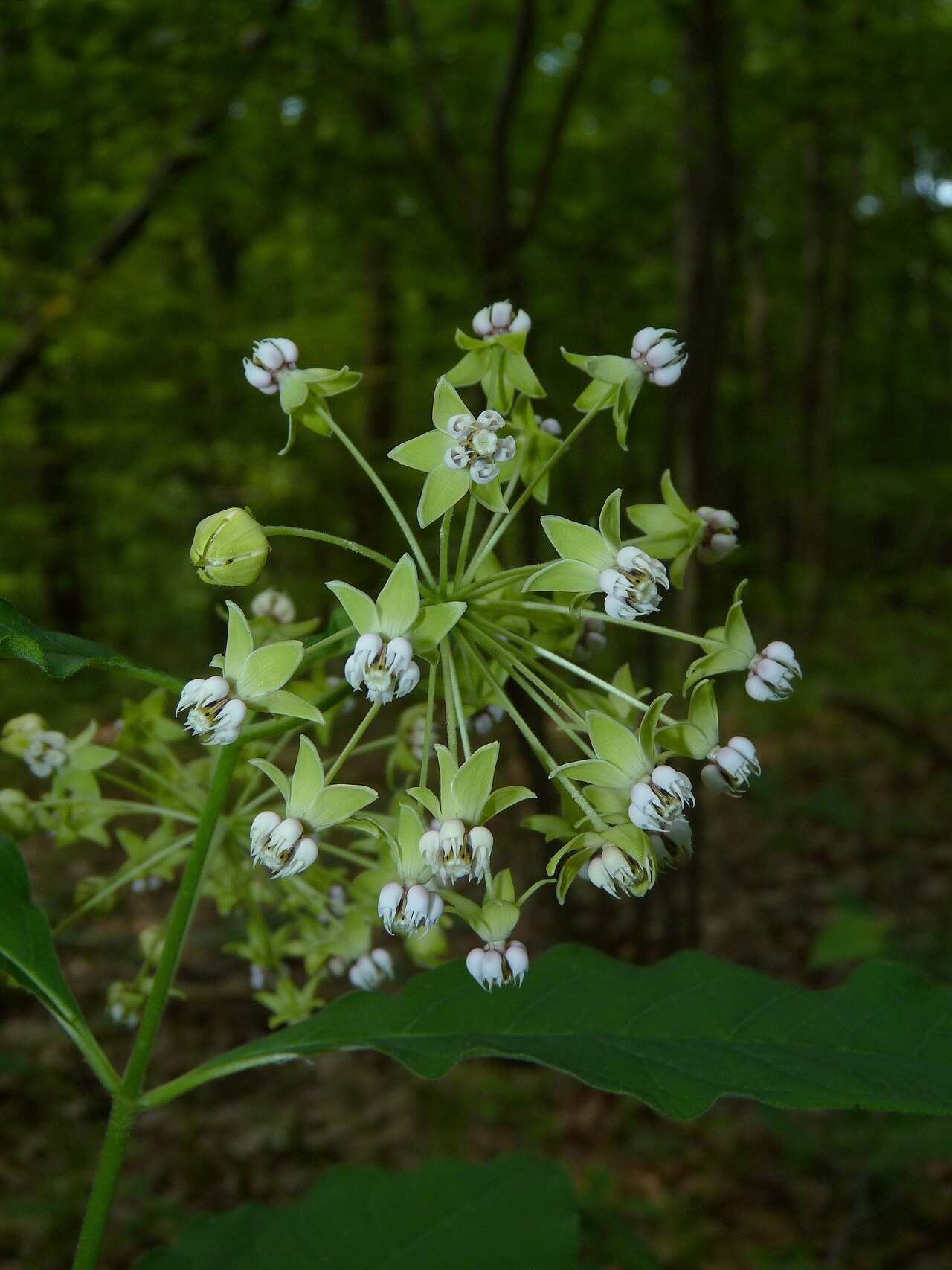
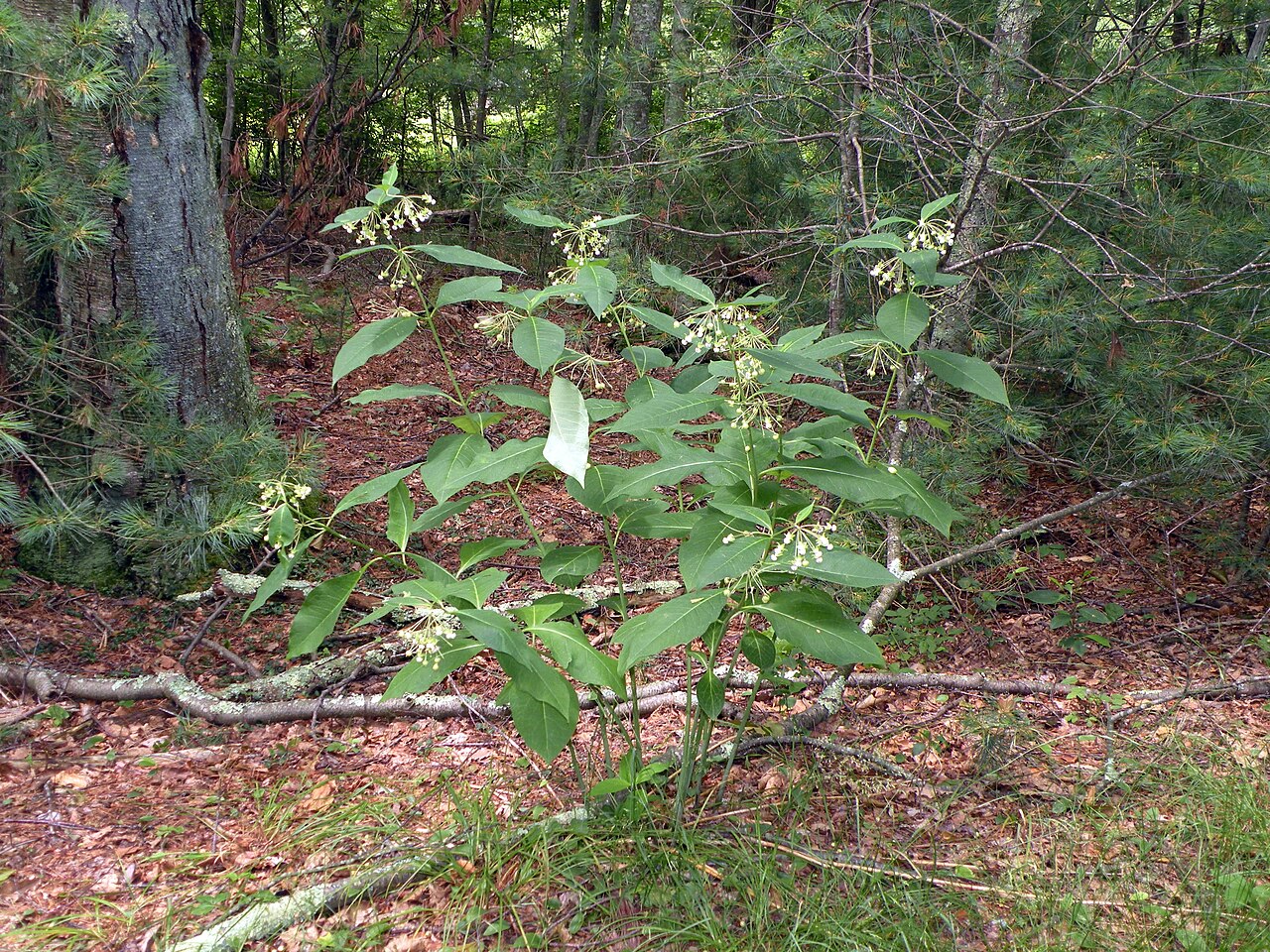
Asclepias exaltata, known as Poke Milkweed or tall milkweed (and once as Asclepias phytolaccoides), is the woodland milkweed of eastern North America. Unlike most milkweeds, which grow in sunny fields and prairies, it is a plant of forests and forest edges. It grows 2 to 5 feet tall on a single stem with broad, thin leaves, and in early summer it hangs out loose, drooping clusters of green-and-white flowers on long, slender stalks.
The common name comes from its leaves, which resemble those of pokeweed (Phytolacca americana); the old name A. phytolaccoides means “pokeweed-like.” Like all milkweeds, it belongs to the dogbane family (Apocynaceae), has milky sap, and produces seed pods that split to release silky-tufted seeds.
Poke milkweed is a valuable host plant for monarch butterflies and other milkweed insects in shady places where other milkweeds cannot grow. It also contains toxic cardiac glycosides, as all milkweeds do, so read the safety notes below. This guide covers identification, range, growing tips and its value to wildlife.
Identification
Poke milkweed is easy to recognize once you have seen it: a tall, single-stemmed milkweed of the woods, with large, thin leaves and loose, nodding flower clusters on long, thread-like stalks.
Stem & Leaves
The plant usually has a single unbranched stem 2 to 5 feet tall (occasionally to 6 feet), smooth or slightly hairy, rising from a deep root. The leaves are opposite, broadly oval to elliptical, 4 to 9 inches long and 1½ to 4 inches wide, thin in texture, pointed at both ends, and on short stalks. They are dark green above and paler, often finely hairy, below. When broken, the stems and leaves bleed white, milky sap.
Flowers
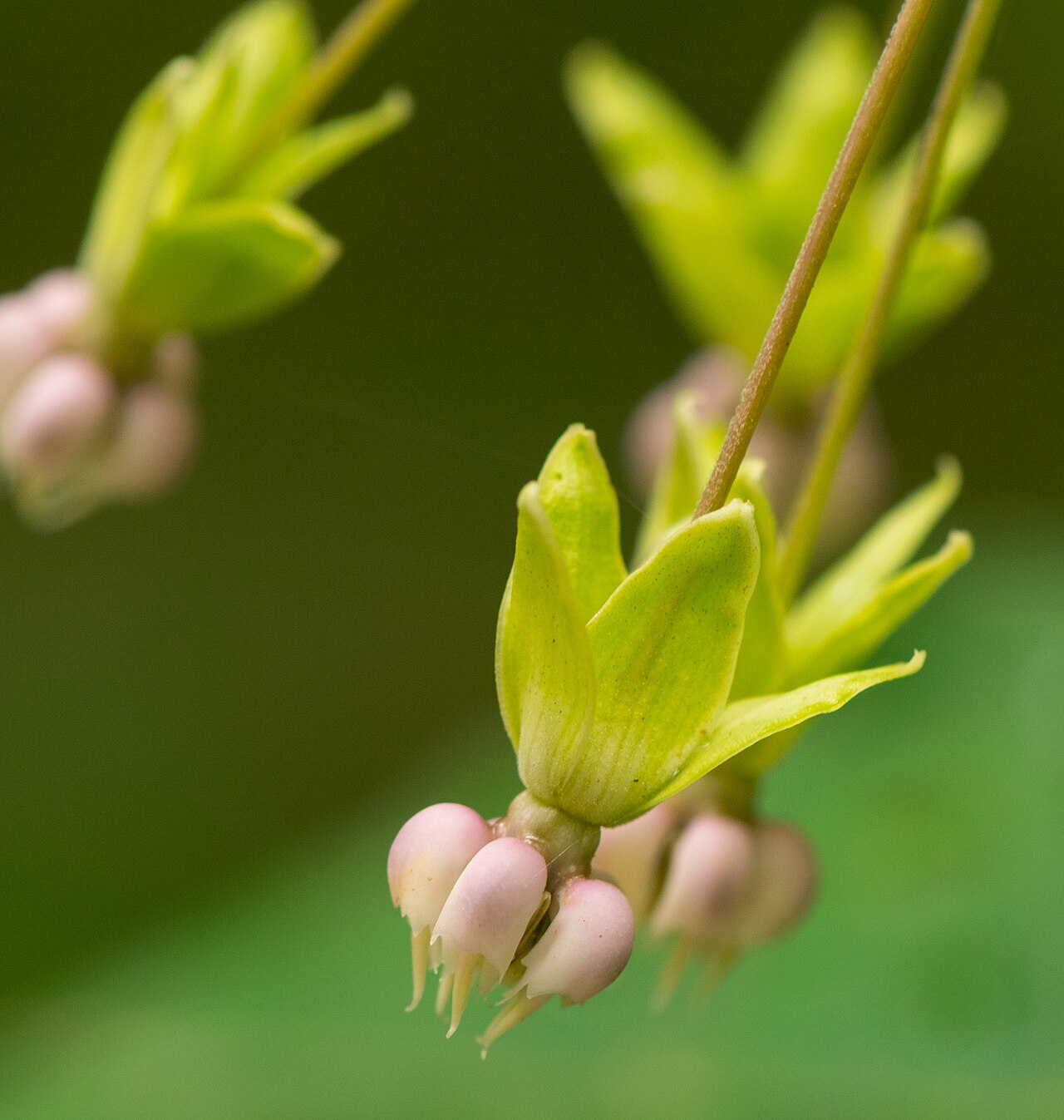
From about late May to July, the plant produces one to several flower clusters (umbels) from the upper leaf axils. Each cluster has 10 to 30 or more flowers on long, slender stalks, 1 to 3 inches long, so the cluster is loose, open and often drooping, quite unlike the tight round heads of common milkweed. Each flower is about ½ inch long. The five petals are pale green, sometimes tinged with purple, and bend sharply back. Above them is the crown of five hoods, white to pale pink or lavender, which hold nectar.
Fruit & Seeds
Pollinated flowers develop into slender, spindle-shaped pods 4 to 6 inches long, smooth and held upright on curved stalks. In late summer and fall the pods split along one side to release flat brown seeds, each with a tuft of silky white hairs that carries it on the wind. Poke milkweed often produces few pods, since only a small fraction of milkweed flowers are successfully pollinated.
Similar Species
Common milkweed (Asclepias syriaca) has thicker, hairier leaves and dense, round clusters of pink-purple flowers, and it grows in sun. Where they meet, the two species occasionally hybridize. Pokeweed, despite its similar leaves, has no milky sap and bears long clusters of white flowers that become dark purple berries.
Quick Facts
| Scientific Name | Asclepias exaltata (syn. A. phytolaccoides) |
| Family | Apocynaceae (dogbane family; milkweed subfamily) |
| Plant Type | Herbaceous perennial |
| Mature Height | 2–5 ft (occasionally to 6 ft) |
| Mature Spread | 1–2 ft |
| Growth Rate | Slow to moderate |
| Sun Exposure | Part shade to light shade; tolerates morning sun |
| Water Needs | Moderate; evenly moist, well-drained soil |
| Soil Type | Rich loam with leaf litter; also sandy or rocky woodland soils |
| Soil pH | About 5.0–7.0 |
| Bloom Time | Late May–July |
| Flower Color | Green petals with white to pale pink or lavender hoods |
| Fall Color | Leaves turn yellow |
| Fruit | Slender upright pod with silky-tufted seeds |
| Deer Resistant | Yes, usually; the toxic sap deters browsing |
| USDA Hardiness Zones | 3–8 |
Native Range
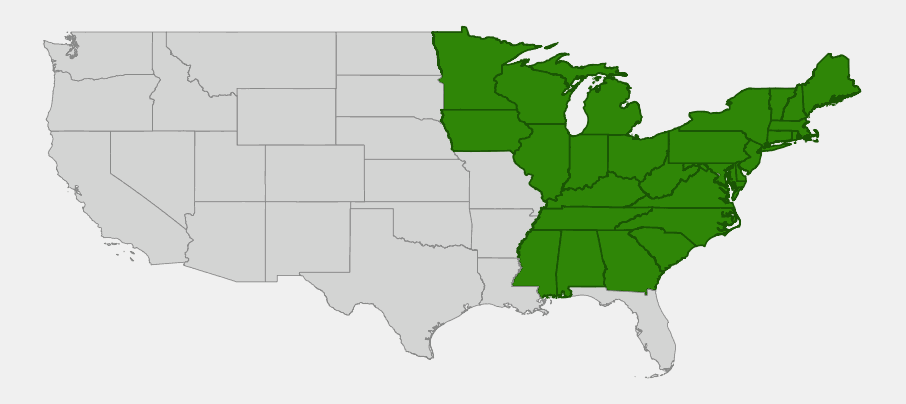
Poke milkweed is native to the eastern United States and southeastern Canada. USDA PLANTS records it from 27 states, from Maine, New Hampshire and Vermont west through New York, Pennsylvania and the Great Lakes states to Minnesota and Iowa, and south along the Appalachians and the Ohio Valley to Georgia, Alabama and Mississippi. In Canada it occurs in southern Ontario and southern Quebec.
It is most common in the Appalachian Mountains and the forests of New England, New York, Pennsylvania and the upper Midwest. In the South it is largely confined to the mountains and upper Piedmont, and in Mississippi, Iowa and Minnesota it is near the edge of its range. It is local or uncommon in several states, and it is tracked as a rare plant in some of them.
It grows in deciduous and mixed forests, especially in moist to fairly dry upland woods, forest edges and openings, rocky slopes, and the margins of streams. It is often found under partial canopy of oak, maple, beech, hemlock or pine, and it tolerates more shade than any other milkweed in its range.
📋 Regional plant lists featuring Poke Milkweed: New York, Pennsylvania & Northern New Jersey · Ohio & Indiana · Michigan, Wisconsin & Eastern Minnesota · Kentucky & Tennessee · Connecticut, Massachusetts & Rhode Island · New Hampshire, Maine & Vermont · Maryland, Virginia & West Virginia · Delaware, Southern New Jersey & Long Island · Illinois, Iowa & Missouri · Alabama, Georgia & Mississippi · North & South Carolina
Growing & Care Guide
Poke milkweed is the best milkweed for shady gardens, and it is increasingly offered by native plant nurseries in the East. It is slower to establish than sun-loving milkweeds, but once settled it is long-lived and needs little care.
Light
Plant in part shade or the light, dappled shade of open woodland. Morning sun with afternoon shade is ideal. In deep shade it grows but flowers sparsely; in full sun and dry soil it struggles.
Soil & Water
Give it rich, evenly moist but well-drained soil with plenty of organic matter, like a natural forest floor. It tolerates somewhat dry woodland soils once established. Water during dry spells in the first year or two. No fertilizer is needed.
Planting Tips
Plant small container plants in spring or early fall. Poke milkweed develops a deep root and resents being moved, so choose the spot carefully. Space plants about 18 to 24 inches apart. Grow it at the edge of a woodland garden, along a shady path or among ferns and other woodland perennials, where its drooping flower clusters can be seen up close.
Pruning & Maintenance
Little maintenance is needed. Leave the foliage for monarch and other caterpillars. Aphids, especially the bright yellow oleander aphid, often gather on milkweeds; they rarely cause serious harm and attract ladybugs and other predators. Wear gloves when handling the plant, and wash your hands afterward, since the milky sap is toxic and irritating to the eyes.
Propagation
Grow from seed collected from pods just as they begin to split. Give the seeds 30 to 60 days of cold, moist stratification, or sow them outdoors in fall. Seedlings grow slowly and usually take two to three years to bloom. Because of the deep root, starting seedlings in deep pots and planting them out young gives the best results.
Landscape Uses
- Shade and woodland gardens: one of the few milkweeds that thrives in part shade
- Monarch habitat: a host plant for monarch caterpillars in wooded landscapes
- Pollinator gardens: its nectar attracts bumblebees, butterflies and hummingbird moths
- Forest edge restoration: within its native range, in woodland openings and edges
- Native plant collections: an unusual milkweed with elegant, drooping flower clusters
Wildlife & Ecological Value
Like other milkweeds, poke milkweed supports a specialized community of insects, and it extends milkweed habitat into the shady forests where other species do not grow.
For Pollinators
The fragrant flowers produce abundant nectar and are visited by bumblebees, other large bees, swallowtail and fritillary butterflies, and hummingbird clearwing moths. Milkweed pollen is packed into paired sacs (pollinia) that clip onto the legs of visiting insects, which carry them to the next flower. Ruby-throated hummingbirds also sometimes visit.
For Birds
Hummingbirds take nectar from the flowers, and some birds, including orioles and other songbirds, use the silky seed fibers or the stem fibers as nest material.
For Mammals
Deer and other mammals generally avoid milkweeds because of their bitter, toxic sap. The cardiac glycosides in all parts of the plant can poison livestock, pets and people if eaten. Keep children and pets from eating the plant, and wash hands after handling it.
Ecosystem Role
Poke milkweed is a host plant for monarch butterfly caterpillars, which store the plant’s toxins and become distasteful to predators. It is also eaten by milkweed tussock moth caterpillars, red milkweed beetles and other milkweed specialists. Because it grows in forests rather than fields, it provides breeding habitat for monarchs and other milkweed insects in heavily wooded regions such as the Appalachians and northern New England.
Cultural & Historical Uses
Linnaeus named Asclepias exaltata in the eighteenth century; the epithet means “tall” or “lofty.” The genus honors Asclepius, the Greek god of medicine. Frederick Pursh later described the same plant as Asclepias phytolaccoides, the pokeweed-like milkweed, a name used in many nineteenth- and early twentieth-century books.
Native peoples and early settlers in eastern North America used several milkweeds for fiber, food and medicine. The tough stem fibers of milkweeds were twisted into cordage, and the silky seed fibers were used as stuffing. Milkweeds are toxic, however, and should not be eaten or used as medicine without expert knowledge.
Today poke milkweed is valued by gardeners and conservationists as a monarch host plant for shady sites. Its graceful, drooping flower clusters are less showy than those of butterfly weed or common milkweed, but they are among the most elegant of any North American milkweed.
Frequently Asked Questions
Is poke milkweed poisonous?
Yes. Like all milkweeds, it contains cardiac glycosides that are toxic to people, pets and livestock if eaten, and the milky sap can irritate skin and eyes. Wear gloves when handling it, wash your hands afterward, and plant it away from areas where livestock graze.
Does poke milkweed grow in shade?
Yes. It is the most shade-tolerant milkweed in eastern North America and grows best in part shade or dappled woodland light, not in full sun.
Do monarchs use poke milkweed?
Yes. Monarch butterflies lay eggs on poke milkweed, and the caterpillars feed on its leaves. It is especially useful in wooded areas where sun-loving milkweeds cannot grow.
Why is it called poke milkweed?
Its broad, thin leaves look like those of pokeweed (Phytolacca americana). Its older scientific name, Asclepias phytolaccoides, means “pokeweed-like milkweed.”
How long does it take to bloom from seed?
Usually two to three years. Seedlings first build a deep root system. Once established, plants can live for many years.

Looking for a nursery that carries Poke Milkweed?
Browse our native plant nursery directory: Alabama · Connecticut, Delaware & Georgia · Illinois, Indiana & Iowa · Kentucky, Maine, Maryland, Massachusetts, Michigan, Minnesota & Mississippi · New Hampshire, New Jersey, New York, North Carolina & Ohio · Pennsylvania, Rhode Island, South Carolina, Tennessee, Vermont & Virginia · West Virginia & Wisconsin