
Ram’s-head Lady’s Slipper (Cypripedium arietinum)
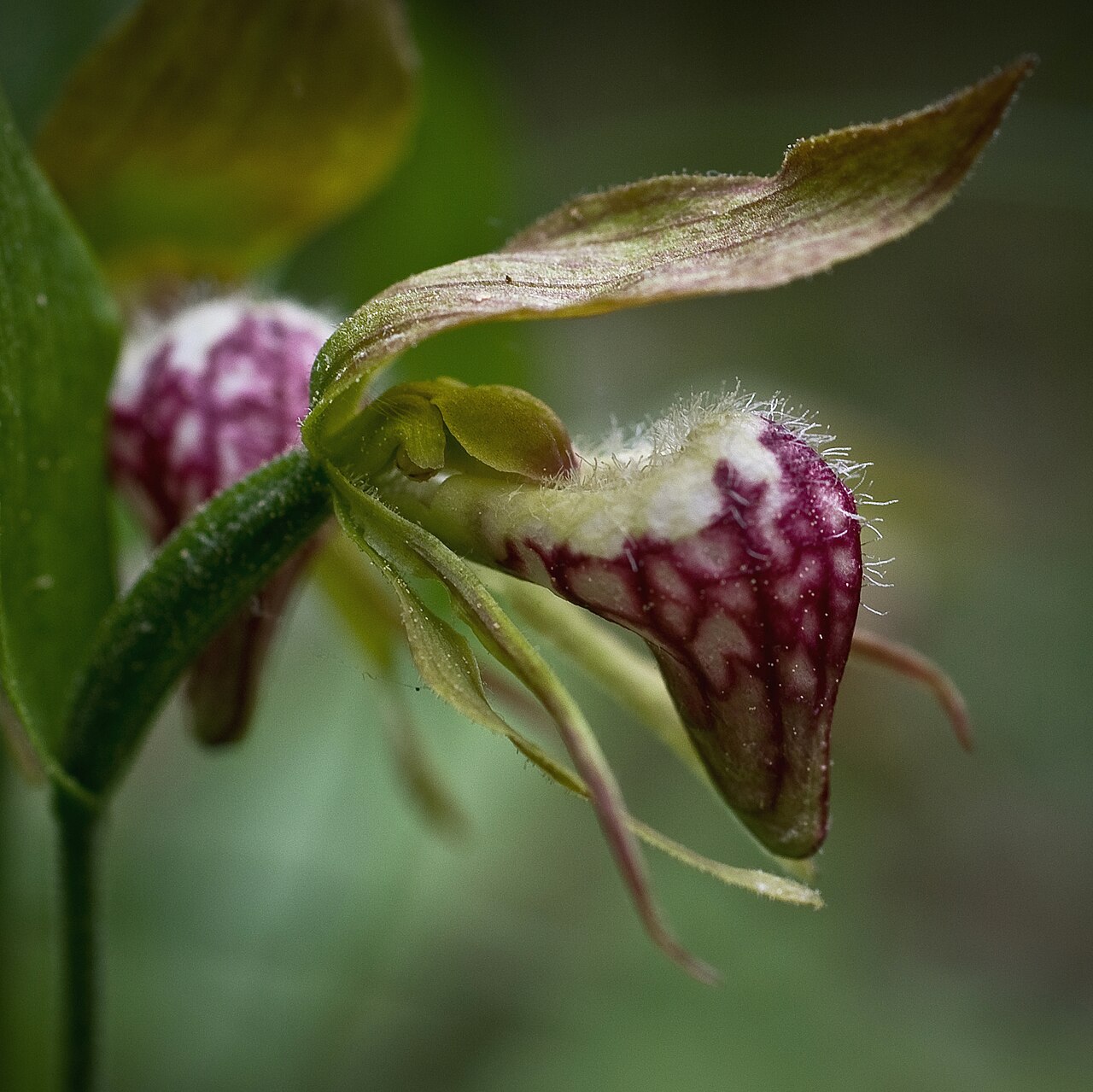
Cypripedium arietinum, the Ram’s-head Lady’s Slipper, is one of the smallest and rarest lady’s slipper orchids in North America. Its single flower is only about an inch tall, with a cone-shaped white pouch netted with crimson veins that points downward like the snout of a ram, framed by narrow, twisted, brownish petals and sepals that suggest a ram’s horns. It grows in cool northern forests, cedar swamps and limestone shores from the Great Lakes to New England and eastern Canada.
Never dig ram’s-head lady’s slipper from the wild. NatureServe ranks it globally vulnerable (G3), and it is critically imperiled (S1) in Maine, New Hampshire, Vermont and Massachusetts and has not been seen in Connecticut in many years. Wild orchids almost never survive transplanting, and every plant removed harms a small population. This page is an identification and appreciation guide.
If you find one, enjoy it where it grows, photograph it without trampling the area around it, and consider reporting it to your state’s natural heritage program. Botanists often find this tiny orchid in groups, so watch where you step.
Identification
Ram’s-head lady’s slipper is easy to overlook because it is so small, but its flower is unlike any other North American orchid. It is the only lady’s slipper in eastern North America with three separate sepals, and its small, pointed, white-and-crimson pouch is distinctive. Its larger relatives include Pink Lady’s Slipper, Yellow Lady’s Slipper and Showy Lady’s Slipper.
Growth Habit
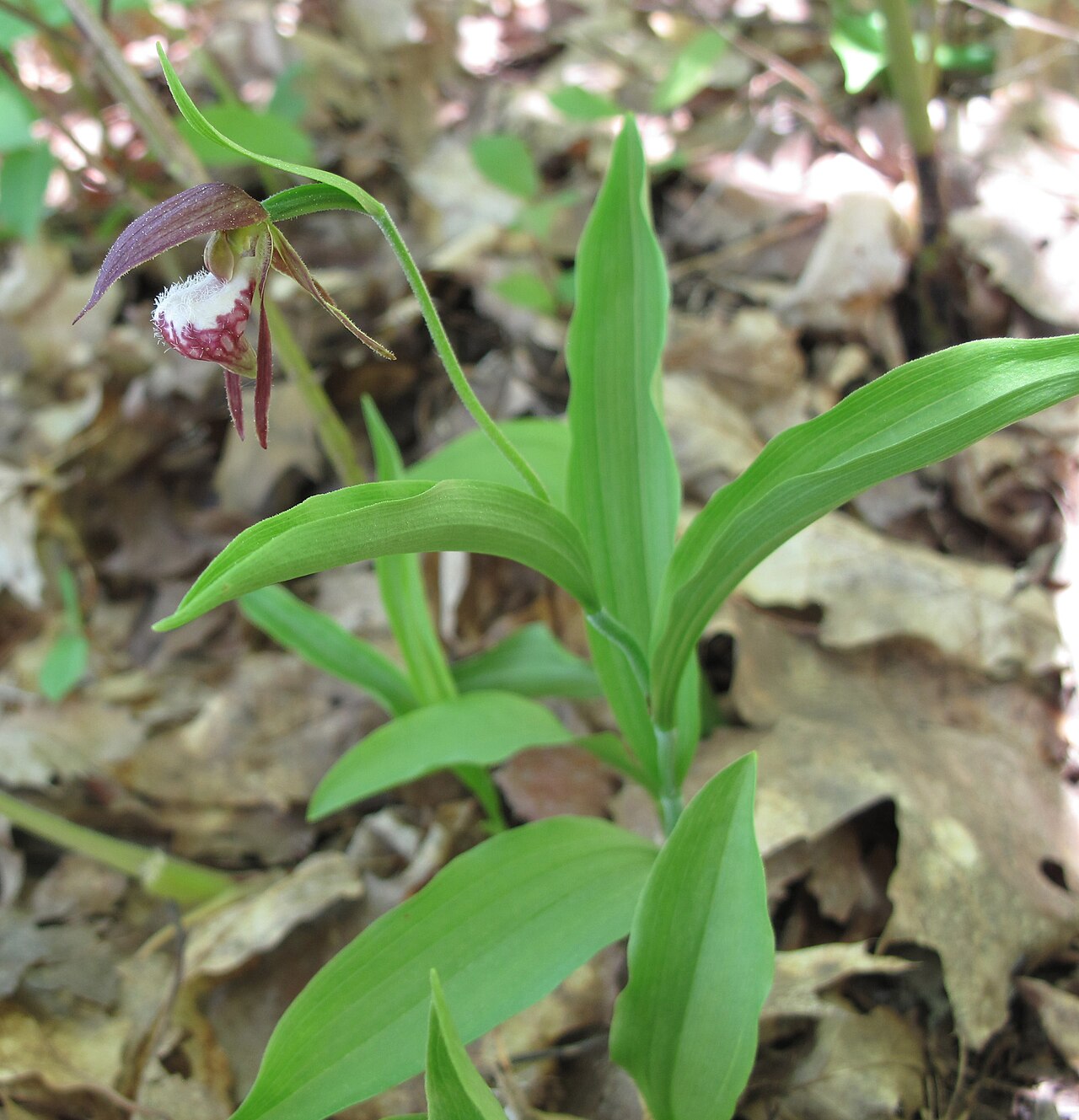
The plant is a small, slender perennial herb, usually 4 to 12 inches tall and occasionally to about 14 inches. It grows from a short rhizome with fibrous roots, and colonies may form clumps of several stems. Plants can live for many years, and some years they may not flower or even appear above ground.
Leaves
Each stem carries three to five alternate, narrowly elliptic to lance-shaped leaves, about 2 to 4 inches long, bluish-green and pleated along their veins. The stem and leaves are finely hairy, and some people find the glandular hairs irritating to the skin.
Flowers
Flowering is in May and June. Each stem usually bears a single flower, rarely two. The pouch (lip) is about 1/2 to 3/4 inch long, cone-shaped and pointed at the bottom, white or pale pink and netted with crimson or purple veins, with a fringe of white, silky hairs around its opening. The two petals and the three separate sepals are narrow, greenish-brown to purplish and somewhat twisted. Plants with white or green flowers occasionally occur.
Fruit
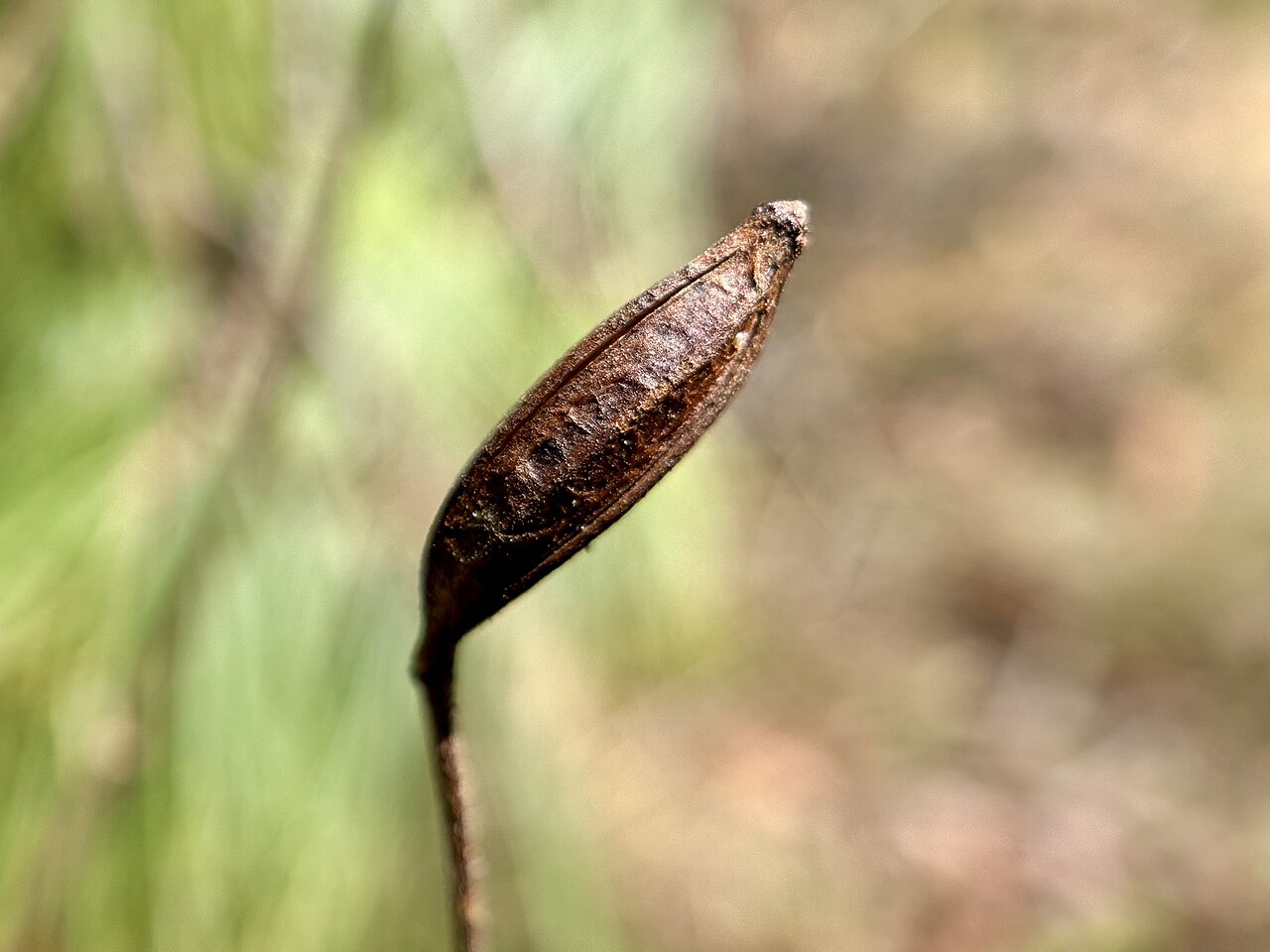
After pollination, the ovary swells into an upright, ribbed capsule that turns brown and splits in late summer and fall, releasing thousands of dust-like seeds that are spread by the wind.
How to Tell It Apart
Most other lady’s slippers have a rounded or egg-shaped pouch and two lower sepals fused into one. The ram’s-head’s pouch is small and cone-shaped, and its lower sepals are separate. Its flowers are also much smaller than those of pink, yellow or showy lady’s slipper.
Quick Facts
| Scientific Name | Cypripedium arietinum W.T. Aiton |
| Family | Orchidaceae (orchid family) |
| Plant Type | Terrestrial orchid; herbaceous perennial |
| Mature Height | 4–12 in (occasionally to 14 in) |
| Mature Spread | 3–6 in per stem; slowly forms small clumps |
| Growth Rate | Very slow; years from seed to flower |
| Sun Exposure | Part shade to light shade; dappled sun |
| Water Needs | Medium; moist but well-drained, never soggy |
| Soil Type | Cool, humus-rich soils over sand or limestone; conifer duff |
| Soil pH | About 6.0–8.0; often calcareous |
| Bloom Time | May–June |
| Flower Color | White pouch with crimson veins; greenish-brown petals |
| Fall Color | Not significant; leaves yellow and die back |
| Fruit | Upright brown capsule with dust-like seeds |
| Deer Resistant | Low; deer browse it where they are numerous |
| USDA Hardiness Zones | 3–6 |
Native Range
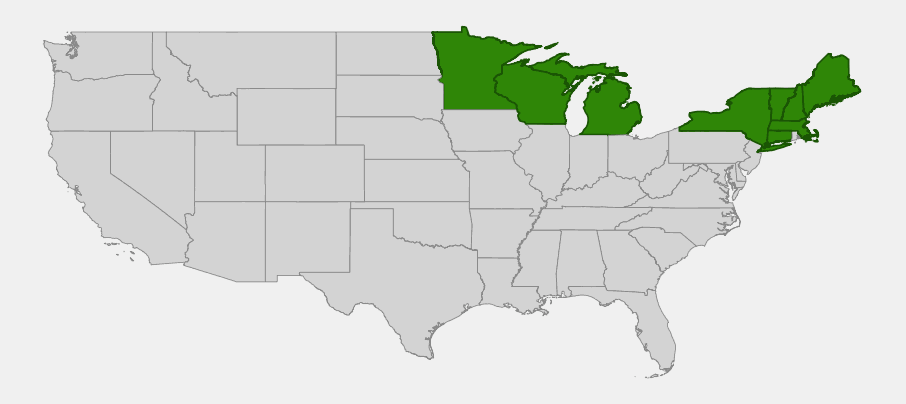
Ram’s-head lady’s slipper is native to northeastern North America. In the United States it occurs in Minnesota, Wisconsin, Michigan, New York, Vermont, New Hampshire, Maine, Massachusetts and Connecticut, and in Canada in Saskatchewan, Manitoba, Ontario, Quebec and Nova Scotia.
Its range is wide but its populations are few and scattered. Its strongholds are in northern Michigan, Ontario and Quebec, especially around the upper Great Lakes. NatureServe ranks it vulnerable (S3) in Michigan, imperiled (S2) in Minnesota, Wisconsin and New York, and critically imperiled (S1) in Maine, New Hampshire, Vermont and Massachusetts. In Connecticut it is known only from historical records.
It grows in cool coniferous and mixed forests, especially northern white cedar and balsam fir woods, in the edges of cedar swamps and bogs, on wooded limestone and dolomite ridges, and on stabilized Great Lakes dunes and old beach ridges. It favors partial shade on moist but well-drained, often calcareous soils with a deep layer of conifer needles.
📋 Regional plant lists featuring Ram’s-head Lady’s Slipper: Michigan, Wisconsin & Eastern Minnesota · New York, Pennsylvania & Northern New Jersey · Delaware, Southern New Jersey & Long Island · Connecticut, Massachusetts & Rhode Island · New Hampshire, Maine & Vermont
Growing & Care Guide
Ram’s-head lady’s slipper is not a garden plant, and wild plants must never be dug or moved. Like other native orchids, its seeds contain almost no food reserves and can germinate only with help from specific soil fungi, and seedlings may spend several years underground before producing a leaf. It is one of the most difficult lady’s slippers to keep alive in cultivation. The notes below explain what it needs in the wild, which is the best way to protect it.
Light
In the wild it grows in dappled shade or light shade under conifers, often at the edge of a clearing or trail where some sun reaches the ground. Dense shade reduces flowering, while full exposure dries the soil.
Soil & Water
It needs cool, moist but well-drained soil with a deep layer of decaying conifer needles over sand, gravel or limestone. The soil is usually neutral to slightly alkaline. Waterlogged soil and summer drought both kill it.
Planting Tips
Do not plant or transplant wild plants. A few specialist orchid nurseries raise Cypripedium species from seed in sterile laboratory culture. If you are tempted by an offer of this species, buy only from a seller who states that the plants are laboratory-propagated, never wild-collected, and be aware that it rarely survives in gardens.
Pruning & Maintenance
The best care for wild plants is protection: keep trails away from known colonies, avoid trampling, control heavy deer browsing, and leave the forest canopy and needle layer intact. Never pick the flowers, which prevents seed production.
Propagation
Propagation is limited to specialized laboratory seed culture. Dividing wild plants is never appropriate, and seed scattered in the wild almost never establishes without the right fungus and conditions.
Landscape Uses
- Nature study and photography: one of the most sought-after wildflowers in northern woods in late spring
- Conservation indicator: its presence marks high-quality cedar, fir and limestone habitats
- Botanical gardens and preserves: the best places to see it are protected natural areas, especially around the upper Great Lakes
- Citizen science: records shared with state heritage programs help track its rare populations
- Education: a striking example of how native orchids depend on soil fungi and specific pollinators
Wildlife & Ecological Value
Ram’s-head lady’s slipper is a small part of northern forest ecosystems, but it depends on a web of fungi, insects and undisturbed habitat.
For Pollinators
Like other lady’s slippers, it offers no nectar reward. Small bees are lured into the pouch, then must squeeze out through a narrow exit past the pollen, carrying it to the next flower. Pollination rates are low, so only a fraction of flowers set seed.
For Birds
The plant has no direct value as bird food, but the cedar and fir woods where it grows are important nesting and wintering habitat for many northern birds.
For Mammals
White-tailed deer browse the leaves and flowers, and heavy browsing can prevent plants from flowering or setting seed.
Ecosystem Role
Ram’s-head lady’s slipper depends on mycorrhizal fungi in the soil, especially in its first years, when the fungus supplies the seedling with nutrients. Because it needs stable, undisturbed conditions, it is a good indicator of intact, high-quality northern forest and shoreline habitats.
Cultural & Historical Uses
The genus name Cypripedium combines Kypris, a name for the goddess Aphrodite, with pedilon, “sandal”: Aphrodite’s slipper. The species name arietinum means “like a ram,” from the Latin aries, because the pointed, downward-facing pouch and the curved petals suggest a ram’s head with horns.
It was described in 1813 in the second edition of Hortus Kewensis, the catalog of plants at the Royal Botanic Gardens, Kew. Its separate lateral sepals once led some botanists to place it in its own genus, Criosanthes, a name that also means “ram flower.”
For generations, orchid enthusiasts and botanists in the Great Lakes region have treated a sighting of ram’s-head lady’s slipper as a highlight of the spring field season. Its rarity and small size make it one of the most prized finds among North American native orchids.
Frequently Asked Questions
Is ram’s-head lady’s slipper rare?
Yes. NatureServe ranks it globally vulnerable (G3). It is critically imperiled in Maine, New Hampshire, Vermont and Massachusetts, imperiled in Minnesota, Wisconsin and New York, and known only from historical records in Connecticut. Michigan and Ontario hold some of its largest populations.
Can I dig up ram’s-head lady’s slipper for my garden?
No. Never dig it from the wild. Wild orchids rarely survive transplanting, and removing plants harms rare populations. Enjoy it where it grows.
Why is it called ram’s-head?
The small, cone-shaped pouch points downward like a ram’s snout, and the narrow, curving petals and sepals around it suggest horns. The scientific name arietinum also means “like a ram.”
When does ram’s-head lady’s slipper bloom?
It blooms in late spring, usually from mid-May to June, depending on latitude and the season.
Where can I see ram’s-head lady’s slipper?
It grows in cool cedar and fir woods, on limestone ridges and on old Great Lakes dunes, mainly in northern Michigan, Wisconsin, Minnesota, New York, northern New England and eastern Canada. Protected preserves and parks in the upper Great Lakes region are the most reliable places to see it.

Looking for a nursery that carries Ram’s-head Lady’s Slipper?
Browse our native plant nursery directory: Connecticut · Maine, Massachusetts, Michigan & Minnesota · New Hampshire & New York · Vermont · Wisconsin

