
Rough-fruited Fairybells (Prosartes trachycarpa)
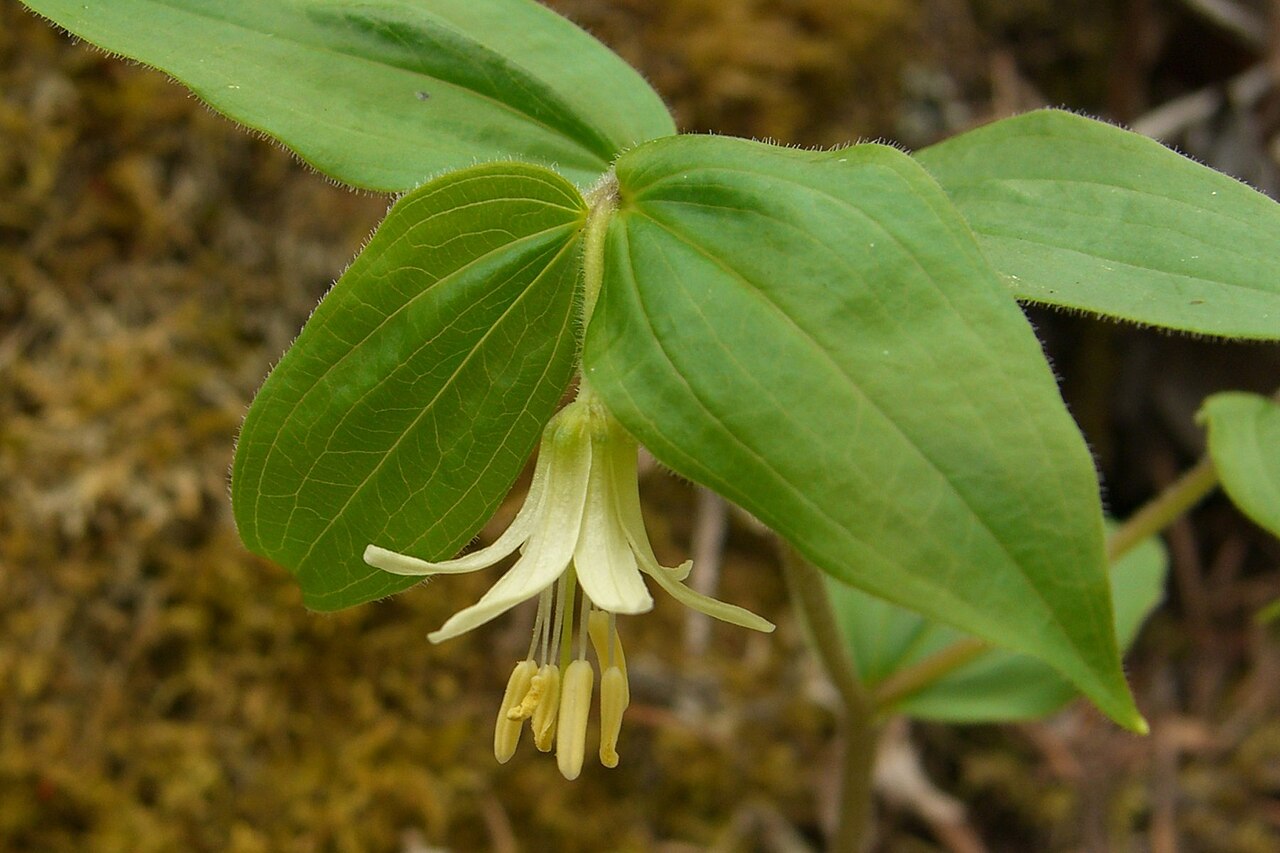
Prosartes trachycarpa, Rough-fruited Fairybells (also roughfruit or wartberry fairybells), is a graceful woodland wildflower of the Rocky Mountains and the northern Great Plains. Its branching stems carry broad, pointed leaves arranged in two flat ranks, and in late spring small creamy-white bells hang beneath the leaves at the branch tips. By late summer they become velvety berries that ripen from yellow to bright orange-red.
It grows in moist, shady places: aspen groves, streamside thickets, spruce and fir forests, and wooded draws and canyons, from British Columbia and Ontario south to Arizona and New Mexico. It is the most widespread fairybells of the interior West, and in the Rockies it is often the only one.
Rough-fruited fairybells is a low-key but lovely plant for shade gardens in cold, dry-winter climates, where many eastern woodland plants struggle. This guide explains how to identify it, where it grows, how to grow it from nursery stock or seed, and its value to wildlife.
Identification
Fairybells (Prosartes) are lily relatives with branching stems, flat sprays of parallel-veined leaves, and hanging flowers at the branch tips. The surface of the ripe berry is the best way to tell rough-fruited fairybells from its relatives.
Stems & Leaves
Plants grow from slender, creeping rhizomes and send up stems 1 to 2 feet tall that fork once or a few times near the top, giving the plant a spreading, layered look. The leaves are alternate, egg-shaped to lance-shaped with a pointed tip, 1½ to 4 inches long, stalkless, with a rounded or slightly clasping base and conspicuous parallel veins. The leaf edges carry tiny forward-pointing hairs, and the undersides are often lightly hairy.
Flowers
One to three flowers hang on short stalks from the tip of each branch, partly hidden beneath the leaves. Each is a narrow bell about ½ inch long, made of six creamy white to greenish-white tepals that flare slightly at the tips. The stamens are about as long as the tepals. Flowering is from May to July depending on elevation and latitude.
Fruit
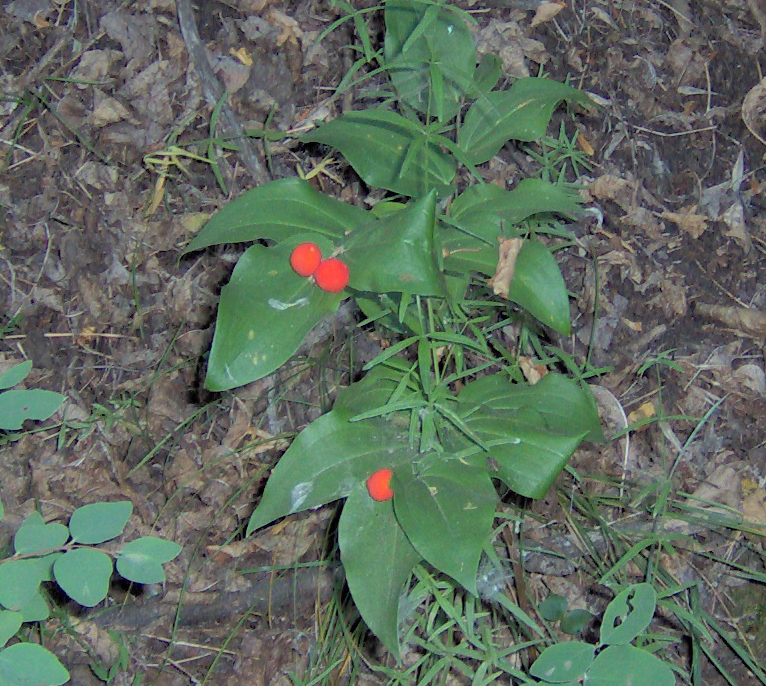
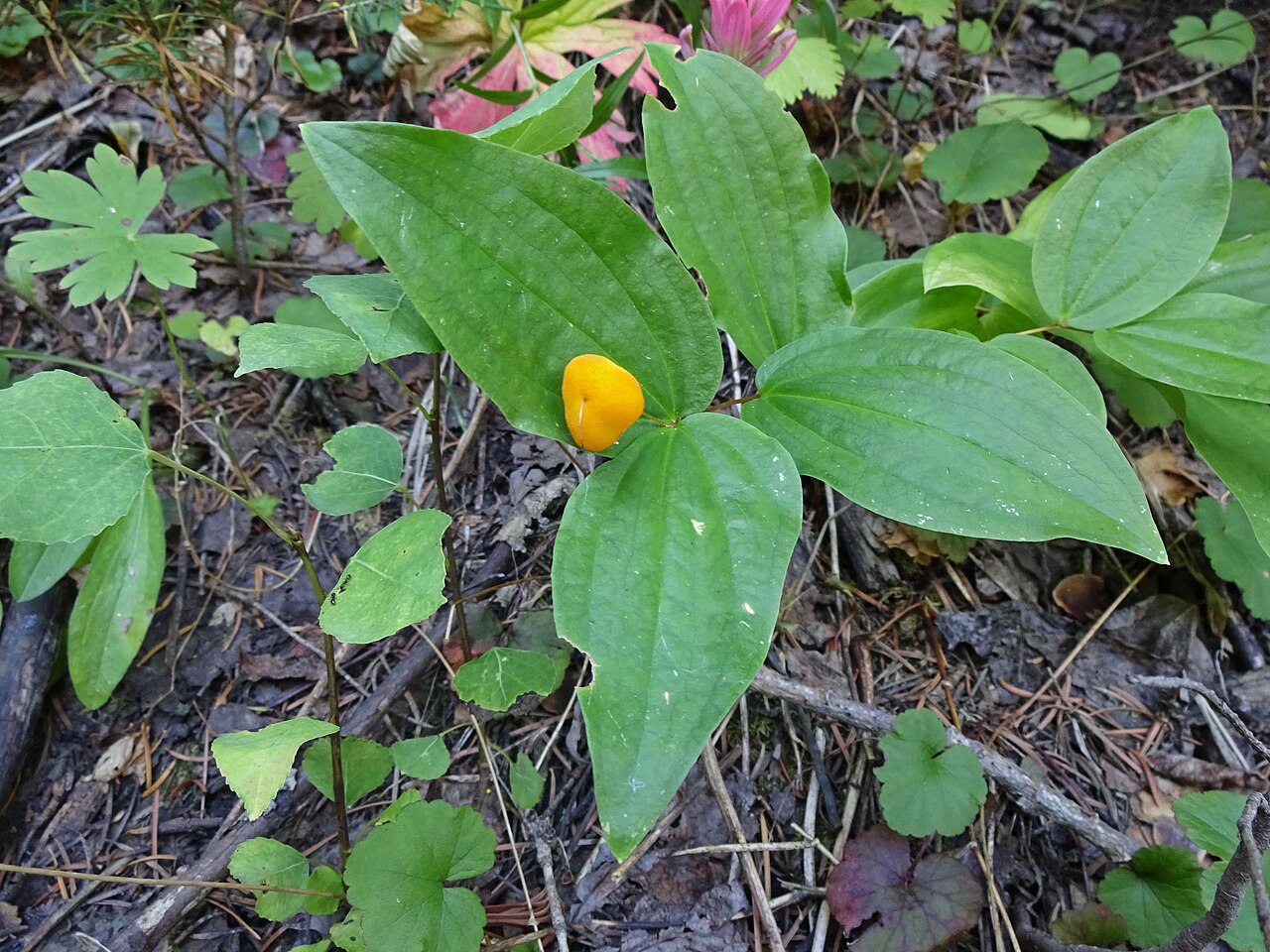
The fruit is a rounded, often slightly three-lobed berry about ⅓ to ½ inch across. Its skin is covered with tiny bumps that make it look and feel velvety or warty, which is the meaning of trachycarpa (“rough fruit”). Berries ripen from greenish-yellow through orange to scarlet in late summer.
Look-alikes
Hooker’s Fairybells has smooth berries and stamens that stick out beyond the tepals. Largeflower Fairybells, of coastal forests, has longer, tubular flowers and smooth berries. Yellow Fairybells of the East has greenish-yellow flowers. Twisted stalk (Streptopus) hangs its flowers from the leaf axils along the stem, not at the branch tips, and false Solomon’s seal (Maianthemum stellatum) has an upright cluster of white star-shaped flowers at the stem tip.
Quick Facts
| Scientific Name | Prosartes trachycarpa S. Watson (syn. Disporum trachycarpum) |
| Family | Liliaceae (lily family) |
| Plant Type | Rhizomatous herbaceous perennial |
| Mature Height | 1–2 ft |
| Mature Spread | 1–2 ft; slowly forms colonies |
| Growth Rate | Slow to moderate |
| Sun Exposure | Partial to full shade |
| Water Needs | Moderate; evenly moist soil |
| Soil Type | Humus-rich loam; forest soils |
| Soil pH | About 5.5–7.5 |
| Bloom Time | May–July |
| Flower Color | Creamy white to greenish-white |
| Fall Color | Leaves turn yellow; orange-red berries |
| Fruit | Velvety, rough-skinned berry, yellow to orange-red |
| Deer Resistant | Moderately; occasionally browsed |
| USDA Hardiness Zones | 3–7 |
Native Range
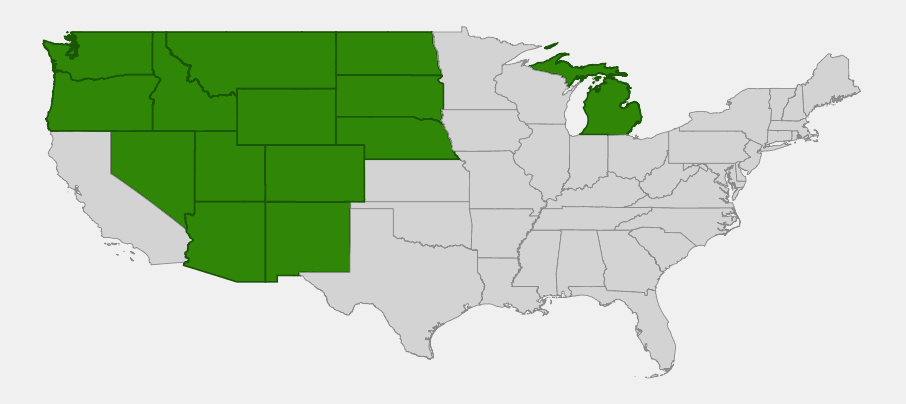
USDA PLANTS lists rough-fruited fairybells as native in Washington, Oregon, Idaho, Montana, Wyoming, Nevada, Utah, Colorado, Arizona, New Mexico, North Dakota, South Dakota, Nebraska and Michigan. In Canada it ranges from British Columbia and Alberta east across Saskatchewan and Manitoba to western Ontario.
Its core range is the Rocky Mountains and the forested ranges of the interior West, including the Blue Mountains of Oregon and Washington, the Black Hills, and the mountains of Utah, Arizona and New Mexico. On the northern plains it follows wooded river valleys, coulees and aspen parklands. Its Michigan populations, near Lake Superior, are outlying records far from the main range.
Across this range it is a plant of moist, shaded sites: aspen groves, streambanks, cottonwood and willow bottoms, moist coniferous forests of spruce, fir and Douglas-fir, and shady draws. It usually grows between about 4,000 and 10,000 feet in the southern Rockies and at lower elevations farther north.
📋 Regional plant lists featuring Rough-fruited Fairybells: Idaho, Eastern Oregon & Eastern Washington · Montana & Wyoming · Utah & Western Colorado · Arizona & New Mexico · North Dakota, South Dakota & Western Minnesota · Nebraska, Kansas & Eastern Colorado · Michigan, Wisconsin & Eastern Minnesota · California & Nevada
Growing & Care Guide
Rough-fruited fairybells is offered by a few native plant nurseries in the Rocky Mountain region and occasionally by woodland plant specialists. It is not hard to grow if you give it what it has in the wild: shade, humus-rich soil and steady moisture. Buy nursery-propagated plants and don’t dig them from the wild.
Light
Partial to full shade. Morning sun with afternoon shade works well in cooler climates. In hot, sunny spots the leaves scorch.
Soil & Water
Plant in loose, well-drained soil rich in organic matter, like a forest floor. Keep it evenly moist in spring and early summer. Once established it tolerates some summer dryness in shade, but in dry climates it does best near a downspout, a shady stream, or with occasional deep watering.
Planting Tips
Set plants about 12 to 18 inches apart in spring or early fall, with the rhizome an inch or two below the surface, and mulch with shredded leaves or conifer needles. It looks best in groups under aspens, among ferns, or along a shady path where the hanging flowers and berries can be seen up close.
Pruning & Maintenance
Leave the leaf litter in place as a natural mulch. Stems die back in fall and can be left until spring. It spreads slowly by rhizomes and rarely needs dividing.
Propagation
Divide clumps in early spring or fall. To grow from seed, clean the seeds from ripe berries and sow them outdoors in fall. Germination is slow and may take two winters, and seedlings take several years to flower.
Landscape Uses
- Woodland and shade gardens: under aspens, conifers or the north side of a house in the Rockies and northern plains
- Native fern and wildflower beds: with baneberry, meadow-rue, false Solomon’s seal and wild sarsaparilla
- Riparian and woodland restoration: moist streamside forest understories
- Wildlife gardens: berries for birds and small mammals
Wildlife & Ecological Value
Rough-fruited fairybells is a modest but steady contributor to the forest understory, feeding wildlife with its berries in late summer.
For Pollinators
The hanging flowers are visited by bumble bees and other bees in spring and early summer, which reach up into the bells for nectar and pollen.
For Birds
Ruffed grouse, thrushes and other forest birds eat the berries and disperse the seeds.
For Mammals
Small mammals such as chipmunks, squirrels and mice eat the berries. Deer and elk browse the foliage occasionally.
Ecosystem Role
Its rhizomes help bind soil along shaded streambanks and slopes, and as part of the rich herb layer of aspen and mixed conifer forests it contributes to the diversity that makes those forests valuable wildlife habitat.
Cultural & Historical Uses
The genus name Prosartes comes from the Greek for “to attach” or “suspend,” usually explained as a reference to the hanging ovules or flowers. The species was long placed in Disporum, a genus of Asian woodland plants, and many field guides still use Disporum trachycarpum. DNA studies showed that the North American fairybells are a separate lineage, and they were returned to Prosartes.
Sereno Watson described the species in the 1870s from collections made in the West. The common names wartberry and roughfruit fairybells both describe the distinctive bumpy berry skin.
The berries are reported to have been eaten raw by some Indigenous peoples of the northern plains and Rockies, though they are bland and seedy. Today it is valued mostly as an attractive native for shade gardens in the interior West, where good native woodland plants are fewer than in the East.
Frequently Asked Questions
Are fairybells berries edible?
The berries of rough-fruited fairybells are not considered poisonous and were reportedly eaten by some Indigenous peoples, but they are bland and seedy. Don’t eat any wild berry unless you are certain of its identity, since some look-alikes, such as baneberry, are poisonous.
How do I tell rough-fruited fairybells from Hooker’s fairybells?
Look at the fruit and stamens. Rough-fruited fairybells has velvety, finely bumpy berries and stamens about as long as the flower. Hooker’s fairybells has smooth berries and stamens that stick out past the tepals.
Does rough-fruited fairybells grow in full sun?
No. It is a shade plant of forests and aspen groves. In full sun the leaves scorch and the plant declines, especially in dry western climates.
Why is it sometimes called Disporum?
It was long classified in Disporum, an Asian genus. DNA studies showed that the North American fairybells are not closely related to the Asian ones, so they are now placed in Prosartes.
Where does rough-fruited fairybells grow?
It grows in moist, shady forests from British Columbia and Ontario south through the Rocky Mountains to Arizona and New Mexico, along wooded river valleys on the northern plains, and in a few outlying sites in Michigan.

Looking for a nursery that carries Rough-fruited Fairybells?
Browse our native plant nursery directory: Arizona · Colorado · Idaho · Michigan & Montana · Nebraska, Nevada, New Mexico & North Dakota · Oregon · South Dakota & Utah · Washington · Wyoming

