
Yellow Fairybells (Prosartes lanuginosa)
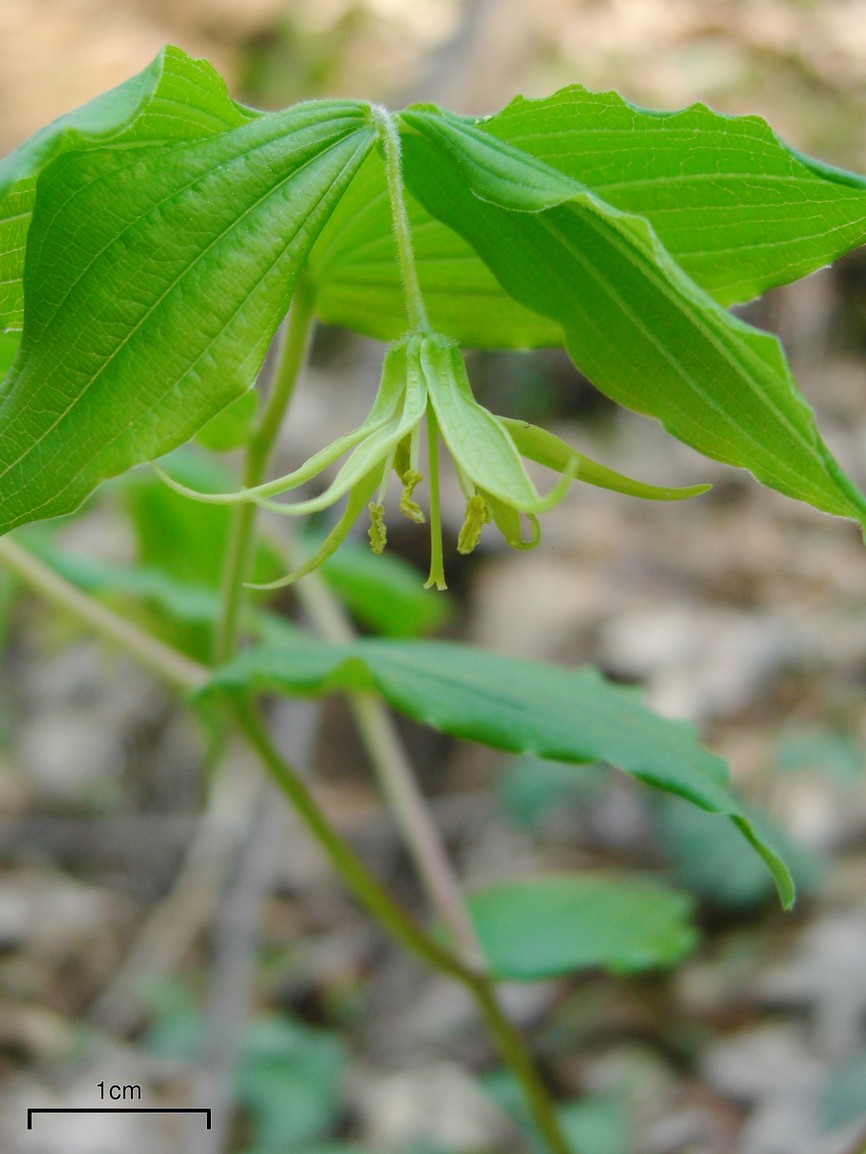
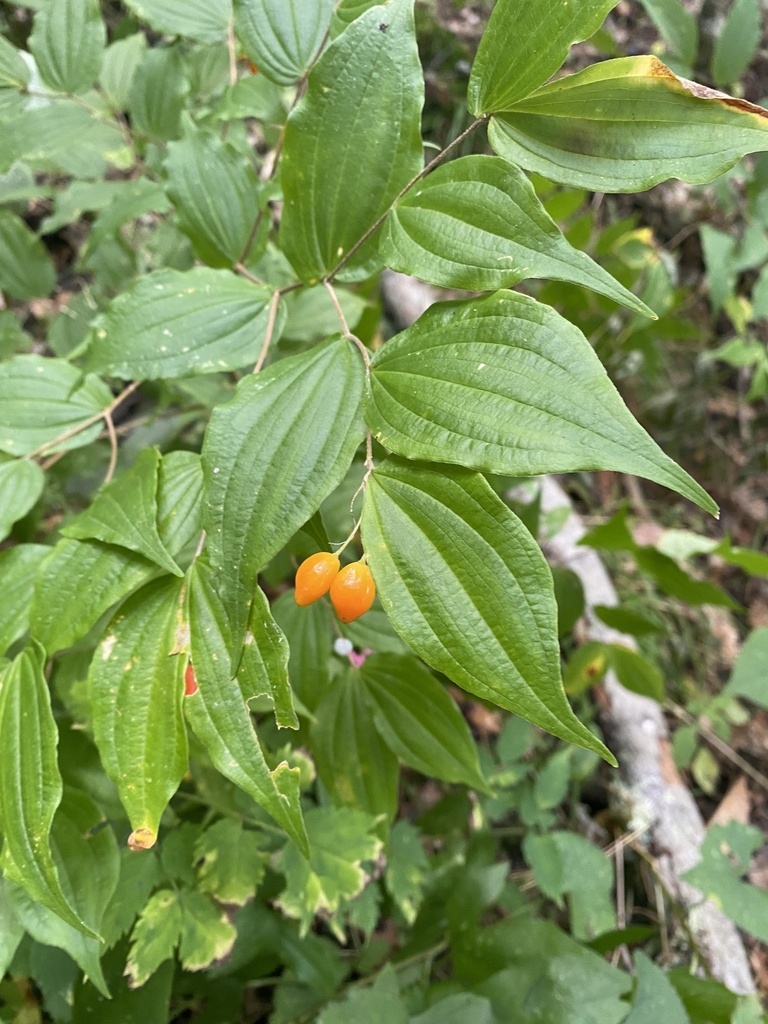
Prosartes lanuginosa, known as Yellow Fairybells or yellow mandarin, is a graceful woodland perennial of rich forests in the Appalachian region of eastern North America. It belongs to the lily family (Liliaceae). Its slender, branching stems carry two rows of pointed, parallel-veined leaves, and in spring pale greenish-yellow, bell-shaped flowers dangle beneath the leaves at the tips of the branches. In late summer the flowers are followed by bright orange-red to red berries.
Yellow fairybells grows from southern Ontario and western New York south through Pennsylvania, Ohio, West Virginia, Kentucky and Virginia to the mountains of the Carolinas, Tennessee, northern Georgia and Alabama, with outlying populations west to Arkansas. Its home is moist, rich deciduous forest: cove forests, wooded ravines and slopes, and stream terraces, often on soils over limestone or other base-rich rock. It was long known as Disporum lanuginosum, and many older books use that name.
For gardeners it is an elegant, low-maintenance plant for shady woodland gardens, combining well with ferns, trilliums and Solomon’s seal. The flowers are subtle, but the branching form and the red berries add a quiet charm. Buy nursery-propagated plants rather than digging them from the wild.
Identification
Look for a branching, Solomon’s-seal-like plant in rich woods, with pointed, stalkless leaves, and pale greenish-yellow bells hanging in ones to threes from the tips of the branches in spring.
Growth Habit
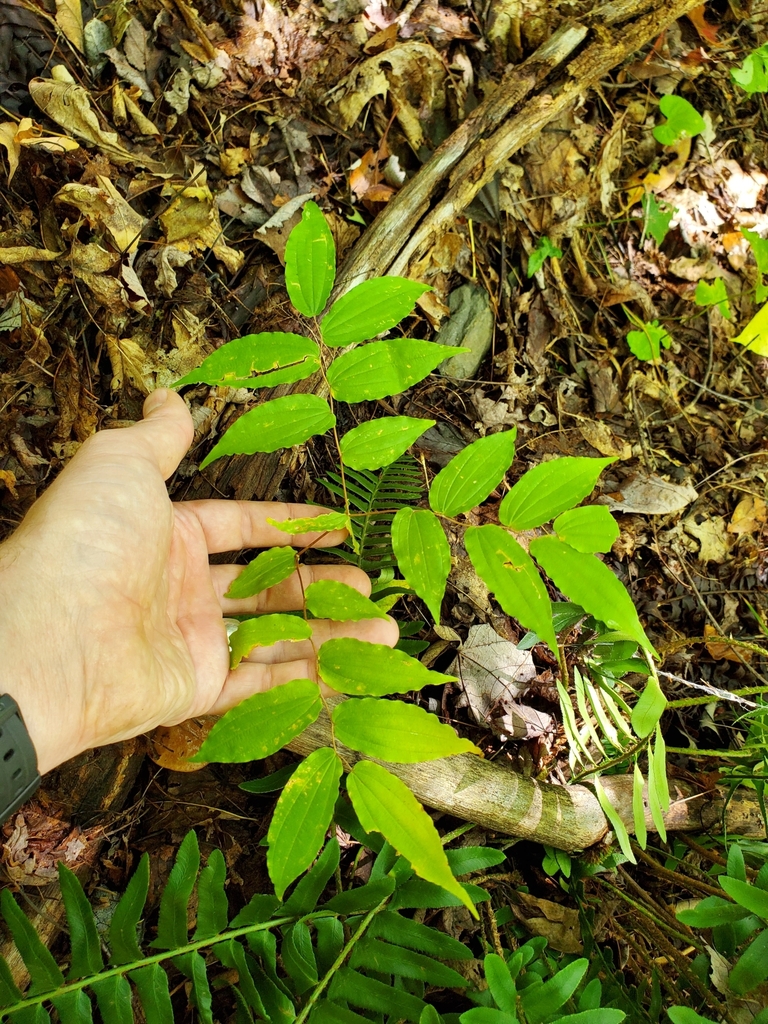
Yellow fairybells is a herbaceous perennial that grows from slender, creeping rhizomes and can form small colonies. Each stem is about 1 to 2 1/2 feet tall, upright at the base and then forking into two or three spreading branches. The stems are finely hairy, especially when young.
Leaves
The leaves are alternate, stalkless or nearly so, about 2 to 5 inches long, and ovate to lance-shaped with long-pointed tips. They have prominent parallel veins and are softly hairy on the underside, a feature reflected in the species name lanuginosa, meaning “woolly.”
Flowers
The flowers hang singly or in groups of two or three at the tips of the branches, partly hidden beneath the leaves. Each is a narrow bell about 1/2 to 3/4 inch long, made of six pale greenish-yellow tepals that spread slightly at the tips, with the stamens and style just inside. The tepals are not spotted. It blooms in April and May, a little later at high elevations.
Fruit
The fruit is a round to slightly oval berry about 1/3 to 1/2 inch across, ripening from green to orange-red or red in mid to late summer. Each berry holds several seeds.
Look-alikes
Spotted mandarin (Prosartes maculata) has creamy flowers with purple spots and grows in a smaller area of the Appalachians and Cumberland Plateau. Bellworts such as perfoliate bellwort have longer, twisted yellow flowers and leaves that clasp or surround the stem. Solomon’s seal has an unbranched, arching stem with flowers hanging along its length, not just at the tips. In the West, its relatives Hooker’s fairybells and largeflower fairybells fill the same role in Pacific and Rocky Mountain forests.
Quick Facts
| Scientific Name | Prosartes lanuginosa |
| Family | Liliaceae (lily family) |
| Plant Type | Rhizomatous woodland perennial |
| Mature Height | 1–2.5 ft |
| Mature Spread | 1–2 ft, slowly colonizing |
| Growth Rate | Slow to moderate |
| Sun Exposure | Part shade to full shade |
| Water Needs | Medium; evenly moist |
| Soil Type | Rich, moist, humus-rich loam |
| Soil pH | Slightly acidic to neutral (about 5.5–7.5) |
| Bloom Time | April–May |
| Flower Color | Pale greenish-yellow |
| Fall Color | Yellow |
| Fruit | Orange-red to red berries, mid to late summer |
| Deer Resistant | No; browsed by deer |
| USDA Hardiness Zones | 4–8 |
Native Range
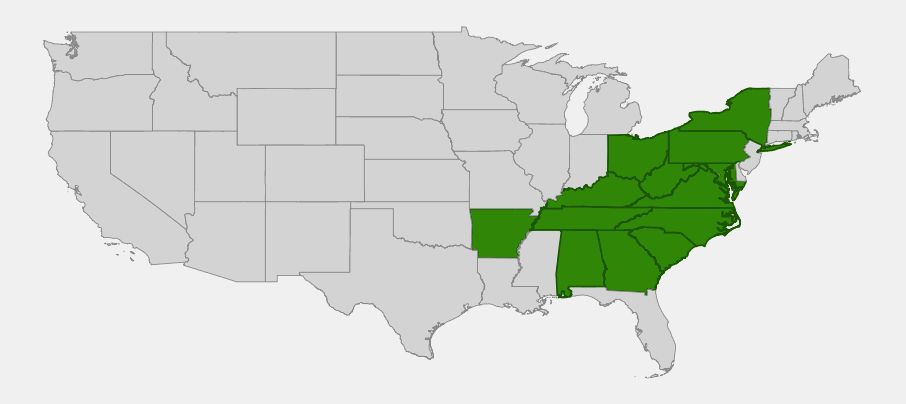
Yellow fairybells is native to eastern North America. USDA PLANTS lists it as native in Alabama, Arkansas, Georgia, Kentucky, Maryland, New York, North Carolina, Ohio, Pennsylvania, South Carolina, Tennessee, Virginia and West Virginia. In Canada it grows in southern Ontario, where it is rare.
It is centered on the Appalachian Mountains and plateaus. It is most common in the Blue Ridge and Ridge and Valley of North Carolina, Tennessee, Virginia and West Virginia, in the Cumberland and Allegheny plateaus of Kentucky, Ohio and Pennsylvania, and in western New York. It reaches its southern limit in the mountains of northern Georgia, Alabama and upstate South Carolina, and it is found in western Maryland. Records from Arkansas are outlying populations well west of the main range.
It grows in rich, moist deciduous forests, especially cove hardwood forests, wooded ravines and north-facing slopes, rocky wooded hillsides and stream terraces. It often grows on base-rich soils over limestone, shale or other calcium-bearing rock, from low elevations up to about 5,000 feet in the southern Appalachians.
📋 Regional plant lists featuring Yellow Fairybells: New York, Pennsylvania & Northern New Jersey · Ohio & Indiana · Kentucky & Tennessee · Maryland, Virginia & West Virginia · Delaware, Southern New Jersey & Long Island · Alabama, Georgia & Mississippi · North & South Carolina · Arkansas, Louisiana, Eastern Oklahoma & Eastern Texas
Growing & Care Guide
Yellow fairybells is a carefree plant for a shady woodland garden with rich, moist soil. It grows slowly but is long-lived, and it fits naturally among other spring wildflowers and ferns.
Light
Part shade to full shade. Dappled light under deciduous trees is ideal. Strong afternoon sun scorches the leaves.
Soil & Water
Plant in rich, moist, well-drained soil with plenty of leaf mold or compost. It prefers slightly acidic to neutral soil and does well over limestone. Keep the soil evenly moist, especially during the first year and in summer droughts.
Planting Tips
Plant rhizomes or potted plants in early spring or fall, about 1 to 1 1/2 feet apart, with the growing tips about 1 inch below the soil surface. Mulch with shredded leaves. Combine with ferns, trilliums, wild ginger, bellworts and Solomon’s seal. Buy nursery-propagated plants; never dig them from the wild.
Pruning & Maintenance
Very little care is needed. Leave the fallen leaves in place as a natural mulch. Cut back the stems after they die down in fall if desired. Protect plants from heavy deer browsing.
Propagation
Divide the rhizomes in early spring or fall. Seed can be sown fresh in fall after cleaning the pulp from the berries; it needs a long period of cold and may take two years to germinate and several more years to flower.
Landscape Uses
- Woodland gardens: an elegant, branching spring perennial for shade
- Shade borders: fine texture with ferns and hostas
- Native plant gardens: pairs with trilliums, bellworts and Solomon’s seal
- Wildlife gardens: summer berries for birds and small mammals
- Naturalizing: slowly forms small colonies in rich woodland soil
Wildlife & Ecological Value
Yellow fairybells is part of the rich spring flora of Appalachian forests and provides flowers in spring and fruit in summer.
For Pollinators
Its nodding flowers are visited by bumblebees and other native bees, which forage for pollen and nectar in spring.
For Birds
Thrushes, grouse and other forest birds eat the red berries in late summer and help disperse the seeds.
For Mammals
White-tailed deer browse the stems and leaves, and small mammals such as chipmunks and mice eat the berries.
Ecosystem Role
It is a characteristic plant of rich cove and ravine forests, adding to their diverse spring herb layer. Its colonies help stabilize soil on moist wooded slopes.
Cultural & Historical Uses
The genus name Prosartes comes from a Greek word meaning “to fasten,” probably referring to the way the ovules are attached. The species name lanuginosa means “woolly,” for the soft hairs on the stems and leaf undersides.
For many years the North American fairybells were placed in Disporum, a genus of Asian woodland plants. DNA studies showed that the American species are more closely related to twisted stalks (Streptopus) in the lily family, so they were returned to the older genus Prosartes.
The French botanist André Michaux first described the plant in 1803 as Uvularia lanuginosa, placing it with the bellworts, after his travels in the southern Appalachians. Its subtle flowers and bright berries have made it a favorite of wildflower walkers in places such as Great Smoky Mountains National Park.
Frequently Asked Questions
Is yellow fairybells the same as Disporum lanuginosum?
Yes. Disporum lanuginosum is an older name for the same plant. North American fairybells are now placed in Prosartes.
Are yellow fairybells berries edible?
They are not a recognized food, and their safety is not well known. Treat them as inedible and leave them for wildlife.
How do I tell yellow fairybells from Solomon’s seal?
Yellow fairybells has a forked, branching stem with flowers only at the branch tips. Solomon’s seal has a single arching stem with flowers hanging all along it.
Does yellow fairybells grow in shade?
Yes. It is a woodland plant that does best in part to full shade with rich, moist soil.
When does yellow fairybells bloom?
In April and May. Its berries ripen orange-red to red in mid to late summer.

Looking for a nursery that carries Yellow Fairybells?
Browse our native plant nursery directory: Alabama & Arkansas · Georgia · Kentucky & Maryland · New York, North Carolina & Ohio · Pennsylvania, South Carolina, Tennessee & Virginia · West Virginia

