
Sickleleaf Silkgrass (Pityopsis falcata)
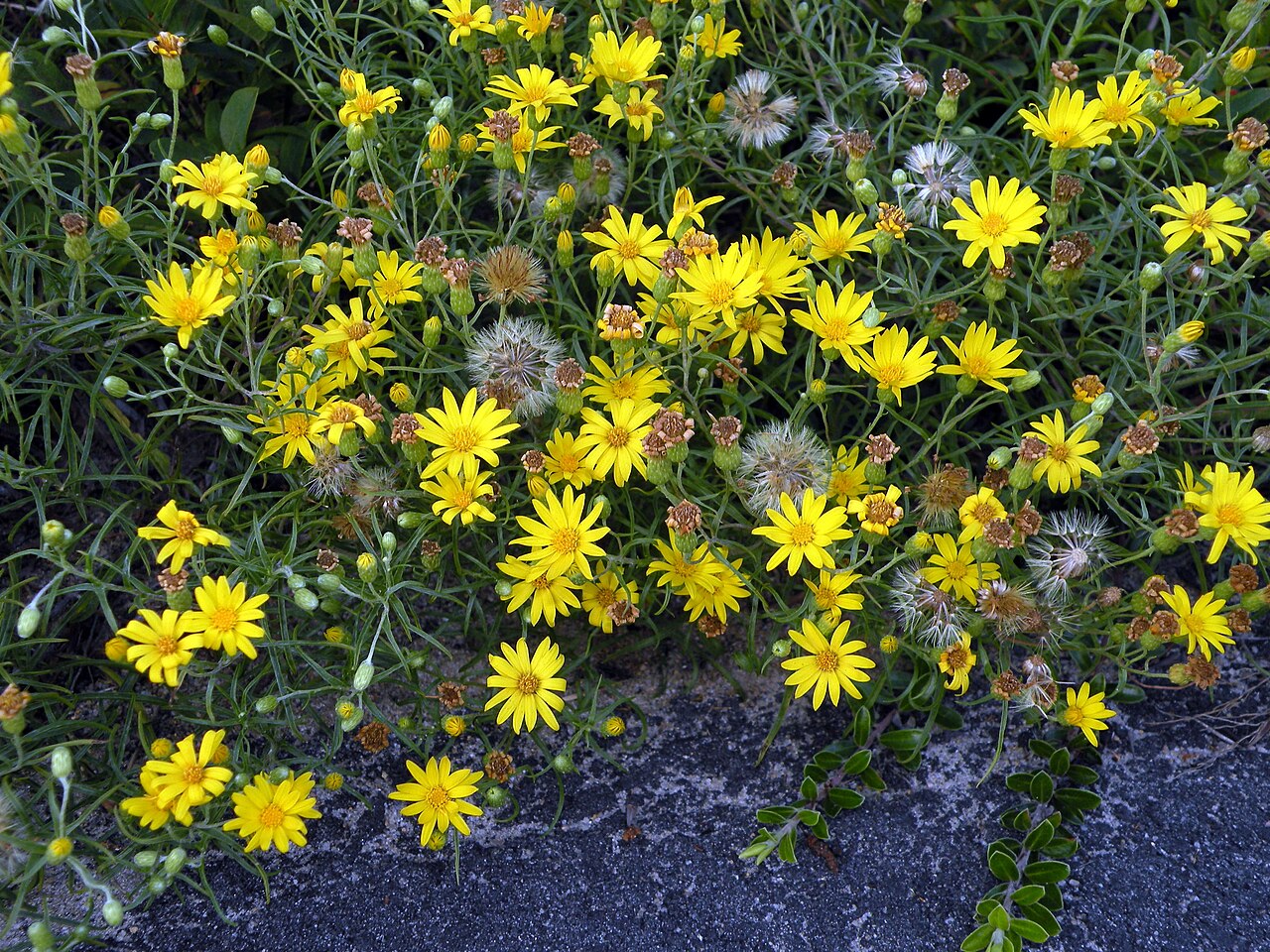
Pityopsis falcata, known as Sickleleaf Silkgrass, sickle-leaved golden aster or New England golden aster, is a low, clumping perennial wildflower in the aster family (Asteraceae). It has narrow, grass-like, silvery-silky leaves that curve like a sickle, and from midsummer into fall it carries clusters of bright yellow, daisy-like flower heads about an inch across. It was long known as Chrysopsis falcata and later as Heterotheca falcata.
It has one of the smallest ranges of any wildflower in the Northeast. It grows only on the coastal plain from Cape Cod and southeastern Massachusetts through Rhode Island, coastal Connecticut and Long Island to the New Jersey Pine Barrens, on sandy and gravelly soils left by the last glaciers. It is the northernmost member of its genus, whose other species are mostly in the Southeast.
Where it grows, it can be locally common in sandplain grasslands, pine barrens, open roadsides and powerline corridors. It is an excellent, tough native for sunny, sandy gardens within its native region, but it is rare in several states, so plants should come only from nursery-propagated stock and never from the wild.
Identification
Look for low clumps of narrow, silvery, curved, grass-like leaves topped by flat clusters of yellow daisies in late summer, on dry, sandy ground near the coast.
Growth Habit
Sickleleaf silkgrass is a perennial that grows in dense tufts from fibrous roots and short rhizomes, so older plants form clumps or small colonies. The flowering stems are usually 4 to 16 inches tall, erect or leaning, sometimes branched, often reddish-brown and covered with long, silky hairs.
Leaves
The leaves are the best feature for identification. They are narrow and grass-like, stiff, covered with silky hairs that give them a silvery-green sheen, often folded along the midrib, and distinctly curved like a sickle or scythe (the meaning of falcata). The stem leaves are stalkless and longer than the basal leaves, which usually wither by flowering time.
Flowers
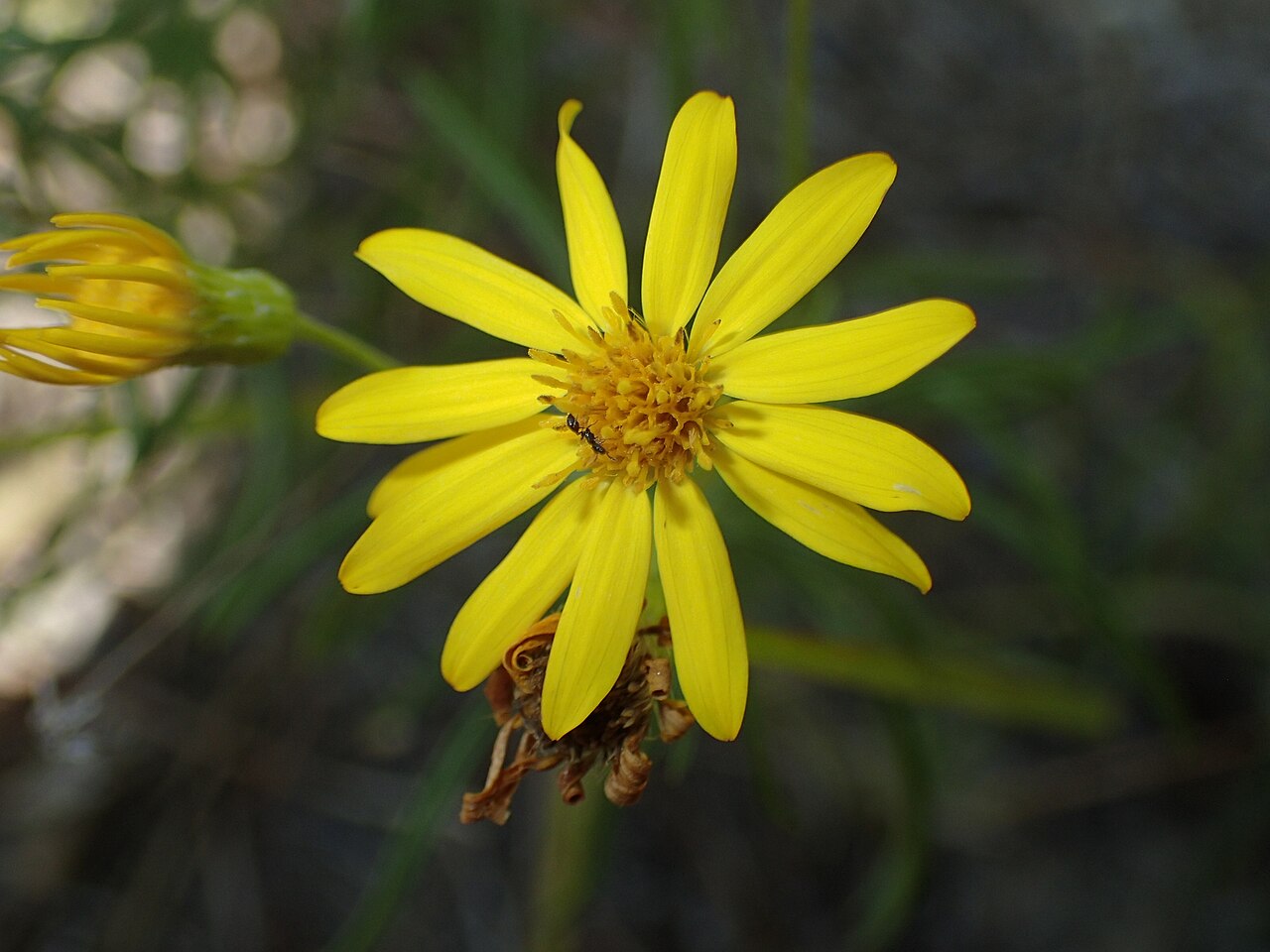
The flower heads are borne in loose, flat-topped clusters of usually 4 to 10, sometimes up to 25, at the tops of the stems, on short, woolly stalks. Each head is about 1 inch across, with 9 to 15 bright yellow rays around a yellow disk of 30 to 60 small tubular flowers. The bell-shaped base of the head is covered with overlapping bracts. Flowering runs from July into September and sometimes October.
Fruit & Seeds
The seeds are small, narrow achenes, each topped with a tuft of tan bristles (pappus) that carries it on the wind, much like a dandelion seed. The fluffy seed heads appear from late summer into fall.
Look-alikes
Its closest relative in the Northeast is Maryland goldenaster (Chrysopsis mariana), which has broader, flat, oval leaves and sticky-glandular flower stalks. The southern golden aster or narrowleaf silkgrass (Pityopsis graminifolia) has long, straight, flat grass-like leaves and taller stems and does not reach New England. Goldenrods have much smaller heads in long or branched clusters.
Quick Facts
| Scientific Name | Pityopsis falcata (syn. Chrysopsis falcata, Heterotheca falcata) |
| Family | Asteraceae (aster family) |
| Plant Type | Clump-forming herbaceous perennial |
| Mature Height | 4–16 in |
| Mature Spread | 6–12 in |
| Growth Rate | Slow to moderate |
| Sun Exposure | Full sun |
| Water Needs | Low; very drought tolerant |
| Soil Type | Dry, sandy or gravelly, low in nutrients |
| Soil pH | Acidic (about 4.5–6.5) |
| Bloom Time | July–September |
| Flower Color | Bright yellow |
| Fall Color | Silvery-green foliage persists |
| Fruit | Small achenes with tan, windborne bristles |
| Deer Resistant | Moderately |
| USDA Hardiness Zones | 5–7 |
Native Range
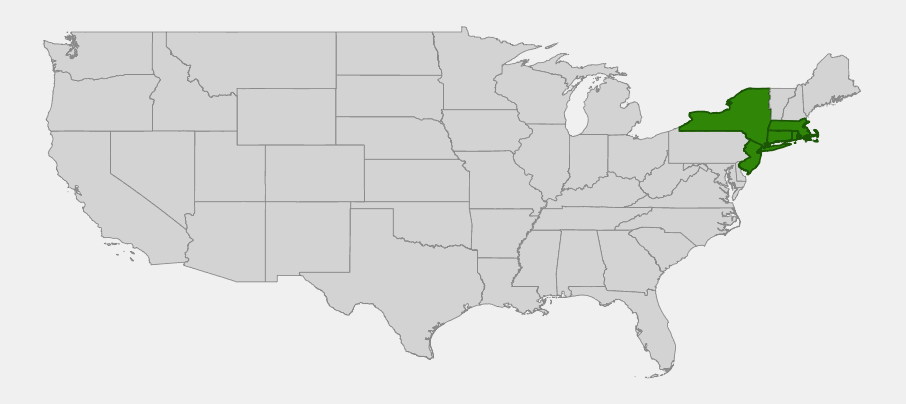
Sickleleaf silkgrass is endemic to the northeastern Atlantic Coastal Plain. Its native range runs from Cape Cod and southeastern Massachusetts through Rhode Island and coastal Connecticut to Long Island and the New Jersey Pine Barrens, in Connecticut, Massachusetts, New Jersey, New York and Rhode Island. It grows mainly on the sandy glacial outwash and till deposited near the edge of the last ice sheet.
USDA PLANTS also lists Florida, based on a single 1955 beach collection near St. Petersburg. Botanists (the Flora of the Southeastern United States and a 2019 review of the genus) consider that specimen a misidentified Florida species, probably Pityopsis tracyi, so Florida is left off this map. A plant found along a railway near Toronto, Ontario, in 1949 was a one-time stray, and the species is not native to Canada.
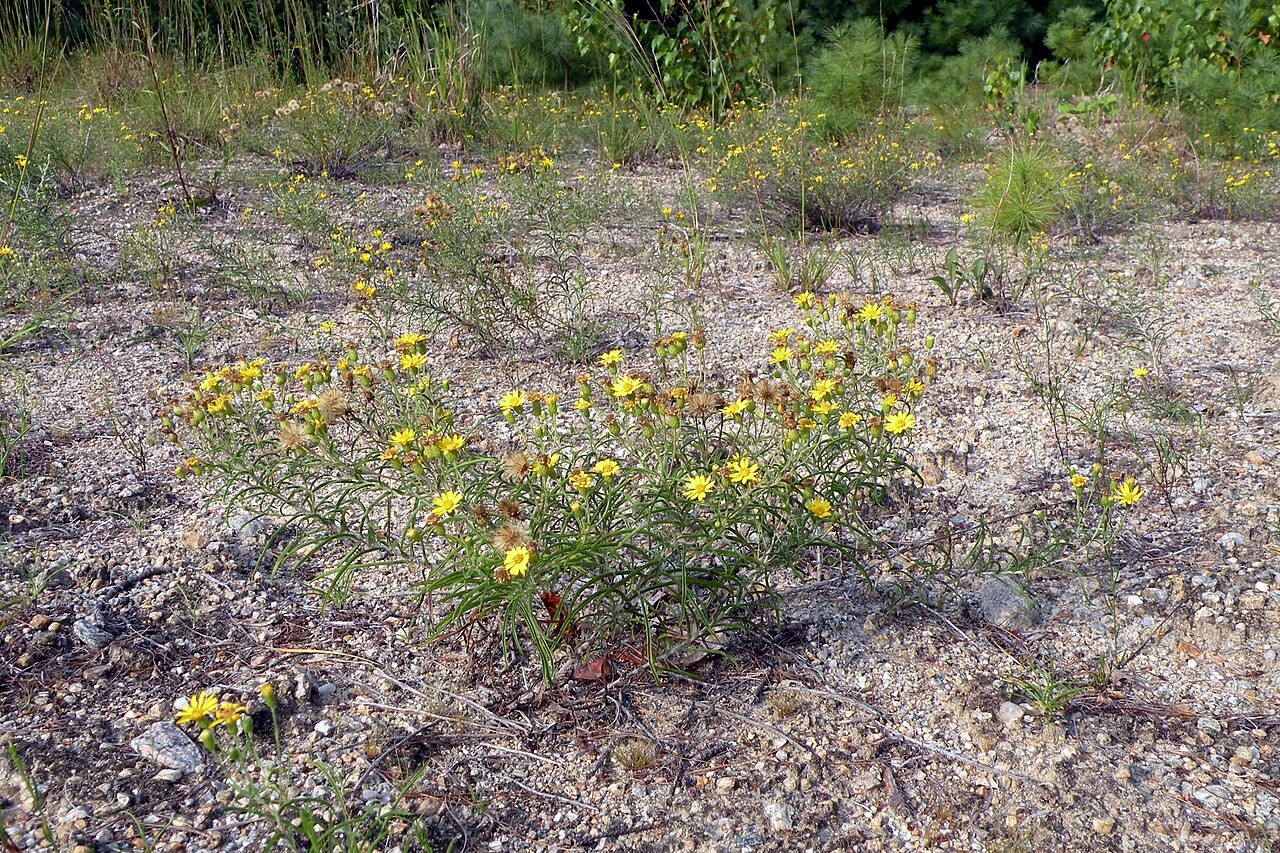
It grows in sunny, open, dry places with sparse vegetation: coastal sandplain grasslands and heathlands, openings in pitch pine and scrub oak barrens, sandy roadsides, railroad and powerline corridors, and old sand pits. NatureServe ranks it critically imperiled in Connecticut, imperiled in Rhode Island, vulnerable in New Jersey and New York, and vulnerable to apparently secure in Massachusetts, where it is most common.
📋 Regional plant lists featuring Sickleleaf Silkgrass: New York, Pennsylvania & Northern New Jersey · Connecticut, Massachusetts & Rhode Island · New Hampshire, Maine & Vermont · Delaware, Southern New Jersey & Long Island
Growing & Care Guide
Sickleleaf silkgrass is a tough, low wildflower for the hottest, driest, sandiest spots in coastal New England, New York and New Jersey gardens. It is uncommon in the nursery trade. Because it is rare in several states, never dig plants from the wild; buy nursery-propagated plants, or grow it from seed obtained from a reputable native seed source.
Light
Full sun. It does not tolerate shade and fades when taller plants or shrubs crowd it.
Soil & Water
It needs very well-drained, dry, sandy or gravelly, acidic soil low in nutrients. Rich, moist or heavy clay soil causes it to rot or be overgrown by other plants. Once established, it needs no watering, even in dry summers.
Planting Tips
Use it at the front of a sunny, sandy border, in a rock or gravel garden, along a sandy driveway edge or in a coastal meadow planting with little bluestem and other low natives. Plant 8 to 12 inches apart in spring. Do not fertilize or mulch heavily, which encourages competition.
Pruning & Maintenance
Little care is needed. Leave the stems standing through fall so the seed can disperse, then cut back old stems in late winter or early spring. In a meadow, occasional mowing or clearing of shrubs keeps the habitat open, as fire and storms once did.
Propagation
Grow it from seed sown in fall or in spring after a short cold, moist period, on the surface of a sandy mix. Established clumps can also be divided carefully in early spring.
Landscape Uses
- Rock and gravel gardens: low, silvery foliage and late summer flowers
- Coastal gardens: thrives in salt-air, sandy sites near the shore
- Sandplain meadow restoration: a characteristic plant of sandplain grasslands
- Pollinator gardens: late summer and fall nectar for bees and butterflies
- Hellstrip and roadside plantings: tolerates heat, drought and poor soil
Wildlife & Ecological Value
In late summer, sickleleaf silkgrass is one of the main nectar flowers of the sandy grasslands and barrens of the northeastern coast.
For Pollinators
The flower heads attract native bees, small butterflies, skippers and flower flies. Where they occur together, the golden aster flower moth (Schinia tuberculum) uses it heavily; its caterpillars feed in the flower heads and the adults rest camouflaged on the yellow flowers.
For Birds
Finches and sparrows of pine barrens and sandplain grasslands may eat the small seeds in fall.
For Mammals
The silky, tough leaves are not a preferred food, and the plant is only lightly browsed by deer and rabbits.
Ecosystem Role
Sickleleaf silkgrass is a typical plant of fire- and disturbance-maintained sandplain grasslands and barrens, which are among the most threatened habitats in the Northeast. It readily colonizes cleared ground, such as road edges and powerline corridors, where open, sandy conditions are maintained.
Cultural & Historical Uses
The genus name Pityopsis means “pine-like,” referring to the narrow leaves of some species. The species name falcata means “sickle-shaped,” for its curved leaves. The common name “silkgrass” describes the silky, grass-like foliage.
Botanists have moved this plant between genera several times. It was first described as Inula falcata in 1813, and was later placed in Chrysopsis and Heterotheca before being treated in Pityopsis. Genetic studies indicate that its closest relative is Ruth’s golden aster (Pityopsis ruthii), a rare plant of a few river gorges in Tennessee.
Its range follows the outer edge of the last glaciation: Cape Cod, the islands, Long Island and the outwash plains of southern New England are made of the same sandy and gravelly deposits on which it grows.
Frequently Asked Questions
Is sickleleaf silkgrass a grass?
No. It is a wildflower in the aster family. The name “silkgrass” describes its narrow, silky, grass-like leaves.
Where does sickleleaf silkgrass grow?
Only on the northeastern coastal plain, from Cape Cod and southeastern Massachusetts through Rhode Island, coastal Connecticut and Long Island to the New Jersey Pine Barrens.
Is sickleleaf silkgrass rare?
It is locally common in parts of Massachusetts and the Pine Barrens, but NatureServe ranks it as critically imperiled in Connecticut and imperiled in Rhode Island. Never dig it from the wild.
When does sickleleaf silkgrass bloom?
From July through September, sometimes into October.
Can I grow sickleleaf silkgrass in my garden?
Yes, in full sun and dry, sandy, acidic soil within its native region. Use nursery-propagated plants or responsibly sourced seed.

Looking for a nursery that carries Sickleleaf Silkgrass?
Browse our native plant nursery directory: Connecticut · Massachusetts · New Jersey & New York · Rhode Island

