
Stout Wood Reed (Cinna arundinacea)
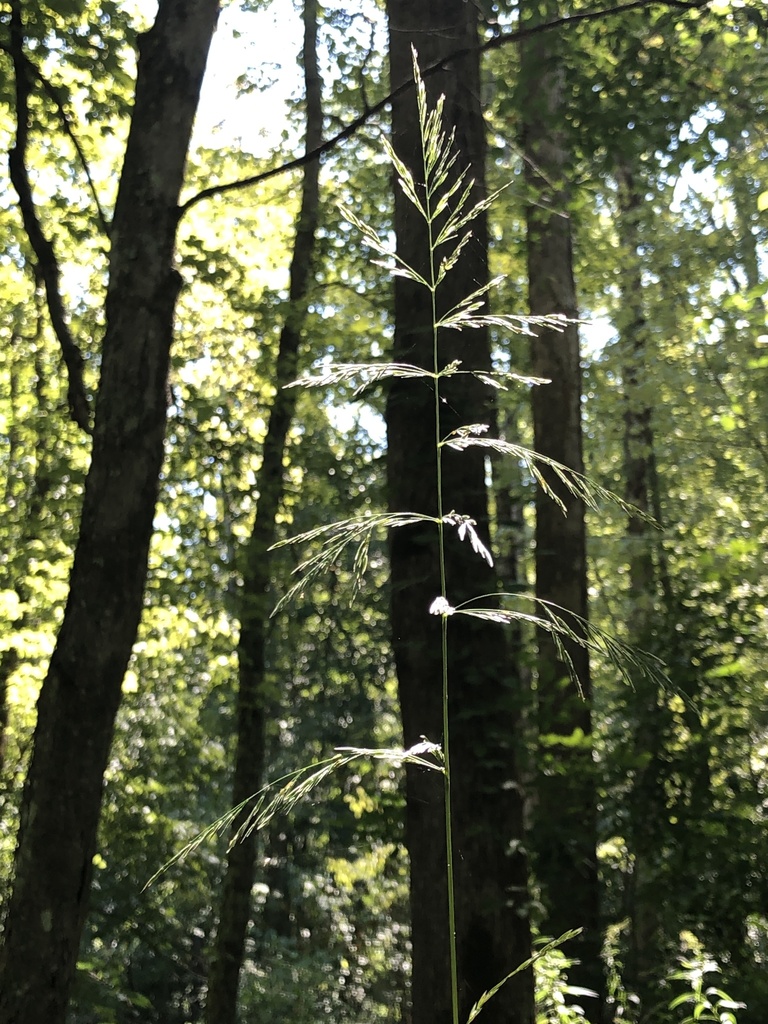
Cinna arundinacea, known as Stout Wood Reed or sweet woodreed, is a tall, cool-season perennial grass of moist, shady woods in eastern North America. It grows 2 to 5 feet tall, sometimes taller, with broad, flat, bright green leaves and a loose, nodding panicle of tiny, one-flowered spikelets that turns from green to tan in late summer and fall.
Stout wood reed is native from New Brunswick, Quebec and Ontario south to Georgia and East Texas and west to the Dakotas, Nebraska, Kansas and Oklahoma. It grows in floodplain and bottomland forests, wooded swamps, stream banks, seeps and moist ravines, usually in partial to full shade.
It is one of the few tall native grasses that thrives in shade. It is a good choice for rain gardens, woodland stream banks and moist shade gardens, where its fine, airy seed heads add texture in late summer and fall when many woodland wildflowers are finished.
Identification
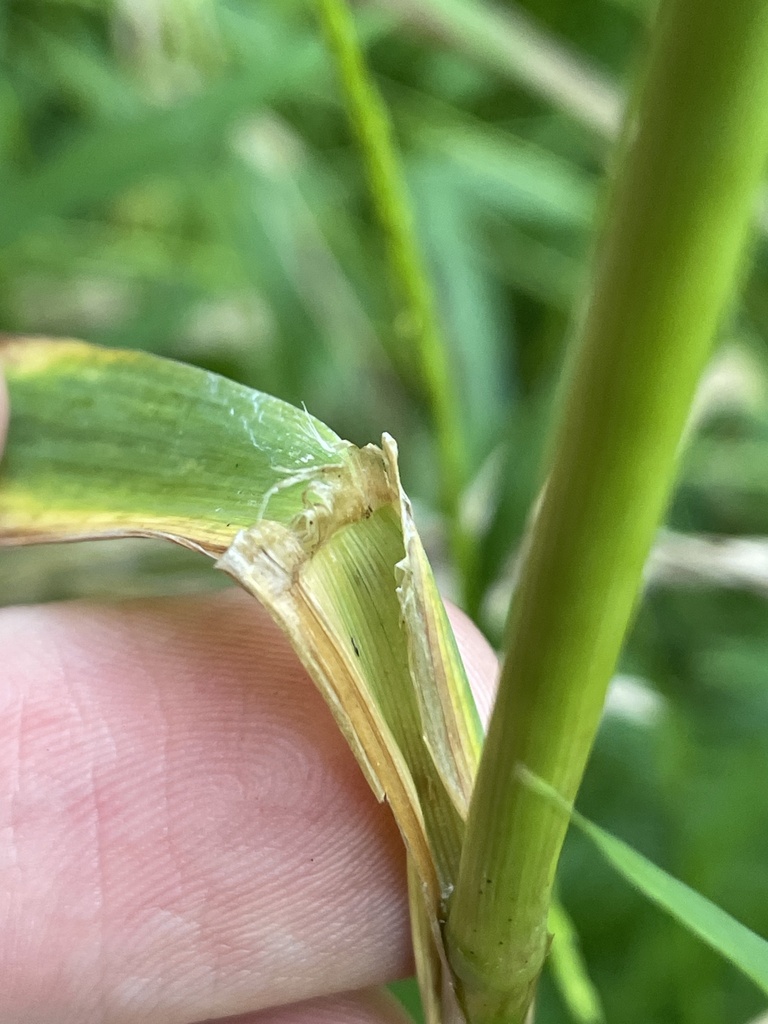
Look for a tall, leafy grass in moist shade, with broad, flat leaves, a long papery ligule, a slightly swollen stem base and a loose, nodding panicle of small spikelets in late summer.
Growth Habit
Stout wood reed grows in small clumps, with one to several upright stems 2 to 5 feet tall rising from short rhizomes. The stems are smooth and often slightly swollen and bulb-like at the base. The plant is leafy for much of its height, and the stems often lean or arch under the weight of the panicle.
Leaves
The leaf blades are flat and fairly broad for a grass, about 1/4 to 3/4 inch wide and 6 to 12 inches long, bright green and smooth or slightly rough. At the base of each blade, the ligule (a thin flap of tissue where the blade meets the sheath) is long and papery, often 1/8 to 3/8 inch, and may be torn at the tip.
Flowers
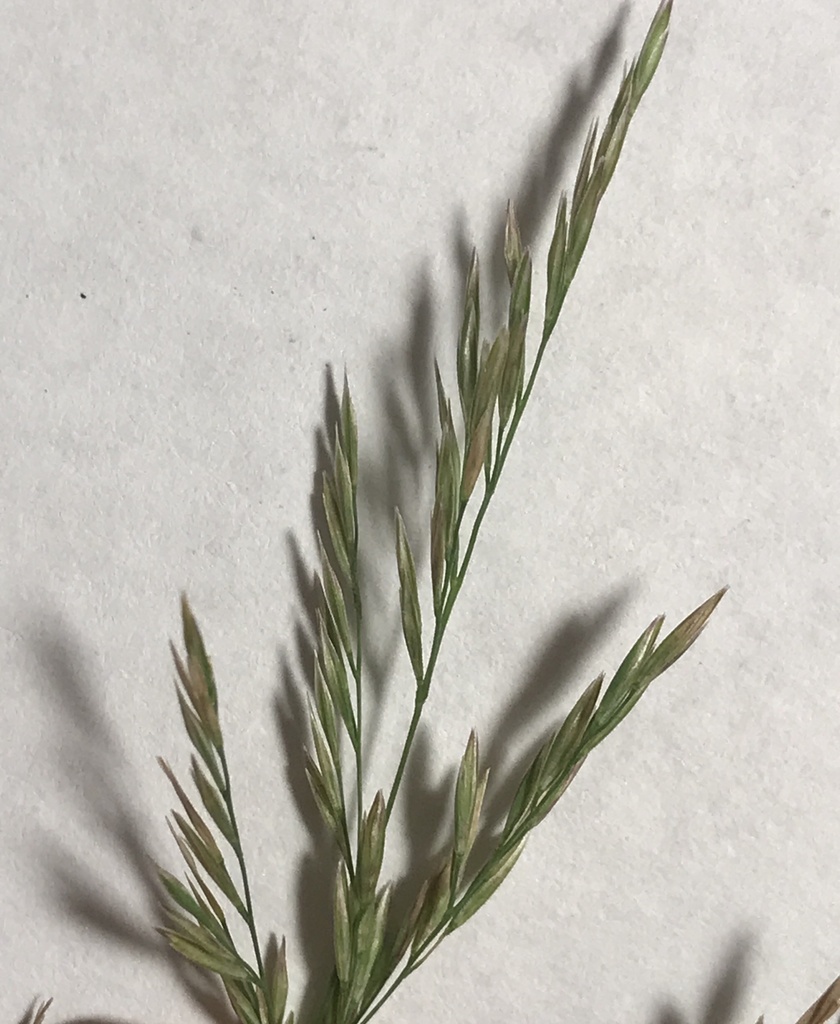
The flower head is a loose panicle about 6 to 12 inches long, at first narrow and erect, then spreading and nodding. Its slender branches are crowded with tiny, flattened spikelets about 1/6 to 1/4 inch long, each with a single floret. The lemma often has a very short awn tip. The panicles are green to purplish when young, turning straw-colored as the seeds ripen. It flowers from mid-summer into early fall.
Fruit & Seeds
Each spikelet produces a single small grain. The whole spikelet falls when ripe, from late summer into fall, and the dry panicles often stay on the stems into winter.
Look-alikes
Drooping woodreed (Cinna latifolia) is a more northern and western species with wider, thinner leaves, a laxer, more open panicle and stems without a swollen base. Virginia wild rye grows in similar places but has a dense, bristly, spike-like head. Rice cutgrass has very rough, cutting leaf edges. Mannagrasses (Glyceria) have spikelets with several florets.
Quick Facts
| Scientific Name | Cinna arundinacea |
| Family | Poaceae (grass family) |
| Plant Type | Cool-season perennial grass |
| Mature Height | 2–5 ft (occasionally to 6 ft) |
| Mature Spread | 1–2 ft |
| Growth Rate | Moderate |
| Sun Exposure | Part shade to full shade |
| Water Needs | Moist to wet; not drought tolerant |
| Soil Type | Moist to wet loam, silt or alluvial soil |
| Soil pH | Acidic to neutral (about 5.0–7.5) |
| Bloom Time | July–September |
| Flower Color | Green to purplish, aging tan |
| Fall Color | Tan to straw-colored |
| Fruit | Tiny grains in one-flowered spikelets |
| Deer Resistant | Moderately |
| USDA Hardiness Zones | 3–9 |
Native Range
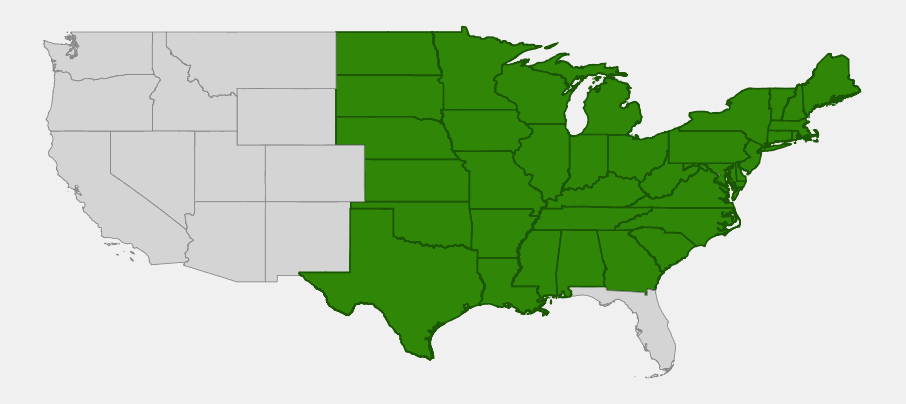
Stout wood reed is native to eastern and central North America. USDA PLANTS lists it as native in 36 states, from Maine to Georgia and west to North Dakota, South Dakota, Nebraska, Kansas, Oklahoma and Texas, and in New Brunswick, Quebec and Ontario. In Texas, Oklahoma, Kansas, Nebraska and the Dakotas it is confined to the wooded eastern parts of those states.
USDA PLANTS also shows a record from Montana, but the Montana Natural Heritage Program lists the species as not documented in the state, so Montana is not shown on the map here. The similar drooping woodreed (Cinna latifolia) is the woodreed of Montana and the Rocky Mountains.
Throughout its range it grows in moist to wet, shady places: floodplain and bottomland forests, wooded swamps and their edges, stream and river banks, seeps, wet ravines and moist woods. It is rated a facultative wetland plant in the National Wetland Plant List.
📋 Regional plant lists featuring Stout Wood Reed: New York, Pennsylvania & Northern New Jersey · Ohio & Indiana · Michigan, Wisconsin & Eastern Minnesota · Kentucky & Tennessee · Nebraska, Kansas & Eastern Colorado · Connecticut, Massachusetts & Rhode Island · New Hampshire, Maine & Vermont · Maryland, Virginia & West Virginia · Delaware, Southern New Jersey & Long Island · Illinois, Iowa & Missouri · Alabama, Georgia & Mississippi · North & South Carolina · Arkansas, Louisiana, Eastern Oklahoma & Eastern Texas · North Dakota, South Dakota & Western Minnesota
Growing & Care Guide
Stout wood reed is easy to grow in moist shade and is sold by some native plant nurseries, especially for wetland and riparian restoration. It is a tall, graceful grass for the shady, damp places where few ornamental grasses do well.
Light
Part shade to full shade. It grows best in the dappled light of a deciduous woodland or on the shady side of a building. It tolerates more sun if the soil stays wet.
Soil & Water
Plant it in moist to wet, organic soil, such as loam, silt or alluvial soil along a stream. It tolerates occasional flooding and saturated soil but does poorly in dry soil, especially in sun. Water during dry spells until it is established, and in long droughts if it is not near water.
Planting Tips
Use it in a rain garden, along a woodland stream or pond, in a moist shade border or in a bottomland restoration. Plant it in groups of three or more, 18 to 24 inches apart, with sedges, ferns and shade-tolerant wildflowers. It mixes well with inland sea oats and wild ryes.
Pruning & Maintenance
Leave the stems and seed heads standing through winter for texture and wildlife, then cut them back to a few inches in late winter or early spring before new growth starts. It needs no fertilizer.
Propagation
Grow it from seed collected in fall, sown outdoors in fall or in spring after a few weeks of cold, moist stratification. Established clumps can be divided in early spring or fall.
Landscape Uses
- Rain gardens: tolerates wet soil and periodic flooding
- Shade gardens: one of the few tall native grasses for shade
- Streambank restoration: roots help hold moist banks and floodplains
- Woodland gardens: airy late-summer seed heads among ferns and sedges
- Wildlife gardens: seed and cover for birds and small mammals
Wildlife & Ecological Value
Stout wood reed adds a tall grass layer to moist woods, providing cover, nesting material and seeds for wildlife.
For Pollinators
Like other grasses, it is wind-pollinated and offers little nectar, but its leaves are food for the caterpillars of some grass-feeding moths and skippers that live in shady, moist woods.
For Birds
Ground-feeding birds such as sparrows, juncos and wild turkeys may eat the small seeds. The clumps provide cover for birds that forage on the forest floor.
For Mammals
Deer and rabbits graze the leaves, especially in spring. Small mammals use the clumps for cover and may eat the seeds.
Ecosystem Role
Stout wood reed is part of the herb layer of floodplain and bottomland forests. Its roots help bind loose alluvial soil along streams, and its leaves and stems add to the leaf litter that builds rich floodplain soils.
Cultural & Historical Uses
The species name arundinacea means “reed-like,” from the Latin arundo, a reed. The genus name Cinna comes from an old Greek name for a kind of grass.
USDA PLANTS calls it sweet woodreed, while many state floras and field guides call it stout wood reed, after its stout, leafy stems and its swollen stem bases, which help separate it from the more slender drooping woodreed.
It is one of the North American grasses named by Linnaeus in his Species Plantarum of 1753, the starting point for modern plant names.
Frequently Asked Questions
Does stout wood reed grow in shade?
Yes. It is one of the best tall native grasses for shade, growing naturally in moist woods and floodplain forests.
Is stout wood reed good for rain gardens?
Yes. It tolerates wet soil and periodic flooding, so it works well in shady rain gardens and along streams.
How tall does stout wood reed get?
Usually 2 to 5 feet, and sometimes up to about 6 feet in rich, moist soil.
How is it different from drooping woodreed?
Drooping woodreed (Cinna latifolia) grows farther north and west, has wider, thinner leaves and a more open panicle, and lacks the swollen stem base of stout wood reed.
Does stout wood reed spread aggressively?
No. It forms small clumps and spreads slowly by short rhizomes and by seed.

Looking for a nursery that carries Stout Wood Reed?
Browse our native plant nursery directory: Alabama & Arkansas · Connecticut, Delaware & Georgia · Illinois, Indiana, Iowa & Kansas · Kentucky, Louisiana, Maine, Maryland, Massachusetts, Michigan, Minnesota, Mississippi & Missouri · Nebraska, New Hampshire, New Jersey, New York, North Carolina, North Dakota, Ohio & Oklahoma · Pennsylvania, Rhode Island, South Carolina, South Dakota, Tennessee, Texas, Vermont & Virginia · West Virginia & Wisconsin

