
False Nettle (Boehmeria cylindrica)
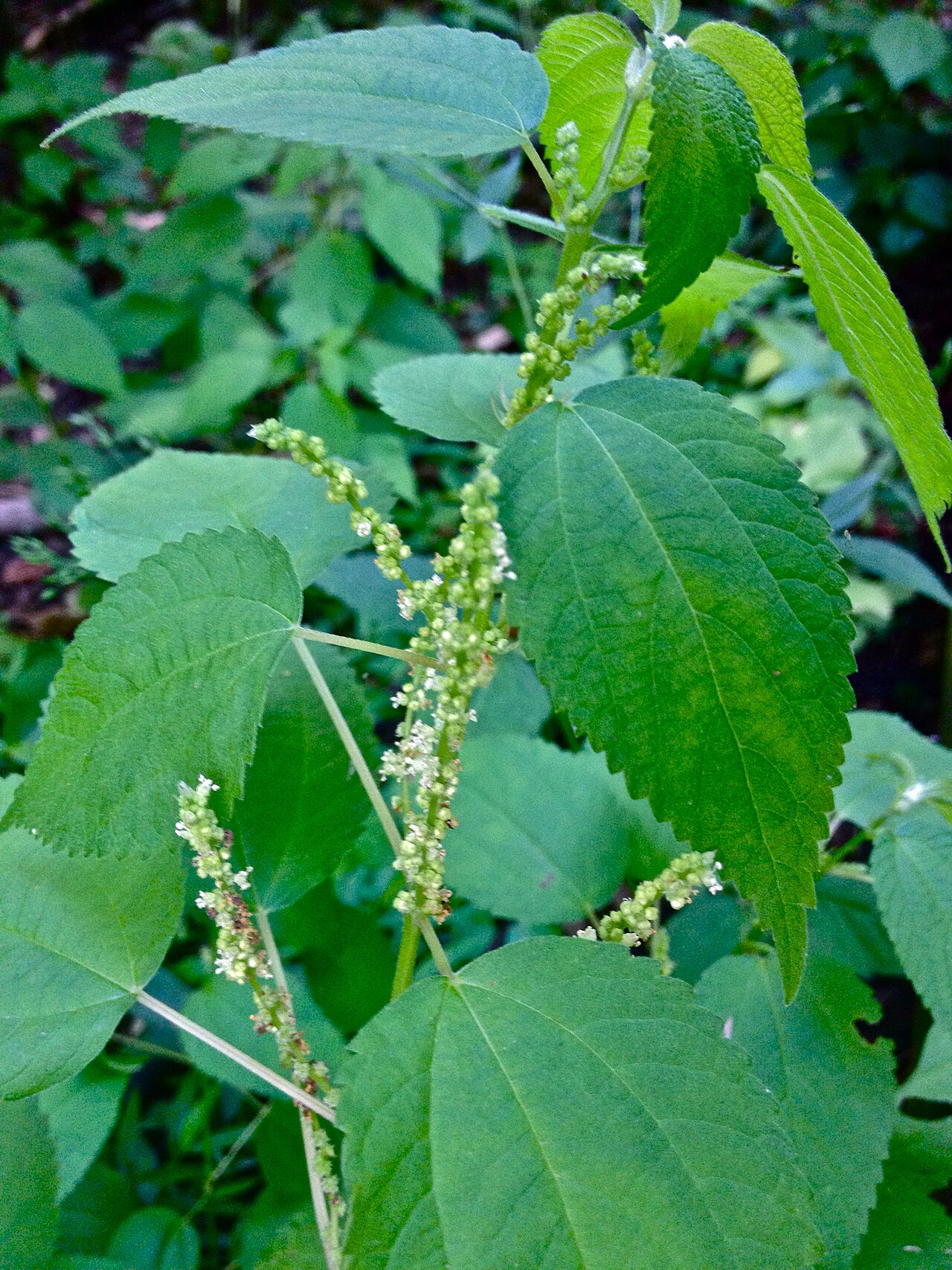
Boehmeria cylindrica, usually called False Nettle and listed by USDA as smallspike false nettle, is a soft, leafy perennial of wet woods, swamps, stream banks and marsh edges across eastern North America. It belongs to the nettle family (Urticaceae) and looks a great deal like a stinging nettle, with opposite, coarsely toothed leaves and slender spikes of green flowers. The difference is easy to feel: false nettle has no stinging hairs at all, so you can handle it bare-handed.
It is one of those plants that most people walk past without noticing. It stands 1 to 3 feet tall, its flowers are tiny and green, and it blends into the lush summer growth of floodplains. Yet it is one of the most widespread wetland wildflowers in the East, it is a larval host for several handsome butterflies, and its tough, fibrous stems earned it the old name “bog hemp”. It is also a close relative of ramie (Boehmeria nivea), an Asian plant grown for one of the strongest natural textile fibers.
This guide explains how to tell false nettle from stinging nettle, wood nettle and clearweed, where it grows from Canada to Florida and Texas (with scattered western and Caribbean outposts), how to use it in rain gardens and shady wet corners, and why it matters to butterflies and wetland ecosystems.
Identification
False nettle is easiest to identify in late summer, when its long flower spikes are fully developed. Early in the season, before flowering, it can be confused with several other members of the nettle family and with some mints. Check for opposite leaves, three prominent veins from the leaf base, no stinging hairs, and a stem that is not translucent.
Stems & Growth Form
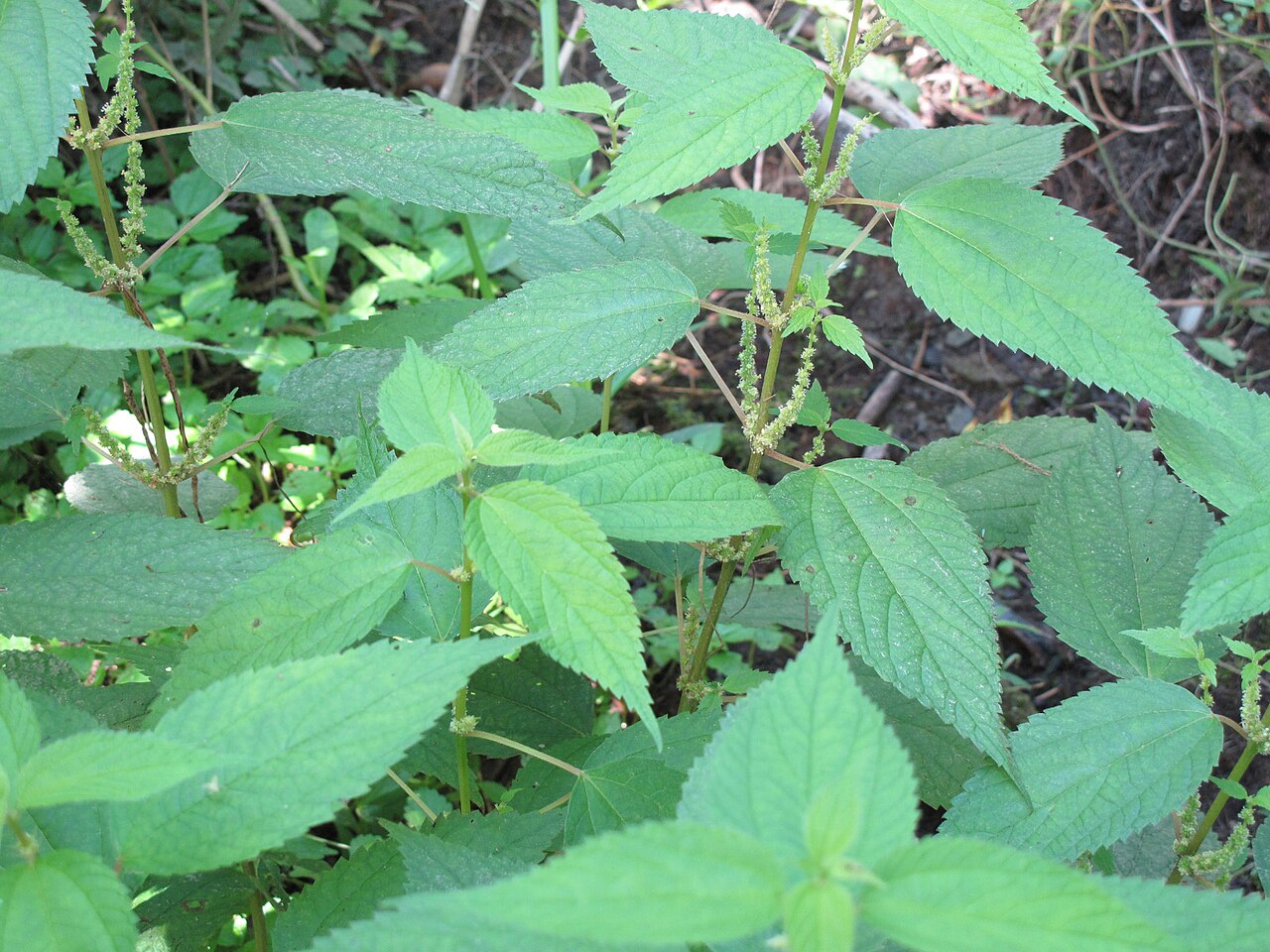
False nettle grows from a short, branching rhizome and forms loose clumps or small colonies. The stems are upright, unbranched or sparingly branched, green to reddish, and usually 1 to 3 feet tall; in rich floodplain soil they can reach 4 feet or a little more. The stems may be smooth or finely hairy (plants with rougher hair were once separated as var. drummondiana or var. scabra), but they never carry the glassy stinging hairs of true nettles. Unlike clearweed, the stem is opaque, not watery and translucent.
Leaves
The leaves are opposite, or occasionally alternate near the top of the plant, on long stalks. The blades are ovate to lance-ovate, about 2 to 5 inches long, with a long-pointed tip, a rounded base and regular, coarse teeth along the margins. Three main veins run from the base of the blade, a classic nettle-family feature. The upper surface is often slightly rough to the touch.
Flowers
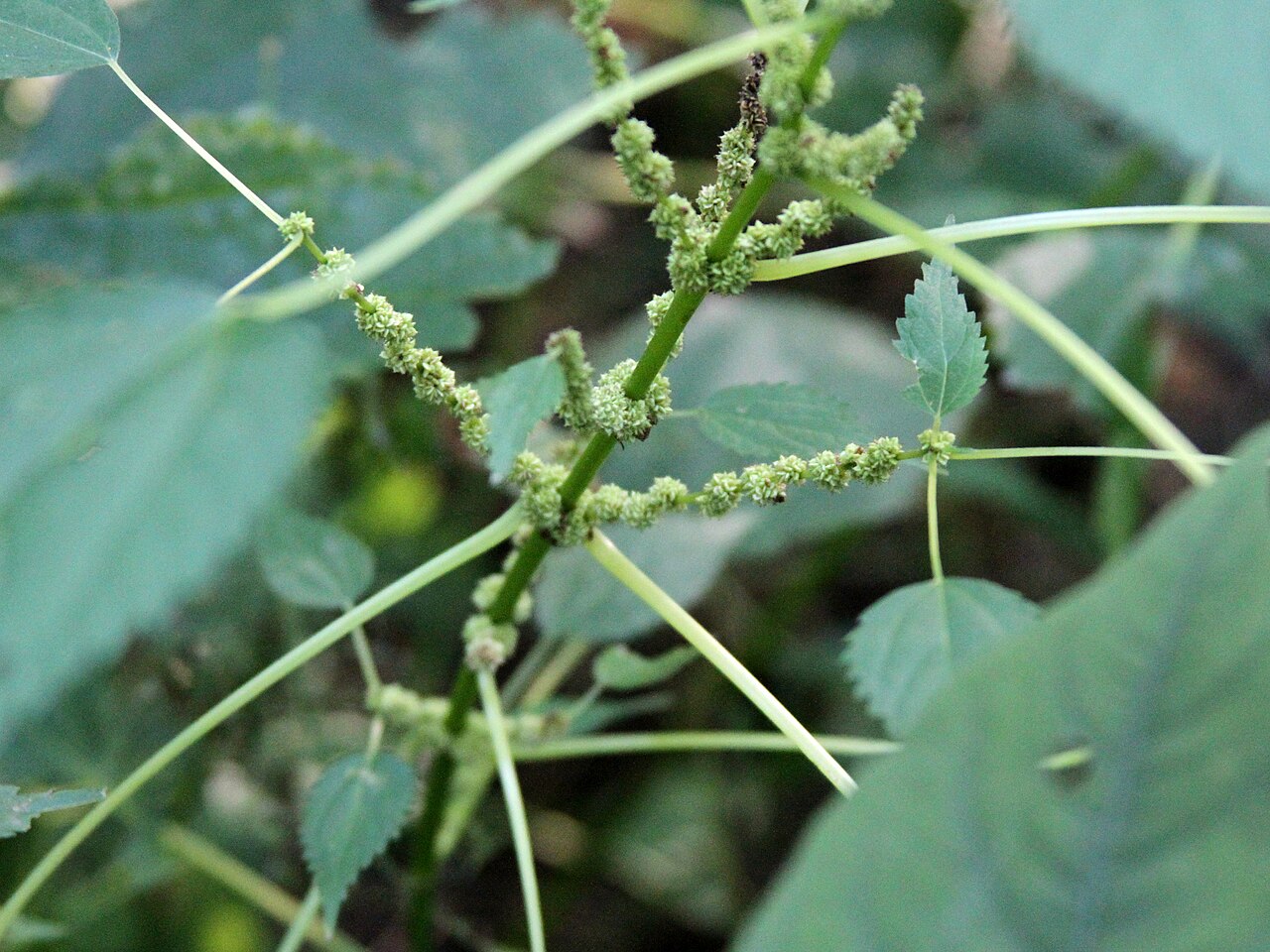
Flowering runs from about midsummer into fall (roughly July to October). The flowers are tiny, greenish, and lack petals. They are packed into small rounded clusters spaced along slender, unbranched spikes that arise from the leaf axils. The spikes are often an inch or two long and frequently end in a small tuft of leaves, which helps identify the plant. Male (staminate) and female (pistillate) flowers are separate, sometimes on the same plant and sometimes on different plants. Male spikes tend to look interrupted and beaded, while female spikes are denser and more continuous. The flowers are wind-pollinated and have no fragrance or nectar.
Fruit & Look-alikes
Female flowers ripen into tiny, flattened achenes enclosed in the persistent, hairy calyx, giving the spikes a fuzzy, brownish look in fall. Stinging nettle (Urtica dioica) also has opposite leaves but carries stinging hairs and branched flower clusters. Wood Nettle stings and has alternate leaves. Clearweed (Pilea pumila) is a smaller annual with a translucent, watery stem. The introduced ramie has alternate leaves with silvery-white undersides.
Quick Facts
| Scientific Name | Boehmeria cylindrica (syn. Urtica cylindrica, B. drummondiana, B. scabra) |
| Family | Urticaceae (nettle family) |
| Plant Type | Herbaceous perennial from a short rhizome; non-stinging |
| Mature Height | 1–3 ft (occasionally to about 4 ft) |
| Mature Spread | 1–2 ft; forms loose clumps or colonies |
| Growth Rate | Moderate |
| Sun Exposure | Part shade to full shade; tolerates sun in wet soil |
| Water Needs | High; moist to wet soil, tolerates seasonal flooding |
| Soil Type | Moist to wet loam, silt, muck or alluvial soil |
| Soil pH | About 5.0–7.5 |
| Bloom Time | July–October |
| Flower Color | Green to greenish white; spikes turn brownish in fruit |
| Fall Color | Little; leaves yellow or brown with frost |
| Fruit | Tiny hairy achenes clustered along the spikes |
| Deer Resistant | Moderate; not a favored browse plant |
| USDA Hardiness Zones | 3–10 |
Native Range
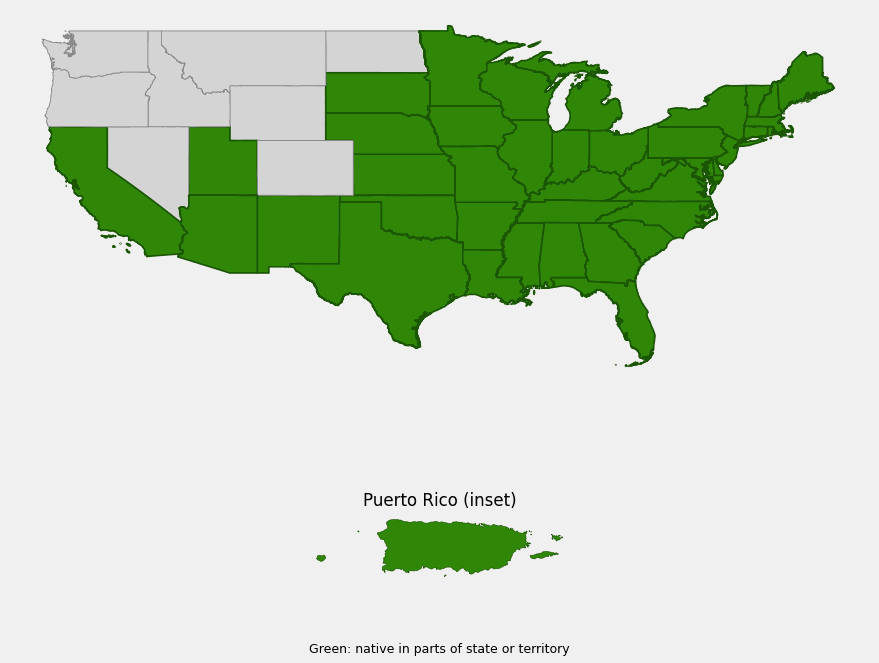
False nettle is one of the most widespread wetland wildflowers in eastern North America. USDA PLANTS records it as native in 40 states, the District of Columbia and Puerto Rico. Its main range runs from Maine, New Brunswick, Quebec and Ontario south through the Atlantic states to Florida, and west across the Ohio and Mississippi valleys to Minnesota, South Dakota, Nebraska, Kansas, Oklahoma and Texas. The Lady Bird Johnson Wildflower Center summarizes it as “Ontario to Quebec, south to Florida, west to Texas, north to Minnesota”.
West of the Great Plains it becomes rare. Scattered, isolated populations are reported from springs, seeps and canyon streams in New Mexico, Arizona and Utah, and USDA also lists California. These are outlying records far from the main range, and the plant should be considered rare and local anywhere in the Southwest. In the East it is common in floodplain forests, swamps and wet thickets and is often abundant along rivers and creeks.
Beyond the United States and Canada, false nettle grows in Bermuda, Mexico, Central America, the West Indies (including Puerto Rico) and South America, making it one of the few nettle-family wildflowers shared by temperate North America and the tropics.
📋 Regional plant lists featuring False Nettle: New York, Pennsylvania & Northern New Jersey · Idaho, Eastern Oregon & Eastern Washington · Ohio & Indiana · Michigan, Wisconsin & Eastern Minnesota · Kentucky & Tennessee · Nebraska, Kansas & Eastern Colorado · Utah & Western Colorado · Connecticut, Massachusetts & Rhode Island · New Hampshire, Maine & Vermont · Maryland, Virginia & West Virginia · Delaware, Southern New Jersey & Long Island · Arizona & New Mexico · Illinois, Iowa & Missouri · Alabama, Georgia & Mississippi · North & South Florida · Puerto Rico · North & South Carolina · Arkansas, Louisiana, Eastern Oklahoma & Eastern Texas · South & West Texas · North Dakota, South Dakota & Western Minnesota · California & Nevada
Growing & Care Guide
False nettle is not a showy garden flower, but it is an easy, adaptable native for places where little else thrives: wet shade, soggy low spots and the edges of ponds and streams. It is best treated as a naturalizing groundcover-height perennial in a wildlife or rain garden, where its texture fills gaps and its leaves feed caterpillars.
Light
False nettle grows best in partial to full shade, the conditions of a floodplain forest. It tolerates more sun where the soil stays consistently wet, as on a pond edge or a marsh margin. In dry, sunny sites the leaves scorch and the plants stay small.
Soil & Water
Give it moist to wet, reasonably fertile soil. Silty or loamy alluvial soils are ideal, but it also grows in muck and in heavier clay if water is plentiful. It tolerates periodic flooding and saturated soil, which makes it useful in the wettest zone of a rain garden or bioswale. It does not need fertilizer; in rich soil it grows taller and spreads faster.
Planting Tips
Set out nursery plants in spring or fall about 12 to 18 inches apart. They knit together into a loose colony within a few seasons. Combine them with taller wetland perennials, ferns and sedges so the plantings look intentional. Because it has no stinging hairs, it is a good choice near paths where a true nettle would be unwelcome.
Pruning & Maintenance
Little maintenance is needed. Leave the stems standing over winter, since insects may overwinter in the litter and the fruiting spikes add winter texture, then cut them down in early spring. The rhizomes spread steadily but not aggressively; pull unwanted shoots at the colony edge if needed. Expect some chewed leaves in summer, which is a sign the plant is doing its job as a caterpillar host.
Propagation
Divide established clumps in early spring or fall. Seed can be collected in fall when the spikes turn brown and sown outdoors in moist soil; a winter of cold, moist conditions helps germination. Plants often self-sow lightly in damp, disturbed ground.
Landscape Uses
- Rain gardens and bioswales: for the wettest, shadiest zones where flooding is frequent
- Streambank and floodplain restoration: its rhizomes help hold soil on shaded banks within its native range
- Butterfly gardens: as a non-stinging larval host for comma and red admiral butterflies
- Woodland and shade gardens: as a fine-textured filler among ferns, sedges and spring ephemerals
- Pond and wetland edges: in moist margins under trees where sun-loving wetland plants struggle
Wildlife & Ecological Value
False nettle looks modest, but in floodplain forests it is often one of the most common plants of the herb layer. That abundance makes it an important food source for nettle-feeding insects and a significant part of the ground cover that shelters wetland wildlife.
For Pollinators
Because its flowers are wind-pollinated, false nettle offers no nectar and is rarely visited by bees. Its value to pollinators is as a caterpillar food plant. The Lady Bird Johnson Wildflower Center lists it as a larval host of the eastern comma (Polygonia comma) and the red admiral (Vanessa atalanta), both of which also feed on true nettles. Planting false nettle supports these butterflies without adding stinging plants to the garden. A small gall midge (Neolasioptera boehmeriae) forms spindle-shaped swellings on the stems.
For Birds
The small seeds may be eaten by ground-feeding birds, and the dense summer growth provides cover for birds that forage on the ground in floodplain forests. The insects that feed on the leaves are also food for warblers, wrens and other insect-eating birds raising young.
For Mammals
Deer browse false nettle occasionally, but it is not a favored food. Its colonies provide cover for small mammals and amphibians in moist woods.
Ecosystem Role
In bottomland forests and along streams, false nettle forms part of the dense herb layer that slows floodwater, traps sediment and shades the soil. Its rhizomes help bind loose alluvial soil. As a host for nettle-feeding insects, it links the forest floor to the wider food web.
Cultural & Historical Uses
Linnaeus described this plant in 1753 as Urtica cylindrica, placing it with the stinging nettles. It was later moved to Boehmeria, a genus named by Nikolaus von Jacquin in honor of the eighteenth-century German botanist Georg Rudolf Böhmer. The species name refers to its cylindrical flower spikes.
The name “bog hemp” refers to the fibrous inner bark of the stems, which is typical of the genus. Its Asian relative, ramie (Boehmeria nivea), has been grown for thousands of years for a strong, lustrous fiber used in textiles. Fibers from many native nettle-family plants were used for cordage by Indigenous peoples of North America, but specific historical uses of false nettle are not well documented, so its main cultural role today is ecological rather than economic.
For gardeners and naturalists, false nettle is a useful lesson in looking closely. It is often mistaken for stinging nettle and pulled out, but it is harmless to handle. Learning to recognize it, and leaving it in place in wet woods and garden corners, is an easy way to support native butterflies.
Frequently Asked Questions
Does false nettle sting?
No. False nettle has no stinging hairs, which is the main way to tell it from stinging nettle and wood nettle. You can brush against it or handle it without any irritation.
How do I tell false nettle from stinging nettle?
Both have opposite, toothed leaves, but false nettle has no stinging hairs and bears its flowers in slender, unbranched spikes that often end in a tuft of small leaves. Stinging nettle has stinging hairs on the stems and leaves and branched, drooping flower clusters.
Is false nettle invasive?
No. It is native across most of the eastern and central United States. It spreads by rhizomes and can form colonies in wet ground, but it is easy to control and is a natural part of floodplain plant communities.
Which butterflies use false nettle?
The Lady Bird Johnson Wildflower Center lists it as a larval host for the eastern comma and the red admiral. Both caterpillars also use stinging nettles, so false nettle is a gentle alternative for butterfly gardens.
Where should I plant false nettle?
Plant it in moist to wet, partly shaded or shaded spots: rain gardens, pond edges, stream banks and low woodland corners. It struggles in dry soil and full sun.

Looking for a nursery that carries False Nettle?
Browse our native plant nursery directory: Alabama, Arizona & Arkansas · California · Connecticut, Delaware, Florida & Georgia · Illinois, Indiana, Iowa & Kansas · Kentucky, Louisiana, Maine, Maryland, Massachusetts, Michigan, Minnesota, Mississippi & Missouri · Nebraska, New Hampshire, New Jersey, New Mexico, New York, North Carolina, Ohio & Oklahoma · Pennsylvania, Rhode Island, South Carolina, South Dakota, Tennessee, Texas, Utah, Vermont & Virginia · West Virginia & Wisconsin