
Aniseroot (Osmorhiza longistylis)
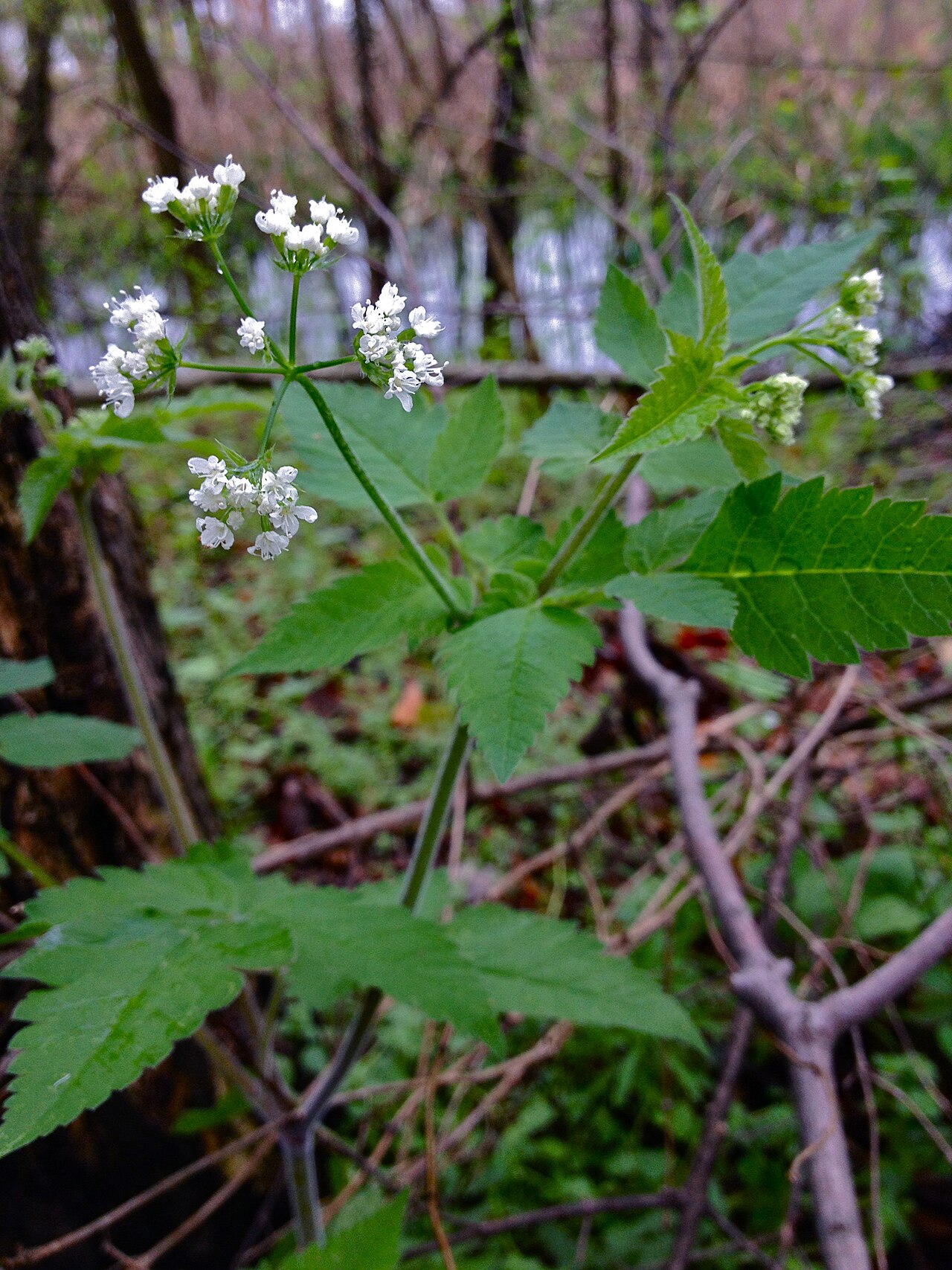
Osmorhiza longistylis, known as Aniseroot, longstyle sweetroot or smooth sweet cicely, is a woodland wildflower of the carrot family (Apiaceae) found across much of eastern and central North America. In spring it sends up a loose, branching plant 1½ to 3 feet tall with lacy, fern-like leaves and small, flat-topped clusters of tiny white flowers. It grows in rich deciduous woods, floodplain forests, wooded ravines and shaded stream banks, often in the company of spring ephemerals.
The best way to know aniseroot is with your nose. Crush a leaf or scratch the thick, fleshy roots and you get a clear, sweet smell of anise or licorice. The genus name Osmorhiza means “scented root” (Greek osme, smell, and rhiza, root), and longistylis refers to the long styles that stick out of each flower. Both traits separate it from its close look-alike, hairy sweet cicely (Osmorhiza claytonii), which has short styles and little or no scent.
Aniseroot is not a showy plant, but it is a useful one for shade gardens and woodland restorations. It fills gaps between larger perennials, feeds small native bees and flies in spring, and spreads its seeds by hitching rides on passing animals. Because it is a member of the carrot family, which includes some of North America’s most poisonous plants, this guide also covers how to tell it apart from dangerous look-alikes.
Identification
Aniseroot is easiest to identify in late spring, when it is in flower or carrying its long, bristly fruits. At any stage, the anise scent of the crushed leaves and roots is the most reliable field mark.
Roots & Stems
The plant grows from a short crown with a cluster of thick, fleshy, carrot-like roots that smell strongly of anise. The stems are usually single from each crown, branched above, and 1½ to 3 feet tall (occasionally taller in rich floodplain soil). They are smooth or only slightly hairy in most plants, although some populations (once named var. villicaulis) have noticeably hairy stems, so stem hairiness alone does not separate it from hairy sweet cicely.
Leaves
The leaves are large and two or three times divided into threes (biternate to triternate), giving them a lacy, fern-like look. The individual leaflets are ovate to lance-shaped, 1 to 3 inches long, coarsely toothed or lobed, and soft. Basal leaves have long stalks, and the stem leaves become smaller and shorter-stalked upward. The foliage is fresh green and appears early in spring, often before the tree canopy closes.
Flowers
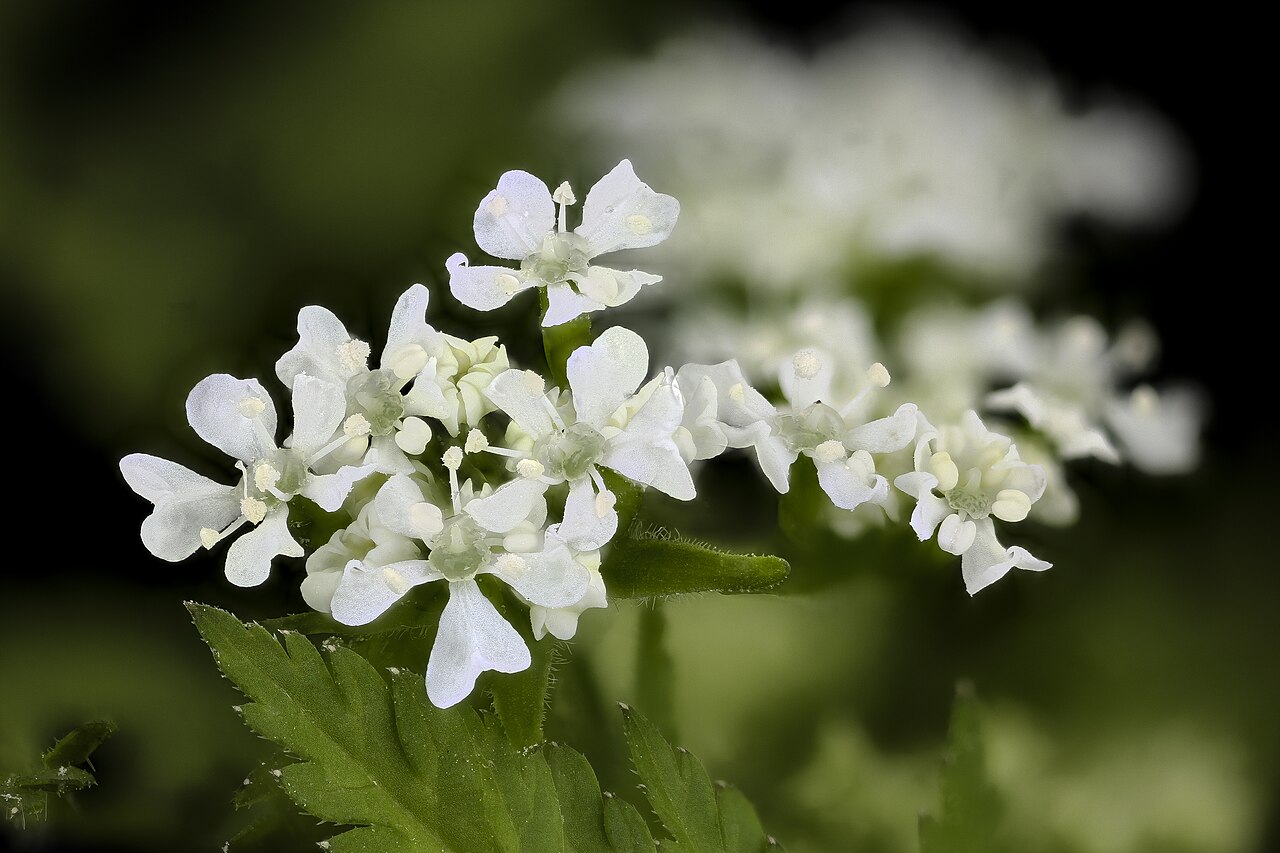
Tiny white flowers, each about ⅛ inch across, are arranged in small compound umbels at the ends of the branches. Each umbel has only a few spreading rays, and each small cluster (umbellet) holds roughly 9 to 18 flowers. The petals are white and incurved at the tips. The key detail is the styles: in aniseroot they are long, about 2 to 4 mm, and extend well beyond the petals, while in hairy sweet cicely they are about 1 mm or less and barely visible. Bloom time is mostly April through early June, a little earlier in the South.
Fruit & Seeds
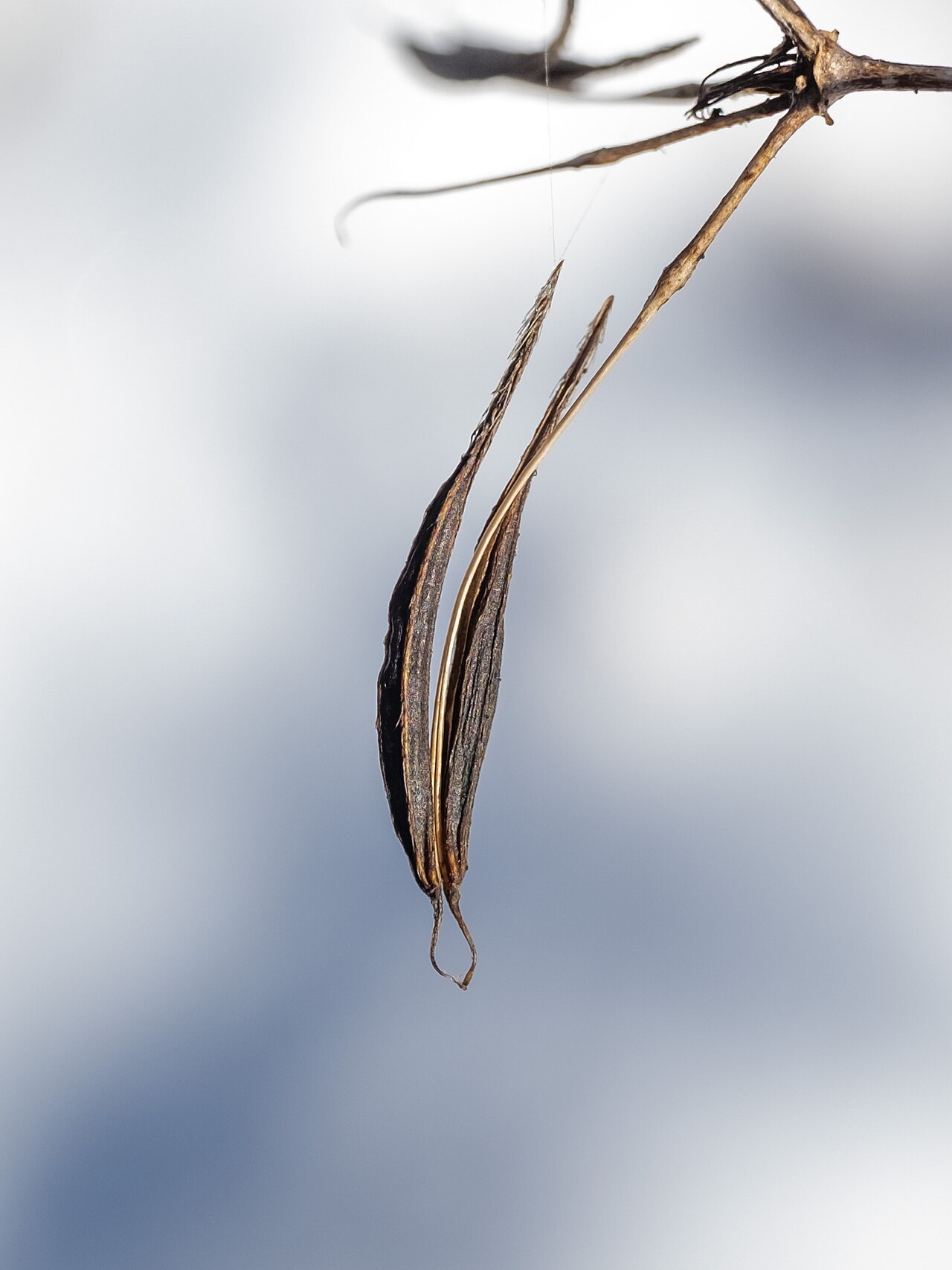
The fruits are narrow, club-shaped schizocarps roughly ¾ inch long that split into two seed-like halves. They are ribbed and lined with stiff, upward-pointing bristles and end in a sharp, tail-like base. When ripe they turn dark brown to black, spread outward and stick readily to fur, socks and pant legs. In the field, the fruits of aniseroot keep a short beak from the persistent long styles.
Look-alikes to Avoid
Aniseroot is in the same family as poison hemlock (Conium maculatum) and water hemlock (Cicuta maculata), two of the most poisonous plants in North America. Poison hemlock has a hairless, purple-spotted stem and a musty, mousy odor, and water hemlock grows in wet ground with chambered roots and large umbrella-like umbels. Neither smells of anise. Still, carrot-family plants are notoriously hard to tell apart, and even experienced foragers have been poisoned. Never taste any wild member of the carrot family unless you are completely certain of its identity.
Quick Facts
| Scientific Name | Osmorhiza longistylis (syn. Washingtonia longistylis) |
| Family | Apiaceae (carrot family) |
| Plant Type | Herbaceous perennial woodland wildflower |
| Mature Height | 1½–3 ft |
| Mature Spread | 1–2 ft |
| Growth Rate | Moderate |
| Sun Exposure | Partial shade to full shade |
| Water Needs | Moderate; prefers evenly moist soil |
| Soil Type | Rich, loamy or alluvial woodland soil high in organic matter |
| Soil pH | About 6.0–7.5 |
| Bloom Time | April–June |
| Flower Color | White |
| Fall Color | None; foliage yellows and dies back by late summer |
| Fruit | Narrow, dark, bristly schizocarp about ¾ in long |
| Deer Resistant | Moderate; occasionally browsed |
| USDA Hardiness Zones | 3–8 |
Native Range
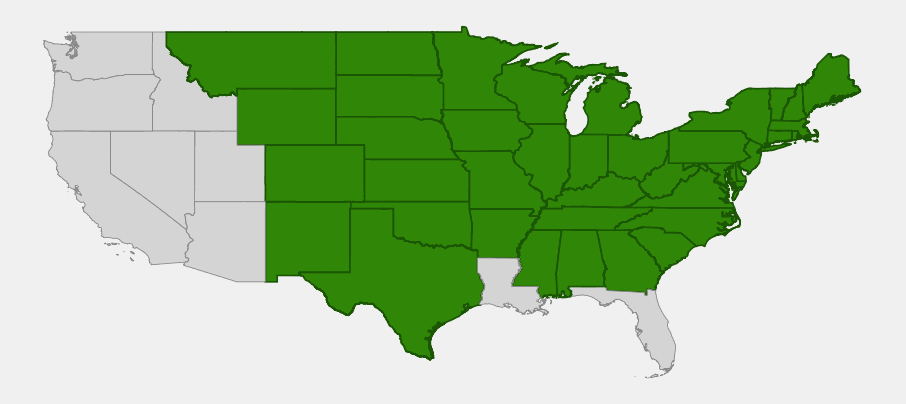
Aniseroot is one of the most widespread woodland wildflowers of eastern and central North America. USDA PLANTS records it as native in 39 states and the District of Columbia, from Maine and the Great Lakes south to Georgia and Mississippi and west across the Great Plains to Texas, New Mexico, Colorado, Wyoming and Montana. In Canada it ranges from Alberta and Saskatchewan east through Manitoba, Ontario and Quebec to the Maritime provinces.
It is most common in the Midwest and the Ohio and Mississippi valleys, where it is a regular plant of rich floodplain forests, wooded bottomlands and moist slopes. Farther east and north it grows in rich hardwood forests, often on limestone or other base-rich soils. At the western edge of its range, on the Great Plains and along the eastern foot of the Rocky Mountains, it follows wooded river corridors, shaded canyons and the cool forests of places like the Black Hills.
It does not grow in Florida or Louisiana, and it is absent from most of the Atlantic and Gulf Coastal Plain. In Texas it is found mainly in the wooded eastern and central parts of the state rather than the arid south and west.
📋 Regional plant lists featuring Aniseroot: New York, Pennsylvania & Northern New Jersey · Idaho, Eastern Oregon & Eastern Washington · Ohio & Indiana · Montana & Wyoming · Michigan, Wisconsin & Eastern Minnesota · Kentucky & Tennessee · Nebraska, Kansas & Eastern Colorado · Connecticut, Massachusetts & Rhode Island · New Hampshire, Maine & Vermont · Maryland, Virginia & West Virginia · Delaware, Southern New Jersey & Long Island · Illinois, Iowa & Missouri · Alabama, Georgia & Mississippi · North & South Carolina · Arkansas, Louisiana, Eastern Oklahoma & Eastern Texas · North Dakota, South Dakota & Western Minnesota
Growing & Care Guide
Aniseroot is an easy, low-maintenance plant for a shady garden with reasonably rich soil. It is not a flashy perennial, so it works best mixed with spring ephemerals, ferns and sedges in a naturalistic woodland planting, where its airy foliage and white flowers soften the spaces between bolder plants.
Light
Give it partial to full shade. It grows well under deciduous trees, where it gets bright spring light before leaf-out and shade in summer. In full sun the leaves scorch and the plant goes dormant early.
Soil & Water
Aniseroot prefers moist, fertile, loamy soil with plenty of leaf litter, like the floodplain and ravine soils where it grows wild. It tolerates clay and periodic flooding, and once established it handles short dry spells, especially after flowering. Avoid very sandy, droughty soils.
Planting Tips
Plant nursery-grown plants in spring or fall, about 12 to 18 inches apart. Seed can be sown outdoors in fall, which is the easiest method. Because the plant has a thick, fleshy root system, set potted plants in without disturbing the root ball and water them through their first season.
Pruning & Maintenance
Little care is needed. Leaving the leaf litter in place feeds the soil and protects the crowns. The foliage often yellows and dies back in mid to late summer, so plant later-season ferns, sedges or woodland asters nearby to cover the gap. If you don’t want the sticky seeds in a path or on your pets, cut the stalks back after flowering.
Propagation
Aniseroot is grown mainly from seed. The seed needs a long period of cold, moist stratification, so sowing it outdoors in fall or early winter works best. Lady Bird Johnson Wildflower Center notes that it is not easy, but not impossible, to start from seed, and germination can be slow and spread out over more than one spring. Established plants self-sow modestly in good conditions.
Landscape Uses
- Woodland and shade gardens: an airy filler among spring ephemerals, ferns and woodland sedges
- Floodplain and riparian restoration: tolerates periodic flooding and rich alluvial soils within its native range
- Pollinator plantings in shade: early flowers for small native bees and flies
- Naturalized edges: informal woodland borders and shady hedgerows where it can self-sow
- Sensory or teaching gardens: the anise-scented foliage is a memorable lesson in plant identification by smell
Wildlife & Ecological Value
Aniseroot is a common, quiet part of spring woodland ecology. It flowers when many trees are just leafing out and provides food and shelter at ground level.
For Pollinators
The small, open flowers offer easy access to pollen and nectar, so they are visited mostly by short-tongued insects: small bees such as sweat bees (Halictidae) and mining bees (Andrena), as well as syrphid flies, small wasps and beetles. In a shady woodland in late spring, it is often one of the few plants blooming for these small pollinators.
For Birds
Birds make little direct use of the plant, though ground-foraging woodland birds find insects among its foliage and leaf litter.
For Mammals
The bristly, barbed fruits are adapted to catch in the fur of deer, raccoons, foxes and other mammals, which carry them to new sites (a dispersal strategy called epizoochory). White-tailed deer and rabbits sometimes browse the leaves, but it is rarely a preferred food.
Ecosystem Role
Aniseroot is part of the herbaceous layer that holds soil and recycles nutrients in floodplain and slope forests. Its tolerance of disturbance means it often persists in second-growth woods where more sensitive wildflowers have disappeared.
Cultural & Historical Uses
John Torrey first described this plant in 1823 as Myrrhis longistylis, placing it with the European sweet cicely (Myrrhis odorata), whose anise flavor is similar. Augustin Pyramus de Candolle moved it to Osmorhiza in 1830, and it was later also placed in a genus called Washingtonia, a name now used only for fan palms. These older names still turn up in historical floras and herbarium records.
The sweet, anise-scented roots have long attracted attention. Ethnobotanical records describe several Indigenous peoples of the Great Lakes and Plains using aniseroot as a medicine and flavoring, and settlers and later foragers chewed the root or used it to flavor teas and candies.
Today foraging guides still mention aniseroot, but almost always with a warning. Its family includes poison hemlock and water hemlock, which have killed people who mistook them for edible relatives. For most people, aniseroot is best enjoyed by crushing a leaf and smelling it, and left in the ground.
Frequently Asked Questions
How do I tell aniseroot from hairy sweet cicely?
Smell the crushed root or leaf: aniseroot has a strong anise or licorice scent, while hairy sweet cicely (Osmorhiza claytonii) has little or none. In flower, aniseroot styles are about 2 to 4 mm long and stick out past the petals, while hairy sweet cicely styles are about 1 mm or shorter. Stem hairiness varies in both species and is not reliable.
Is aniseroot edible?
The root and leaves have been used as flavoring, but you should never eat any wild carrot-family plant unless you are absolutely certain of its identity. Poison hemlock and water hemlock are deadly and can grow nearby. If in doubt, leave it alone.
Is aniseroot the same as sweet cicely?
Not exactly. “Sweet cicely” is the common name for Myrrhis odorata, a European herb with a similar anise flavor, and it is also used loosely for North American Osmorhiza species. Aniseroot is a different plant, native to North America.
Will aniseroot spread in my garden?
It self-sows moderately in moist, shady spots but is not aggressive. Its sticky seeds can travel on pets and clothing, so cut the seed heads off after flowering if you want to limit spread.
Why does the plant disappear in summer?
Like many woodland wildflowers, aniseroot does most of its growing in spring. In mid to late summer the leaves often yellow and die back, especially in dry or hot weather. The roots remain alive and send up new growth the next spring.

Looking for a nursery that carries Aniseroot?
Browse our native plant nursery directory: Alabama & Arkansas · Colorado, Connecticut, Delaware & Georgia · Illinois, Indiana, Iowa & Kansas · Kentucky, Maine, Maryland, Massachusetts, Michigan, Minnesota, Mississippi, Missouri & Montana · Nebraska, New Hampshire, New Jersey, New Mexico, New York, North Carolina, North Dakota, Ohio & Oklahoma · Pennsylvania, Rhode Island, South Carolina, South Dakota, Tennessee, Texas, Vermont & Virginia · West Virginia, Wisconsin & Wyoming