
Sidebeak Pencilflower (Stylosanthes biflora)
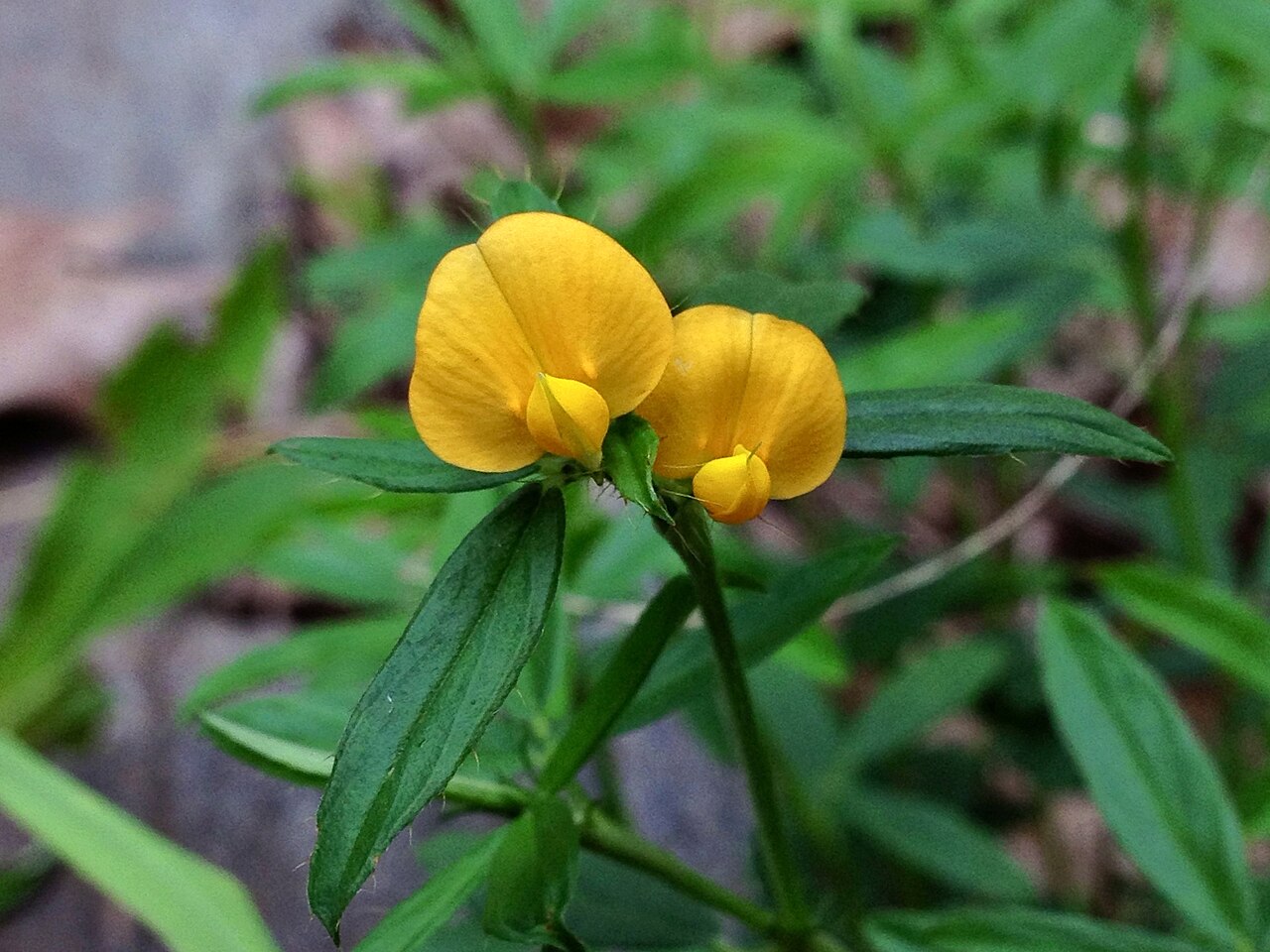
Stylosanthes biflora, known as Sidebeak Pencilflower or simply pencilflower, is a small, wiry perennial legume of dry, open woods, barrens, glades and sandy fields in the eastern and central United States. It grows only 4 to 20 inches tall, with narrow, three-part leaves, and from early summer into fall it produces bright orange-yellow pea flowers, usually one or two at a time at the tips of the stems.
It is easy to miss: its stems are thin, its leaves small, and each flower opens in the morning and wilts by afternoon. But it is a common and widespread member of prairie, savanna and open woodland plant communities, from New York and Pennsylvania south to Florida and west to Kansas and Texas. Like other legumes, it fixes nitrogen with the help of bacteria in its roots.
Sidebeak pencilflower is a good small plant for dry, sunny, sandy or rocky gardens, rock gardens and meadow and prairie plantings on poor soil. It is rarely sold as a plant, but seed is sometimes available from native seed companies in the Southeast.
Identification
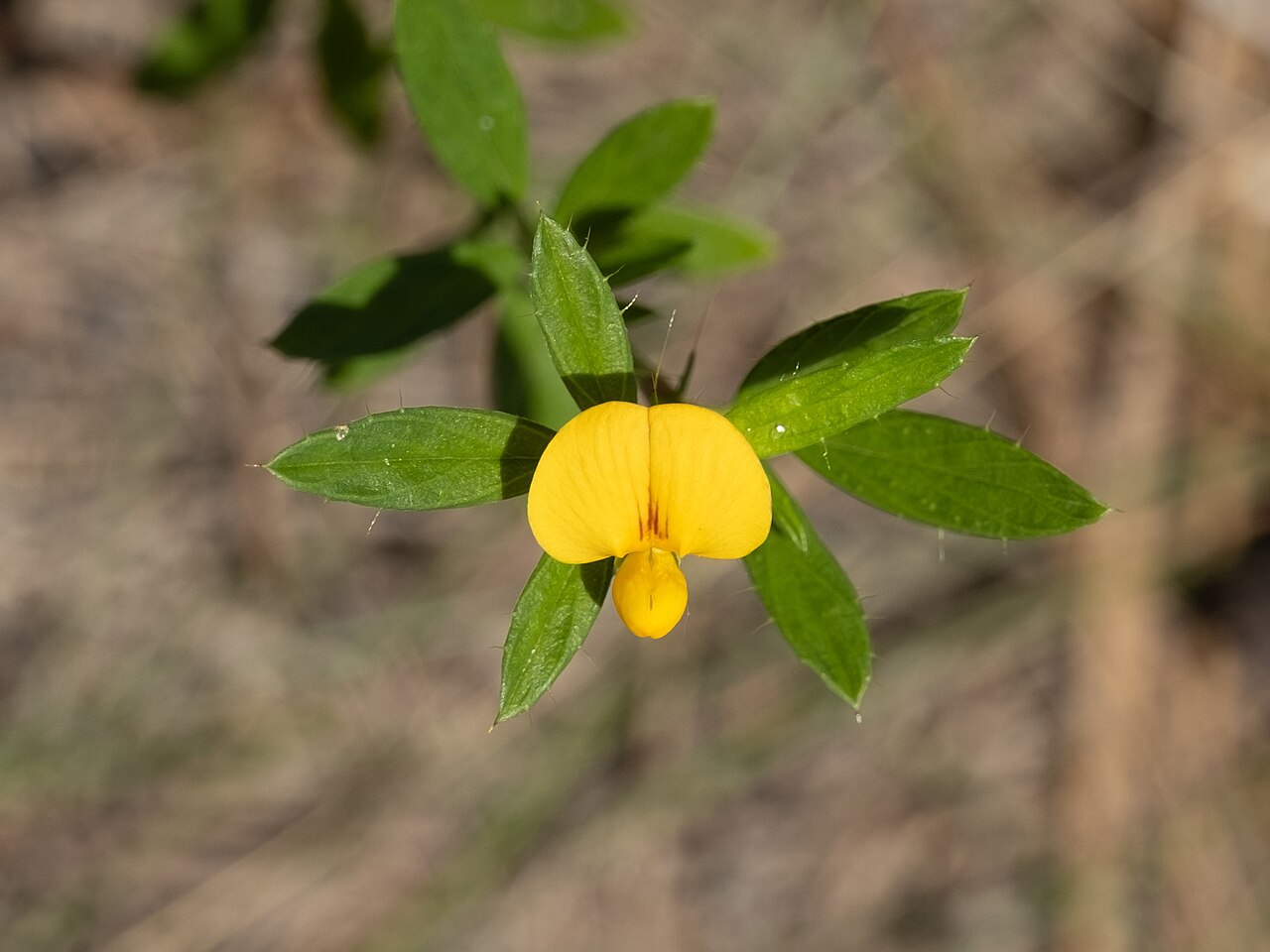
Look for a small, wiry plant with narrow, three-part leaves, bristly sheaths where the leaves join the stem, and one or two bright orange-yellow pea flowers at the stem tips, in dry, sunny, open ground.
Growth Habit
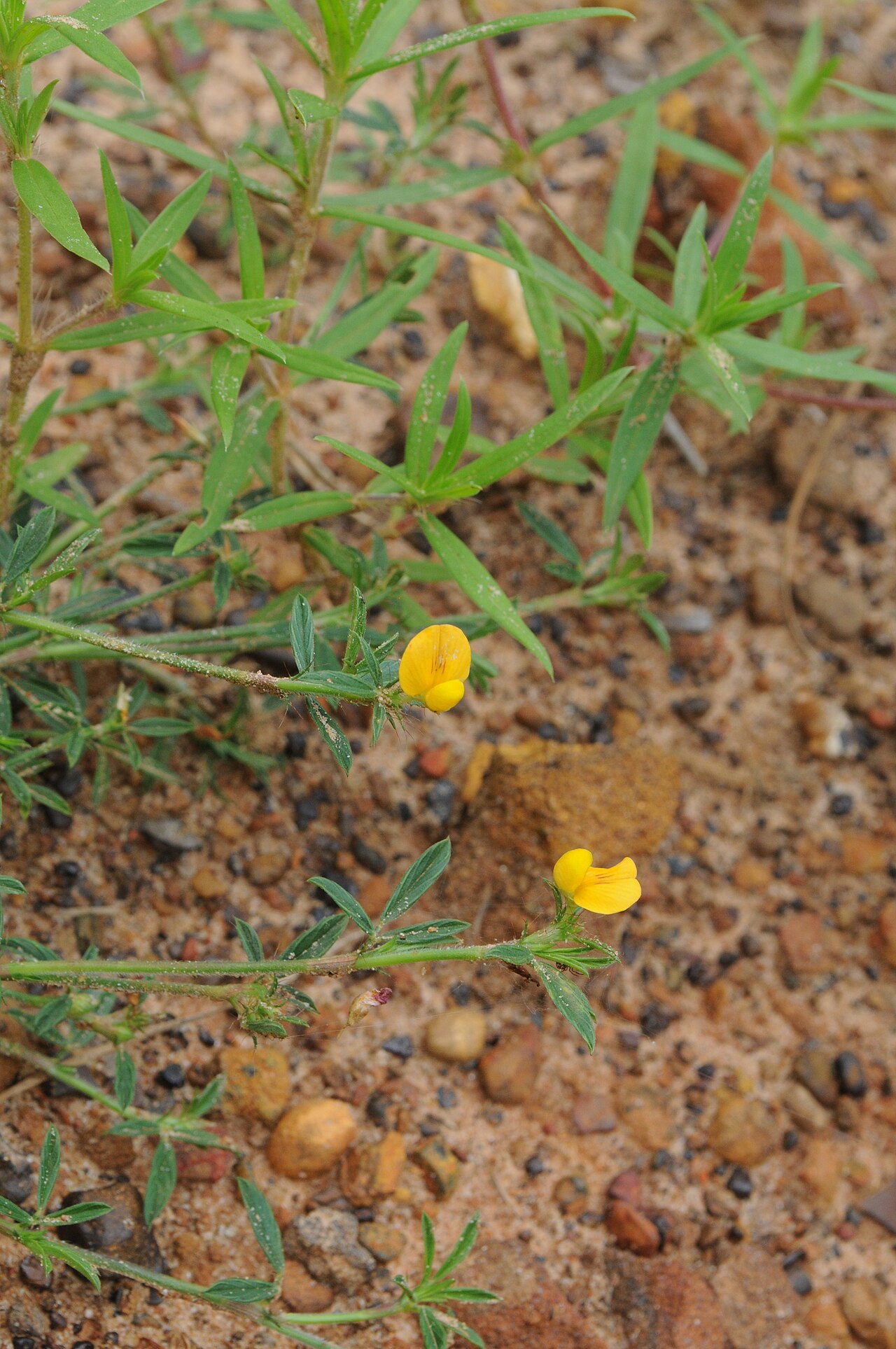
Sidebeak pencilflower is a low perennial with several slender, wiry stems, 4 to 20 inches long, that are upright to sprawling from a woody root crown. The stems are often lined with bristly hairs, especially in the upper part, though some plants are nearly smooth.
Leaves
The leaves are alternate and divided into three narrow, lance-shaped to elliptic leaflets, 1/2 to 1 1/2 inches long, with prominent veins and fine bristles on the edges. At the base of each leaf, the stipules are fused into a sheath around the stem, often with long bristles; this is a good field mark.
Flowers
The flowers are about 1/2 inch across, orange-yellow to golden, with a broad, rounded upper petal (banner) that often has faint red-orange lines. They grow singly or two to a few together at the tips of the stems among leafy, bristly bracts, which is where the species name biflora (“two-flowered”) comes from. A long, slender, stalk-like tube under the flower makes it look stalked. Each flower lasts only part of a day. Bloom time is May or June to September.
Fruit & Seeds
The fruit is a small, flattened pod with one or two segments, each holding one seed. The tip of the pod carries a short, curved beak attached slightly to one side, which gives the plant the name “sidebeak.”
Look-alikes
Sensitive partridge pea (Chamaecrista nictitans) also has small yellow flowers, but its leaves have many pairs of small leaflets. Yellow-flowered bush clovers and rattlebox (Crotalaria) have different leaves and larger flower clusters. When not in flower, sidebeak pencilflower can look like a small bush clover, such as slender bush clover, but its bristly stipule sheaths and veiny leaflets set it apart.
Quick Facts
| Scientific Name | Stylosanthes biflora |
| Family | Fabaceae (pea family) |
| Plant Type | Small herbaceous perennial legume |
| Mature Height | 4–20 in |
| Mature Spread | 6–12 in |
| Growth Rate | Slow to moderate |
| Sun Exposure | Full sun to part shade |
| Water Needs | Low; dry, well-drained soil |
| Soil Type | Sandy, gravelly or rocky soils; thin soils |
| Soil pH | Acidic to slightly alkaline (about 5.0–7.5) |
| Bloom Time | June–September |
| Flower Color | Orange-yellow to golden |
| Fall Color | None |
| Fruit | Small one- to two-seeded pod with a side beak |
| Deer Resistant | No; browsed by deer and rabbits |
| USDA Hardiness Zones | 5–9 |
Native Range
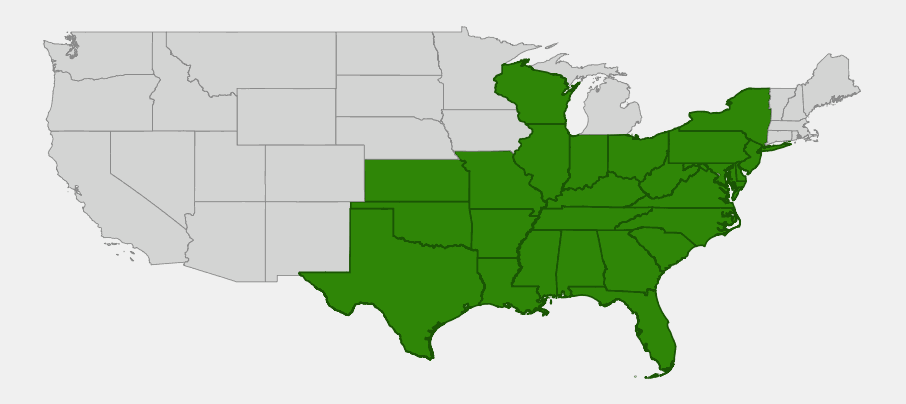
Sidebeak pencilflower is native to the eastern and central United States. USDA PLANTS records it from 26 states. This page maps 25 of them, from southern New York, New Jersey and Pennsylvania south to Florida and west to Illinois, Missouri, Kansas, Oklahoma and Texas. USDA also lists Arizona, but we found no specimens or verified observations from there and have left it off the map.
It is most common in the Southeast, the Piedmont, the Ozarks and Ouachitas, and the Interior Low Plateaus of Kentucky and Tennessee. In the north it becomes rare: the few New York records are mostly old collections from Long Island, Staten Island and Manhattan, and Wisconsin has only a single historical record from 1903, an outlying collection. In Texas it grows mainly in the eastern part of the state, with scattered records south to the Coastal Bend near Corpus Christi.
Its habitats are dry and open: open oak, pine and oak-hickory woods, woodland edges, sandhills, pine barrens, rocky glades, barrens, upland prairies, old fields and roadsides. It favors thin, poor, sandy or rocky soils and sites that are kept open by fire.
📋 Regional plant lists featuring Sidebeak Pencilflower: New York, Pennsylvania & Northern New Jersey · Ohio & Indiana · Michigan, Wisconsin & Eastern Minnesota · Kentucky & Tennessee · Nebraska, Kansas & Eastern Colorado · Maryland, Virginia & West Virginia · Delaware, Southern New Jersey & Long Island · Illinois, Iowa & Missouri · Alabama, Georgia & Mississippi · North & South Florida · North & South Carolina · Arkansas, Louisiana, Eastern Oklahoma & Eastern Texas · South & West Texas
Growing & Care Guide
Sidebeak pencilflower is a modest plant that is easy to keep in the right conditions: sun, lean, well-drained soil and little competition from tall plants. It is rarely sold as a plant but can be grown from seed.
Light
Full sun to light shade. It flowers best in sun and tolerates the dappled light of open oak and pine woods.
Soil & Water
Grow it in sandy, gravelly or rocky, well-drained soil with little organic matter. It is drought-tolerant once established and needs no supplemental watering except during establishment. Rich, moist soil lets other plants smother it.
Planting Tips
Sow seed in fall or in spring after scarification. Place it at the front of a dry meadow or prairie planting, in a rock garden, along sunny paths or among short native grasses where it won’t be shaded out.
Pruning & Maintenance
Very little is needed. Cut back or burn old growth in late winter. Keep taller plants from crowding it. Protect seedlings from rabbits.
Propagation
Grow it from seed. The seeds have hard coats; nick them or rub them with sandpaper before sowing. It has a taproot and does not transplant well once established.
Landscape Uses
- Dry sandy or rocky gardens: a small, long-blooming legume for poor soils
- Prairie and meadow plantings: fills gaps among short grasses
- Rock gardens: a dainty yellow accent in sun
- Savanna and barrens restoration: part of fire-maintained open plant communities
- Pollinator gardens: summer flowers for small bees
Wildlife & Ecological Value
Though small, sidebeak pencilflower supports pollinators, butterflies and wildlife in dry, open habitats.
For Pollinators
Small native bees, including sweat bees and small leafcutter bees, visit the flowers in the morning, when they are open. In the South, it is a larval host plant of the barred yellow butterfly.
For Birds
Quail and other seed-eating birds may eat the small seeds, but it is a minor food source.
For Mammals
Deer and rabbits graze the leaves and stems, which are rich in protein like those of other legumes.
Ecosystem Role
As a legume, it adds nitrogen to poor, sandy and rocky soils. It is part of the diverse, fire-maintained ground layer of open pine and oak woodlands, barrens and prairies.
Cultural & Historical Uses
The genus name Stylosanthes comes from the Greek stylos, “column,” and anthos, “flower,” for the long, stalk-like tube below each flower. The species name biflora means “two-flowered.”
Several tropical species of Stylosanthes, known as stylo, are important forage legumes for cattle in Australia, Africa, Asia and South America. Sidebeak pencilflower is one of the few members of the genus native to temperate North America.
Botanists have described several forms of this species in the past, including Stylosanthes riparia and S. floridana, based on differences in hairiness. These are now included in Stylosanthes biflora.
Frequently Asked Questions
Why is it called sidebeak pencilflower?
Its small pod has a short, curved beak attached slightly to one side. “Pencilflower” refers to the slender, pencil-like tube below each flower.
Why are the flowers only open in the morning?
Each flower lasts only part of a day, opening in the morning and wilting later. The plant produces new flowers over a long season.
Can I grow sidebeak pencilflower in my garden?
Yes, in a sunny spot with dry, sandy or rocky, well-drained soil and little competition. It is easiest from seed.
Is sidebeak pencilflower good for wildlife?
Yes. Small bees visit the flowers, it is a host plant for the barred yellow butterfly in the South, and deer and rabbits graze it.
Does sidebeak pencilflower grow in Arizona?
USDA PLANTS lists Arizona, but we found no specimens or verified observations from there. It is a plant of the eastern and central United States.

Looking for a nursery that carries Sidebeak Pencilflower?
Browse our native plant nursery directory: Alabama & Arkansas · Delaware, Florida & Georgia · Illinois, Indiana & Kansas · Kentucky, Louisiana, Maryland, Mississippi & Missouri · New Jersey, New York, North Carolina, Ohio & Oklahoma · Pennsylvania, South Carolina, Tennessee, Texas & Virginia · West Virginia & Wisconsin