
Staghorn Clubmoss (Lycopodiella cernua)
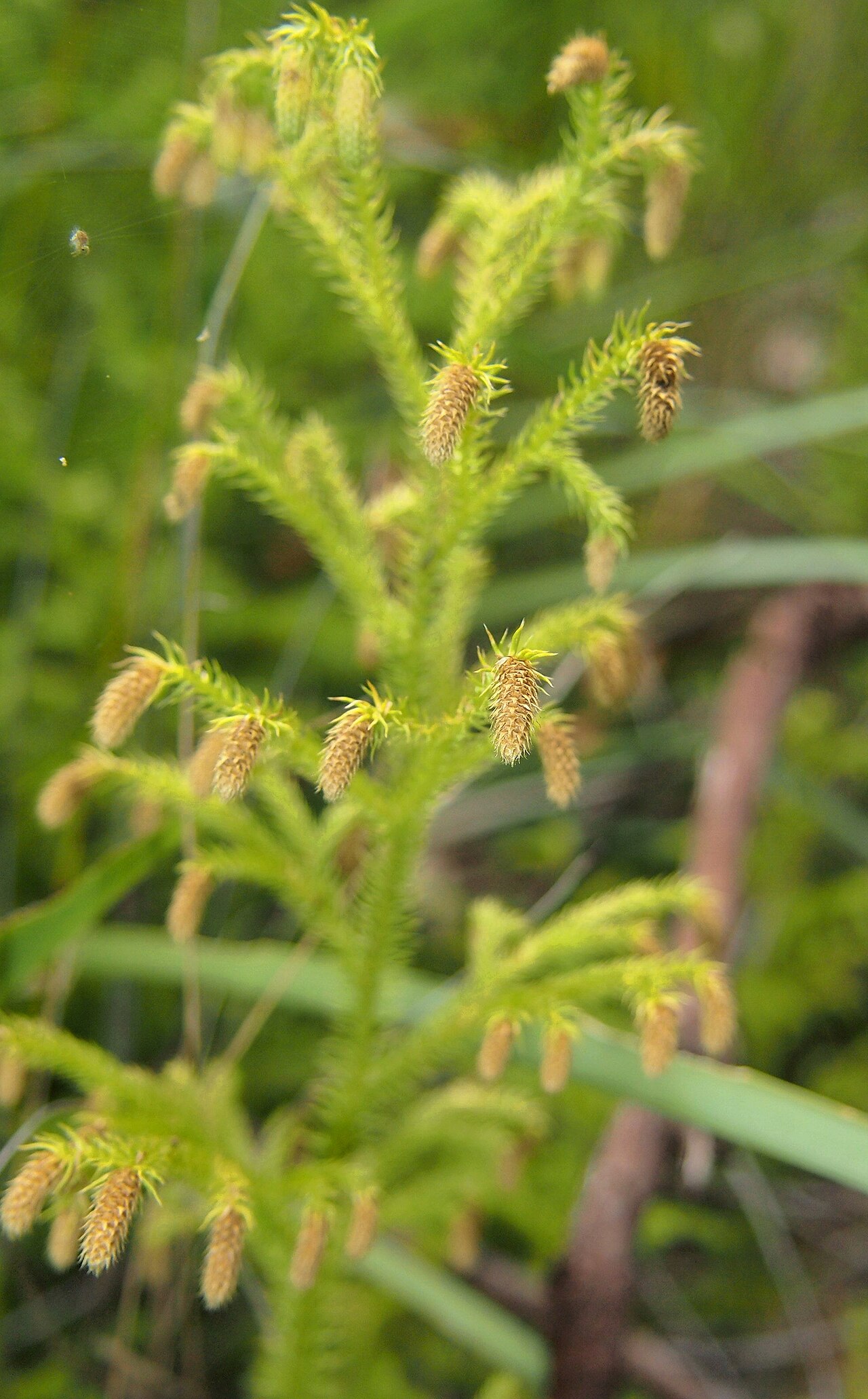
Lycopodiella cernua, known as Staghorn Clubmoss or nodding clubmoss, and in Hawaiian as wāwaeʻiole, is a tropical clubmoss that looks like a forest of miniature pine or Christmas trees. Its upright, many-branched stems, usually 1 to 3 feet tall, are covered with tiny needle-like leaves, and the tips of the branches bend downward under small, nodding spore cones. It spreads by long, arching runners that root where they touch the ground, forming patches on wet, acidic soil.
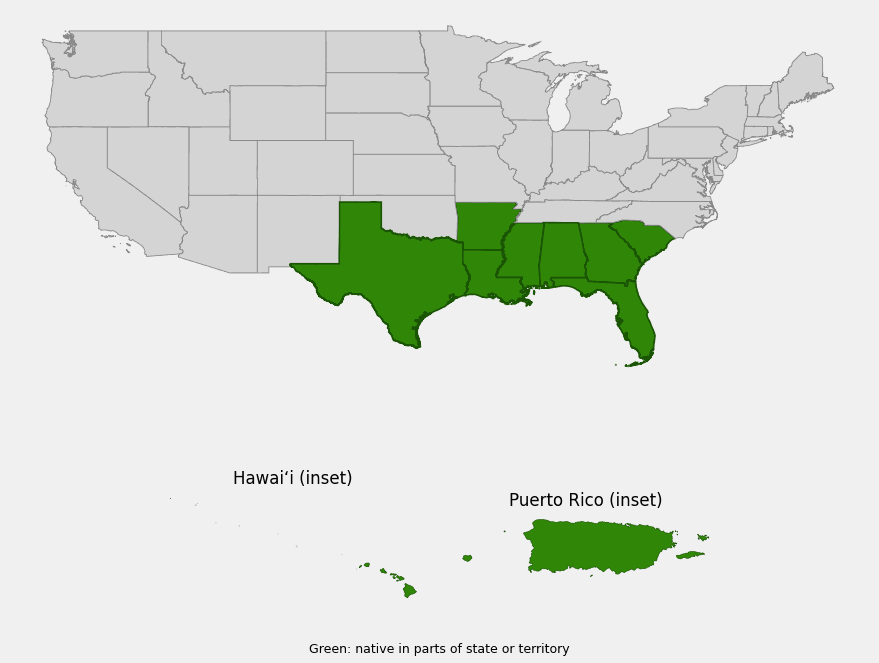
Staghorn clubmoss is one of the most widespread clubmosses in the world, found throughout the tropics and subtropics. In the United States it is native to the Gulf and southern Atlantic Coastal Plain from South Carolina to eastern Texas, to Hawaiʻi and to Puerto Rico and the U.S. Virgin Islands. In Hawaiʻi and Puerto Rico it is a familiar plant of road cuts and wet slopes, while on the mainland it is a less common plant of seepage slopes, bogs and ditches.
Many botanists now place this plant in its own genus, as Palhinhaea cernua, and older references call it Lycopodium cernuum. Clubmosses are not mosses but lycophytes, an ancient group of vascular plants that reproduce by spores. This page covers how to recognize it, where it grows, why it is hard to cultivate, and its place in tropical and Southeastern ecosystems.
Identification
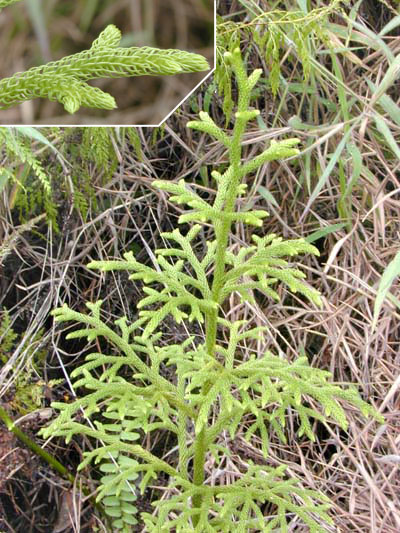
Staghorn clubmoss is the tallest and most tree-like clubmoss in most of its range. Its nodding cones and arching runners set it apart from the bog clubmosses (Lycopodiella species in the narrow sense) that grow in the same wet, sandy places in the Southeast.
Runners & Upright Stems
The plant has two kinds of stems. Horizontal stems arch over the ground and root at their tips, sometimes running several feet, and they connect upright stems into colonies. The upright stems are usually 1 to 3 feet tall, occasionally taller in the tropics. They branch repeatedly, with the branches spreading and drooping at their tips, giving the plant the look of a small conifer or a stag’s antlers.
Leaves
The leaves are tiny, under a quarter-inch long, narrow, pointed and needle-like. They are bright green to yellow-green and densely crowded along all the stems and branches. On the main stems they are spaced a little farther apart and often point outward or slightly downward.
Spore Cones
Staghorn clubmoss reproduces by spores, not flowers or seeds. The spores are produced in small cones (strobili) at the tips of the branchlets. Each cone is about a quarter-inch long, stalkless, yellowish to pale brown, and nods downward, which is the meaning of cernua. In warm climates the cones can be present at almost any time of year.
Similar Species
In the Southeast, bog clubmosses such as foxtail clubmoss (Lycopodiella alopecuroides) and southern bog clubmoss (L. appressa) also grow in wet, sandy, acidic places, but their spore cones stand upright at the ends of unbranched stalks, and they lack the many-branched, tree-like form. In northern forests, tree clubmosses such as Flat-branched Tree Clubmoss look somewhat similar but grow in shady woods and have upright cones.
Quick Facts
| Scientific Name | Lycopodiella cernua (L.) Pic. Serm. (syn. Palhinhaea cernua, Lycopodium cernuum) |
| Family | Lycopodiaceae (clubmoss family) |
| Plant Type | Evergreen clubmoss (lycophyte); spreads by arching runners |
| Mature Height | 1–3 ft (occasionally taller in the tropics) |
| Mature Spread | Colonies spread several feet by runners |
| Growth Rate | Moderate |
| Sun Exposure | Full sun to part shade |
| Water Needs | Medium to high; moist to wet, often seepy soils |
| Soil Type | Acidic, nutrient-poor sand, clay, peat or weathered volcanic soil |
| Soil pH | About 4.0–5.5 |
| Bloom Time | Does not flower; spore cones present much of the year |
| Flower Color | None; small yellowish-brown spore cones |
| Fall Color | None; evergreen |
| Fruit | None; reproduces by spores |
| Deer Resistant | Yes |
| USDA Hardiness Zones | 8–13 |
Native Range
USDA PLANTS records staghorn clubmoss as native in Alabama, Arkansas, Florida, Georgia, Louisiana, Mississippi, South Carolina and Texas, as well as Hawaiʻi, Puerto Rico and the U.S. Virgin Islands. On the mainland it is a plant of the Coastal Plain, growing on wet, sandy or clayey acidic soils in seepage slopes, bogs, wet pine flatwoods, ditches, borrow pits and road cuts. In Texas it is limited to the eastern part of the state. The Arkansas record is an outlying one, at the northern edge of its range.
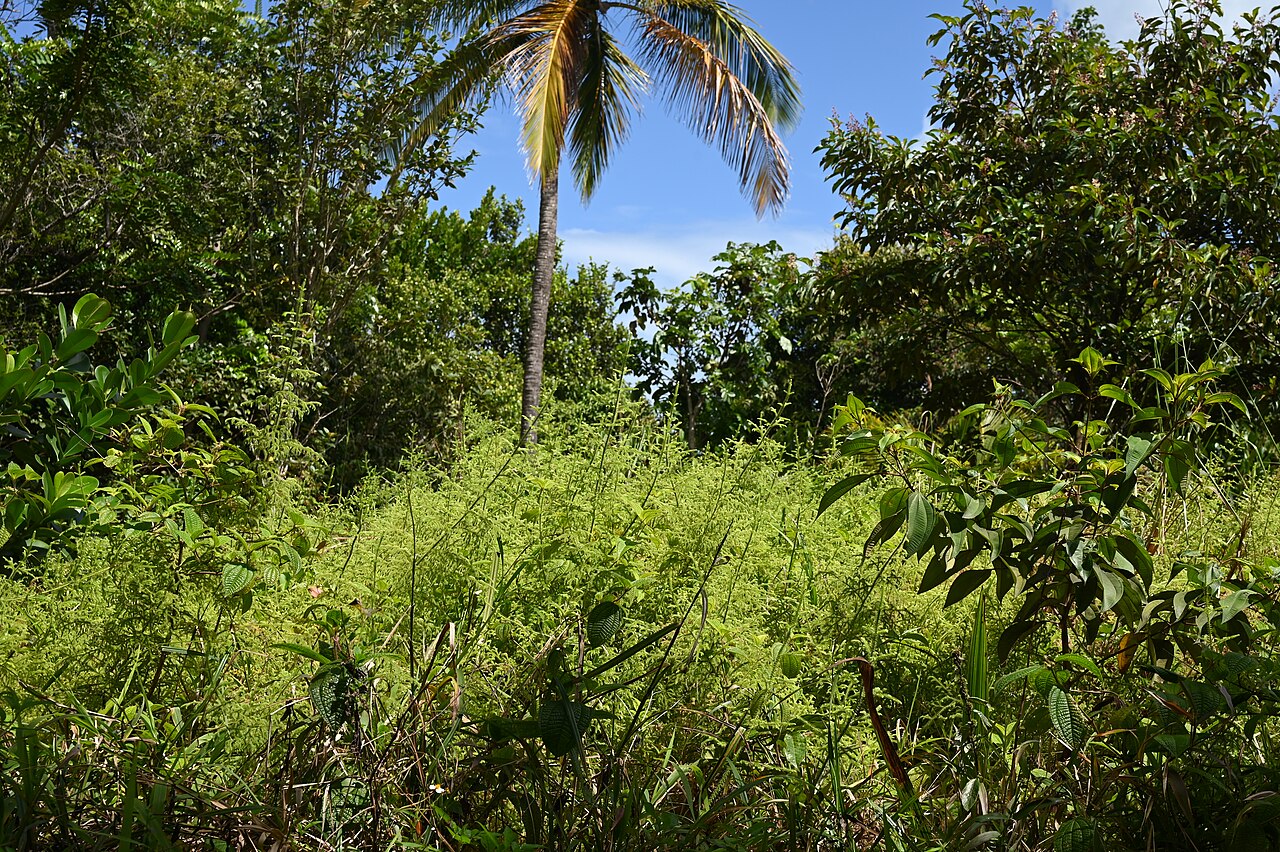
In Hawaiʻi it grows on all the main islands, from near sea level into the mountains, on wet road cuts, lava, cliffs, forest edges and openings in ʻōhiʻa forest. In Puerto Rico it is common on acidic clay road banks and landslides in the wet uplands. Throughout the tropics it is a pioneer of bare, wet, acidic ground.
Worldwide, staghorn clubmoss occurs in tropical and subtropical regions of the Americas, Africa, Asia, Australia and the Pacific islands. Some botanists split it into several species or varieties; USDA treats the plants of the United States as Lycopodiella cernua var. cernua.
📋 Regional plant lists featuring Staghorn Clubmoss: North & South Florida · Alabama, Georgia & Mississippi · North & South Carolina · Arkansas, Louisiana, Eastern Oklahoma & Eastern Texas · Hawaii · Puerto Rico
Can You Grow It?
Staghorn clubmoss is very rarely cultivated, and it is not a practical garden plant. Like other clubmosses, it has a complex life cycle: its spores grow into tiny underground or surface plants (gametophytes) that depend on partnerships with soil fungi, and it can take years to produce a new plant. Dug plants almost always decline and die. Please enjoy it where it grows and never dig it from the wild.
Light
In the wild it grows in full sun or light shade on open, disturbed ground. Under a closing canopy of shrubs and trees it slowly disappears.
Soil & Water
It needs constantly moist to wet, acidic, nutrient-poor soil, often with seeping groundwater. These conditions, plus the right soil fungi, are very hard to reproduce in a garden.
Planting Tips
Rather than planting it, protect it. If staghorn clubmoss appears on your land, for example on a seepy bank or road cut, leave the area unmowed and avoid fertilizers and herbicides. Gardeners in Hawaiʻi and the Gulf South sometimes find it colonizing wet, bare ground on its own.
Pruning & Maintenance
No pruning is needed. Where it occurs naturally, occasional disturbance that keeps the site open, such as fire in pine flatwoods or the creation of new bare soil, helps it persist.
Propagation
Propagation from spores is possible in the laboratory but slow and uncertain, because the gametophytes need specific fungal partners. The arching runners root at their tips, and a rooted tip can occasionally be moved within the same site, but this is rarely successful and should not be done with wild plants.
Where to See It
- Hawaiʻi: road cuts and trails in wet upland forest on all the main islands, including Hawaiʻi Volcanoes National Park
- Puerto Rico: wet clay road banks and landslides in the Cordillera Central and El Yunque area
- Florida and the Gulf Coast: seepage slopes, bog edges and wet ditches in pine flatwoods
- Georgia and South Carolina: acidic seeps and wet road cuts on the southern Coastal Plain
- Southeast Texas and Louisiana: wet, sandy seeps and pitcher plant bogs on the western Gulf Coastal Plain
Wildlife & Ecological Value
Staghorn clubmoss has little direct value as food for wildlife, but it plays a useful role as a pioneer on bare, wet soil.
For Pollinators
As a spore-bearing plant, staghorn clubmoss produces no flowers, nectar or pollen, so it offers nothing to pollinators directly. Small insects and spiders shelter among its branches.
For Birds
It is not a significant food plant for birds, though its dense patches give cover to small ground-dwelling animals.
For Mammals
Mammals rarely eat clubmosses, which contain alkaloids. Feral pigs in Hawaiʻi sometimes root through patches.
Ecosystem Role
Staghorn clubmoss is a pioneer that colonizes bare, eroded, acidic soil on landslides, road cuts and burned or cleared areas. Its runners and dense stems help hold soil and slow erosion, creating conditions for other plants to establish. Its underground gametophytes form close relationships with soil fungi, part of an ancient partnership that goes back to the earliest land plants.
Cultural & Historical Uses
In Hawaiʻi, staghorn clubmoss is called wāwaeʻiole, “rat’s foot,” after the shape of its branch tips. Its fresh, ferny stems have been used in lei and other decorations. In parts of tropical Asia the plant is used in traditional medicine and as decorative greenery.
Clubmosses belong to one of the oldest surviving lineages of vascular plants. Their relatives, the giant scale trees (Lepidodendron), dominated swamp forests about 300 million years ago, and their remains formed much of the world’s coal. Today’s clubmosses are small, but they still show the basic features of that ancient group: tiny single-veined leaves, and spores borne in cones.
The plant’s scientific names reflect changing ideas about clubmoss classification. Linnaeus named it Lycopodium cernuum in 1753. Later botanists moved it to Lycopodiella, and many current classifications place it in Palhinhaea, a genus named for the Portuguese botanist Ruy Telles Palhinha.
Frequently Asked Questions
Is staghorn clubmoss a moss?
No. Despite the name, clubmosses are lycophytes, a group of vascular plants with true roots, stems and leaves that conduct water. True mosses are non-vascular plants. Clubmosses reproduce by spores, like ferns.
Can I grow staghorn clubmoss?
It is very difficult. Clubmosses rely on specific soil fungi during their early life stages, and transplanted plants usually die. Admire it in the wild and protect it where it appears naturally, rather than trying to dig or buy it.
Where does staghorn clubmoss grow in the United States?
It is native to the Coastal Plain from South Carolina and Florida west to eastern Texas, with an outlying record in Arkansas, and to Hawaiʻi, Puerto Rico and the U.S. Virgin Islands. It favors wet, acidic, open or disturbed soils.
Is Lycopodiella cernua the same as Palhinhaea cernua?
Yes. They are two scientific names for the same plant. Many modern classifications use Palhinhaea cernua, while USDA PLANTS and many floras still use Lycopodiella cernua. The older name Lycopodium cernuum also refers to it.
Is staghorn clubmoss poisonous?
Clubmosses contain alkaloids, and they should not be eaten. Handling the plant is generally harmless.

Looking for a nursery that carries Staghorn Clubmoss?
Browse our native plant nursery directory: Alabama & Arkansas · Florida, Georgia & Hawaii · Louisiana & Mississippi · South Carolina & Texas

