
Star Milkvine (Matelea biflora)
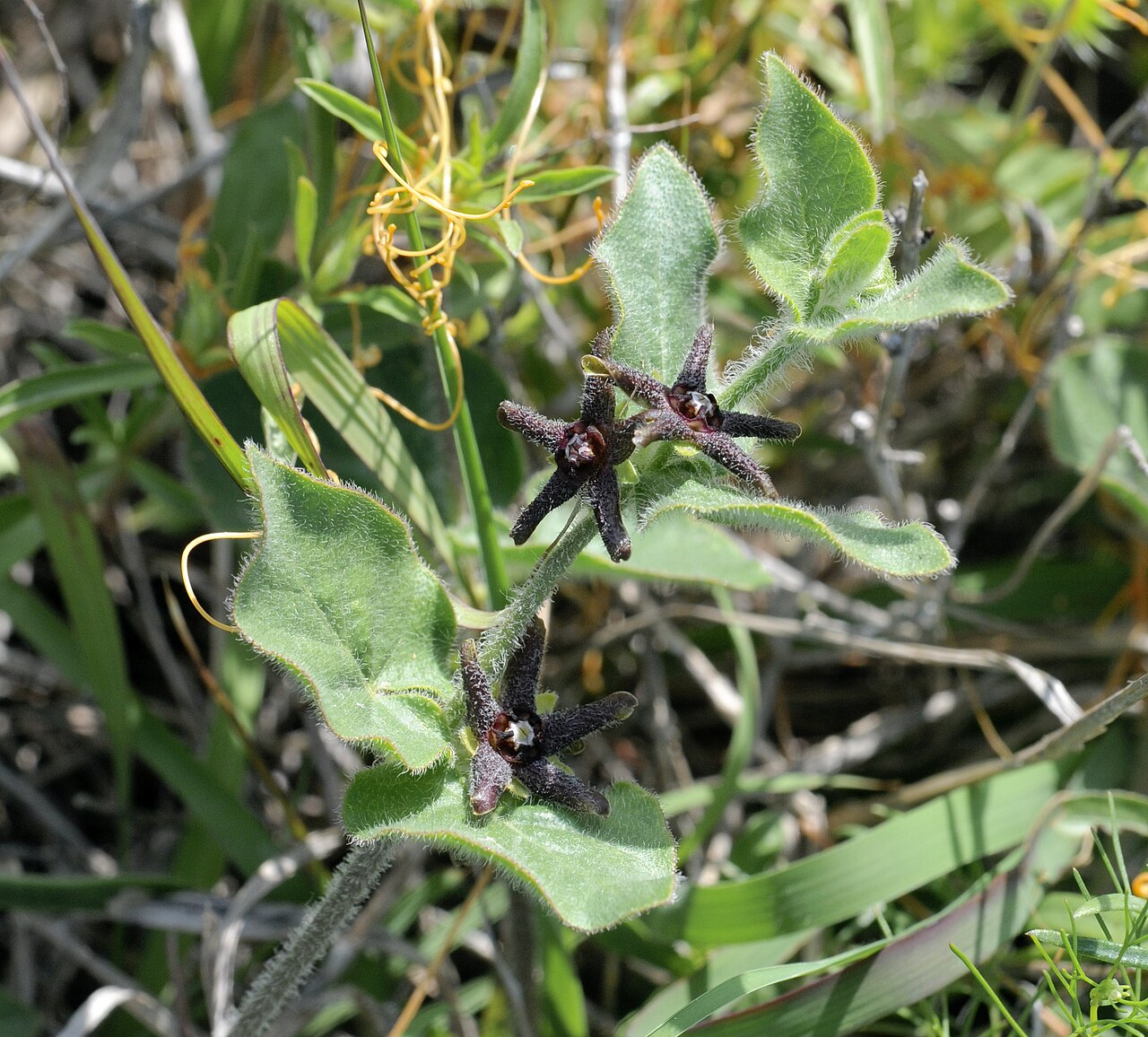
Matelea biflora, known as Star Milkvine, two-flower milkvine or purple milkvine, is a small, trailing native perennial of the prairies and rocky hills of Texas, Oklahoma and eastern New Mexico. Its soft, hairy stems sprawl along the ground for a foot or two from a thick rootstock, and in spring it bears striking, star-shaped flowers of deep maroon to chocolate-purple, often in pairs. Though easy to overlook among the grasses, the flowers are some of the most unusual in the southern prairies.
Star milkvine belongs to the dogbane family (Apocynaceae), in the same group as the milkweeds, and like them it has milky sap, intricate flowers with a central crown and seed pods with silky-tufted seeds. The genus Matelea includes the milkvines and anglepods, most of which are twining vines; star milkvine is unusual in being low and trailing rather than climbing. The species name biflora means “two-flowered.”
It is common in central Texas, especially on chalky, limestone soils. This guide covers how to identify star milkvine, where it grows, whether it can be grown in gardens, its relationships with insects and its place in the prairie flora.
Identification
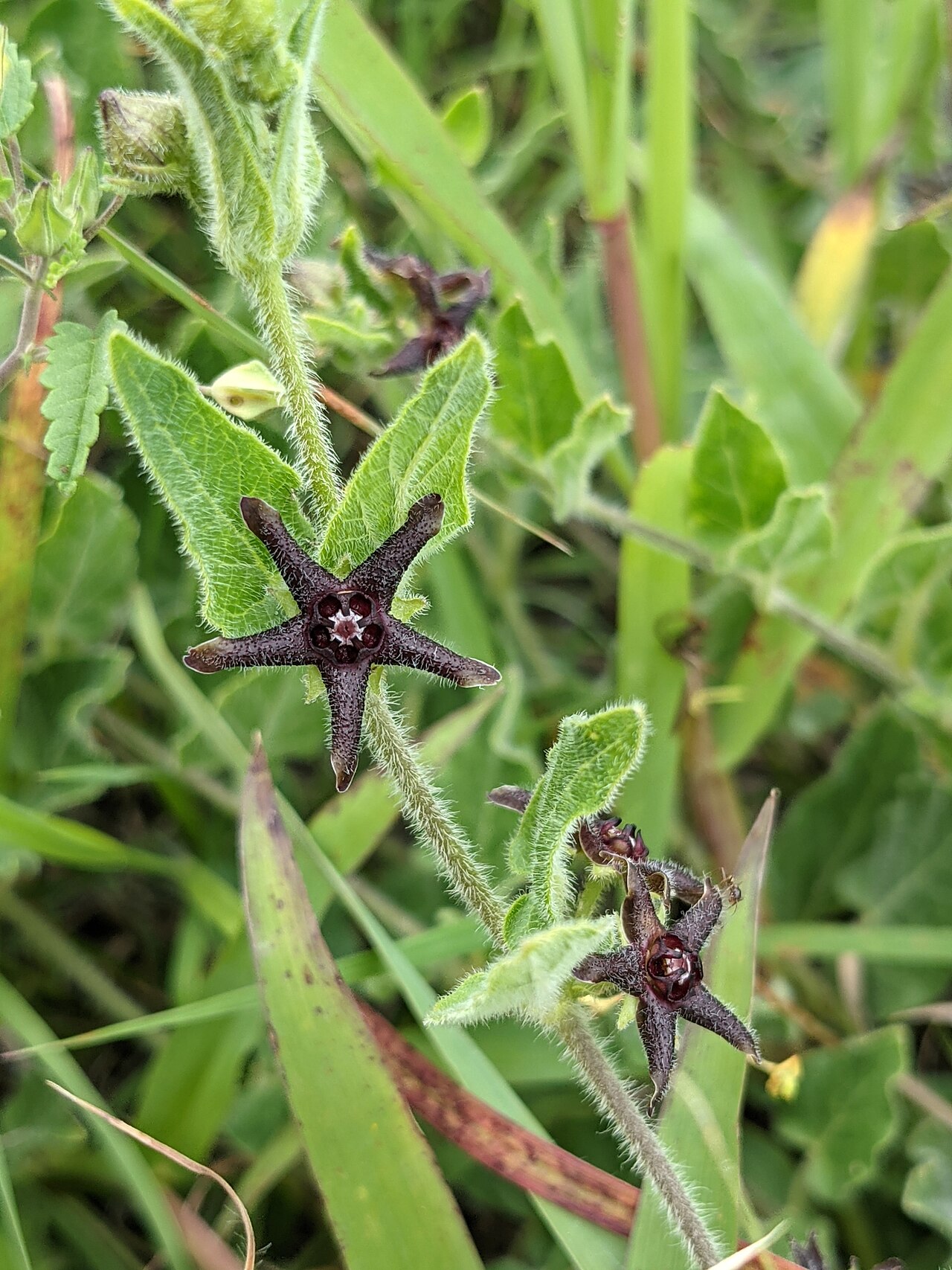
Star milkvine is a low, sprawling plant with soft, gray-green, heart-shaped leaves and dark, star-shaped flowers. Look for it in spring in prairies, pastures and on rocky limestone slopes, where its stems lie flat or trail through the grasses.
Growth Habit
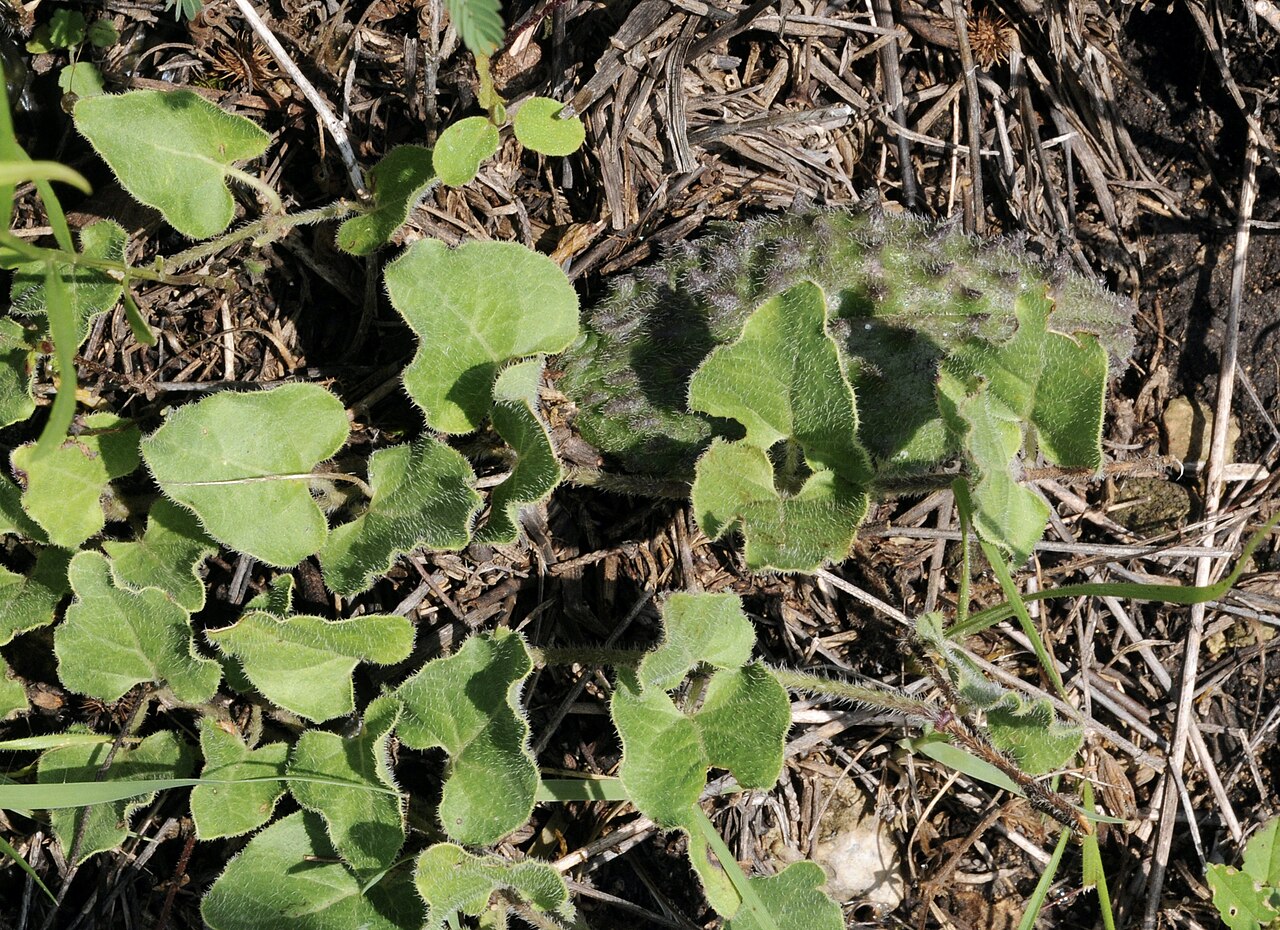
It is a herbaceous perennial that grows from a thick, woody rootstock. Several slender stems spread outward along the ground, or lean on nearby grasses, reaching about 1 to 2 feet long; the plant itself is rarely more than a few inches tall. The stems are covered with soft, spreading hairs and contain milky sap.
Leaves
The leaves are opposite, on short stalks, and mostly heart-shaped to triangular or arrow-shaped, about 1 to 2 1/2 inches long, with a notched base and a pointed or blunt tip. They are densely hairy and soft to the touch, often with wavy edges, and gray-green to medium green.
Flowers
The flowers are carried singly or in small clusters of two or three in the leaf axils on short stalks. Each flower is about 3/4 inch across, with five narrow, pointed corolla lobes that spread to form a five-pointed star. The color is a deep maroon, purple-brown or chocolate, often with a velvety texture, and the center holds a small, fleshy crown (corona) around the fused stamens and style, typical of the milkweed group. Bloom time is mainly March to June.
Fruit & Seeds
After pollination, the flowers produce a plump, pod-like follicle, a few inches long, similar to a small milkweed pod. It splits along one side to release flat seeds, each with a tuft of silky hairs that carries it on the wind.
Look-alikes
Pearl milkweed (Matelea reticulata) is a tall, twining vine with green, net-veined flowers and a pearly center. Anglepod is a high-climbing vine of moist woods with angled pods. Other trailing milkvines of Texas, such as Matelea cynanchoides and Matelea parviflora, have smaller flowers or different leaves and are best separated with a regional flora.
Quick Facts
| Scientific Name | Matelea biflora (Raf.) Woodson |
| Family | Apocynaceae (dogbane family; milkweed subfamily Asclepiadoideae) |
| Plant Type | Trailing herbaceous perennial vine |
| Mature Height | 2–6 in; stems trailing to about 2 ft long |
| Mature Spread | 1–3 ft |
| Growth Rate | Slow to moderate |
| Sun Exposure | Full sun to part shade |
| Water Needs | Low; drought tolerant |
| Soil Type | Well-drained limestone soils: chalky, rocky, gravelly or clay loam |
| Soil pH | Neutral to alkaline (about 7.0–8.5) |
| Bloom Time | March–June |
| Flower Color | Deep maroon to purple-brown |
| Fall Color | None notable |
| Fruit | Pod-like follicle with silky-tufted seeds |
| Deer Resistant | Fairly resistant; milky sap deters browsing |
| USDA Hardiness Zones | 7–9 |
Native Range
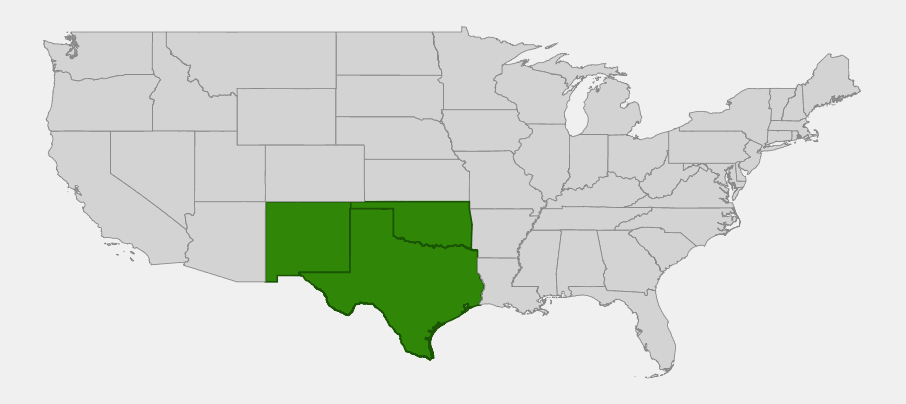
Star milkvine is native to the southern Great Plains and central Texas. USDA PLANTS lists it in Texas, Oklahoma and New Mexico.
It is most common in central and north-central Texas, including the Edwards Plateau and Hill Country, the Lampasas Cut Plain, the Grand Prairie, the Cross Timbers and the Blackland Prairie, and it extends into the Rolling Plains and southern Oklahoma. In New Mexico it reaches the eastern part of the state at the western edge of its range.
It grows in prairies, pastures, open grassland, rocky slopes and roadsides, usually in chalky or limestone soils. It often grows among short and mid-grasses in open, sunny places, sometimes in the light shade of junipers and oaks.
📋 Regional plant lists featuring Star Milkvine: South & West Texas
Growing & Care Guide
Star milkvine is mostly a plant for naturalists and native meadow gardeners rather than formal beds. It is rarely sold, but where it already grows in a pasture, lawn edge or meadow it is easy to keep: simply avoid mowing during its spring bloom. Seed is occasionally offered by Texas native seed suppliers.
Light
Grow it in full sun to light part shade, in open spots where its trailing stems are not smothered by tall plants.
Soil & Water
It prefers well-drained, alkaline soil, such as rocky or chalky limestone soil or clay loam. Once established it needs no supplemental water except in extreme drought. Wet, poorly drained soil can rot the rootstock.
Planting Tips
It is best grown from seed sown in a native meadow or prairie planting among short grasses, or in a rock garden where the trailing stems can drape over stones. Leave space around it, since its low stems are easily overshadowed. Where it occurs naturally, delay spring mowing until after it has flowered and set seed.
Pruning & Maintenance
No pruning is needed. The stems die back to the rootstock in winter, and new growth appears in spring. Avoid herbicides and heavy disturbance, which easily eliminate this inconspicuous plant.
Propagation
Collect the seeds when the pods split in late spring or summer, before the silky tufts carry them away. Sow them in fall or in spring after a few weeks of cold, moist stratification. Seedlings develop a deep rootstock and resent transplanting, so sow them directly or in deep pots. Do not dig plants from the wild.
Landscape Uses
- Native meadows and prairies: an unusual spring flower among short grasses
- Rock gardens: trailing stems drape over stones in dry, sunny spots
- Naturalistic lawns and pastures: persists where mowing is delayed until after flowering
- Pollinator gardens: adds to the diversity of native flowers for specialist insects
- Prairie restoration: for limestone prairies of central Texas and Oklahoma
Wildlife & Ecological Value
Like other members of the milkweed group, star milkvine has complex flowers and toxic sap, and it is part of a web of specialized insect relationships.
For Pollinators
As in milkweeds, the pollen is packed into waxy sacs (pollinia) that attach to the legs or mouthparts of visiting insects. The dark, maroon flowers of milkvines like this one are thought to be visited mainly by flies and small bees, attracted by nectar held in the central crown, though the pollinators of this species are not well studied.
For Birds
Birds make little direct use of the plant. The low, leafy stems provide some cover for insects that ground-foraging birds eat.
For Mammals
The milky sap contains bitter and potentially toxic compounds, as in many members of the milkweed group, and the plant is lightly grazed. Its deep rootstock lets it recover from grazing and mowing.
Ecosystem Role
Star milkvine is part of the diverse community of forbs in central Texas prairies. Plants in the milkweed subfamily support specialized insects that can tolerate their sap. Its persistence in old pastures and on rocky slopes makes it an indicator of remnant native grassland.
Cultural & Historical Uses
Like many plants in the milkweed group, star milkvine has milky sap that may contain toxic compounds. It should not be eaten, and the sap can irritate sensitive skin and eyes. Keep children and pets from chewing on the plant, and wash your hands after handling it.
The species was first named by the eccentric naturalist Constantine Rafinesque in the nineteenth century and later placed in Matelea by the American botanist Robert Woodson, a specialist in the milkweed and dogbane families who revised the North American milkvines in the mid-twentieth century. It has also been treated in the genus Gonolobus.
For people who walk the prairies of central Texas in spring, finding the dark, velvety stars of this milkvine hidden in the grass is a small reward of careful looking. It is one of many native wildflowers that survive in old pastures, roadsides and rocky hillsides, and a reason to delay mowing until spring flowers have finished.
Frequently Asked Questions
Is star milkvine a milkweed?
It is a close relative. It belongs to the same subfamily as the milkweeds and shares their milky sap, complex flowers with pollen sacs and pods of silky-tufted seeds, but it is in the genus Matelea.
Does star milkvine climb?
Not much. Unlike most milkvines, it is a low, trailing plant whose stems sprawl along the ground or lean on grasses rather than twining high into shrubs.
When does star milkvine bloom?
Mainly from March to June, with the dark, star-shaped flowers appearing in pairs or small clusters in the leaf axils.
Is star milkvine poisonous?
It has milky sap and, like many milkweed relatives, is considered potentially toxic. It should not be eaten.
Can I grow star milkvine?
It can be grown from seed in sunny, dry, well-drained limestone soils, but it is rarely sold. Where it already grows, the best approach is to protect it and delay mowing until after it has set seed.

Looking for a nursery that carries Star Milkvine?
Browse our native plant nursery directory: New Mexico & Oklahoma · Texas

