
Texas Ragwort (Senecio ampullaceus)
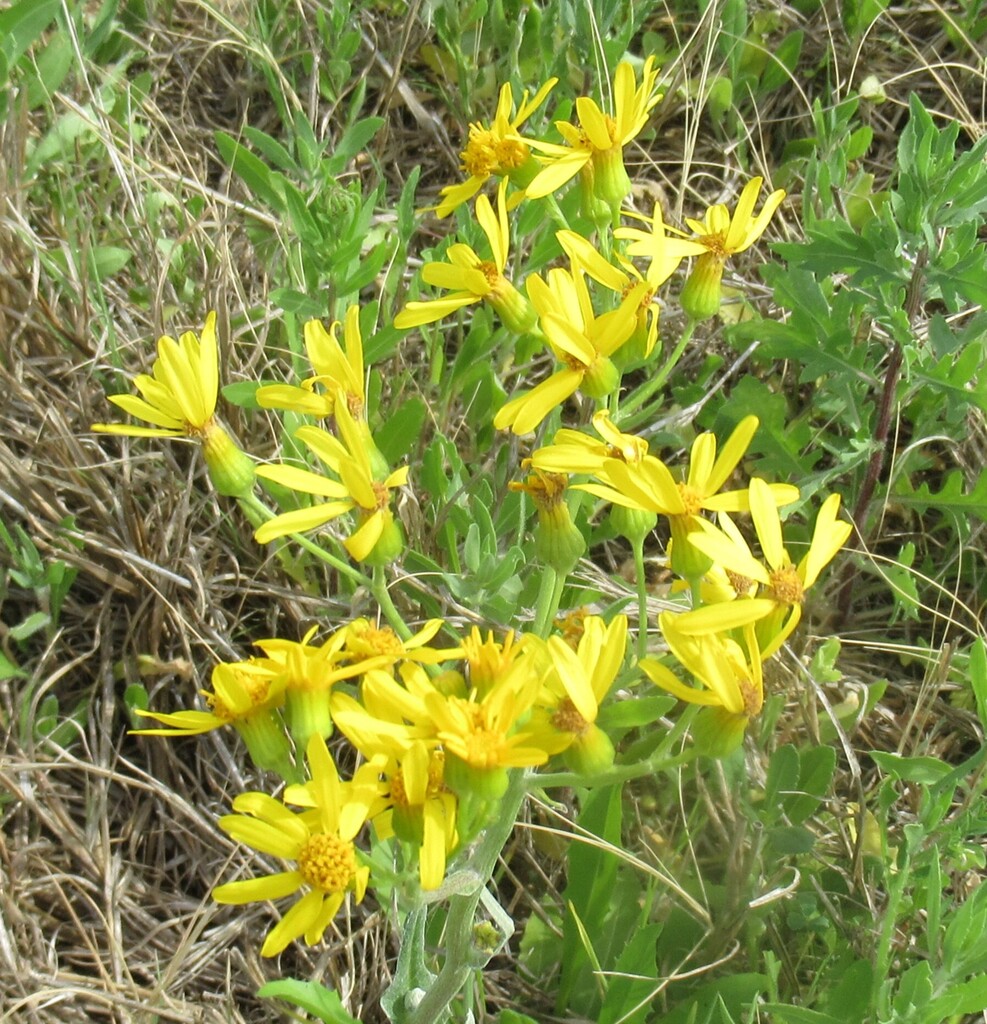
Senecio ampullaceus, known as Texas Ragwort or Texas groundsel, is a showy annual wildflower found only in Texas. It belongs to the aster family (Asteraceae). In late winter and spring it fills sandy fields, roadsides and open woods with masses of bright yellow, daisy-like flower heads, often blooming alongside bluebonnets and other spring wildflowers. Its smooth, grayish-green leaves clasp the stem, and plants usually grow 1 to 2 feet tall.
Texas ragwort grows mainly on sandy soils in the eastern half of the state, from the Pineywoods and Post Oak Savannah south through the Coastal Plain to South Texas and west to the edge of the Cross Timbers and Hill Country. It thrives in disturbed, open ground and can form dense, eye-catching stands in old fields and along highways.
Safety note: like many Senecio species, Texas ragwort contains pyrrolizidine alkaloids, which can cause serious liver damage. It is toxic to livestock and to people and pets if eaten. Never use it as food or medicine, and keep animals from grazing heavy stands. It is a fine wildflower to admire or to sow in a wildflower meadow away from pastures.
Identification
Look for an early spring annual on sandy ground with smooth, grayish leaves that clasp the stem and flat-topped clusters of yellow, daisy-like heads with about eight rays.
Growth Habit
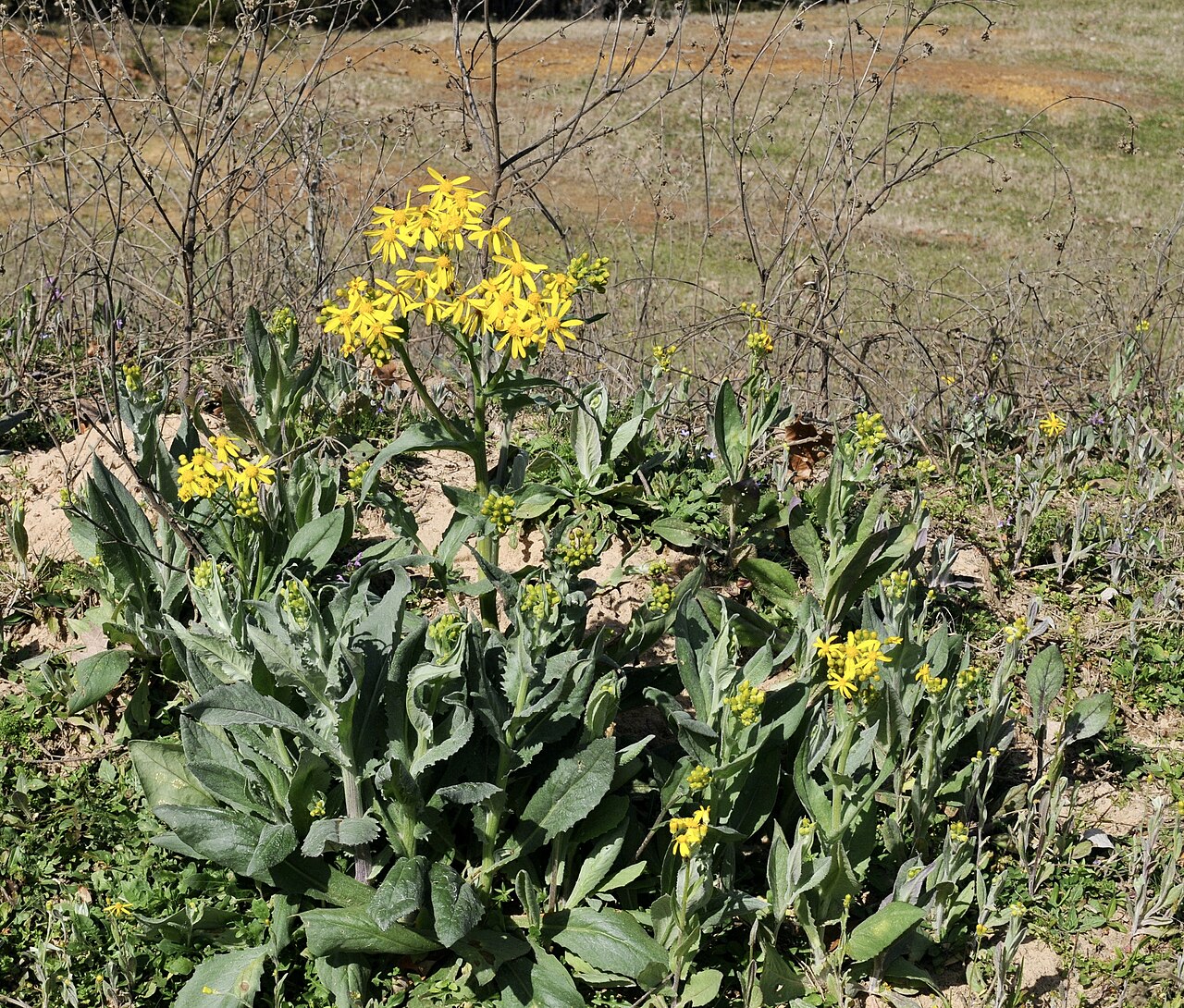
Texas ragwort is a cool-season annual. Seeds sprout in fall or winter and form a rosette of leaves, then the plant sends up one or more stout, branching stems in late winter. Plants are usually 1 to 2 feet tall, sometimes up to about 3 feet in rich soil. The stems are smooth or have small tufts of cottony hairs, especially where the leaves join the stem.
Leaves
The leaves are alternate, about 1 to 4 inches long, oblong to lance-shaped or spoon-shaped, and fairly thick. Their edges are smooth or have a few small teeth. The upper leaves have no stalk and clasp the stem with their base. They are smooth and grayish- or bluish-green, sometimes with patches of cobwebby hairs when young.
Flower Heads
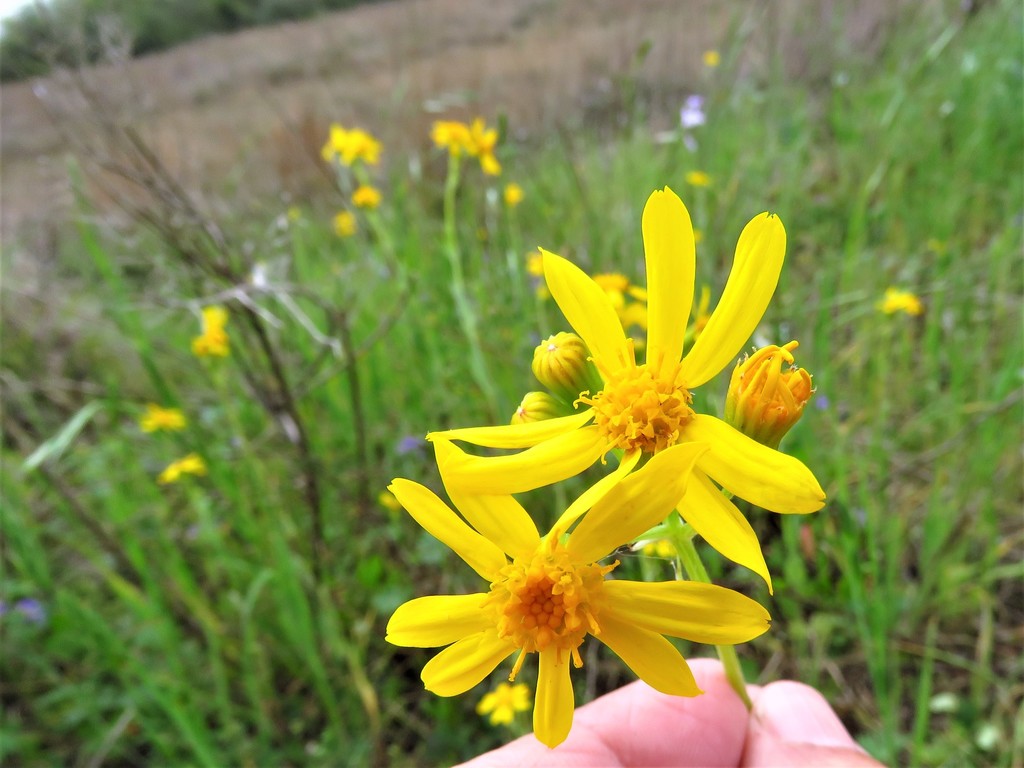
The flower heads are borne in loose, flat-topped clusters at the ends of the stems. Each head is about 1 to 1 1/4 inches across, with usually 7 to 9 (often 8) bright yellow ray florets around a yellow disk of tiny tubular florets. The bracts under the head are green, narrow and of equal length, with small dark tips on some. It blooms from about February to May, peaking in March and April.
Seeds
Each seed (achene) carries a tuft of soft, white pappus bristles, and the ripe heads turn into small white puffs that release the seeds on the wind in late spring. The plant then dies, leaving its seeds to sprout the next fall.
Look-alikes
Butterweed (Packera glabella) is a spring annual of wet ground with deeply divided, lobed leaves. Golden ragwort and other Packera species are perennials with long-stalked basal leaves. Common groundsel (Senecio vulgaris), a weed from Europe, has tiny heads with no or very short rays.
Quick Facts
| Scientific Name | Senecio ampullaceus |
| Family | Asteraceae (aster family) |
| Plant Type | Cool-season annual wildflower |
| Mature Height | 1–2 ft (occasionally 3 ft) |
| Mature Spread | 6–18 in |
| Growth Rate | Fast |
| Sun Exposure | Full sun to part shade |
| Water Needs | Low to medium; moist in winter and spring |
| Soil Type | Sandy, well-drained soil |
| Soil pH | Slightly acidic to neutral (about 5.5–7.5) |
| Bloom Time | February–May |
| Flower Color | Bright yellow |
| Fall Color | None; dies after setting seed |
| Fruit | Small achenes with white, fluffy bristles |
| Deer Resistant | Moderate; toxic and seldom browsed |
| USDA Hardiness Zones | 7–9 (annual) |
Native Range
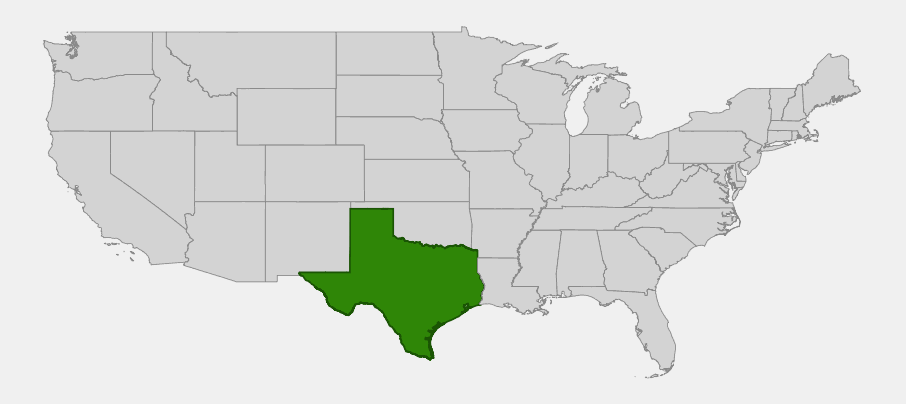
Texas ragwort is a Texas endemic: it grows naturally only in Texas. USDA PLANTS also lists Missouri, but the only Missouri records are old herbarium specimens from a railroad right-of-way in St. Louis, which indicates a short-lived, introduced occurrence rather than a native population. This page treats Texas as its only native state.
Within Texas it is common in the eastern and central parts of the state. It grows in the Pineywoods and the Post Oak Savannah of East Texas, the Blackland Prairie, the Gulf Coastal Plain and the coastal prairies, and south into the South Texas Plains, reaching the eastern edge of the Edwards Plateau and the Cross Timbers. It is most abundant on deep sands, such as the Carrizo and other sandy belts of East and Central Texas.
Typical habitats are sandy fields and pastures, roadsides, open oak woods and woodland edges, prairie openings and disturbed ground. Because it is an annual that sprouts on bare soil, it is often most abundant a year or two after soil disturbance and in fields that were recently cleared or plowed.
📋 Regional plant lists featuring Texas Ragwort: Arkansas, Louisiana, Eastern Oklahoma & Eastern Texas · South & West Texas
Growing & Care Guide
Texas ragwort is an easy, self-sowing annual for sunny, sandy wildflower plantings in Texas. It is best used in meadows and large naturalized areas rather than in pastures or small gardens, because it reseeds freely and is toxic to livestock.
Light
Full sun gives the best flowering. It also grows in light shade along open woodland edges.
Soil & Water
Grow it in sandy, well-drained soil. Like other cool-season annuals, it needs moisture from fall through spring and dies back in early summer, so it needs no summer watering. Heavy clay and soggy soils are poor sites.
Planting Tips
Sow fresh seed on bare, lightly raked soil in early to mid fall, at the same time as bluebonnets and other Texas spring wildflowers. Press the seed into the soil but do not bury it deeply. Seedlings form rosettes in winter and flower the following spring. Keep it away from horse and cattle pastures because of its toxicity.
Pruning & Maintenance
No pruning is needed. Let plants set seed in late spring if you want them to return next year, then pull or mow the dead stems. To limit spread, cut the flower heads before they turn into white puffs. Wear gloves when handling large amounts of the plant.
Propagation
Propagate by seed. Collect the ripe, fluffy seed heads in late spring, store the seed dry over summer and sow it in fall. It reseeds on its own in open, sandy ground.
Landscape Uses
- Wildflower meadows: masses of yellow in early spring with bluebonnets
- Roadside and field plantings: self-sows on open sandy ground
- Early pollinator food: one of the first abundant nectar sources in spring
- Naturalized areas: an annual for large, informal spaces away from livestock
- Sandy sites: grows in poor, sandy soils where many plants struggle
Wildlife & Ecological Value
As an early-blooming, abundant wildflower, Texas ragwort is an important spring resource for insects in East and Central Texas.
For Pollinators
Its yellow heads are visited by many native bees, including small sweat bees and mining bees, as well as honey bees, flies and butterflies, which use its nectar and pollen early in the season when few other flowers are open.
For Birds
Finches and other small seed-eating birds may take the seeds, and insects on the plants are food for warblers and other birds moving through in spring.
For Mammals
Most mammals avoid it because of its bitter, toxic alkaloids. Cattle and horses may eat it when other forage is scarce, which can poison them.
Ecosystem Role
It is a pioneer annual that quickly covers bare, sandy ground after disturbance, helping hold the soil until perennial plants return. Some insects that feed on Senecio store its alkaloids in their own bodies as a defense against predators.
Cultural & Historical Uses
The genus name Senecio comes from the Latin word senex, meaning “old man,” a reference to the white, hair-like bristles on the seeds. The species name ampullaceus means “flask-shaped,” probably for the shape of the flower heads before they open.
Texas ragwort was first described by the British botanist William Jackson Hooker in 1836, in Curtis’s Botanical Magazine, during the early years of botanical exploration in Texas. Its bright yellow sheets are a familiar part of East Texas springs, and in good years they color whole fields and highway shoulders.
Because of the pyrrolizidine alkaloids in its leaves and flowers, ranchers and veterinarians in Texas regard it as a poisonous plant for livestock. The same compounds are found in many ragworts and groundsels worldwide, so none of them should be used as herbal remedies.
Frequently Asked Questions
Is Texas ragwort poisonous?
Yes. It contains pyrrolizidine alkaloids, which can damage the liver. It is toxic to livestock and to people and pets if eaten. Never use it as food or medicine.
Is Texas ragwort native only to Texas?
Yes. It is endemic to Texas. USDA PLANTS lists an old Missouri record, but that came from a railroad yard in St. Louis and is considered introduced.
Is Texas ragwort an annual or a perennial?
It is an annual. Seeds sprout in fall or winter, the plant blooms in spring, sets seed and dies by early summer.
When does Texas ragwort bloom?
From about February to May, with the main display in March and April.
Can I grow Texas ragwort in my wildflower meadow?
Yes, if you have sunny, sandy ground and no grazing animals nearby. Sow seed in fall and let it reseed. It spreads freely in open, disturbed soil.

Looking for a nursery that carries Texas Ragwort?
Browse our native plant nursery directory: Texas

