
Eastern Woodland Sedge (Carex blanda)
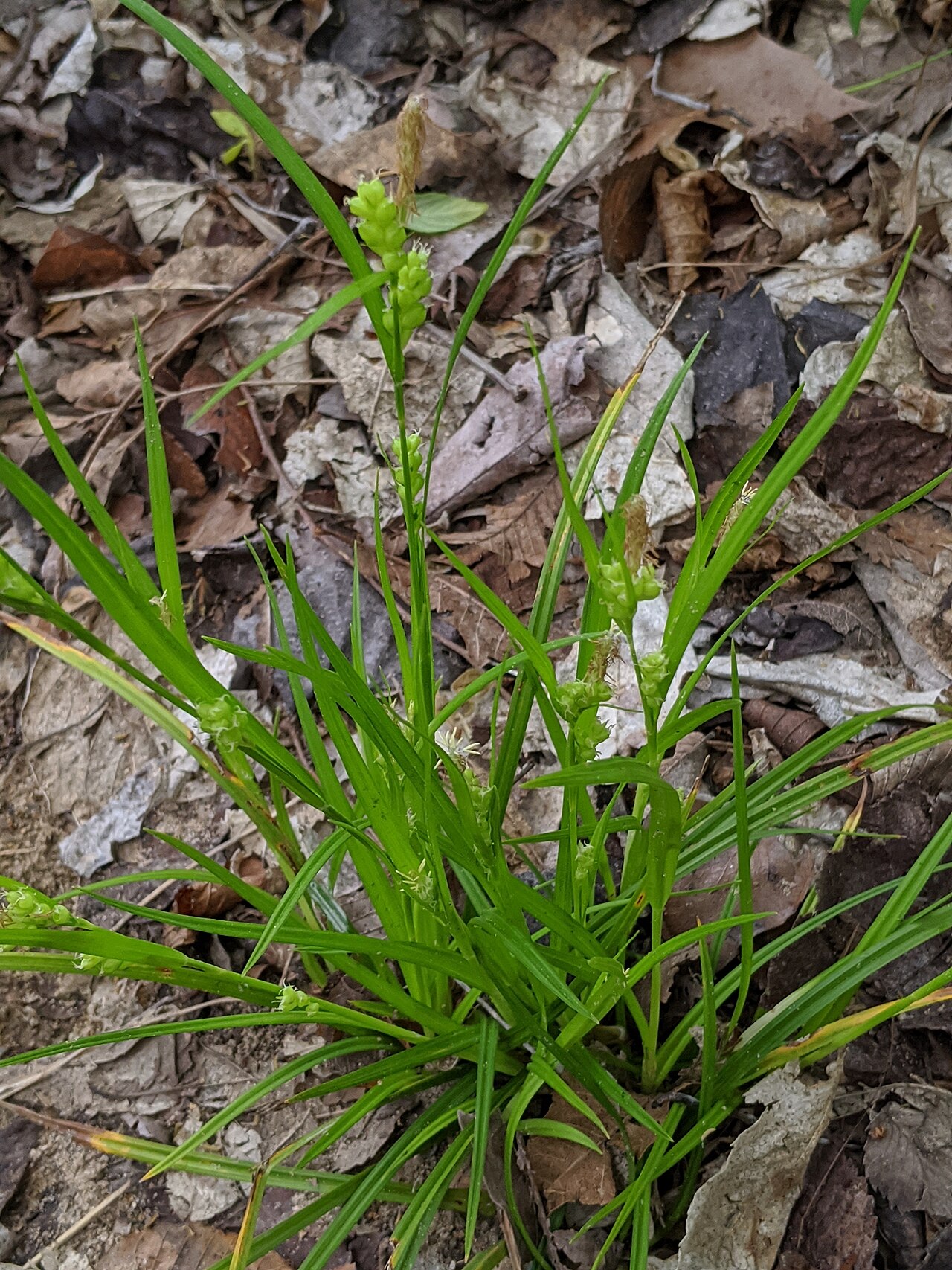
Carex blanda, known as Eastern Woodland Sedge or common woodland sedge, is one of the most widespread and adaptable native sedges of eastern and central North America. It belongs to the sedge family (Cyperaceae) and to Carex section Laxiflorae, a group of broad-leaved woodland sedges.
It forms low, loose tufts of soft, bright green leaves about 6 to 14 inches long that stay green from early spring well into late fall, and in mild areas through winter. In spring short stems carry a slim, pale male spike above small green female spikes of plump, ribbed seed sacs (perigynia). The plant is modest rather than showy, but it makes an excellent living mulch and lawn alternative in shade.
Eastern woodland sedge grows from New England and southern Canada west to the Dakotas and Kansas and south to Florida and Texas. It tolerates sun or shade, moist or fairly dry soil and some disturbance, which makes it one of the easiest native sedges for home landscapes and restoration.
Identification
Look for a low, clumping sedge with soft, flat, light green leaves 1/8 to 1/3 inch wide, short spring flowering stems, and female spikes of plump, many-nerved perigynia with short, abruptly bent beaks.
Growth Habit
Eastern woodland sedge is a cool-season perennial that grows in dense to loose tufts from short rhizomes, but it does not run or form a continuous sod. Clumps are usually 6 to 12 inches tall and spread slowly outward. It also seeds itself readily into bare or disturbed soil, especially in lawns and garden beds.
Leaves
The leaves are flat, soft, light to medium green, about 1/16 to 3/8 inch wide and 5 1/2 to 14 inches long. Their bases are pale to light brown, without the reddish-purple tinge of some related sedges. Leaves of the previous year often remain green through mild winters, and new leaves appear very early in spring.
Flowers
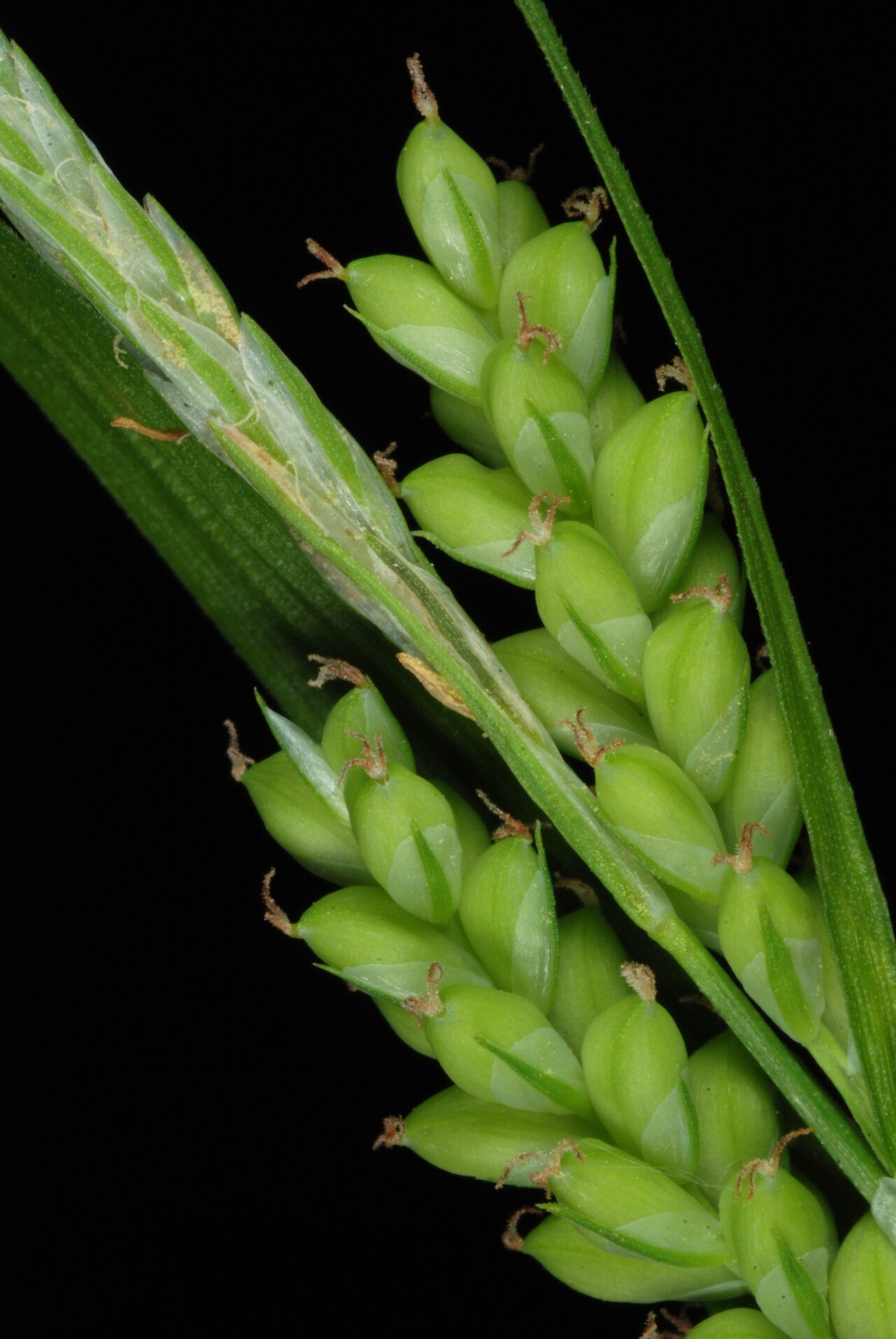
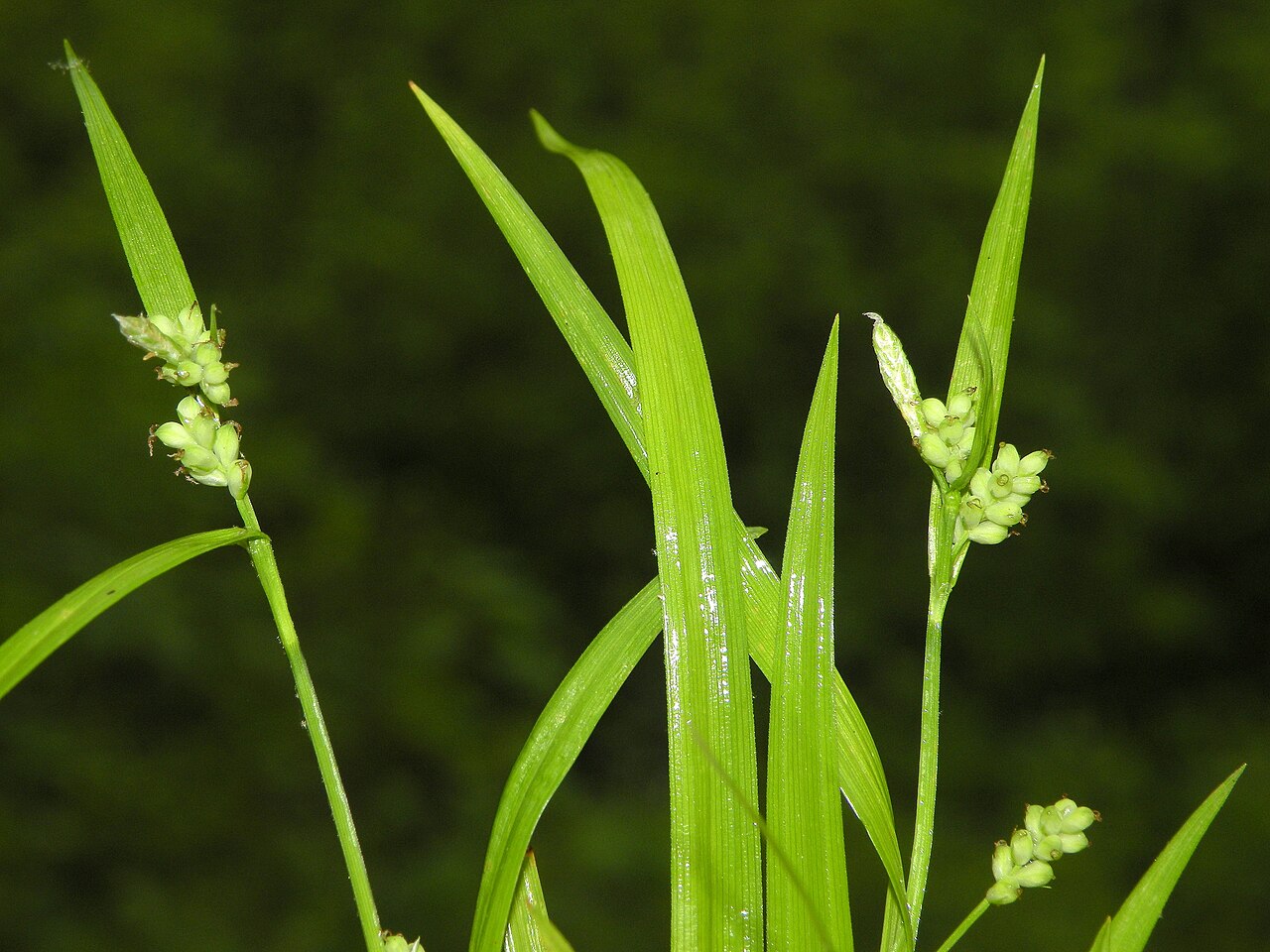
Flowering stems appear from about March to May. They are triangular, often shorter than to about as long as the leaves, and arch outward as the seeds ripen. At the tip is a single slender, pale male (staminate) spike; just below it are usually two or three small, short-stalked female (pistillate) spikes clustered close together, plus often one more female spike lower down on a longer stalk. Each female spike holds about 4 to 36 perigynia.
Fruit & Seeds
The perigynia are green, plump, roughly egg-shaped and finely many-nerved, about 1/8 inch long, with a short beak that bends abruptly to one side. Each encloses a single three-sided achene. They ripen in late spring and early summer and drop when touched.
Look-alikes
Several close relatives in section Laxiflorae, such as loose-flowered sedge (Carex laxiflora), white bear sedge (C. albursina) and graceful sedge (C. gracilescens), look very similar; they are separated by leaf width, the color of the leaf bases, and the shape and size of the perigynia, and often need a hand lens. Pennsylvania sedge (Carex pensylvanica) has much narrower leaves, reddish-purple leaf bases and hairy perigynia, and spreads by long rhizomes into a sod.
Safety Notes
Eastern woodland sedge is not known to be toxic to people, pets or livestock.
Quick Facts
| Scientific Name | Carex blanda |
| Family | Cyperaceae (sedge family) |
| Plant Type | Clumping, cool-season perennial sedge |
| Mature Height | 6–18 in |
| Mature Spread | 8–18 in |
| Growth Rate | Moderate to fast |
| Sun Exposure | Full sun to full shade |
| Water Needs | Moderate; tolerates moist to fairly dry soil |
| Soil Type | Adaptable: loam, clay, rocky or sandy soil |
| Soil pH | About 5.5–7.5 |
| Bloom Time | March–May |
| Flower Color | Inconspicuous; pale male spikes, green female spikes |
| Fall Color | Stays green into late fall; semi-evergreen |
| Fruit | Plump green perigynia with bent beaks |
| Deer Resistant | Yes |
| USDA Hardiness Zones | 3–9 |
Native Range
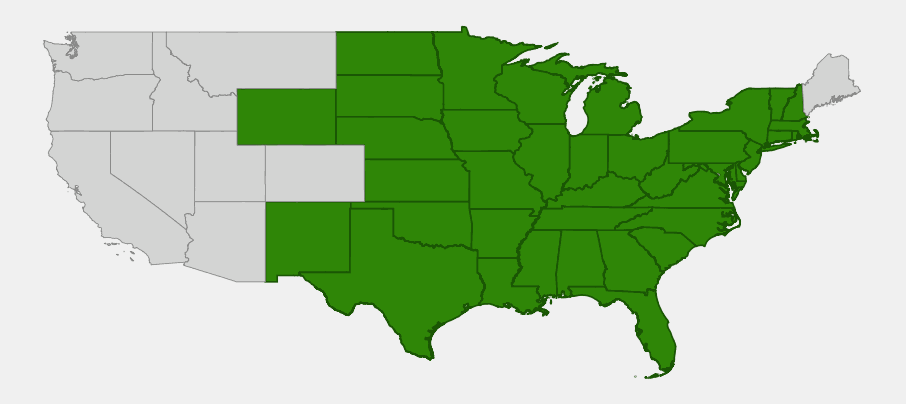
Eastern woodland sedge is native across much of eastern and central North America, from Quebec, Ontario, Manitoba and Saskatchewan south to Florida and Texas. USDA PLANTS lists it as native in Alabama, Arkansas, Connecticut, Delaware, Florida, Georgia, Illinois, Indiana, Iowa, Kansas, Kentucky, Louisiana, Maryland, Massachusetts, Michigan, Minnesota, Mississippi, Missouri, Nebraska, New Hampshire, New Jersey, New Mexico, New York, North Carolina, North Dakota, Ohio, Oklahoma, Pennsylvania, Rhode Island, South Carolina, South Dakota, Tennessee, Texas, Vermont, Virginia, West Virginia, Wisconsin and Wyoming, as well as the District of Columbia.
It is common through the Midwest, the Ohio Valley and the mid-Atlantic, becoming less frequent on the southeastern coastal plain and in northern New England. The records from Wyoming and New Mexico are outlying western occurrences at the edge of the Great Plains, well away from its main eastern range.
It grows in a wide range of habitats: moist to dry deciduous forests, floodplain woods, wooded slopes and ravines, woodland edges and openings, savannas, thickets, and shaded lawns, pastures and trailsides. It is one of the few native sedges that does well in disturbed ground and regularly colonizes shady yards on its own.
📋 Regional plant lists featuring Eastern Woodland Sedge: New Hampshire, Maine & Vermont · Connecticut, Massachusetts & Rhode Island · New York, Pennsylvania & Northern New Jersey · Delaware, Southern New Jersey & Long Island · Maryland, Virginia & West Virginia · North & South Carolina · Alabama, Georgia & Mississippi · North & South Florida · Kentucky & Tennessee · Ohio & Indiana · Michigan, Wisconsin & Eastern Minnesota · Illinois, Iowa & Missouri · Nebraska, Kansas & Eastern Colorado · North Dakota, South Dakota & Western Minnesota · Montana & Wyoming · Arkansas, Louisiana, Eastern Oklahoma & Eastern Texas · South & West Texas
Growing & Care Guide
Eastern woodland sedge is widely available from native plant nurseries as plugs and seed. It is one of the toughest native sedges for gardens and is often recommended as a shade-tolerant groundcover or a low-mow lawn substitute.
Light
It grows in anything from full sun to fairly deep shade. Part shade to dappled shade suits it best; in full sun it needs soil that does not dry out completely, and in deep shade it grows more loosely.
Soil & Water
It tolerates clay, loam, rocky and sandy soils and a wide pH range. Average to moist soil gives the lushest growth, but established plants handle summer dry spells and dry shade under trees better than most sedges. Water new plantings regularly through their first season.
Planting Tips
Set plugs about 10 to 12 inches apart for a groundcover that fills in within two or three seasons. Use it as a living mulch under shrubs and trees, along woodland paths, in rain gardens and on shady slopes, or mix it with spring wildflowers such as wild geranium, woodland phlox and mayapple. It is also useful for replacing turf in shaded corners where lawn grass struggles.
Pruning & Maintenance
Very little care is needed. Comb or trim out old, tattered leaves in early spring just before new growth starts. As a lawn substitute it can be mowed high, at about 4 inches, a few times a year. It self-sows readily into open soil; remove unwanted seedlings while they are small, or cut off the seed stems in late spring if you want to limit spread.
Propagation
Divide clumps in early spring or fall. Seed sown outdoors in fall germinates the following spring; for spring sowing, give it about 60 days of cold, moist stratification. Fresh seed collected in early summer and sown promptly also works well.
Landscape Uses
- Shade groundcover and lawn alternative: soft, low and semi-evergreen
- Woodland gardens: pairs well with spring wildflowers and ferns
- Rain gardens and swales: tolerates periodic wet and dry
- Erosion control: holds soil on shady slopes and banks
- Woodland restoration: quickly covers disturbed forest floors
Wildlife & Ecological Value
Like most sedges, eastern woodland sedge supports wildlife mainly as food for caterpillars and as seed and cover for ground-dwelling birds and small mammals.
For Pollinators
Sedges are wind-pollinated and offer little nectar, but Carex species are larval host plants for many insects, including several satyr butterflies such as the eyed brown and Appalachian brown, and a number of moths. Clumps also give shelter to overwintering insects and ground-nesting bees.
For Birds
Turkeys, sparrows, juncos and other ground-feeding birds eat sedge seeds, which ripen in early summer when few other seeds are available. The dense tufts provide cover for ground-foraging birds.
For Mammals
Small mammals such as mice and voles eat the seeds and shelter in the clumps. Deer and rabbits browse sedges lightly but rarely damage established plantings.
Ecosystem Role
Its early-season and late-season green leaves help protect the forest floor from erosion and keep soil covered when most plants are dormant. Because it quickly colonizes disturbed ground, it helps stabilize soil after logging, flooding or construction and can compete with invasive groundcovers in shade.
Cultural & Historical Uses
The American botanist and educator Chester Dewey described Carex blanda in 1826. Dewey devoted much of his career to the study of North American sedges, publishing a long series of papers on the genus Carex in the American Journal of Science.
The species name blanda is Latin for “smooth,” “mild” or “pleasant,” likely referring to the soft, smooth leaves and perigynia. The genus name Carex is the classical Latin name for sedges.
Native plant gardeners have taken a growing interest in eastern woodland sedge as an alternative to turfgrass in shade. Its ability to appear on its own in lawns and garden beds has made it a familiar plant to many homeowners, even if they do not know its name.
Frequently Asked Questions
Can eastern woodland sedge replace a lawn?
In shade and part shade, yes. It forms a soft, low, semi-evergreen cover that can be mowed high a few times a year, though it does not tolerate heavy foot traffic like turfgrass.
Does eastern woodland sedge spread aggressively?
Its clumps spread slowly, but it self-sows readily into bare or disturbed soil. Cut the seed stems in late spring if you want to limit seedlings.
Will it grow in dry shade?
Yes. Once established it handles dry shade under trees better than most native sedges, although it looks lushest in average to moist soil.
Is eastern woodland sedge evergreen?
It is semi-evergreen. Leaves stay green into late fall and often through mild winters, and new growth starts very early in spring.
How is it different from Pennsylvania sedge?
Eastern woodland sedge has wider, softer leaves without red-purple bases and forms clumps. Pennsylvania sedge has very narrow leaves with reddish bases, hairy perigynia, and spreads by rhizomes into a sod.

Looking for a nursery that carries Eastern Woodland Sedge?
Browse our native plant nursery directory: Alabama & Arkansas · Connecticut, Delaware, Florida & Georgia · Illinois, Indiana, Iowa & Kansas · Kentucky, Louisiana, Maryland, Massachusetts, Michigan, Minnesota, Mississippi & Missouri · Nebraska, New Hampshire, New Jersey, New Mexico, New York, North Carolina, North Dakota, Ohio & Oklahoma · Pennsylvania, Rhode Island, South Carolina, South Dakota, Tennessee, Texas, Vermont & Virginia · West Virginia, Wisconsin & Wyoming

