
Toadshade (Trillium sessile)
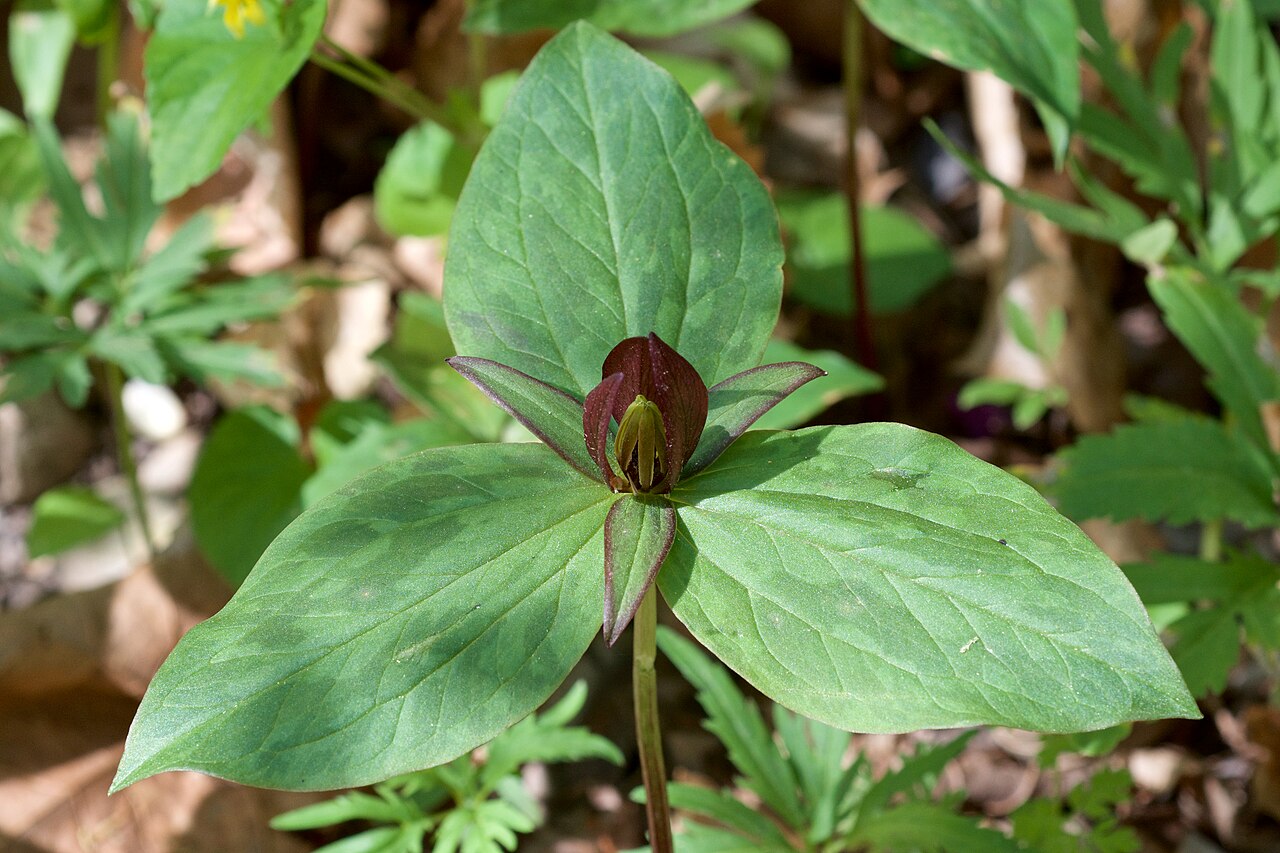
Trillium sessile, known as Toadshade, toad trillium or sessile trillium, is a small spring wildflower of rich forests in the eastern and central United States. Like all trilliums it has its parts in threes: three broad leaves held in a whorl atop a short stem, and a single flower with three sepals and three petals. In toadshade the maroon to reddish-purple flower sits directly on the leaves without a stalk and stays upright and partly closed, like a small flame or candle. It belongs to the bunchflower family (Melanthiaceae).
Toadshade blooms in early to mid spring, often a little earlier than other stalkless trilliums that share its range. Its leaves are plain green or lightly mottled, and the flower has a faint spicy or musky scent. Although it is a common wildflower in parts of the Ohio and Mississippi valleys, it grows slowly and can take many years to reach flowering size from seed.
This guide covers how to tell toadshade from similar trilliums, where it grows, how to grow it in a woodland garden, and its role in the forest. One rule matters above all: never dig trilliums from the wild. Buy only nursery-propagated plants, because many trilliums sold as “nursery grown” have in fact been collected from wild populations.
Identification
Toadshade belongs to the group of sessile (stalkless) trilliums, which have upright flowers sitting directly on the leaves. Several look alike, and the details of leaves, sepals and stamens are needed to tell them apart.
Stem & Leaves
Each plant grows from a thick underground rhizome and sends up one or two unbranched stems, usually 4 to 10 inches tall. At the top of the stem is a whorl of three stalkless leaves (botanically, bracts), broadly oval to nearly round, up to about 4 inches long. They may be plain green or mottled with darker and lighter green, and any mottling tends to fade as the season goes on. The stem is roughly three times as long as a leaf.
Flowers
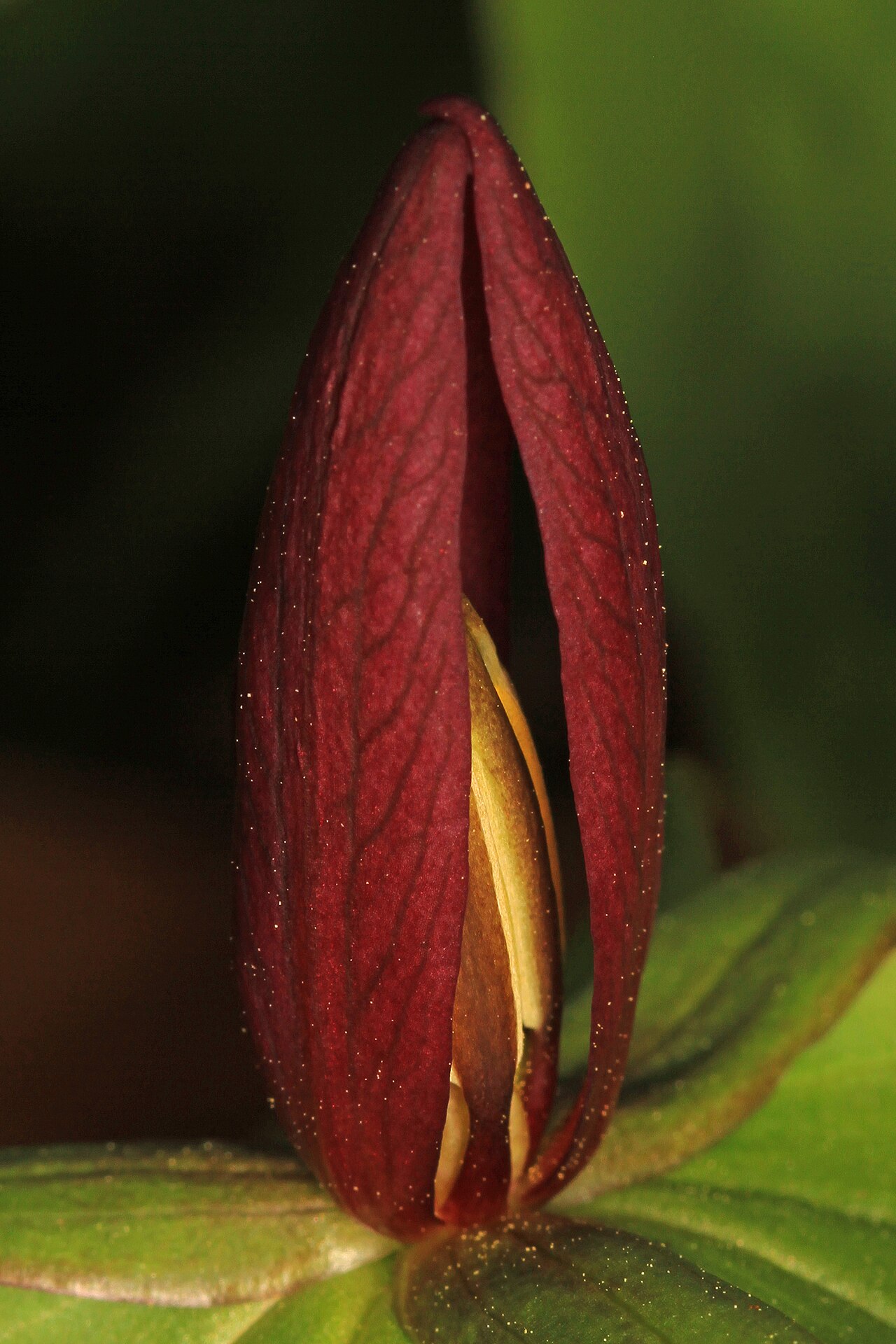
The single flower sits directly in the center of the three leaves. The three sepals are green, often streaked with purple, and spread outward or upward; unlike those of prairie trillium, they are not bent down. The three petals are erect, narrow and elliptic, usually about an inch long, and maroon to reddish-purple. They stay partly closed for weeks. A rare form with entirely yellow-green petals, f. viridiflorum, appears here and there throughout the range. The six stamens are about half as long as the petals, with short filaments and pale pollen sacs, and the tissue connecting the anthers extends noticeably beyond the pollen sacs. Three dark, erect stigmas rise from the small, six-angled ovary. The flower has a spicy or musky odor and blooms from about March to May.
Fruit & Seeds
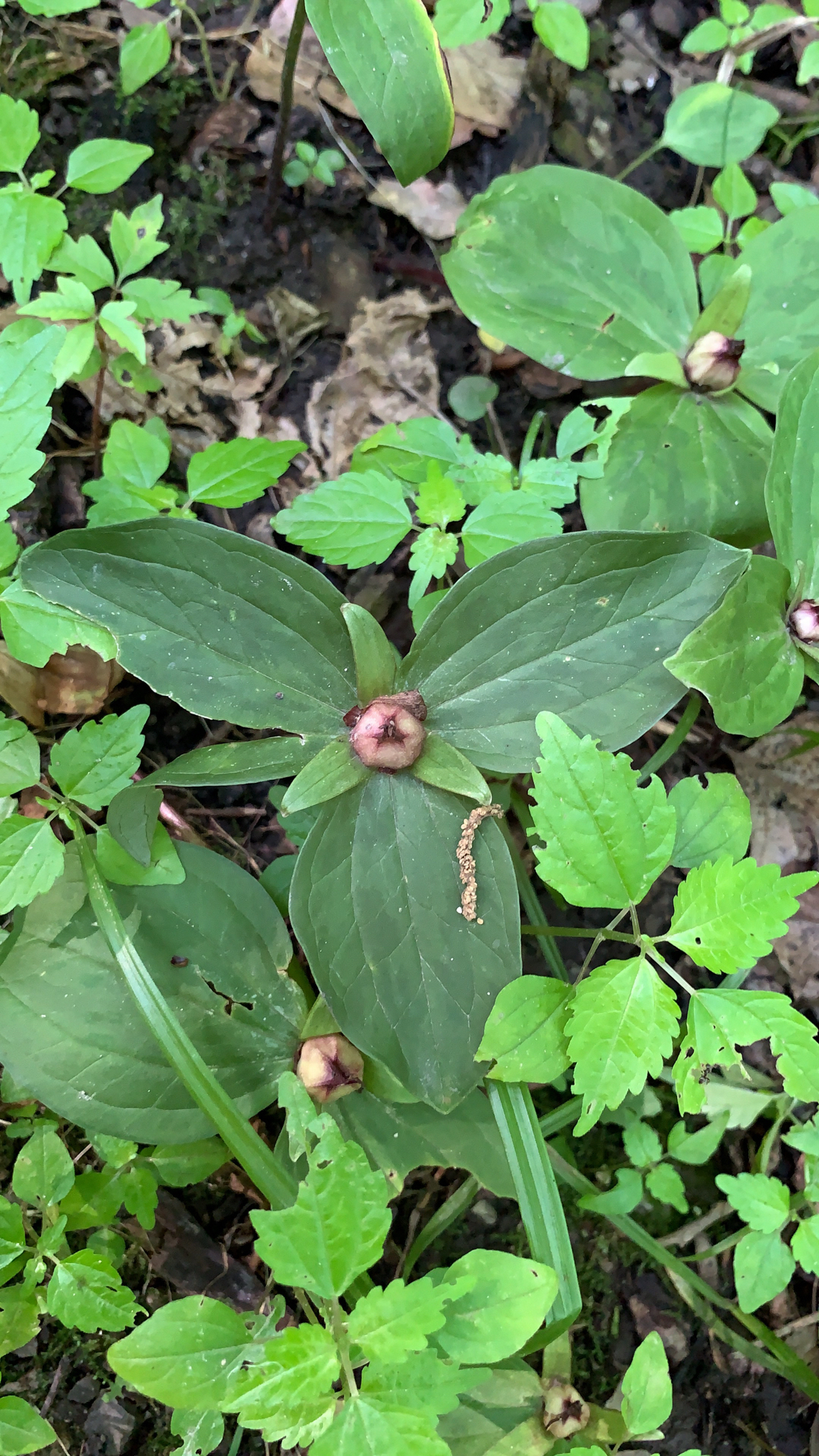
The fruit is a rounded to egg-shaped berry about half an inch tall, with six ridges that merge into three toward the top. It ripens in early summer to whitish-green tinged with pink and holds about 15 to 25 golden-yellow seeds. Each seed carries a small fatty appendage (elaiosome) that attracts ants. The leaves usually yellow and die back by midsummer, much earlier in dry years.
Similar Species
Prairie trillium (Trillium recurvatum), which shares much of its range, has leaves narrowed to stalk-like bases and sepals that bend sharply downward. Sweet Betsy (Trillium cuneatum) of the Southeast is a much larger plant with longer petals and strongly mottled leaves. Yellow trillium (Trillium luteum), once treated as a variety of toadshade, has lemon-yellow petals and a lemony scent.
Quick Facts
| Scientific Name | Trillium sessile |
| Family | Melanthiaceae (bunchflower family) |
| Plant Type | Herbaceous perennial from a rhizome; spring ephemeral |
| Mature Height | 4–10 in |
| Mature Spread | 4–8 in; slowly forms clumps |
| Growth Rate | Slow |
| Sun Exposure | Part shade to full shade |
| Water Needs | Moderate; moist in spring, tolerates summer dryness while dormant |
| Soil Type | Rich, humusy loam; often over limestone; alluvial soils |
| Soil pH | About 6.0–7.5 |
| Bloom Time | March–May |
| Flower Color | Maroon to reddish-purple; rarely yellow-green |
| Fall Color | None; leaves die back in summer |
| Fruit | Ridged, whitish-green to pinkish berry with ant-dispersed seeds |
| Deer Resistant | No; deer browse trilliums heavily |
| USDA Hardiness Zones | 4–8 |
Native Range
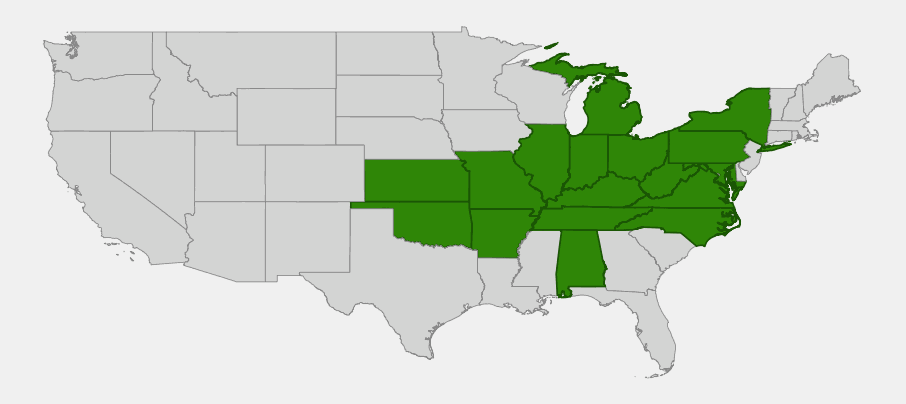
Toadshade is found only in the eastern half of the United States. USDA PLANTS records it from 17 states and the District of Columbia: Alabama, Arkansas, Illinois, Indiana, Kansas, Kentucky, Maryland, Michigan, Missouri, New York, North Carolina, Ohio, Oklahoma, Pennsylvania, Tennessee, Virginia and West Virginia. It does not occur in Canada, New England or the southern Coastal Plain.
It is most abundant in Ohio, Indiana, northern Kentucky and Missouri. Curiously, it is largely absent from central Illinois, which splits the species into an eastern population centered on the Ohio Valley and a western population centered on Missouri and the Ozarks. Plants of the western group often have taller stems and narrower leaves. Records in New York, North Carolina, Michigan, Kansas and Oklahoma are near the edges of the range, where the plant is local or rare.
It grows in rich deciduous woods, especially on limestone and other calcareous soils, on alluvial floodplains and riverbanks, and on wooded slopes and ravines. It is more tolerant of disturbance than many trilliums and can persist along fencerows, in lightly grazed woods and in brushy second-growth forest.
📋 Regional plant lists featuring Toadshade: New York, Pennsylvania & Northern New Jersey · Ohio & Indiana · Michigan, Wisconsin & Eastern Minnesota · Kentucky & Tennessee · Nebraska, Kansas & Eastern Colorado · Maryland, Virginia & West Virginia · Illinois, Iowa & Missouri · Alabama, Georgia & Mississippi · North & South Carolina · Arkansas, Louisiana, Eastern Oklahoma & Eastern Texas
Growing & Care Guide
Toadshade is one of the easier trilliums to grow in a shady garden within its range, but it is slow. Plants take several years to reach flowering size and then spread gradually into clumps. Buy only from nurseries that propagate their own trilliums from seed or division, and ask if you are unsure. Never dig wild trilliums: transplanted wild plants often die, and collecting depletes slow-growing populations.
Light
Plant in part to full shade under deciduous trees. Toadshade does its growing in spring, when sunlight reaches the forest floor, and goes dormant by midsummer when the canopy is dense. Avoid hot, sunny spots, which scorch the leaves.
Soil & Water
Toadshade prefers rich, loose, moist soil with plenty of leaf mold or compost, ideally neutral to slightly alkaline. It tolerates heavier clay-loam better than many woodland plants, as long as the soil is not waterlogged. Keep the soil moist in spring. In summer, the dormant rhizome tolerates dry soil. Leave fallen leaves in place to form natural mulch.
Planting Tips
Plant dormant rhizomes in late summer or fall, 2 to 3 inches deep, or set out potted plants in early spring. Space them 6 to 12 inches apart in groups so the small plants make a show. Plant ferns, wild ginger or sedges nearby to cover the space after the trilliums go dormant, and mark their positions so they are not dug up by mistake.
Pruning & Maintenance
No pruning is needed. Do not cut the leaves after flowering; the plant needs them to store energy in the rhizome. If deer are common, protect plants with fencing or repellents, since browsing of the leaves can set them back for years. Keep invasive groundcovers such as garlic mustard, lesser celandine and vinca away from them.
Propagation
Established clumps can be divided carefully in late summer after the plants go dormant, keeping a growing bud with each section of rhizome. Seed is slow: sow fresh seed outdoors in summer as soon as the fruit ripens, without letting it dry. Seeds typically need a warm and a cold period and may take two years to germinate, then several more years to bloom. This slow cycle is why propagated trilliums are relatively expensive and why wild-collected plants are so often sold instead.
Landscape Uses
- Woodland gardens: a small, early accent among other spring wildflowers under deciduous trees
- Shade gardens: paired with ferns, wild ginger and sedges that fill the space in summer
- Native plant collections: an easy introduction to the sessile trilliums
- Woodland restoration: within its native range, using nursery-propagated plants
- Nature study: a common, easily recognized spring wildflower for wildflower walks
Wildlife & Ecological Value
Toadshade is part of the rich spring flora of eastern hardwood forests. Its odd, dark, musky-smelling flowers and ant-dispersed seeds show how trilliums are adapted to life on the forest floor.
For Pollinators
The dark, upright, partly closed flowers and their musky scent attract mainly flies and beetles, which crawl among the stamens and pick up pollen. Small bees occasionally visit. Like many sessile trilliums, toadshade can also set seed by self-pollination when insects are scarce.
For Birds
Toadshade has little direct value for birds, but it grows in the leaf-litter layer of rich woods used by ground-foraging birds such as wood thrushes, ovenbirds and wild turkeys.
For Mammals
White-tailed deer browse trilliums readily, and heavy deer populations have caused trillium declines in many forests. Small mammals may eat the fruits and seeds. Trillium populations are often used as an indicator of deer browsing pressure.
Ecosystem Role
Toadshade seeds carry a fatty appendage that ants carry back to their nests. The ants eat the appendage and discard the seed, often in a nutrient-rich spot, which helps plant the next generation. This process, called myrmecochory, is common in spring wildflowers of eastern forests. Because ants move seeds only short distances, trillium populations spread slowly, and plants are slow to return once a woodland has been cleared.
Cultural & Historical Uses
Trillium sessile was one of the first three trillium species named by Carl Linnaeus in 1753. The species name means “stalkless,” for the flower that sits directly on the leaves. For much of the following two centuries the name was used loosely for almost any stalkless trillium, including several western and southern species now recognized as distinct.
The common name toadshade may come from the idea that toads could shelter under its umbrella of three leaves, while the mottling of some plants has also been compared to the skin of a toad. The name has occasionally been used for prairie trillium as well, so the scientific name is the safest way to be sure which plant is meant.
Trilliums are treasured spring wildflowers and the target of wild collecting for the plant trade. Toadshade is still common in much of its range, but it grows slowly and suffers where deer are abundant or forests are cleared. Gardeners can help by buying only nursery-propagated trilliums, controlling invasive groundcovers, and enjoying wild plants where they grow.
Frequently Asked Questions
How do I tell toadshade from prairie trillium?
Look at the leaves and sepals. Prairie trillium has leaves narrowed at the base into short stalks and sepals that bend sharply down along the stem. Toadshade has stalkless leaves and sepals that spread outward or upward.
Can I dig toadshade from the woods?
No. Never dig wild trilliums. Transplanted plants often fail, and collecting harms slow-growing populations. Buy only plants that the nursery has propagated itself.
Why does my toadshade disappear in summer?
It is a spring ephemeral. After flowering and setting fruit, the leaves yellow and die back, usually by midsummer, and the plant rests underground until the next spring. This is normal.
How long does it take to grow toadshade from seed?
Several years. Seeds may take up to two years to germinate, and seedlings usually need four or more years to reach flowering size. Division of established clumps is much faster.
Is toadshade poisonous?
Trilliums are not considered highly toxic, but they are not food plants, and their berries and rhizomes should not be eaten. Pets and children should be kept from eating any part of the plant.

Looking for a nursery that carries Toadshade?
Browse our native plant nursery directory: Alabama & Arkansas · Illinois, Indiana & Kansas · Kentucky, Maryland, Michigan & Missouri · New York, North Carolina, Ohio & Oklahoma · Pennsylvania, Tennessee & Virginia · West Virginia