
White-Veined Wintergreen (Pyrola picta)
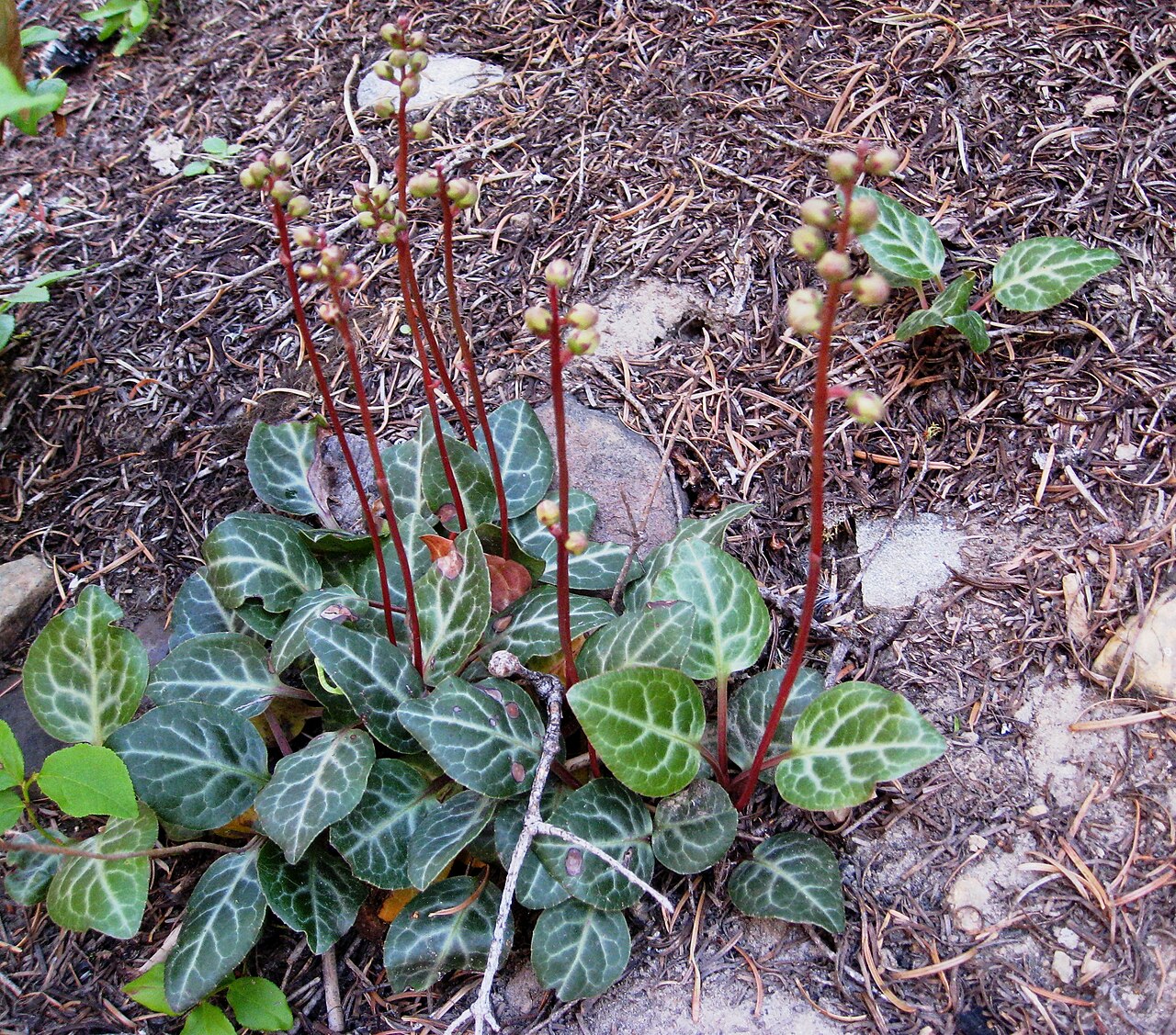
Pyrola picta, known as White-Veined Wintergreen or whitevein shinleaf, is a small evergreen wildflower of shady western conifer forests. It forms a low rosette of thick, leathery, dark green leaves marked with striking white or pale gray-green veins, and in summer it sends up a reddish stalk of nodding, waxy, bell-shaped flowers in shades of greenish-cream, white or pink.
It belongs to the wintergreen tribe (Pyroleae) of the heath family (Ericaceae), along with pipsissewa, one-sided wintergreen and the other shinleafs. Like its relatives, it lives in close partnership with soil fungi. It is a mixotroph: it makes some of its own food by photosynthesis but also takes a share of its carbon from mycorrhizal fungi that connect it to the roots of nearby trees. Some plants even flower with few or no leaves, living almost entirely on what the fungi supply.
White-veined wintergreen grows from British Columbia and Alberta south through the mountains of the western United States to California, Arizona and New Mexico, and east to the Black Hills of South Dakota. Because it depends on its fungal partners, it cannot be grown from nursery stock and should never be dug up. This guide covers how to identify it, where it grows, why it can’t be cultivated, and its role in the forest.
Identification
White-veined wintergreen is one of the easiest pyrolas to identify, even when it is not in bloom, thanks to its patterned leaves.
Growth Habit
It is a low, evergreen perennial, often described as a subshrub, that spreads slowly by slender underground rhizomes. Each plant has a basal rosette of a few leaves and, in summer, a single upright flowering stalk usually 4 to 12 inches tall. The stalk is often reddish or purplish.
Leaves
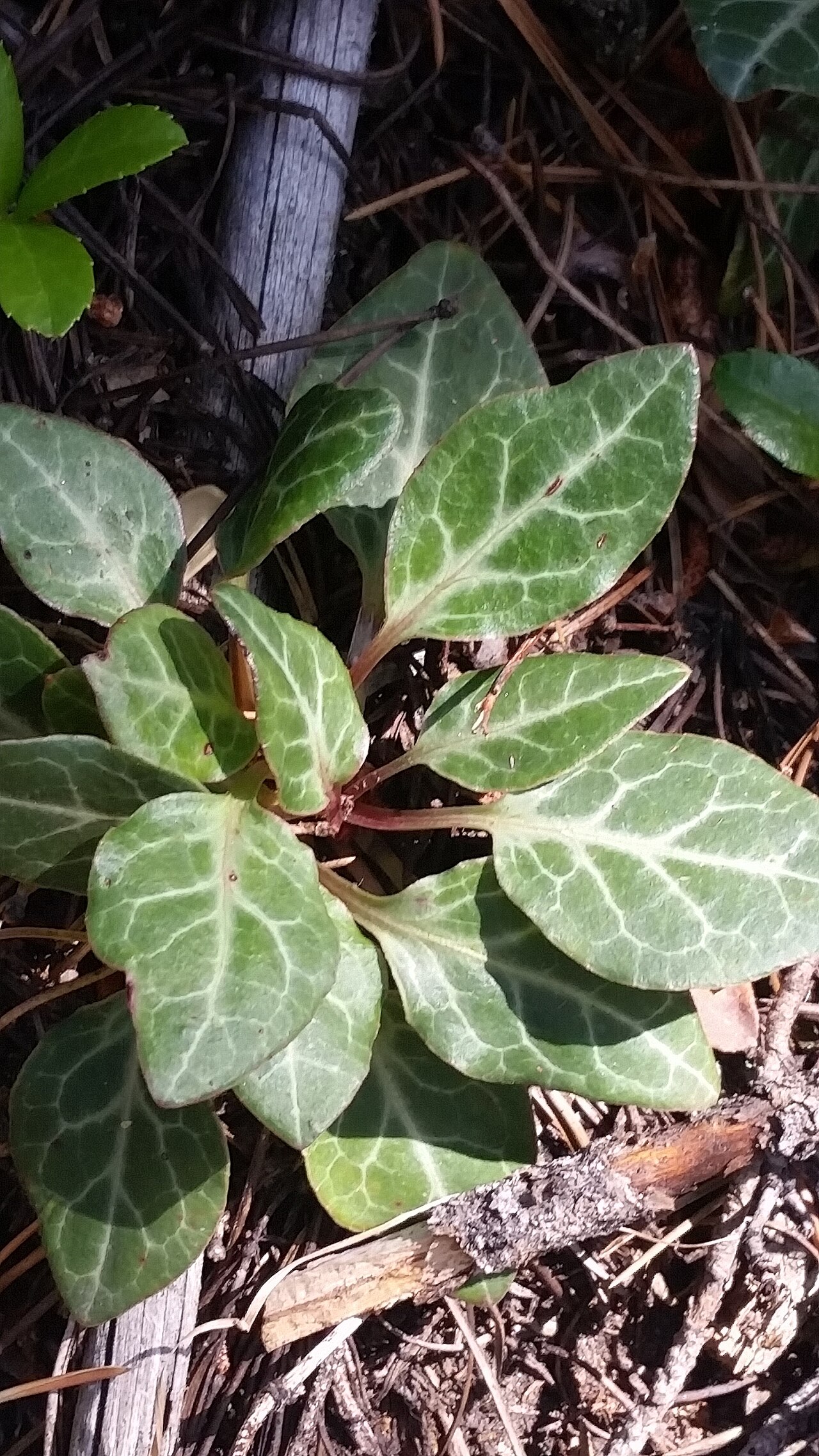
The leaves are thick, leathery and evergreen, oval to egg-shaped, about 1 to 3 inches long, on short stalks. They are dark green above, often purplish beneath, and marked with white to pale gray-green veins along the midrib and main side veins, giving a mottled or “painted” look; picta means painted. The leaf edges are smooth or have small, widely spaced teeth. Some plants have small, reduced leaves or none at all.
Flowers
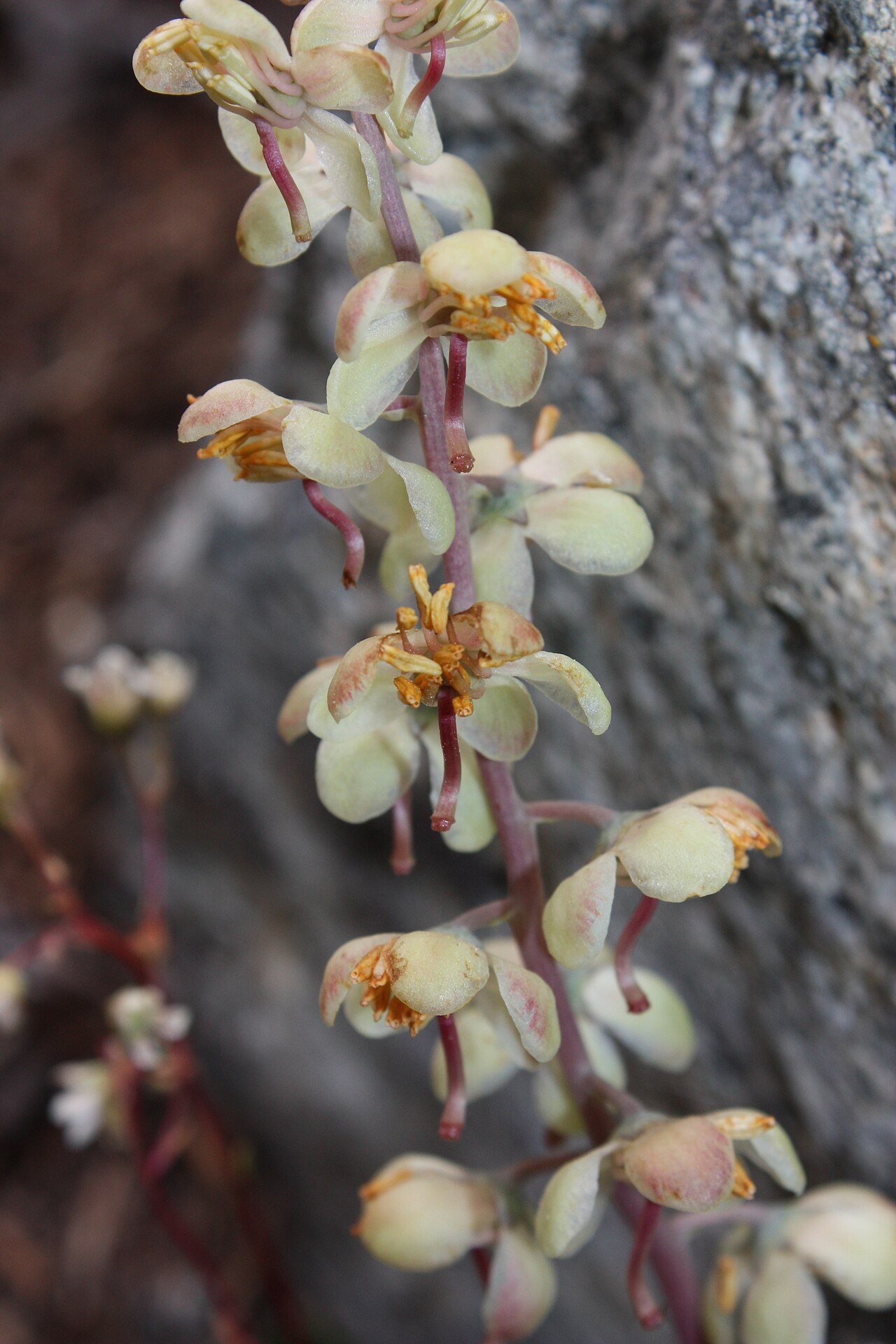
The flowers hang in a loose raceme of about 5 to 25 along the upper part of the stalk. Each is nodding, about 1/3 to 1/2 inch across, with five waxy, cupped petals that are greenish-white, cream, pink or purplish. A long, curved style projects below the petals, a typical feature of Pyrola. They bloom from about June to August.
Fruit & Seeds
The fruit is a small, roundish capsule that splits open to release extremely tiny, dust-like seeds. The seeds have almost no stored food and depend on fungi to germinate and grow.
Look-alikes
Other pyrolas, such as bog wintergreen (Pyrola asarifolia), have plain green leaves without white veins. Little prince’s pine (Chimaphila menziesii) also has white-marked leaves, but its leaves are narrow and toothed, grow along a short woody stem, and its flowers face outward in a small cluster. The rattlesnake plantains (Goodyera) have white-netted leaves too, but they are orchids, with spikes of small white, hooded flowers.
Quick Facts
| Scientific Name | Pyrola picta Sm. |
| Family | Ericaceae (heath family); sometimes placed in Pyrolaceae |
| Plant Type | Evergreen perennial (subshrub); partly mycoheterotrophic |
| Mature Height | 4–12 in in flower |
| Mature Spread | 4–8 in per rosette; spreads slowly by rhizomes |
| Growth Rate | Slow |
| Sun Exposure | Shade to part shade |
| Water Needs | Low to moderate; dry to moist forest soils |
| Soil Type | Acidic, humus-rich forest duff over well-drained soil |
| Soil pH | Acidic, about 4.5–6.0 |
| Bloom Time | June–August |
| Flower Color | Greenish-white, cream, pink or purplish |
| Fall Color | None; leaves are evergreen |
| Fruit | Small, round capsule with dust-like seeds |
| Deer Resistant | Not well documented |
| USDA Hardiness Zones | Not cultivated; grows wild in cold to mild mountain climates |
Native Range
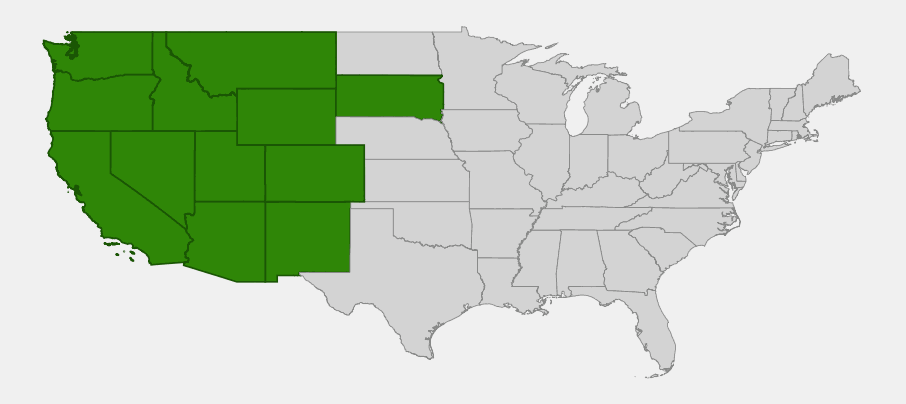
White-veined wintergreen is native to western North America. USDA PLANTS lists it in Arizona, California, Colorado, Idaho, Montana, Nevada, New Mexico, Oregon, South Dakota, Utah, Washington and Wyoming, and in Alberta and British Columbia in Canada. Its range continues south into northern Mexico.
It is most common in the Cascades, Sierra Nevada, Klamath Mountains and the northern Rocky Mountains, and it occurs on both sides of the Cascades in Oregon and Washington. Farther south and east it becomes more scattered, growing in the mountains of Utah, Colorado, Arizona and New Mexico, with an outlying population in the Black Hills of South Dakota.
It grows in the shade of coniferous and mixed forests, typically in deep needle litter under Douglas-fir, true firs and pines, from low elevations in the Pacific Northwest to high mountain forests in the Southwest. It tolerates drier forest soils than many of its relatives.
📋 Regional plant lists featuring White-Veined Wintergreen: Montana & Wyoming · Utah & Western Colorado · Arizona & New Mexico · North Dakota, South Dakota & Western Minnesota · Western Oregon & Western Washington · California & Nevada
Can You Grow It?
No. White-veined wintergreen cannot be grown from nursery stock and should never be dug up or transplanted. It is not sold by native plant nurseries, and plants taken from the wild almost always die.
Why It Depends on Fungi
The plant gets part of its food from mycorrhizal fungi that are also connected to the roots of surrounding conifers. Its dust-like seeds have almost no stored energy and can only germinate when the right fungus infects them. Without that underground network, which cannot be moved with a plant or recreated in a garden, it slowly starves.
Why You Should Not Dig It
Digging tears the plant away from its fungal partners and damages the forest floor where it grows. Transplanted pyrolas typically decline over a year or two and die, so digging only removes a plant from a place where it was thriving.
Protecting It Where It Grows
The best way to enjoy it is to protect the forests where it lives. Stay on trails, avoid trampling the forest floor, and leave fallen needles and woody debris in place, since they support the fungi the plant depends on.
If It Grows on Your Land
If you have it in a wooded lot, keep the trees and the duff layer. Avoid raking, soil disturbance, fertilizer and irrigation around it. Shade-loving companions that already grow there, such as twinflower and pipsissewa, are signs of a healthy forest floor.
Propagation
It is not propagated commercially. Its seeds require specific fungi to germinate, and divisions taken from wild plants rarely survive. Appreciate it in the wild and photograph it rather than collecting it.
Where to See It
- Conifer forests of the Cascades and Sierra Nevada: common in shady Douglas-fir and fir forests
- Northern Rocky Mountains: in national forests of Idaho, Montana and Wyoming
- National parks: including Mount Rainier and other western mountain parks
- Southwestern mountains: scattered in high forests of Arizona, New Mexico, Utah and Colorado
- Black Hills of South Dakota: an outlying eastern population in pine forest
Wildlife & Ecological Value
White-veined wintergreen is a small plant, but it is part of the underground fungal network that links trees and understory plants in western forests.
For Pollinators
The nodding, waxy flowers are visited by bumble bees and other bees. Bumble bees can shake pollen from the flowers by vibrating their flight muscles, a method called buzz pollination that is common in the heath family.
For Birds
The plant provides little direct food for birds, but it grows in the conifer forests that shelter many forest birds.
For Mammals
Its evergreen leaves may be nibbled occasionally by deer, elk and small mammals, but it is not an important forage plant.
Ecosystem Role
As a partial mycoheterotroph, it is part of a three-way relationship: forest trees feed sugars to mycorrhizal fungi, and the fungi pass some of that carbon on to the wintergreen. Its presence is a sign of an undisturbed forest floor with a healthy fungal community.
Cultural & Historical Uses
The genus name Pyrola means “little pear”, because the leaves of some species resemble pear leaves. The species name picta means “painted”, for the white-patterned leaves. The species was named by the English botanist James Edward Smith in the early nineteenth century.
Pyrolas are often called wintergreens because their leaves stay green through the winter, and shinleafs because the leaves of some species were once used in plasters for bruises and sores. Today the plants are best left where they grow, since they cannot survive being collected.
Plants of Pyrola picta with few or no leaves, which live almost entirely on fungal carbon, were once described as a separate species, Pyrola aphylla. Botanists now generally treat them as a form of white-veined wintergreen, and studies of these plants helped show how much the pyrolas rely on their fungal partners.
Frequently Asked Questions
Can I grow white-veined wintergreen in my garden?
No. It depends on mycorrhizal fungi linked to forest trees for part of its food and to germinate. It is not sold by nurseries, and plants dug from the wild almost always die.
Why are its leaves white-veined?
The pale veins are a natural pattern of the species; picta means “painted”. The pattern makes it easy to identify even when the plant is not in bloom.
Where does white-veined wintergreen grow?
In shady coniferous and mixed forests of western North America, from British Columbia and Alberta south to California, Arizona and New Mexico, and east to the Black Hills of South Dakota.
When does it bloom?
From about June to August, with nodding, waxy flowers on a reddish stalk.
Is it related to the wintergreen used for flavoring?
Only distantly. The wintergreen flavoring comes from Gaultheria procumbens. Both are in the heath family, but pyrolas are not used for flavoring.

Looking for a nursery that carries White-Veined Wintergreen?
Browse our native plant nursery directory: Arizona · California · Colorado · Idaho · Montana · Nevada & New Mexico · Oregon · South Dakota & Utah · Washington · Wyoming

