
Woolly Rosemallow (Hibiscus lasiocarpos)
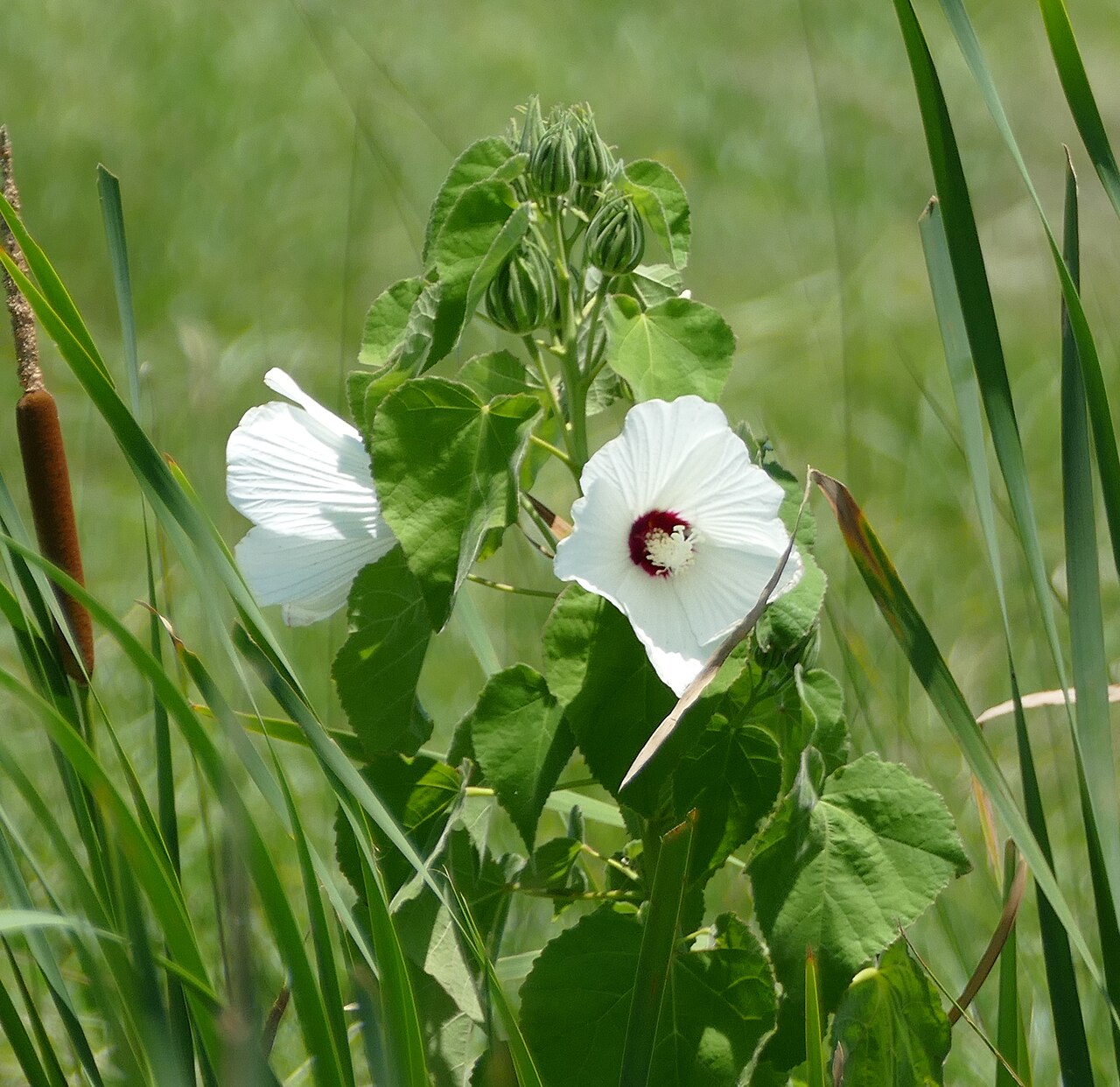
Hibiscus lasiocarpos, known as Woolly Rosemallow or hairy-fruited hibiscus, is a large, shrubby perennial of the mallow family (Malvaceae) that grows in marshes, sloughs, ditches and along rivers in the south-central United States, with a separate population in the Central Valley of California. From early summer into fall it opens huge white flowers, often 4 to 6 inches across, each with a deep crimson eye. The whole plant is covered in soft, star-shaped hairs that make its leaves feel velvety and look gray-green.
It is a close relative of eastern rosemallow (Hibiscus moscheutos), and many botanists treat it as a subspecies or variety of that species. USDA PLANTS keeps it as a separate species, Hibiscus lasiocarpos, and that is the name used here. The main differences are the dense, velvety hairs on both sides of the leaves and the hairy seed capsules; the species name lasiocarpos means “woolly fruit.” A 2025 study moved the native rosemallows to the genus Muenchhusia, so you may also see it listed as Muenchhusia moscheutos subsp. lasiocarpos.
Woolly rosemallow is a spectacular plant for rain gardens, pond edges and other wet, sunny places. It dies back to the ground each winter and returns from a woody crown in late spring. In California, the native population (var. occidentalis) is rare; buy nursery-propagated plants and never dig wild plants.
Identification
Look for a tall, bushy, gray-green perennial in wet ground with soft, velvety, heart-shaped leaves and very large white flowers with a dark red center.
Growth Habit
Plants are herbaceous perennials that grow from a woody crown and send up several stout, erect to leaning stems each year, forming a clump 3 to 7 feet tall and 2 to 4 feet wide. The stems, leaves, flower stalks and calyx are covered with dense, soft, star-shaped (stellate) hairs. Plants die back to the crown after frost.
Leaves
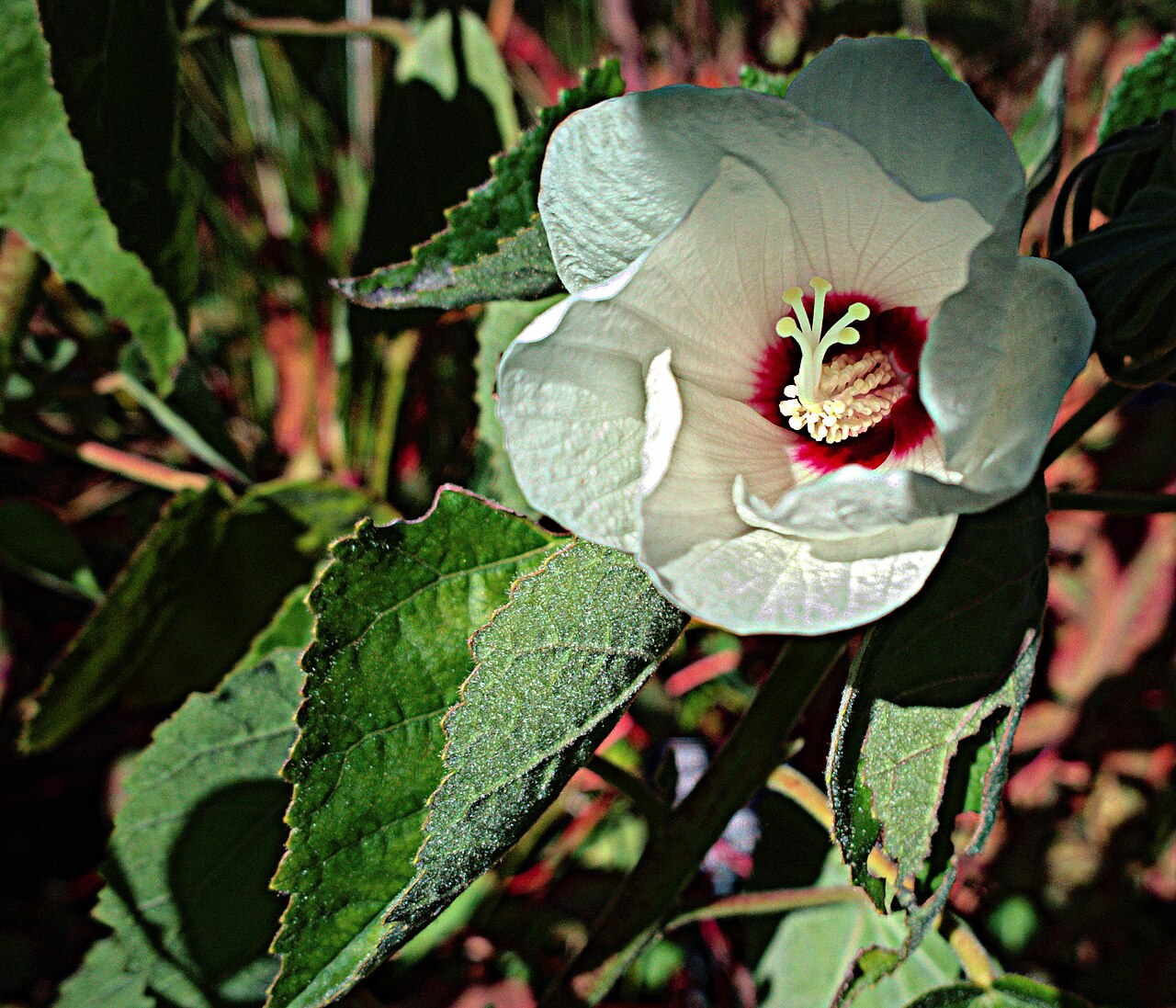
The leaves are alternate, 3 to 6 inches long, broadly oval to heart-shaped, with a pointed tip and toothed edges, and sometimes have two shallow side lobes. They are densely hairy on both surfaces, so they feel like felt and look grayish green. Eastern rosemallow leaves are usually smooth or nearly so on the upper surface.
Flowers
The flowers are borne singly in the upper leaf axils from about June to September, sometimes into October. Each flower is 4 to 6 inches (occasionally more) across, with five broad, overlapping petals that are usually white, sometimes pale pink, with a large crimson to maroon blotch at the base. A long column of fused stamens with cream to white anthers rises from the center. Below the green, hairy calyx is a ring of narrow bracts. Each flower lasts about a day.
Fruit & Seeds
The fruit is an oval capsule about 1 inch long with a short beak, densely covered in long hairs, which gives the species its name. It splits into five sections in fall to release smooth, rounded brown seeds.
Look-alikes
Eastern rosemallow has leaves that are hairy only beneath and smooth capsules; it is more common in the East and along the Atlantic and Gulf coasts. Scarlet rosemallow (H. coccineus) has deeply cut, palmately divided leaves and red flowers. Halberd-leaf rosemallow (H. laevis) has smooth, arrowhead-shaped leaves and pink flowers. Seashore mallow (Kosteletzkya pentacarpos) is smaller, with pink flowers about 2 inches across.
Quick Facts
| Scientific Name | Hibiscus lasiocarpos (syn. H. moscheutos subsp. lasiocarpos) |
| Family | Malvaceae (mallow family) |
| Plant Type | Herbaceous perennial, shrub-like |
| Mature Height | 3–7 ft |
| Mature Spread | 2–4 ft |
| Growth Rate | Fast |
| Sun Exposure | Full sun to part shade |
| Water Needs | High; wet to moist soil |
| Soil Type | Clay, loam or silty, wet to moist |
| Soil pH | Slightly acidic to alkaline (about 6.0–8.0) |
| Bloom Time | June–September |
| Flower Color | White (sometimes pink) with a crimson eye |
| Fall Color | Yellowish; dies back to the ground |
| Fruit | Hairy, beaked capsule about 1 in long |
| Deer Resistant | Low; deer and rabbits browse young shoots |
| USDA Hardiness Zones | 5–9 |
Native Range
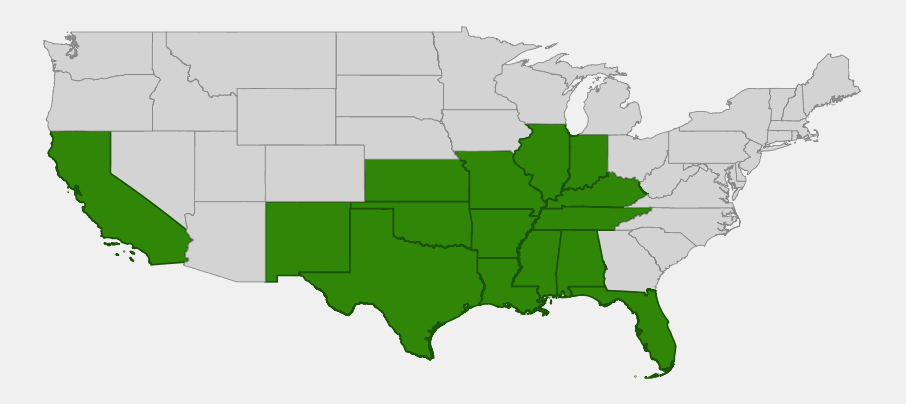
Woolly rosemallow is native to the south-central United States, northeastern Mexico and California. USDA PLANTS lists it as native in Alabama, Arkansas, California, Florida, Illinois, Indiana, Kansas, Kentucky, Louisiana, Mississippi, Missouri, New Mexico, Oklahoma, Tennessee and Texas. It is most common in the lower Mississippi Valley and the western Gulf Coastal Plain, especially in Arkansas, Louisiana, Missouri, southern Illinois, western Tennessee, eastern Oklahoma and eastern and central Texas.
It reaches westward along rivers onto the Edwards Plateau and the Concho River country of west-central Texas. Records from Alabama, Florida, Indiana, Kansas, Kentucky and New Mexico are few and scattered and lie at the edges of its range. In California, the variety occidentalis, often called Delta rose-mallow, grows in freshwater marshes and along sloughs and rivers of the Sacramento Valley and the Sacramento-San Joaquin Delta. It is listed by the California Native Plant Society as rare (List 1B.2).
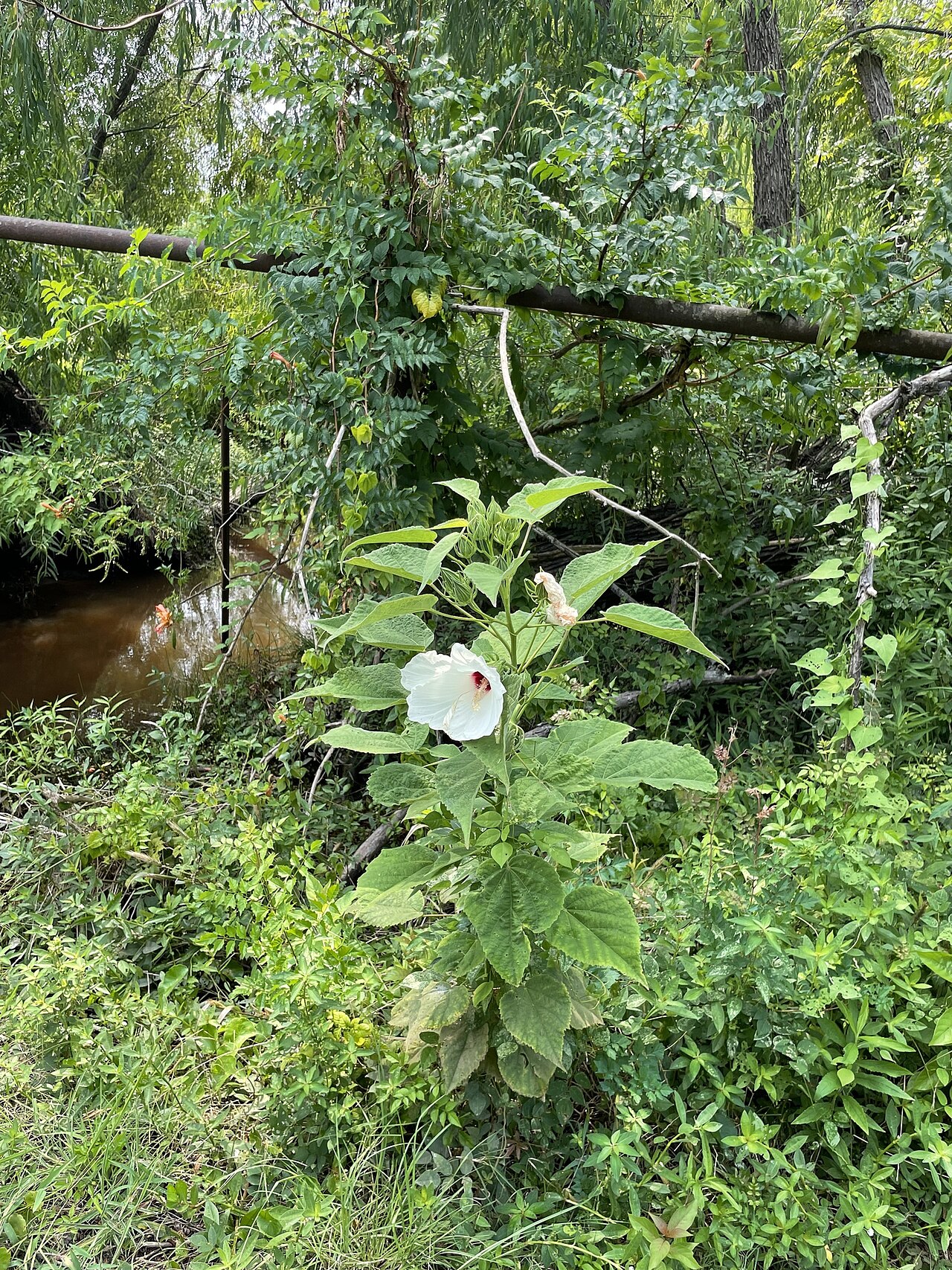
Typical habitats are freshwater marshes, swamp edges, sloughs, oxbow lakes, wet ditches, river and creek banks, wet prairies and farm ponds, mostly at low elevations. It grows in full sun or light shade in soil that stays wet for much of the growing season, and it tolerates periodic flooding.
📋 Regional plant lists featuring Woolly Rosemallow: Ohio & Indiana · Kentucky & Tennessee · Nebraska, Kansas & Eastern Colorado · Illinois, Iowa & Missouri · Alabama, Georgia & Mississippi · North & South Florida · Arkansas, Louisiana, Eastern Oklahoma & Eastern Texas · South & West Texas · California & Nevada
Growing & Care Guide
Woolly rosemallow is easy to grow if it has sun, rich soil and plenty of water. It is late to emerge in spring, then grows quickly into a bushy plant that blooms for weeks in the heat of summer.
Light
Full sun gives the most flowers and the sturdiest stems. It tolerates light shade, especially in hot climates, but blooms less and may lean toward the light.
Soil & Water
Plant in moist to wet, fertile soil. Clay and silty soils are fine. It grows well at pond edges, in rain gardens, in low spots that hold water and in large containers set in shallow water. In ordinary garden beds it needs regular deep watering in summer; it wilts quickly in dry soil.
Planting Tips
Plant in spring after the soil warms. Space plants 3 to 4 feet apart. Mark the location, because the crowns do not show new shoots until late spring, and it is easy to dig into them by mistake. Combine with other wetland plants such as swamp milkweed, blue flag iris and sedges.
Pruning & Maintenance
Cut the dead stems to a few inches above the ground in late fall or early spring. Watch for hibiscus sawfly larvae, which can skeletonize the leaves in summer; healthy plants usually recover. Japanese beetles also feed on the flowers in some areas.
Propagation
It grows easily from seed. Nick or soak the hard seed coat before sowing in spring, or sow outdoors in fall. Seedlings often bloom in their second year. Mature clumps can be divided in early spring, and softwood cuttings root in summer.
Landscape Uses
- Rain gardens: thrives in wet, sunny low spots
- Pond and stream edges: large summer flowers along the water
- Wetland restoration: a showy native for marsh and ditch plantings
- Pollinator gardens: attracts specialist bees and hummingbirds
- Specimen plant: bold texture and huge flowers in late summer
Wildlife & Ecological Value
Woolly rosemallow supports a variety of insects and other wildlife in the marshes and wet places where it grows.
For Pollinators
The big flowers are visited by bumblebees, the rose-mallow bee (Ptilothrix bombiformis), a specialist that collects pollen mainly from native hibiscus, and other bees. Hummingbirds occasionally visit for nectar. The leaves feed the caterpillars of the gray hairstreak and painted lady butterflies and several moths.
For Birds
Ducks, quail and other birds eat the seeds, and the dense clumps provide cover for marsh birds such as wrens and red-winged blackbirds.
For Mammals
Deer and rabbits browse the young shoots. Muskrats and other marsh mammals use the clumps as cover.
Ecosystem Role
Its deep, woody crown and roots help stabilize stream banks and pond edges, and its tolerance of flooding makes it a useful plant in wetland and riparian restoration.
Cultural & Historical Uses
Woolly rosemallow was first described by the Spanish botanist Antonio José Cavanilles in 1787. Botanists have long debated whether it is a separate species or part of eastern rosemallow; the two hybridize where they meet, and many floras combine them. In 2025, researchers moved the native rosemallows from Hibiscus to the revived genus Muenchhusia, but most gardeners and nurseries still use Hibiscus.
Native rosemallows, including this species, were used in breeding the popular hardy hibiscus hybrids sold in garden centers, which have dinner-plate-sized flowers in white, pink and red. The wild species are more graceful and better adapted to wet native gardens.
Like other members of the mallow family, the leaves and roots of rosemallows contain mucilage. Indigenous peoples and settlers used related plants as soothing remedies, but this should not be tried at home. The plant is not known to be toxic.
Frequently Asked Questions
Is woolly rosemallow the same as eastern rosemallow?
They are very closely related, and many botanists treat woolly rosemallow as a subspecies of eastern rosemallow. USDA keeps them separate. Woolly rosemallow has velvety hairs on both leaf surfaces and hairy seed capsules.
Does woolly rosemallow need standing water?
No, but it needs consistently moist to wet soil. It grows well in garden beds with regular watering, and it can also grow in shallow water at pond edges.
Why has my woolly rosemallow not come up in spring?
It is one of the last perennials to emerge, often in late spring after the soil warms. Be patient and mark the location so you do not damage the crown.
Is woolly rosemallow native to California?
Yes. A distinct population, variety occidentalis (Delta rose-mallow), grows in the Sacramento Valley and the Sacramento-San Joaquin Delta. It is rare and listed by the California Native Plant Society.
Do hummingbirds visit woolly rosemallow?
Occasionally, but its main visitors are bumblebees and specialist rose-mallow bees.

Looking for a nursery that carries Woolly Rosemallow?
Browse our native plant nursery directory: Alabama & Arkansas · California · Florida · Illinois, Indiana & Kansas · Kentucky, Louisiana, Mississippi & Missouri · New Mexico & Oklahoma · Tennessee & Texas

