
Celandine Poppy (Stylophorum diphyllum)
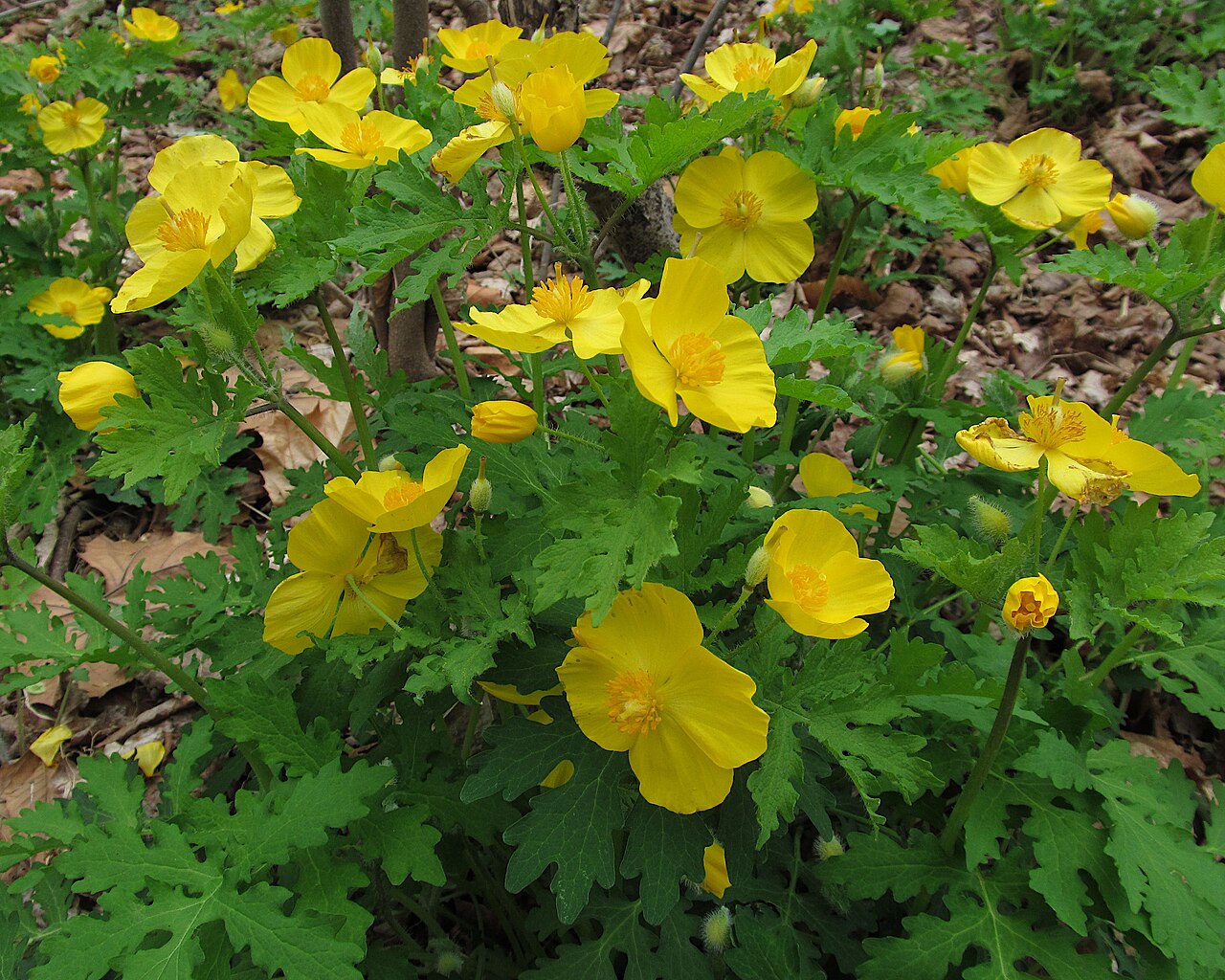
Stylophorum diphyllum, known as Celandine Poppy, Wood Poppy, or Yellow Wood Poppy, is one of the brightest native wildflowers of the rich, moist woods of the Ohio Valley and the southern Appalachian foothills. Each spring a clump of deeply cut blue-green leaves pushes up a stack of buttercup-yellow, two-inch poppies, sometimes with a hint of orange, and a well-established colony can flower for weeks. It belongs to the poppy family (Papaveraceae), and like its relatives it bleeds a bright yellow-orange latex when a stem is broken.
For gardeners in the Deep South it is a plant with a precise address. Celandine Poppy is native to northern Alabama and northwestern Georgia, where it occurs in rich coves, ravine bottoms, and the toe slopes of bluffs. It is not native to Mississippi. It appears on the shared Alabama, Georgia and Mississippi regional list because it is a dependable, well-behaved shade perennial for the region, but Mississippi gardeners should treat it as a garden-worthy plant from the neighboring Interior Low Plateau rather than a local native, and the Native Range section below says exactly where it belongs and suggests true Mississippi natives to grow beside it.
It is also a plant with a summer schedule. Celandine Poppy is a spring ephemeral in spirit, if not in strict botany: it leafs out early, blooms from late winter into spring, sets seed by midsummer, and in a dry Southern July the foliage will yellow and fade. Plant it where that graceful retreat is hidden by ferns and other woodland companions, keep the soil consistently moist through spring, and you will be rewarded with one of the most cheerful shade plants in the Southeast, one that even seeds itself around politely by enlisting ants.
Identification
Celandine Poppy is a clump-forming herbaceous perennial that grows from a thick, woody crown (caudex) and stout, fleshy roots that spread slowly as rhizomes. The foliage forms a low, loose mound, and the flowering stems rise to roughly 12 to 20 inches in typical woodland conditions and can stretch to about two feet in deep, rich, consistently moist garden soil. A mature clump spreads about a foot across and widens gradually over the years. Every green part of the plant exudes a yellow to orange sap when cut or broken, which is the quickest field mark for separating it from look-alikes and can stain skin and clothing.
Leaves
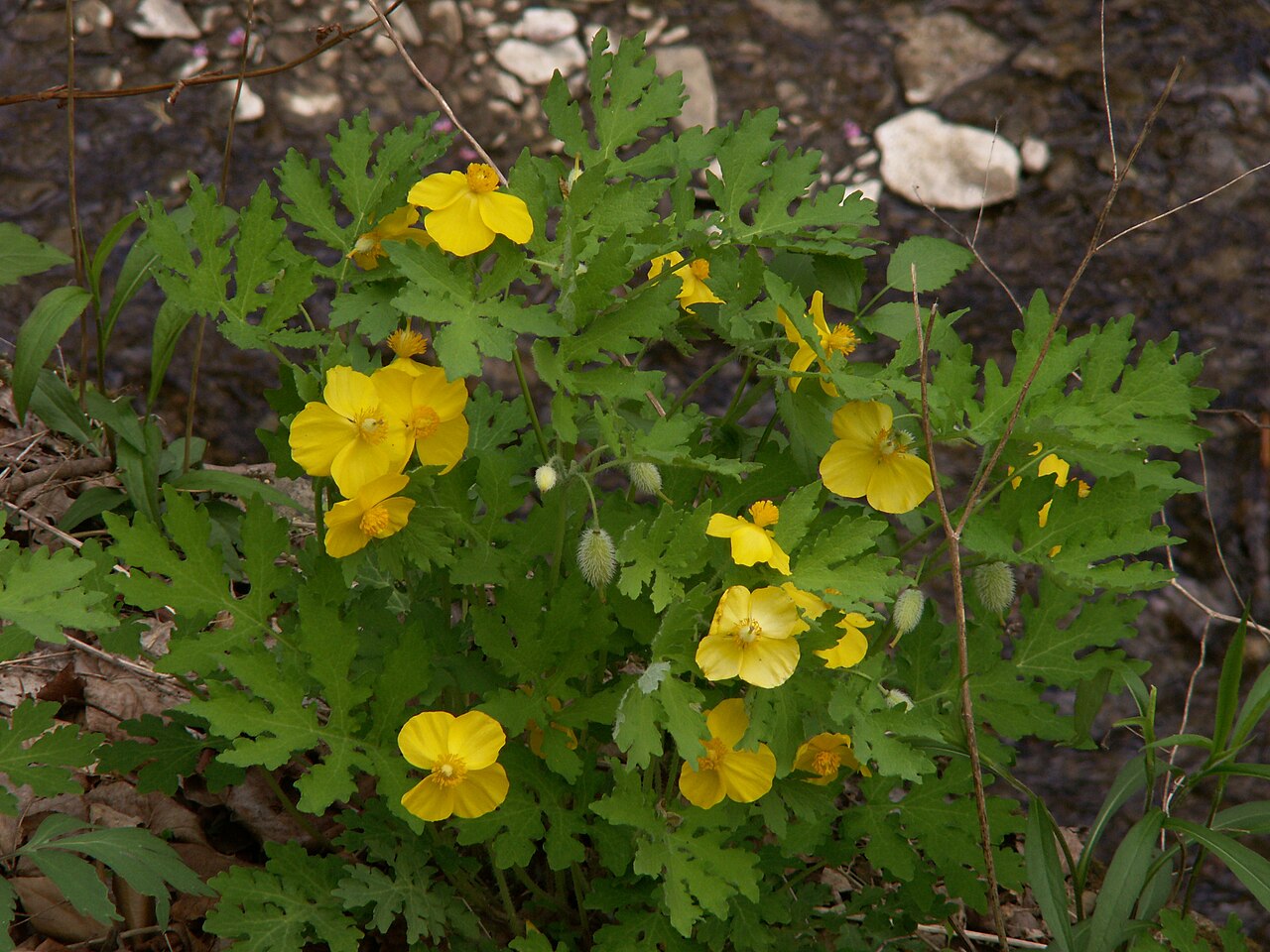
The basal leaves are pinnately divided, dark blue-green above and paler, silvery, and finely hairy beneath, carried on long, conspicuously hairy leaf stalks. Each leaf has two to three pairs of deep primary lobes, and those lobes are in turn shallowly scalloped or toothed, giving the foliage a bold, oak-leaf texture that contrasts nicely with the fine fronds of ferns and the broad leaves of hostas or mayapples. The name diphyllum means “two-leaved” and refers to the pair of opposite leaves that sit directly below the flower cluster on each flowering stem. In the wild the clumps put up fresh leaves in late winter, often before the trees overhead have leafed out.
Flowers
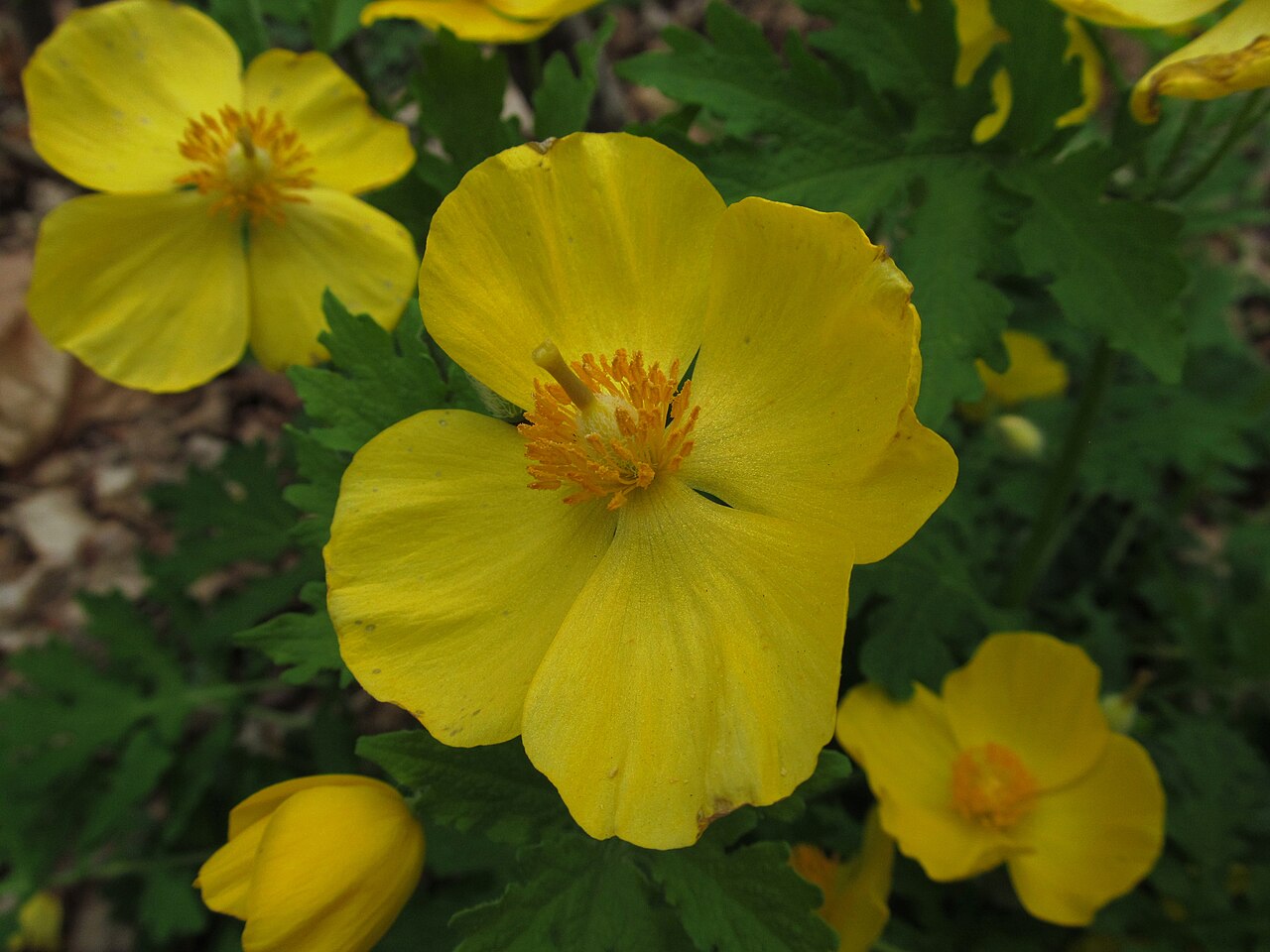
The flowers are the reason to grow the plant. They are one to two inches across, with four broad yellow petals, a boss of many yellow-orange stamens, and a single knobby stigma held on a slender column, a feature reflected in the genus name (Stylophorum, roughly “style-bearer”). The two small hairy sepals drop as each bud opens. Flowers are borne singly or in loose clusters of two to four at the top of the stem, between the pair of stem leaves, and they open a few at a time so that a clump stays in bloom for weeks. The blossoms produce pollen but no nectar, and the bristly, hairy buds are nearly as distinctive as the open blooms.
Fruit & Seeds
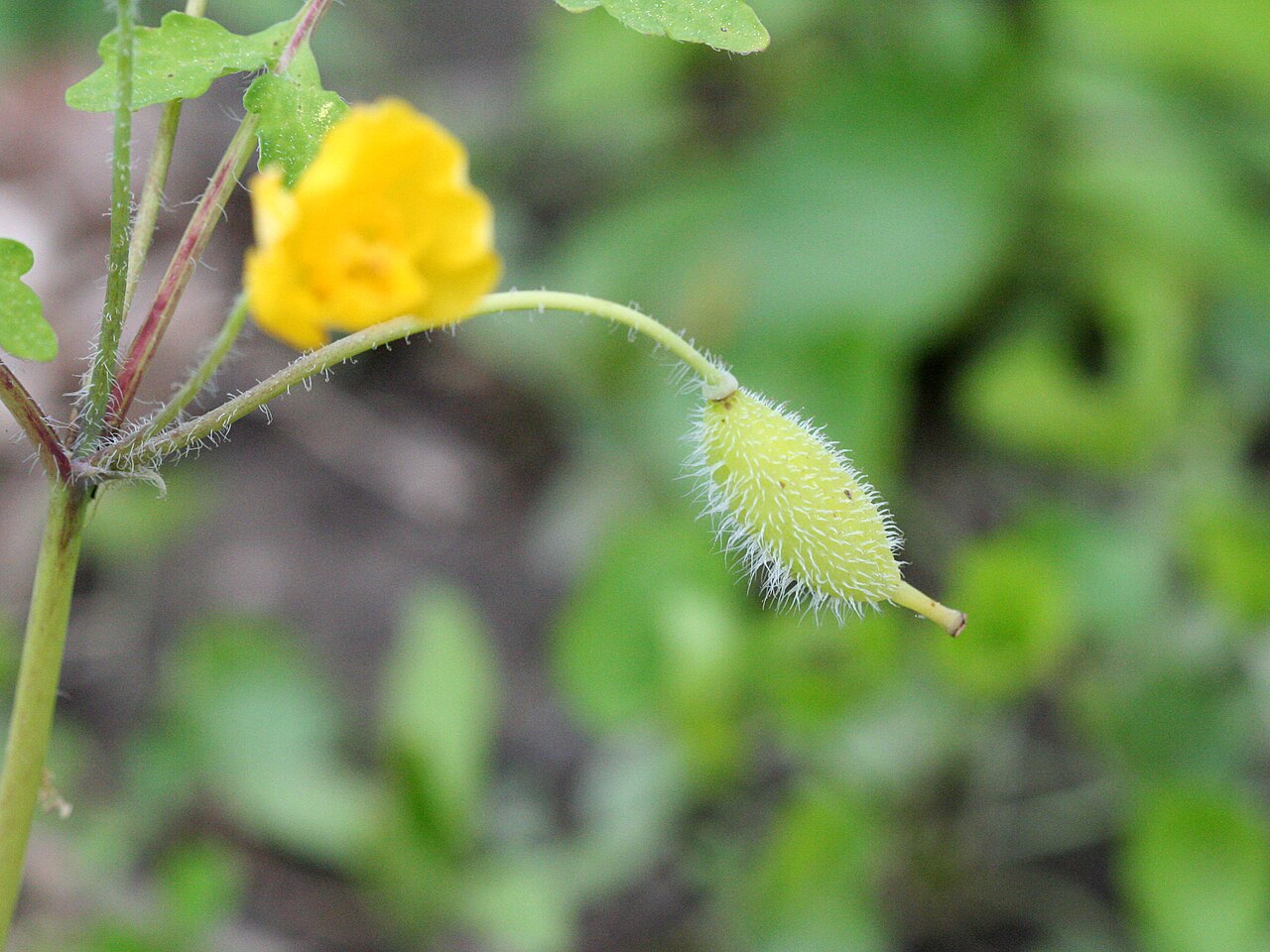
Pollinated flowers give way to a pendant, bristly, ovoid capsule about an inch long that is blue-green when young. By midsummer the capsule splits open along four flaps to release shiny dark brown to black seeds, each carrying a fleshy white appendage called an elaiosome. Ants carry the seeds off to their nests to eat the elaiosomes and discard the intact seeds in nutrient-rich refuse piles, which is why seedlings so often appear a few feet from the parent clump and why the plant turns up in tidy colonies rather than in a scattered ring.
Quick Facts
| Scientific Name | Stylophorum diphyllum (Michx.) Nutt. |
| Family | Papaveraceae (Poppy) |
| Plant Type | Herbaceous perennial wildflower (rhizomatous, clump-forming) |
| Mature Height | 16–24 in (flowering stems often 12–20 in in the wild) |
| Mature Spread | 12–18 in, slowly widening clumps |
| Growth Rate | Slow to moderate; clumps thicken over several seasons |
| Sun Exposure | Shade to part shade (early-spring sun, dappled shade later) |
| Water Needs | Average; consistent moisture through spring, goes dormant if summer soil dries out |
| Soil Type | Rich, humus-heavy, moist but well-drained loam; tolerates limestone soils |
| Soil pH | 5.5–7.5 (acidic to mildly alkaline) |
| Bloom Time | March – May in the Deep South; can rebloom lightly if deadheaded |
| Flower Color | Bright yellow to yellow-orange |
| Fall Color | None significant; foliage yellows and fades in summer drought |
| Fruit | Hanging, bristly, ovoid capsule (about 1 in) with ant-dispersed seeds |
| Deer Resistant | Yes (toxic latex; generally avoided by deer) |
| USDA Hardiness Zones | 4–9 |
Native Range
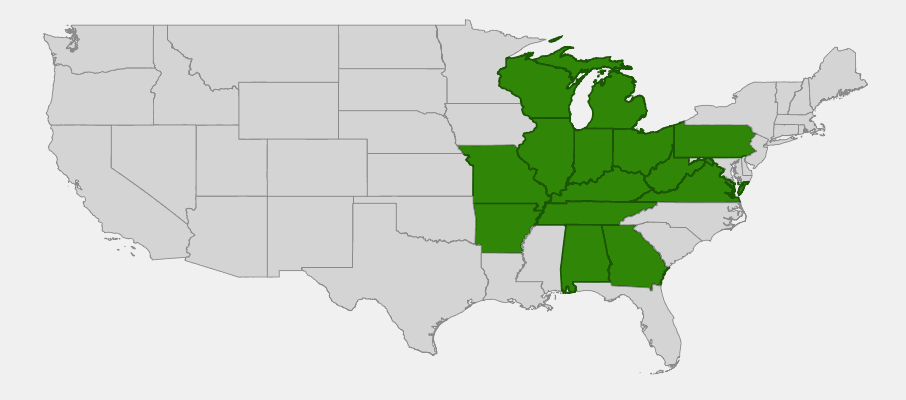
Celandine Poppy is a plant of the eastern interior. Its natural range runs from western Pennsylvania north to Wisconsin and Michigan and south through the Ohio Valley and Interior Low Plateau to southwestern Virginia, Tennessee, and Arkansas, with outlying populations in southern Ontario and in the Southeast in northern Alabama and northern Georgia. The Lady Bird Johnson Wildflower Center describes the range as “W. PA (possibly) n. to WI and MI, s. to s.w. VA, TN and AR, with isolated populations in southern Ontario and northern AL,” and the USDA Plants Database lists the species as native in both Alabama and Georgia. Georgia is confirmed by the USDA list, the Wildflower Center, university extension sources, and field records from Walker County (Pigeon Mountain) in the northwestern corner of the state.
Mississippi is outside the native range. The species does not appear on the USDA or Lady Bird Johnson state lists for Mississippi, and county-level mapping from the Biota of North America Program shows no native occurrence there. If you garden in Mississippi, Celandine Poppy is a fine, well-behaved introduction for a rich, shaded, moist site, but it is not a local native and is not part of Mississippi’s natural plant communities. For true Mississippi natives that fill the same spring-color niche, consider Eastern Red Columbine (Aquilegia canadensis), which thrives in part shade to shade and is documented as native in Mississippi, and Golden Alexanders (Zizia aurea) for yellow spring flowers in moist part-shade to sunny sites; both are listed as native in Mississippi by the Wildflower Center. Note also that Celandine Poppy has naturalized outside its native range: North Carolina State Extension describes it as not native there but readily escaping in the mountains and Piedmont.
In its natural habitat the plant is a species of rich, moist deciduous woods, typically open woods at the base of limestone bluffs, along streams, and in ravine bottoms where the soil stays cool, deep, and full of leaf mold. NatureServe ranks it globally secure, but it is somewhat uncommon and spottily distributed throughout its range. It is listed as endangered in Ontario, and its habitat is under pressure from forest clearance, from selective logging that opens the canopy too far, and from invasive garlic mustard. That is a strong reason to buy nursery-propagated plants and never to dig wild colonies.
📋 Regional plant lists featuring Celandine Poppy: Alabama, Georgia & Mississippi · Illinois, Iowa & Missouri
Growing & Care Guide
Celandine Poppy is easy to grow once its two simple demands are met: rich, moist soil in spring and shade from the summer sun. It is long-lived, not aggressive, and rarely troubled by pests or disease, which makes it one of the most rewarding native perennials for the shady, leaf-littered corners of Alabama and Georgia gardens.
Light
Give it shade to part shade. The ideal site mimics a deciduous woodland: bright, direct light in late winter and early spring while the tree canopy is bare, then dappled or high shade once the trees leaf out. Under evergreen canopy, with no early-spring light, plants flower sparingly, while in full sun the foliage scorches and the plant retreats early in summer. In the warmer parts of Alabama and Georgia, favor a site that gets morning light and is shaded from the afternoon sun, such as the east side of a house, the north-facing edge of a woodland bed, or the shade of a large deciduous tree.
Soil & Water
Plant Celandine Poppy in deep, humus-rich, moist but well-drained loam. It grows naturally over limestone and tolerates alkaline soils, yet it does equally well in acidic woodland soil as long as the organic matter is generous, so the red clays of the Piedmont and the thin limestone soils of the Ridge and Valley are both workable if you dig in leaf mold or compost. Mulch with two to three inches of shredded leaves each fall. Keep the soil evenly moist from bud break through seed set. Once established, plants are moderately drought tolerant, but in a dry summer the foliage will yellow and the plant will go dormant, returning the following spring, a habit the Lady Bird Johnson Wildflower Center notes as well. A modest weekly soaking in a dry spell keeps the leaves fresh much longer.
Planting Tips
Set container plants in fall or very early spring, with the crown at soil level, and water them in well. Space plants 12 to 18 inches apart for a colony, and allow for a few volunteers. Plants may take a year or two to settle in and are slow to reach full size, so resist the urge to divide them early. Choose a site where the summer fade is masked by neighbors: Christmas Fern (Polystichum acrostichoides), Lady Fern (Athyrium filix-femina), and Wild Geranium (Geranium maculatum) all fill in as the poppy declines. Wear gloves when handling stems, since the sap can stain skin and irritate sensitive people.
Pruning & Maintenance
Maintenance is minimal. Deadhead spent flowers if you do not want seedlings, and cut the flowering stems back after bloom to encourage a scattering of repeat flowers into summer, especially if the soil is kept moist. If the leaves brown in a dry summer, cut the plant back and mark the spot so you do not dig into the dormant crown. Watch for slugs on the emerging spring foliage; otherwise insects and disease are minor. Self-sown seedlings are easy to pull or transplant, so the plant never becomes a problem, and it is nothing like the invasive European celandines.
Propagation
Celandine Poppy grows readily from seed and from division. Fresh seed germinates best and must not be allowed to dry out; sow it in a shaded bed or flat as soon as the capsules split in early summer, or store it in a moist medium and give it a warm period followed by a cold period, which mimics the natural cycle. Seedlings are slow to reach flowering size. To divide, lift an established clump in spring, cut the thick rhizome into pieces with at least one to two growing points each, and replant at the same depth in moist soil, preferably on a cool, cloudy morning.
Landscape Uses
Celandine Poppy earns its place in many shaded settings:
- Woodland wildflower gardens paired with ferns, Wild Ginger, Bloodroot, and Foamflower
- Shady borders and paths where the early bright yellow blooms show against dark mulch
- Naturalizing in moist woodlands, ravine plantings, and along shaded stream and pond margins
- Rain gardens in shade, since it tolerates moist soils
- Texture contrast next to large-leaved plants such as hostas and mayapples
- Deer-pressured sites, because its latex makes it unpalatable
Wildlife & Ecological Value
Celandine Poppy is a modest but genuine contributor to the spring woodland. Its value lies in early bloom, seed dispersal partnerships, and a place in the rich-woods plant community rather than in showy wildlife spectacles.
For Pollinators
The flowers produce abundant pollen but no nectar, so they serve pollen-collecting insects, primarily small native bees and pollen-feeding flies, at a time of year when few flowers are open in the woods. Its early bloom in the Southeast, opening in March in many years, is its main pollinator value; a bright yellow patch in bloom at the base of a bluff can draw bees on the first warm days of spring.
For Birds
Celandine Poppy is not a bird plant in the way a berry-producing shrub is. Its indirect value comes from the leaf-litter invertebrate community that the rich-woods soils it grows in support, and from the insects that visit its flowers, both of which are a food supply for ground-foraging and nesting woodland birds in spring.
For Mammals
Chipmunks feed on the seeds, and gardeners who want more volunteers sometimes have to protect ripening capsules from them. The toxic latex keeps deer and other browsers away from the foliage, which is a practical advantage for gardens with heavy deer pressure.
Ecosystem Role
The seeds are dispersed by ants that are attracted to the white elaiosome, and in return the plant is planted by the ants in nutrient-rich sites. This kind of ant-plant partnership (myrmecochory) is a hallmark of eastern rich-woods wildflowers, many of which, including Bloodroot, Trilliums, and Dutchman’s Breeches, share it. Celandine Poppy typically grows with a community of spring-blooming herbs on rich, calcium-influenced soils: Blue Cohosh (Caulophyllum thalictroides), Dutchman’s Breeches (Dicentra cucullaria), Virginia Waterleaf (Hydrophyllum virginianum), and other species beneath Sugar Maple (Acer saccharum) and Yellow Buckeye (Aesculus flava). The health of those communities is threatened by garlic mustard, which is reported to suppress the regeneration of native woodland wildflowers, so growing Celandine Poppy in your own garden woods is a small way to keep the species alive and its partners connected.
Cultural & Historical Uses
The French botanist André Michaux, who explored the southern Appalachians in the late 1700s, described the species as Chelidonium diphyllum in 1803, placing it in the genus of the European Greater Celandine, whose bright yellow sap and lobed leaves it resembles. Thomas Nuttall later moved it into its own genus, Stylophorum, giving the plant the botanical name it carries today, Stylophorum diphyllum (Michx.) Nutt. The common name “celandine” ultimately derives from the Greek chelidon, meaning swallow, from an old European belief that swallows used the sap of Greater Celandine to restore the sight of their young.
The bright yellow to orange sap was used by Native Americans as a dye, and contact with it can stain hands and clothing to this day. The sap is mildly toxic and can irritate the skin of sensitive people, and the plant has no place in the kitchen or the herb cabinet. Its long-standing value is ornamental. It has become a favorite of eastern wildflower gardeners, and the Lady Bird Johnson Wildflower Center calls it “a fine species to grow in Eastern wildflower gardens, far less aggressive than the introduced European species.”
That last point deserves emphasis, because “celandine” is a confusing word in the garden. The invasive European species, Greater Celandine (Chelidonium majus), has smaller flowers, three-quarters of an inch or less, and slim, hairless, upright seed capsules, while Lesser Celandine (Ficaria verna) is a different, low-growing invader of woodland floors. Celandine Poppy has much larger flowers and hanging, bristly capsules, and it is a true native of eastern North American woods.
Frequently Asked Questions
Is Celandine Poppy native to Mississippi?
No. It is native to northern Alabama and northern Georgia, along with the Ohio Valley states and Tennessee, but not to Mississippi. It is a fine garden plant there for a rich, moist shady bed, but Mississippi gardeners who want a true native for similar conditions can grow Eastern Red Columbine or Golden Alexanders, both native to Mississippi.
Is it the same as the invasive celandine?
No. Greater Celandine (Chelidonium majus) and Lesser Celandine (Ficaria verna) are European invaders. Celandine Poppy has flowers one to two inches across and hanging, bristly, ovoid seed capsules; Greater Celandine has flowers of about three-quarters of an inch and slender, hairless capsules. Celandine Poppy self-sows but is easy to pull, and it does not take over a garden.
Why does my Celandine Poppy disappear in summer?
It goes dormant when the soil dries out or the weather gets hot, and the foliage yellows and fades. This is normal, not a sign of death. Keep the soil evenly moist to prolong the leaves, cut back tired foliage, mulch, and mark the spot; the plant returns the following spring.
Will it spread or self-seed?
It does both, gently. Seeds carry an elaiosome that attracts ants, which carry them a short distance away, so new plants pop up near the parent. Chipmunks may eat some of the seed. Unwanted seedlings are easy to remove, and deadheading prevents seed set.
Is it deer resistant and safe to handle?
It is generally left alone by deer because the latex is toxic. The sap is mildly toxic and can stain skin and irritate sensitive people, so wear gloves when dividing plants or cutting stems, and keep it out of the kitchen; it is an ornamental and not an edible or medicinal plant.

Looking for a nursery that carries Celandine Poppy?
Browse our native plant nursery directory: Alabama · Georgia · Mississippi