
Beach Pea (Lathyrus japonicus)
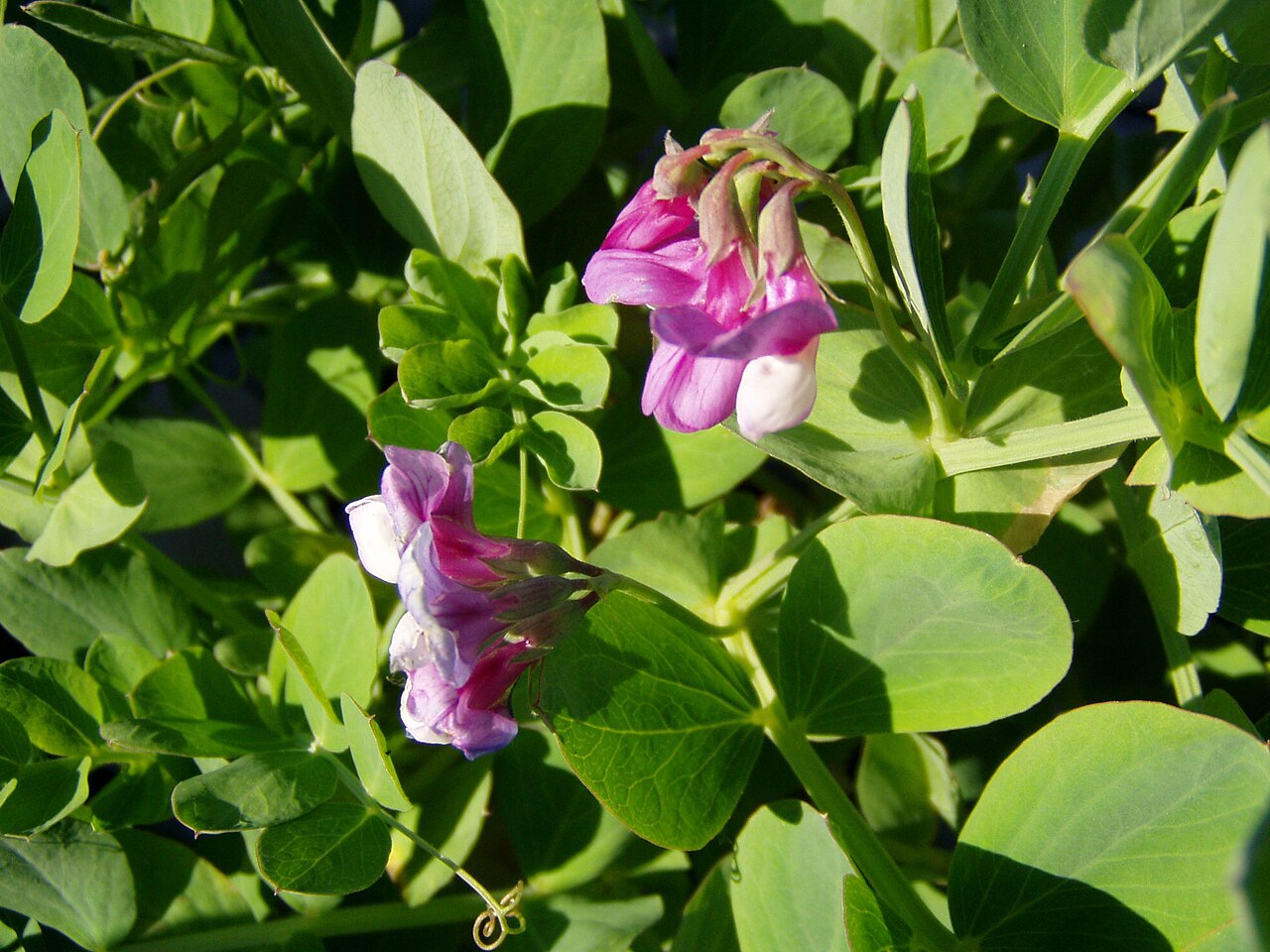
Lathyrus japonicus, known as Beach Pea, sea pea or sea vetchling, is a wild perennial pea of sandy and gravelly shores. It sends long, trailing stems across the upper beach and foredunes, covers them with fleshy blue-green leaves, and from June into August holds up clusters of pink-purple flowers that look like small sweet peas. It belongs to the legume family (Fabaceae), and like most legumes it carries nitrogen-fixing bacteria in its roots, which lets it grow in loose, nutrient-poor sand where few other flowering plants can.
Beach pea has one of the widest natural ranges of any North American wildflower. It grows on the Atlantic coast from Labrador to New Jersey, on the Pacific coast from Alaska to northern California, along the shores of the Great Lakes, and on the coasts of northern Europe and eastern Asia. The reason is its seed. The hard-coated peas float and can stay alive in seawater for years, so currents carry them from one beach to the next, and they sprout once waves and sand have scuffed the seed coat.
For gardeners near the coast or a big lake, beach pea is one of the best native plants for stabilizing sand. Its rhizomes knit the surface of dunes and gravel banks, it shrugs off salt spray and wind, and it flowers for weeks with almost no care. This guide covers how to recognize it, where it grows, how to establish it in a shoreline or sandy garden, and what it offers bees, butterflies and the dune community.
Identification
Beach pea is easy to recognize once you know where to look. On the upper beach it is usually the only plant with pinnate, pea-like leaves, tendrils and showy purple pea flowers. The best single feature is its very large, arrowhead-shaped stipules at the base of each leaf, which separate it from the vetches and from other wild peas.
Stems & Roots
Plants spread by long, branching rhizomes that run through the sand, sometimes for several feet, and send up new shoots along their length. The stems are angled but not winged, smooth or slightly hairy, and usually trail along the ground or lean on other plants. Individual stems are typically 1 to 2½ feet long. The leafy mats stand about 6 inches to 2 feet high, depending on how much support they have from beach grass and driftwood.
Leaves
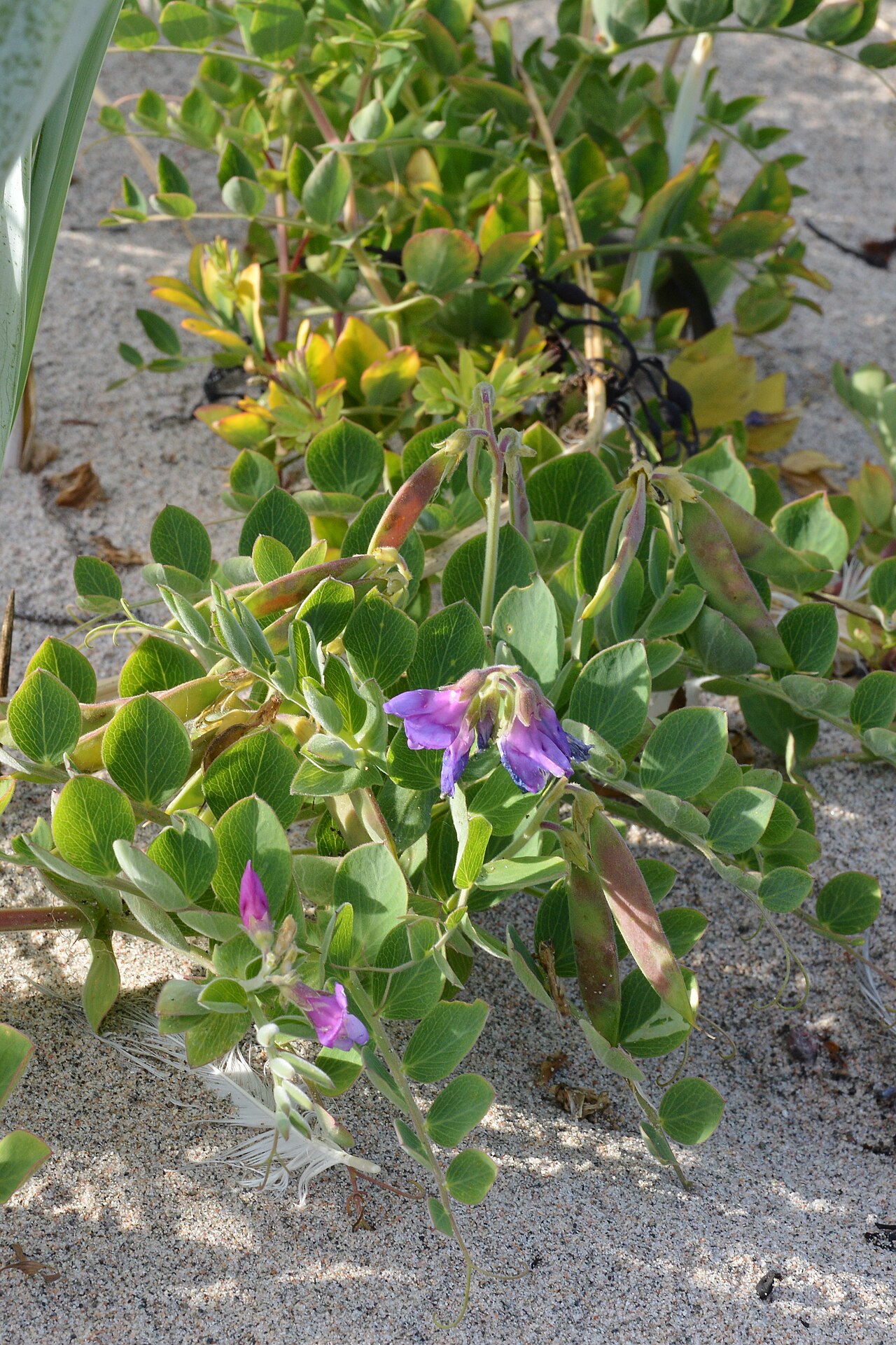
The leaves are alternate and pinnately compound, 2 to 4 inches long, with usually three to five pairs of oval to elliptic leaflets (sometimes two to six). The leaflets are thick, somewhat succulent and gray-green or blue-green with a waxy surface that sheds salt spray. The leaf ends in a branched tendril, which may grip neighboring grass stems. At the base of each leaf sit a pair of broad, arrowhead-shaped stipules, often nearly as large as the leaflets themselves.
Flowers
Flowers are borne on long stalks in loose clusters of about 3 to 12. Each flower is ¾ inch long or a little less, with the typical pea structure: a broad upright banner petal, two wing petals and a keel. The banner is usually deep purple to magenta, the wings and keel paler lilac. As flowers age they fade toward blue. Bloom starts in June and continues through July and August, often with flowers, young pods and ripe pods on the same plant.
Fruit & Seeds
The fruit is a flattened pod 1½ to 2½ inches long, green at first and turning brown and leathery when ripe. Each pod holds several round, hard seeds that look like small garden peas. When the pod dries it twists open and drops the seeds onto the sand, where they may be buried or washed away by storm tides. The seeds are the plant’s long-distance travelers and germinate best after their coat is nicked or worn.
Quick Facts
| Scientific Name | Lathyrus japonicus (syn. L. maritimus, L. japonicus var. maritimus) |
| Family | Fabaceae (pea or legume family) |
| Plant Type | Herbaceous perennial; trailing, rhizomatous vine |
| Mature Height | 6 in–2 ft (trailing stems 1–2½ ft long) |
| Mature Spread | 3–6 ft or more; spreads by rhizomes into broad patches |
| Growth Rate | Moderate to fast once established |
| Sun Exposure | Full sun |
| Water Needs | Low to moderate; good drought tolerance in deep sand once rooted |
| Soil Type | Sand, gravel and cobble beaches; very well-drained, low-fertility soils |
| Soil pH | About 6.0–8.0; tolerates limy and shell-rich sands |
| Bloom Time | June–August |
| Flower Color | Purple to pink-purple, fading bluish |
| Fall Color | None of note; foliage yellows and dies back in late fall |
| Fruit | Flat brown pod 1½–2½ in long with hard, pea-like seeds |
| Deer Resistant | Low; deer and rabbits browse foliage and pods |
| USDA Hardiness Zones | 2–8 |
Native Range
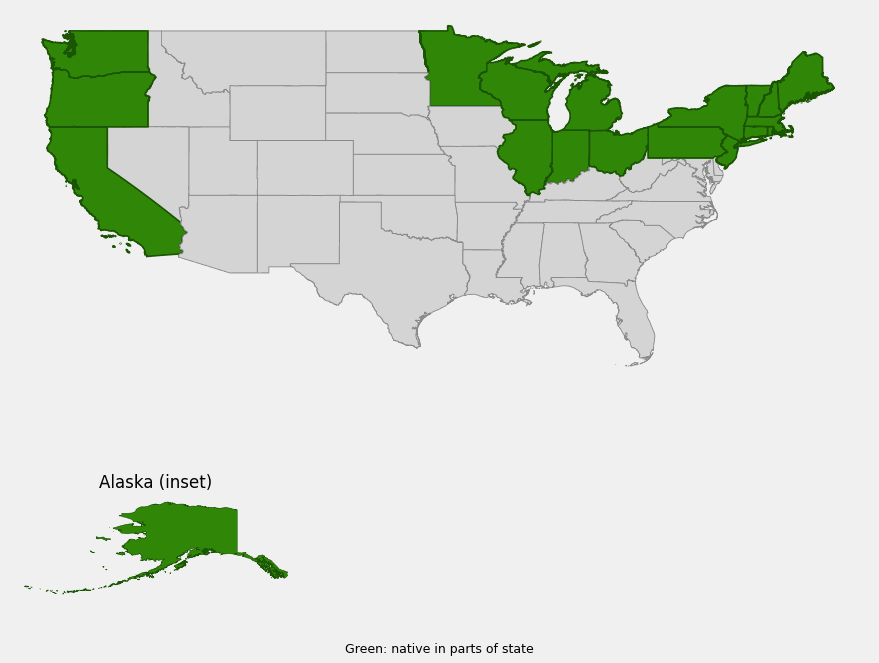
Beach pea is circumboreal, native to temperate and subarctic coasts across North America, Europe and Asia. In North America the Lady Bird Johnson Wildflower Center and USDA PLANTS record it on the Atlantic coast from Labrador and Newfoundland south through the Maritime provinces and New England to New Jersey, along the Pacific coast from Alaska through British Columbia, Washington and Oregon into northern California, and inland along the shores of the Great Lakes. In the United States it is native to Alaska, California, Connecticut, Illinois, Indiana, Maine, Massachusetts, Michigan, Minnesota, New Hampshire, New Jersey, New York, Ohio, Oregon, Pennsylvania, Rhode Island, Vermont, Washington and Wisconsin.
Within those states it is a strictly shoreline plant. It is common on the beaches of Maine, Massachusetts and Long Island and on the gravel and sand shores of Lake Superior and Lake Michigan. It becomes scarce toward the southern ends of its range, on the New Jersey coast, in northern California and on the shores of Lake Erie, where beaches are heavily used or have been armored with seawalls. The Great Lakes populations, far from salt water, are a reminder of the post-glacial seas and lakes whose shores the species followed inland.
Botanists recognize several varieties. The common North American plant is var. maritimus, which has hairless or nearly hairless leaves. Var. pellitus, with softly hairy foliage, also occurs on northeastern coasts, and some Great Lakes and Hudson Bay plants with smaller flowers have been named var. parviflorus. In the garden and in the field they behave alike.
📋 Regional plant lists featuring Beach Pea: Alaska · Western Oregon & Western Washington · California & Nevada · Michigan, Wisconsin & Eastern Minnesota · Illinois, Iowa & Missouri · Ohio & Indiana · New York, Pennsylvania & Northern New Jersey · Delaware, Southern New Jersey & Long Island · Connecticut, Massachusetts & Rhode Island · New Hampshire, Maine & Vermont
Growing & Care Guide
Beach pea is a plant for sand, sun and wind. It is most at home in coastal and lakeshore gardens, dune restorations and sandy banks, but it also grows well inland in any sunny, very well-drained bed. What it will not tolerate is shade, heavy clay or soil that stays soggy.
Light
Plant beach pea in full sun. On the beach it grows in completely open sand, and in shade it becomes sparse and flowers poorly. A site with sea breeze and good air movement also helps keep the foliage free of mildew in humid summers.
Soil & Water
Use sand, gravelly sand or a sandy loam that drains instantly. Beach pea fixes its own nitrogen, so it needs no compost or fertilizer, and rich soil mainly encourages weeds that crowd it. Water new plantings regularly through their first summer. Once the rhizomes are established, they reach moisture deep in the sand and the plant handles drought, salt spray and occasional overwash well. In a garden bed, water only during long dry spells.
Planting Tips
Set out container plants in spring, 1½ to 2 feet apart, or sow seed in late fall or spring. The seed coat is very hard, so nick each seed with a file or rub it on sandpaper, then soak it overnight before sowing ½ to 1 inch deep. Untreated seed can sit in the soil for months before sprouting. On dunes, plant among beach grass rather than in bare blowing sand, so that young plants are not buried or blasted before they root. Avoid trampling new plantings; pathways and boardwalks protect both the pea and the dune.
Pruning & Maintenance
Little is needed. Pull weeds while the plants fill in, and cut back dead stems in late fall or early spring if you want a neat look; on a dune it is better to leave them, since dead stems trap blowing sand. Plants may get powdery mildew in late summer in sheltered, humid gardens. It is mostly cosmetic. If beach pea spreads farther than you want in a small garden, simply pull the runners.
Propagation
Grow beach pea from scarified seed, or divide established clumps in early spring by cutting sections of rhizome with a shoot attached. Collect pods when they turn brown but before they split, and dry them in a paper bag. Divisions transplant best when dormant or just breaking bud, and they need steady moisture until new roots form.
Landscape Uses
- Dune and shoreline stabilization: rhizomes bind loose sand on foredunes, gravel banks and lakeshore bluffs
- Coastal gardens: salt- and wind-tolerant groundcover for seaside cottages and beach houses
- Sandy slopes and banks: a flowering groundcover for dry, sunny, infertile ground inland
- Pollinator plantings: a long-blooming summer nectar source for bumblebees in exposed sites
- Restoration: used in beach and dune revegetation with beach grass and seaside goldenrod
Wildlife & Ecological Value
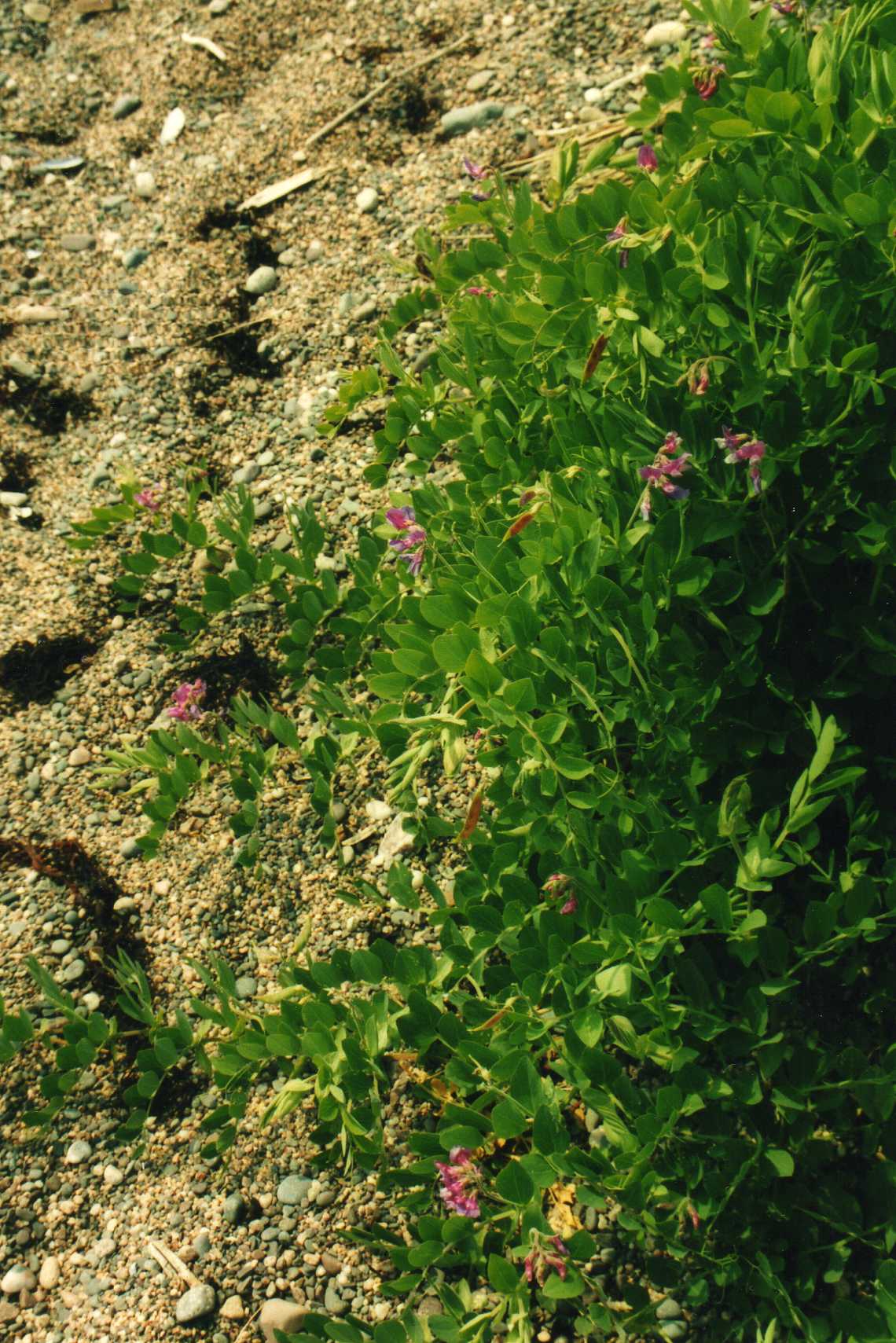
Beach pea is one of a small group of plants that can live on the upper beach, and it does a lot of ecological work there. By fixing nitrogen and trapping sand it helps build the low dunes that later support beach grass, shrubs and the animals that use them.
For Pollinators
Its flowers are adapted to strong bees. Bumblebees land on the keel, push it down with their weight and reach the nectar while pollen is dusted onto their undersides. Leafcutter bees and other medium-sized native bees also visit. Because beach pea blooms through the whole of summer on beaches where few other flowers grow, it is an important food source in coastal habitats. It is also a larval host plant for the eastern tailed-blue butterfly, whose caterpillars feed on the flowers and young pods of wild peas and vetches.
For Birds
Shorebirds and dune-nesting birds use beach pea mats for cover, and the ripening seeds are eaten by some seed-eating birds. More importantly, the plant helps build and stabilize the upper-beach and foredune habitat used by nesting birds along both coasts and the Great Lakes.
For Mammals
Deer, rabbits and hares graze the foliage and pods, and voles and other small mammals shelter under its mats. The seeds are eaten by mice and other rodents on the dunes.
Ecosystem Role
Beach pea is a pioneer of shifting sand. Root nodules containing Rhizobium bacteria convert nitrogen from the air into a form plants can use, enriching very poor beach sand. Its rhizomes and trailing stems slow wind, trap blown sand and start the small mounds that grow into dunes. Its floating seeds let it recolonize beaches after storms, which helps shorelines recover naturally.
Cultural & Historical Uses
The young peas and pods of beach pea are edible in small amounts and have long been eaten as a wild food on northern coasts. A well-known English story from 1555 tells how people at Orford in Suffolk survived a famine by gathering beach peas from the shingle, an event mentioned by the herbalist John Gerard in the 1590s. Most foragers today treat it only as an occasional nibble, because like many Lathyrus species its seeds contain compounds that can cause the nerve disease lathyrism if eaten in large quantities over a long period.
The scientific name has a confusing history. Carl Ludwig Willdenow named Lathyrus japonicus in 1802 from Japanese material, but for most of the twentieth century North American botanists called the plant Lathyrus maritimus, the name used by Linnaeus for European plants. Once it was clear that the coastal peas of Europe, Asia and North America are the same species, the older name L. japonicus took priority, even for plants on Cape Cod or Lake Superior. The leaves have also been used in traditional Chinese medicine.
In recent decades beach pea has become a valued restoration plant. Coastal managers along the Atlantic coast and on the Great Lakes include it in dune plantings alongside American beach grass, both because it holds sand and because its nitrogen helps the grasses grow. It is also a familiar summer flower for beachgoers, often the first wild pea many people learn.
Frequently Asked Questions
Are beach peas edible?
The young peas and pods are edible in small amounts and have been eaten as a wild food, but the seeds contain compounds that can cause lathyrism, a nerve disorder, if eaten in quantity over time. Treat them as an occasional taste, not a staple. Never collect from protected dunes or from plants growing near pollution.
How do I tell beach pea from vetch?
Beach pea has broad, fleshy blue-green leaflets, large arrowhead-shaped stipules and flowers about ¾ inch long in loose clusters. Vetches (Vicia) have many narrow leaflets, small stipules and usually smaller, more crowded flowers. Beach pea also grows almost only on beaches and lakeshores.
Will beach pea grow away from the coast?
Yes, if the soil is sandy or gravelly, drains fast and gets full sun. It does not need salt. It is most likely to struggle in heavy clay, in shade and in hot, humid inland gardens far south of its natural range.
Is beach pea invasive?
No. It is native across its North American range and spreads by rhizomes in loose sand. In a small, sandy garden bed it can spread widely, but it is easy to pull and does not invade woodland or heavy soils.
Why won’t my beach pea seeds sprout?
The seed coat is very hard and waterproof, an adaptation that lets the seeds float in seawater. Nick each seed with a file or sandpaper and soak it overnight before sowing, and most will germinate within a few weeks in warm soil.

Looking for a nursery that carries Beach Pea?
Browse our native plant nursery directory: Alaska · California · Connecticut · Illinois & Indiana · Maine, Massachusetts, Michigan & Minnesota · New Hampshire, New Jersey, New York & Ohio · Oregon · Pennsylvania, Rhode Island & Vermont · Washington · Wisconsin