
Catchfly Prairie Gentian (Eustoma exaltatum)
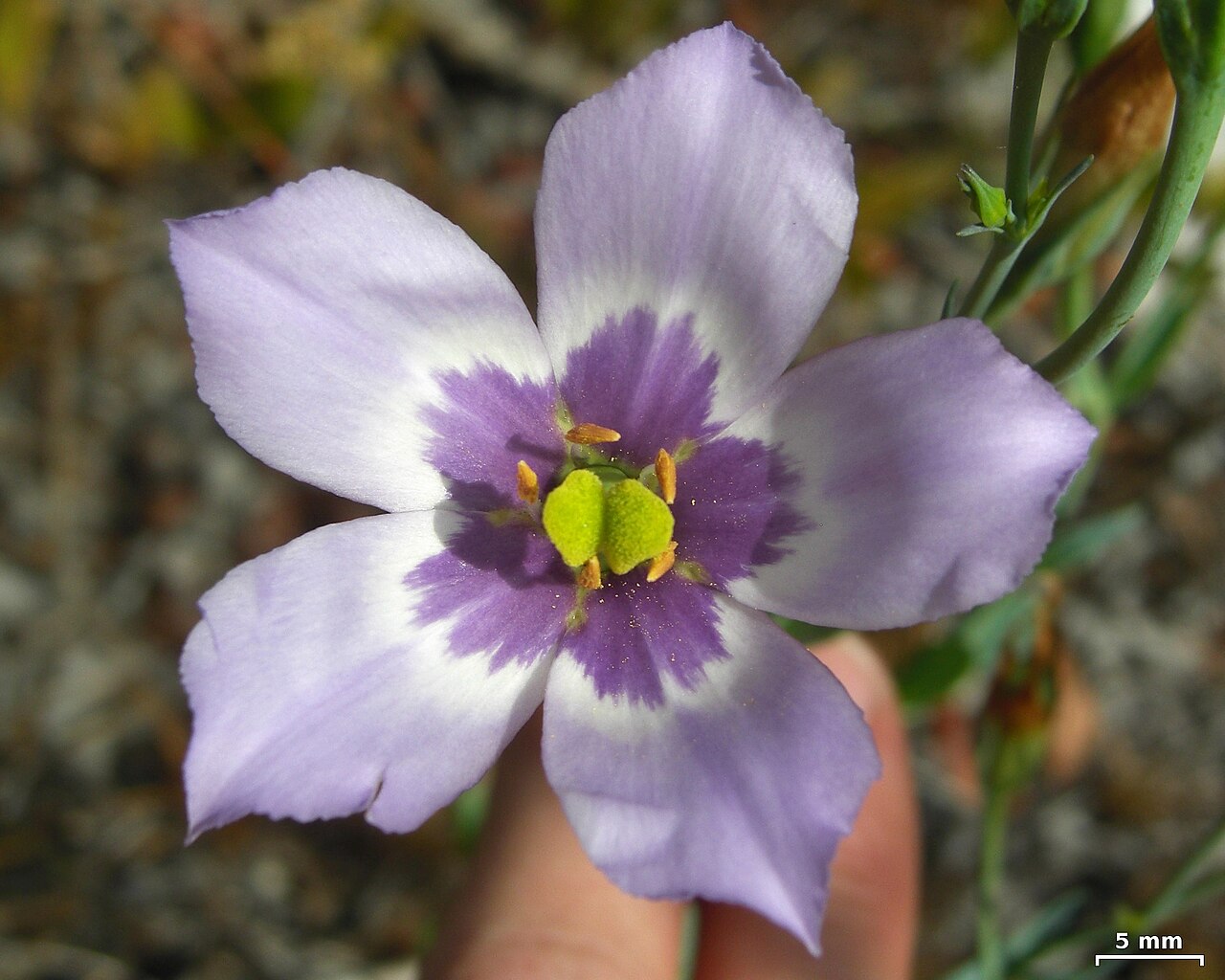
Eustoma exaltatum, the Catchfly Prairie Gentian, is a slender, blue-green wildflower of moist, often salty or alkaline ground, with cup-shaped flowers in pale lavender, blue-violet or white, each marked with a dark purple eye. It is also called marsh gentian and seaside gentian. In Florida it grows along the coast in the edges of salt marshes, coastal prairies, shell mounds and marl flats, and in the Southwest it turns up at desert springs and seeps. It belongs to the gentian family (Gentianaceae).
The species is closely related to the much larger-flowered Texas bluebell or showy prairie gentian of the Great Plains, the wild ancestor of the cut flower sold as lisianthus. USDA PLANTS treats the two as one species, Eustoma exaltatum, with the bluebell as subspecies russellianum, which is why the USDA range reaches north to Montana and South Dakota. Many botanists, and the Atlas of Florida Plants, keep them separate: the bluebell is often called Eustoma russellianum or E. grandiflorum, and E. exaltatum in the strict sense is the smaller-flowered plant of Florida, coastal Texas, the desert Southwest and the Caribbean.
Catchfly prairie gentian is an annual or short-lived perennial that blooms over a long season and reseeds where conditions suit it. It is not common in the nursery trade, but specialist native nurseries in Florida sometimes offer it. This guide covers how to identify it, where it grows, and how to grow it in a coastal or wet-prairie garden.
Identification
Catchfly prairie gentian is easy to recognize in flower: few other plants of salt marsh edges and coastal prairies have smooth, waxy, blue-green leaves combined with upright, cup-shaped lavender flowers with a dark center.
Stems & Leaves
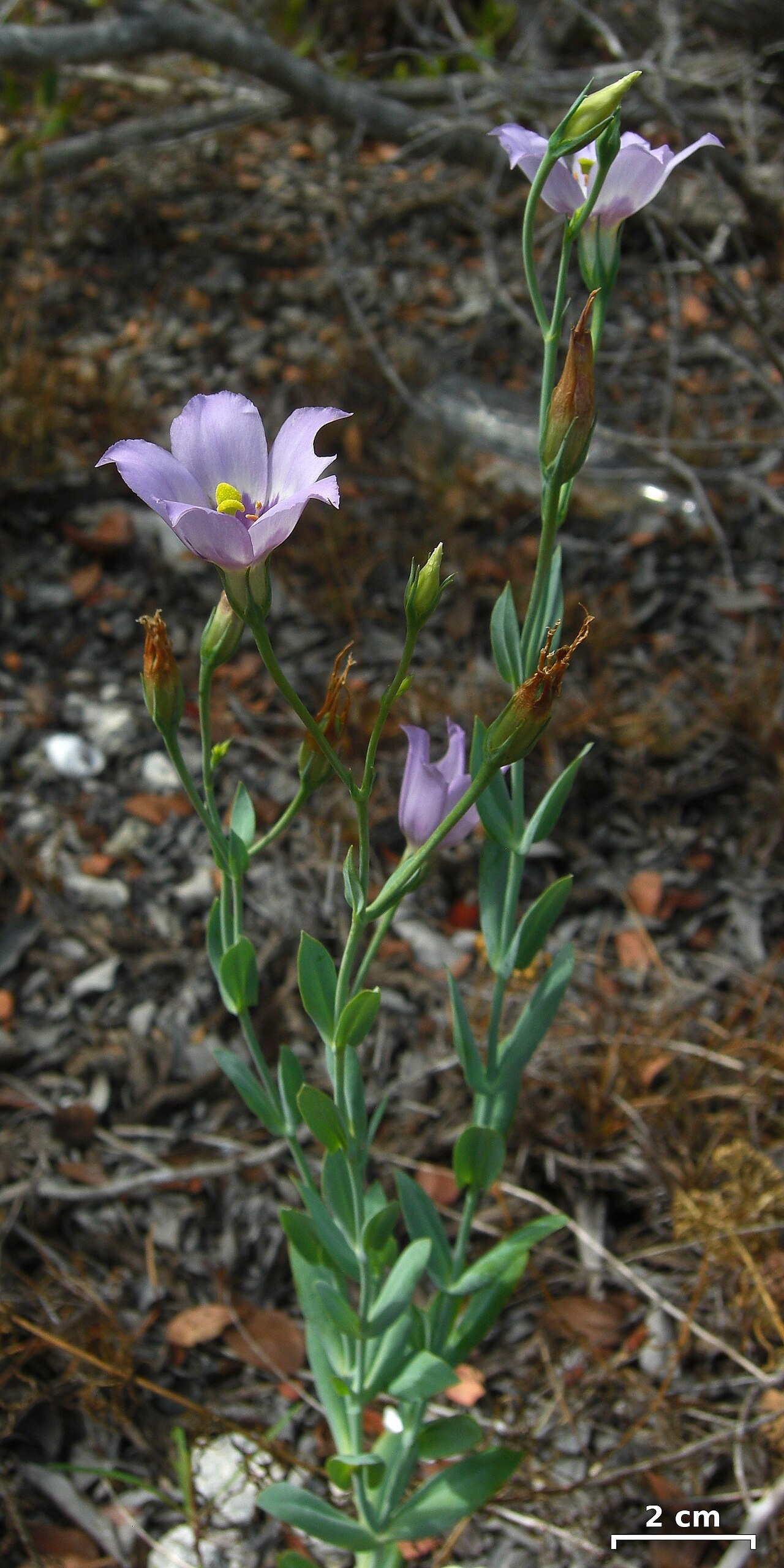
Plants are usually 1 to 2 feet tall, occasionally to 3 feet, with one or a few upright stems that branch in the upper part. The whole plant is smooth and has a whitish, waxy bloom that gives it a gray-green or blue-green color. Leaves are opposite, oblong to lance-shaped, about 1 to 3 inches long, and clasp the stem at their bases. Young plants start as a small rosette.
Flowers
Flowers are borne singly at the ends of slender stalks, often several open at once. Each has five (sometimes six) broad, spreading petal lobes about ½ to 1 inch long, joined at the base into a short tube, making a shallow cup or saucer roughly 1 to 1½ inches across. The color ranges from pale lavender to blue-violet or white, and the center has a dark purple ring. A long style ends in a conspicuous, broad, two-lobed stigma, and the five stamens have yellow to orange anthers.
In south Florida it can bloom in almost any month. Elsewhere the main bloom is from spring into fall.
Fruit & Seeds
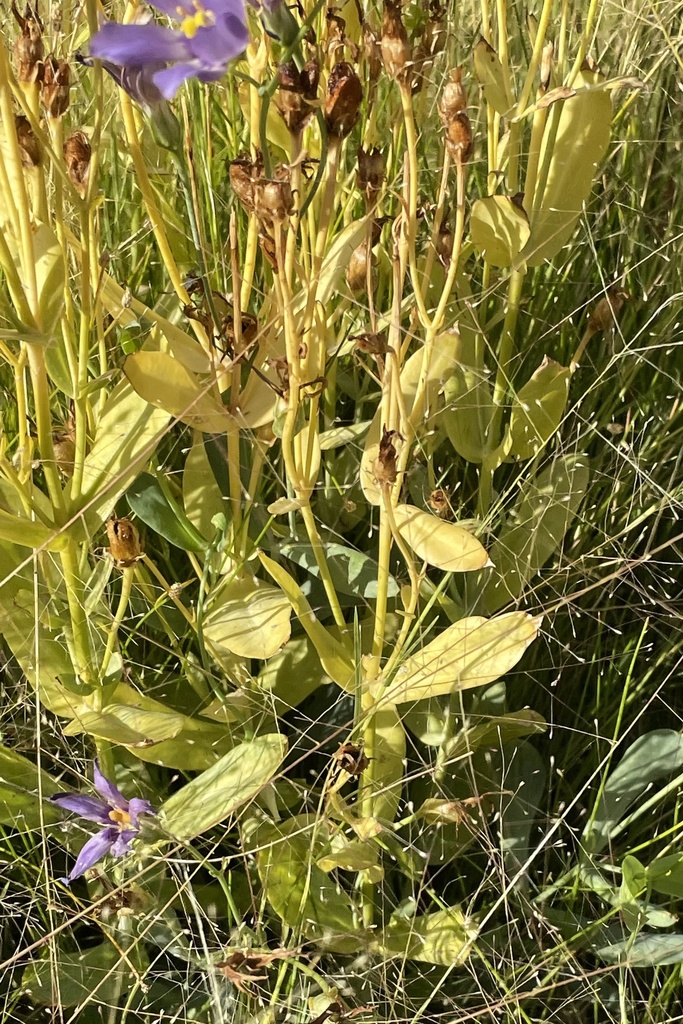
The fruit is a narrow, oblong capsule about ½ inch long that turns brown and splits to release many tiny, dust-like seeds.
Similar Species
Texas bluebell (Eustoma exaltatum subsp. russellianum, often called E. russellianum) has much larger, bell-shaped flowers 2 to 3 inches across with petal lobes over an inch long, and grows in prairies and fields from Texas north on the Great Plains. Seaside gentian is also a local name for Eustoma in Florida and should not be confused with true gentians (Gentiana), which have tubular, often pleated flowers and grow in different habitats.
Quick Facts
| Scientific Name | Eustoma exaltatum (USDA includes subsp. russellianum, also called E. russellianum or E. grandiflorum) |
| Family | Gentianaceae (gentian family) |
| Plant Type | Annual or short-lived perennial wildflower |
| Mature Height | 1–2 ft (occasionally to 3 ft) |
| Mature Spread | 6–12 in |
| Growth Rate | Fast |
| Sun Exposure | Full sun to light shade |
| Water Needs | Moderate to high; moist soil, tolerates brief drying |
| Soil Type | Moist sand, marl, shell or clay; tolerates salt and alkaline soils |
| Soil pH | Neutral to alkaline (about 6.5–8.5) |
| Bloom Time | Spring–fall; nearly year-round in south Florida |
| Flower Color | Pale lavender, blue-violet or white with a dark purple center |
| Fall Color | None |
| Fruit | Narrow capsule with tiny seeds |
| Deer Resistant | Unknown; occasionally browsed |
| USDA Hardiness Zones | 8–11 |
Native Range
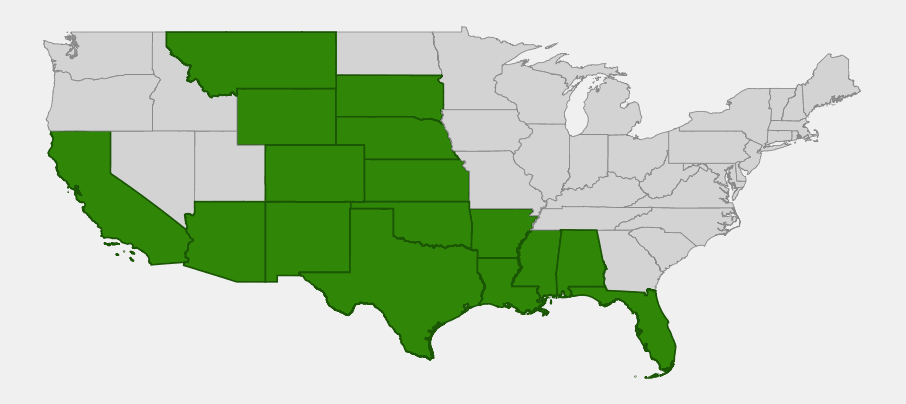
USDA PLANTS, which includes the Texas bluebell in this species, records Eustoma exaltatum as native in sixteen states: Alabama, Arizona, Arkansas, California, Colorado, Florida, Kansas, Louisiana, Mississippi, Montana, Nebraska, New Mexico, Oklahoma, South Dakota, Texas and Wyoming. The Lady Bird Johnson Wildflower Center summarizes the range as the southern United States from Florida west to California, and north in the interior to Montana and South Dakota. The species also ranges south through Mexico and Central America and across the Caribbean.
The northern Great Plains and interior records belong mostly to the large-flowered Texas bluebell. The smaller-flowered catchfly prairie gentian in the narrow sense is a plant of the Gulf and Atlantic coasts of Florida, the Florida Keys, coastal Texas and Louisiana, and the deserts of Arizona, southern California, New Mexico and northern Mexico, where it grows around springs, seeps and alkaline flats. In Florida, the Atlas of Florida Plants records it from coastal counties around the peninsula and the Keys, with scattered inland records.
In coastal Florida it grows in the upper edges of salt marshes, coastal prairies and grasslands, interdunal swales, shell mounds, marl prairies and disturbed open ground such as ditches and road shoulders near the coast. Its tolerance for salt and lime-rich soils lets it grow where many other wildflowers cannot.
📋 Regional plant lists featuring Catchfly Prairie Gentian: North & South Florida · Alabama, Georgia & Mississippi · Arkansas, Louisiana, Eastern Oklahoma & Eastern Texas · South & West Texas · Nebraska, Kansas & Eastern Colorado · North Dakota, South Dakota & Western Minnesota · Montana & Wyoming · Arizona & New Mexico · California & Nevada
Growing & Care Guide
Catchfly prairie gentian is best treated as a reseeding annual or short-lived perennial for sunny, moist sites near the coast. It is rarely sold, so look for it at Florida native nurseries or grow it from seed collected from your own or a nursery’s plants. Do not dig plants from the wild; they seldom survive transplanting, and seed is easy to work with.
Light
Plant it in full sun. It tolerates a little afternoon shade, but in shade it becomes leggy and flowers poorly.
Soil & Water
It needs moist soil, at least through the growing and flowering season. Sandy, marly or shelly soils that stay damp but do not hold standing water for long are ideal, and it handles slightly salty or alkaline conditions well. In dry beds, water during droughts. It does not need fertilizer.
Planting Tips
Sow seed on the soil surface in fall or late winter and press it in lightly without covering; the seeds are tiny and need light to germinate. Keep the surface moist until seedlings appear. Because it does not compete well with dense grasses or mulch, give it open ground among low plants at the edge of a rain garden, swale, pond or coastal planting.
Pruning & Maintenance
Leave some flowers to ripen into capsules so the plant can reseed. Remove dead stems once seed has dropped. Keep vigorous grasses and groundcovers from crowding the small rosettes, especially in their first months.
Propagation
Grow it from seed. Commercial lisianthus is propagated from seed as well, though it is slow to reach flowering size. Wild-type plants usually flower in their first year from fall-sown seed in Florida.
Landscape Uses
- Coastal gardens: for moist, salty or alkaline spots near the shore
- Rain gardens and swales: on the upper edges, where soil stays damp but not flooded
- Wet prairie and salt marsh edge restoration: within its native range, from local seed
- Pollinator gardens: long-blooming flowers for native bees
- Cottage-style borders: a native relative of lisianthus with a looser, airy habit
Wildlife & Ecological Value
Catchfly prairie gentian is a modest but long-blooming part of coastal and wet-prairie plant communities, adding nectar and pollen in places with few other flowers.
For Pollinators
The open, cup-shaped flowers give easy access to pollen and nectar. They are visited mainly by bees, including small native bees, as well as butterflies and other insects. The broad stigma stands above the anthers, which encourages visitors to carry pollen between flowers.
For Birds
The tiny seeds have little food value for birds, but the open coastal grasslands where it grows are used by wading birds, shorebirds and grassland sparrows.
For Mammals
The plant has no notable value for mammals and is seldom eaten.
Ecosystem Role
As a salt-tolerant colonizer it is one of the first wildflowers to appear on bare, damp ground after storms, fires or disturbance along the coast. Like many gentians it is a short-lived plant that depends on open, recently disturbed ground and moves around the landscape from year to year by seed.
Cultural & Historical Uses
Linnaeus described this plant as Gentiana exaltata from Caribbean material. The English botanist Richard Salisbury later separated it as Eustoma, a name from the Greek for “open mouth,” referring to the wide throat of the flower, and George Don published the combination Eustoma exaltatum in the 1830s.
Its showy Great Plains relative, the Texas bluebell, was taken into cultivation in the twentieth century, and Japanese breeders turned it into lisianthus, now one of the world’s major cut flowers, with double, rose-like blooms in white, pink, purple and bicolors. Wild Texas bluebells became scarce in some areas as people dug and picked them. The smaller-flowered catchfly prairie gentian has never become a commercial plant.
The plants of the gentian family are known for bitter compounds, and several have been used in traditional medicine. There is little documented use of catchfly prairie gentian itself, and it should not be eaten.
Frequently Asked Questions
Is catchfly prairie gentian the same as lisianthus?
Not quite. Garden and florist lisianthus was bred from the Texas bluebell, which USDA treats as a subspecies of Eustoma exaltatum and many botanists call E. russellianum or E. grandiflorum. Catchfly prairie gentian is the smaller-flowered coastal and desert form, with lavender to white flowers about 1 to 1½ inches across.
Is catchfly prairie gentian an annual or a perennial?
It behaves as an annual or a short-lived perennial. In frost-free south Florida individual plants may live for more than a year, but populations persist mainly by reseeding.
Can it grow in salty soil?
Yes. It grows naturally at the upper edges of salt marshes and on shell and marl soils near the coast, and it tolerates moderate salt and alkaline conditions.
Why is it called marsh gentian or seaside gentian?
These names reflect its habitat: moist, open, often brackish ground near the coast. It is in the gentian family but is not a true gentian of the genus Gentiana.
How do I grow it from seed?
Sow the tiny seeds on the surface of moist, sandy soil in fall or late winter, press them in without covering, and keep the surface damp. Seedlings grow slowly at first. Thin them so each plant has a few inches of space.

Looking for a nursery that carries Catchfly Prairie Gentian?
Browse our native plant nursery directory: Alabama, Arizona & Arkansas · California · Colorado & Florida · Kansas · Louisiana, Mississippi & Montana · Nebraska, New Mexico & Oklahoma · South Dakota & Texas · Wyoming