
Scrub Palmetto (Sabal etonia)
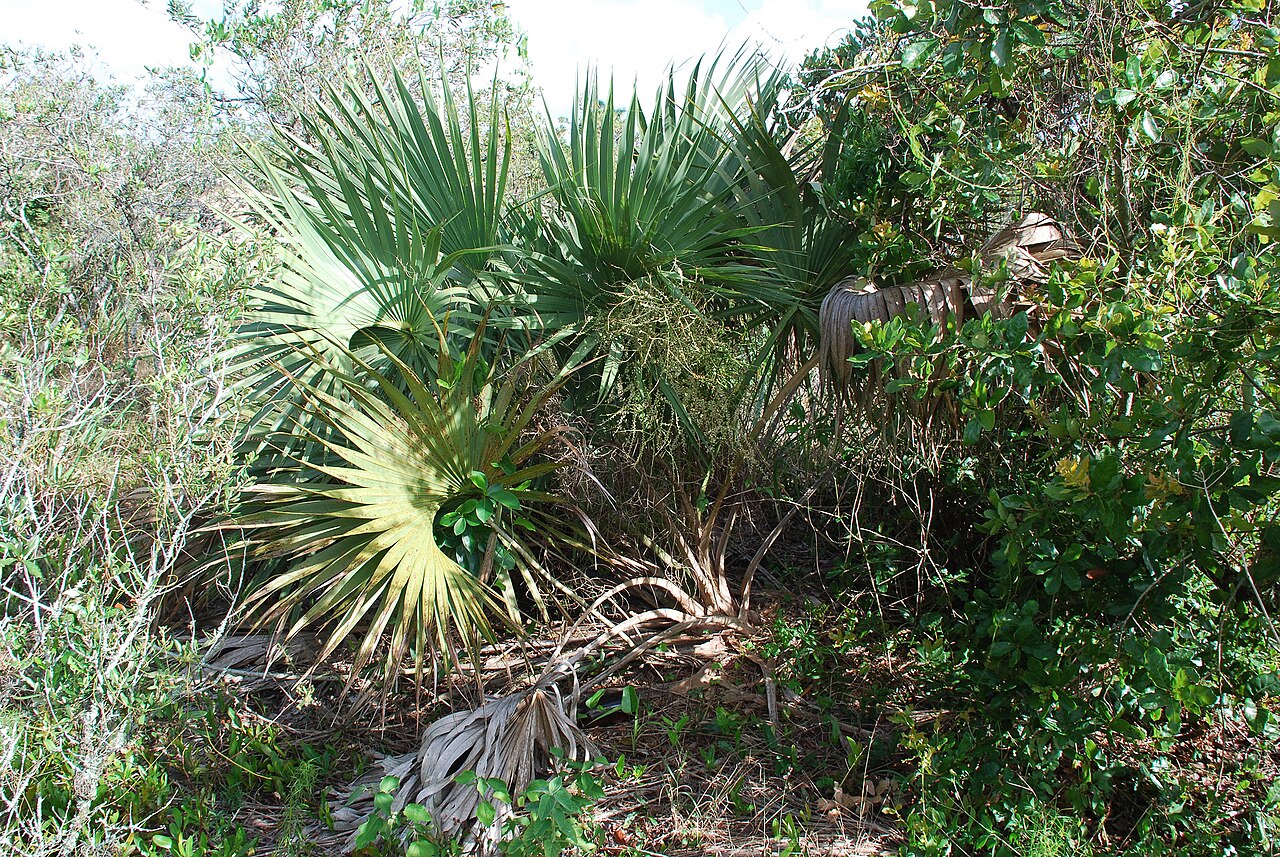
Sabal etonia, the Scrub Palmetto, is a small, trunkless fan palm found only in Florida. It is a signature plant of the state’s ancient sand ridges, where its clumps of stiff, green fan leaves grow among scrub oaks, sand pine and Florida rosemary on deep, dry, white sand. It belongs to the palm family (Arecaceae), in the same genus as Florida’s state tree, the cabbage palm.
The Atlas of Florida Plants lists scrub palmetto as a Florida endemic: it grows wild nowhere else in the world. It is not listed as endangered or threatened by the state, but much of its scrub habitat has been lost to development and citrus groves. If you want to grow it, buy nursery-propagated plants from a native plant nursery, and never dig plants from the wild; wild palmettos also rarely survive being moved.
Scrub palmetto is slow-growing, extremely drought-tolerant and almost maintenance-free once established. It makes a handsome, low, tropical-looking accent for dry, sunny, sandy gardens in central and south Florida, and it provides fruit and cover for scrub wildlife. This guide explains how to tell it from the similar saw palmetto and dwarf palmetto, where it grows, and how to plant it.
Identification
Scrub palmetto shares its habitat with saw palmetto (Serenoa repens), and the two are often confused. The quickest check is the leaf stalk: saw palmetto stalks are edged with sharp teeth, while scrub palmetto stalks are smooth. Dwarf palmetto (Sabal minor) is a closely related species of wet, shady bottomlands rather than dry scrub; its flower stalks stand stiffly upright above the leaves.
Stem & Habit
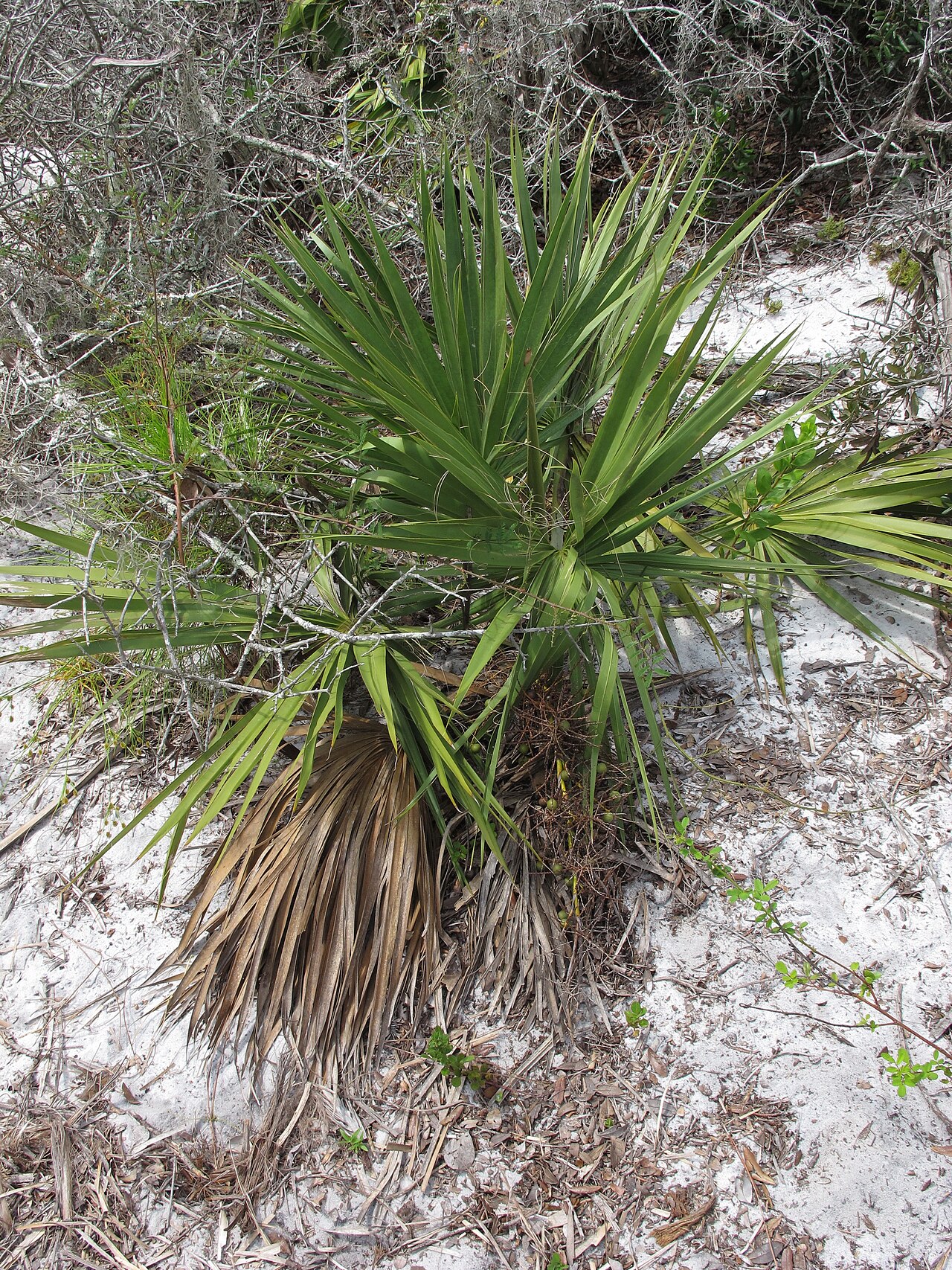
Scrub palmetto has no visible trunk. Its stem grows horizontally under the sand, with only the leaves and flower stalks showing above ground. A plant usually carries a clump of 4 to 7 living leaves and stands about 3 to 6 feet tall. Unlike saw palmetto, it does not creep across the ground to form large colonies; each plant stays a single clump.
Leaves
The leaves are costapalmate: fan-shaped, but with the leaf stalk continuing as a curved midrib (costa) into the blade, so the leaf is strongly folded and often twisted or arched. Each blade is about 2 to 3 feet across, deeply divided into stiff segments, usually yellow-green to green, with fine threads between the segments. The leaf stalks are smooth, without teeth.
Flowers
In spring, roughly March to June, the plant produces branched flower stalks from among the leaves. They usually arch outward and are about as long as the leaves or shorter, rather than standing well above them. The individual flowers are tiny, creamy white and fragrant, and are visited by many kinds of bees and other insects.
Fruit
The fruits are round, about half an inch across, and ripen from green to glossy black in fall. They are larger than those of dwarf palmetto and have a thin, sweetish pulp around a single hard seed.
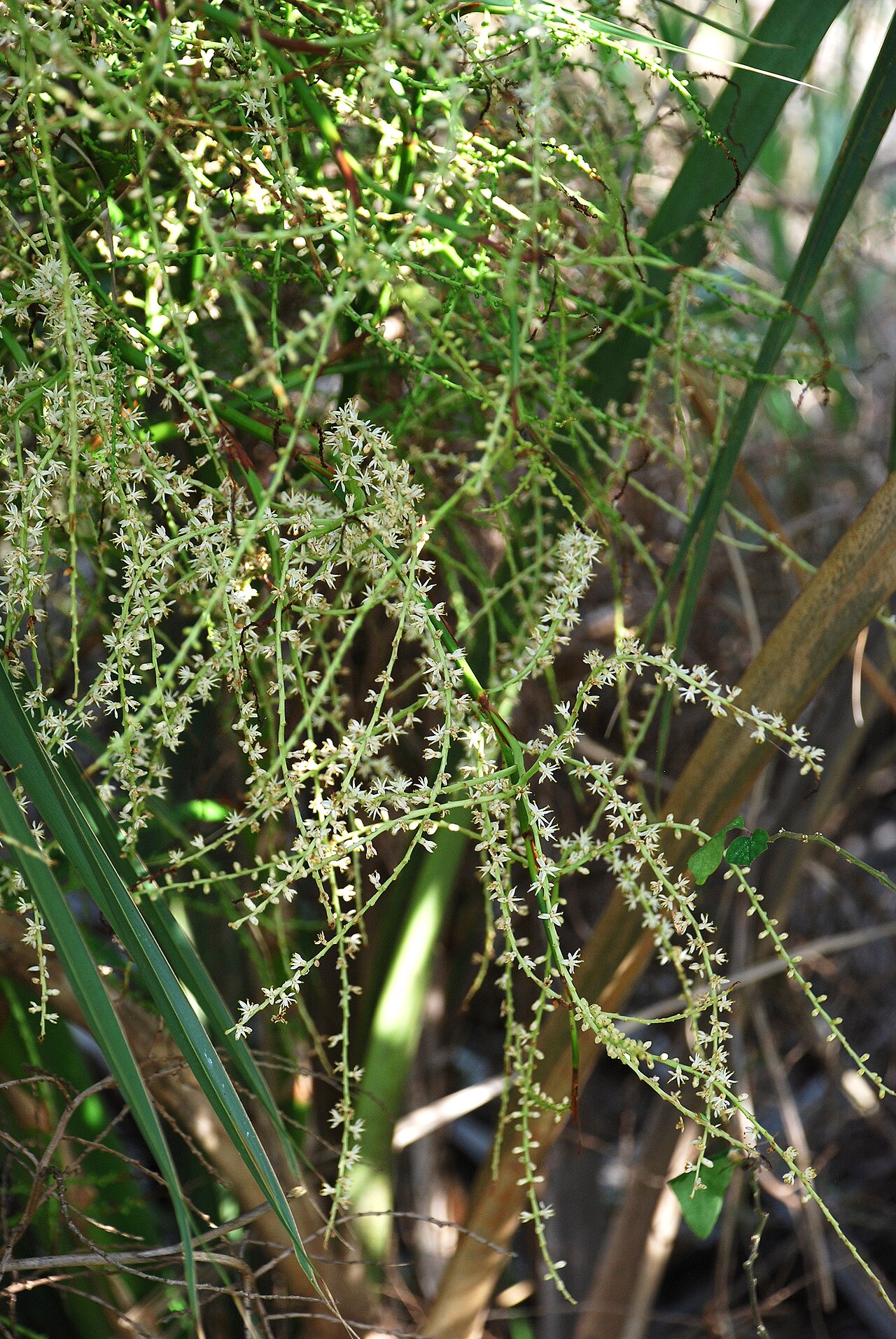
Quick Facts
| Scientific Name | Sabal etonia (USDA symbol SAET) |
| Family | Arecaceae (palm family) |
| Plant Type | Trunkless evergreen fan palm with an underground stem |
| Mature Height | 3–6 ft |
| Mature Spread | 3–6 ft |
| Growth Rate | Very slow |
| Sun Exposure | Full sun to part shade |
| Water Needs | Very low; deep, dry, well-drained sand |
| Soil Type | Deep, infertile sand |
| Soil pH | Acidic (about 4.5–6.5) |
| Bloom Time | March–June |
| Flower Color | Creamy white |
| Fall Color | None; evergreen |
| Fruit | Round black drupe, about ½ in, ripening in fall |
| Deer Resistant | Yes; tough leaves are seldom browsed |
| USDA Hardiness Zones | 8–10 |
Native Range
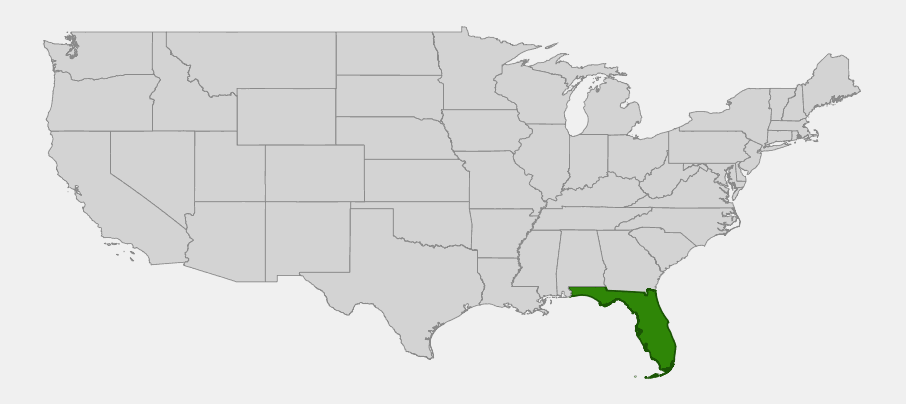
Scrub palmetto is endemic to peninsular Florida. USDA PLANTS and the Lady Bird Johnson Wildflower Center record it only from Florida, and the Atlas of Florida Plants classes it as a Florida endemic. Its range runs through the central and eastern peninsula, from around the Ocala National Forest and Putnam County south through the Lake Wales Ridge to the southern end of the central ridges, with populations on the old coastal dunes of the Atlantic coast.
It grows on deep, excessively drained, nutrient-poor sands: sand pine scrub, oak scrub, rosemary scrub, scrubby flatwoods and the drier edges of sandhills. These habitats burn every few decades. Scrub palmetto survives fire because its growing tip is protected underground, and it resprouts quickly afterward.
Because the central Florida ridges have been heavily cleared for citrus and housing, much of the remaining scrub palmetto habitat is in preserves such as Archbold Biological Station, the Lake Wales Ridge State Forest, Lake June-in-Winter Scrub State Park and the Ocala National Forest.
📋 Regional plant lists featuring Scrub Palmetto: North & South Florida
Growing & Care Guide
Scrub palmetto is one of the toughest plants you can grow on dry Florida sand. It needs no irrigation once established, no fertilizer and almost no pruning. Its one drawback is patience: it grows very slowly, especially from seed.
Light
Full sun is best and gives the most compact plants. It tolerates part shade under open pines or oaks, where the leaves become greener and the clump more open.
Soil & Water
Plant it in deep, well-drained sand. It does not tolerate soggy or poorly drained soil. Water a new plant regularly for its first growing season, then only during long droughts, if at all. Do not fertilize; rich soil and irrigation are not needed and may shorten its life.
Planting Tips
Buy small, nursery-grown container plants and plant them at the same depth they grew in the pot. Like other Sabal palms, seedlings grow their stem downward into the sand before turning to grow horizontally, and the roots of wild plants are cut when they are dug, so field-collected palmettos usually die. Collecting from the wild also harms a Florida endemic: always buy propagated stock.
Pruning & Maintenance
Remove completely brown, dead leaves if you want a tidier look, cutting them close to the base. Do not remove green leaves; the palm needs them. No other care is needed.
Propagation
Grow it from fresh seed. Clean the pulp from ripe black fruits in fall and sow the seeds in deep pots of sandy mix. Germination can take several months, and seedlings grow very slowly for their first years. Plants cannot practically be divided.
Landscape Uses
- Dry, sandy native gardens: a low, tropical-looking accent with scrub oaks, Florida rosemary and gopher apple
- Xeriscape and low-water landscapes: no irrigation needed once established
- Scrub restoration: within its native range in central and east-central Florida, from local nursery stock
- Wildlife gardens: fruit and shelter for scrub animals
- Foundation and accent plantings: in sunny, sandy yards where tall palms would be out of scale
Wildlife & Ecological Value
In Florida scrub, where food and shelter are scarce, scrub palmetto is a valuable plant for wildlife.
For Pollinators
The many small, fragrant flowers attract a wide variety of bees, wasps, flies and beetles in spring. Palms are an important nectar and pollen source in scrub habitats, where flowering shrubs are often sparse.
For Birds
Birds such as mockingbirds, catbirds and other fruit-eaters eat the ripe black fruits. The dense, spreading leaves offer shade and cover for ground-feeding birds of the scrub.
For Mammals
Raccoons, foxes, black bears and other mammals eat palmetto fruits, and the clumps provide cover for small mammals.
Ecosystem Role
Scrub palmetto is part of the low, fire-adapted shrub layer of Florida scrub. It resprouts from its underground stem after fire, helping the habitat recover quickly, and its fallen leaves add a little organic matter to very poor sand.
Cultural & Historical Uses
The species was described in 1896 by the American botanist George V. Nash, from material collected in Florida by Walter T. Swingle. Its epithet etonia refers to the Etonia scrub region in Putnam County, where the palm grows. The genus name Sabal is of uncertain origin.
Ecologists at Archbold Biological Station on the Lake Wales Ridge have studied scrub palmetto alongside saw palmetto for many years, including its slow growth, its long life and how it recovers after fire.
Scrub palmetto is far less familiar to gardeners than saw palmetto or cabbage palm, but Florida native plant nurseries grow it from seed, and it is increasingly used in water-wise landscapes in central Florida.
Frequently Asked Questions
Is scrub palmetto endangered?
It is not listed as endangered or threatened in Florida. It is, however, a Florida endemic found nowhere else, and much of its scrub habitat has been destroyed. Buy only nursery-propagated plants and never collect it from the wild.
How do I tell scrub palmetto from saw palmetto?
Look at the leaf stalks. Saw palmetto stalks have sharp, saw-like teeth along the edges; scrub palmetto stalks are smooth. Scrub palmetto leaves are also strongly folded and curved along a midrib, and the plant grows as a single clump rather than creeping across the ground.
Can I transplant a scrub palmetto from the wild?
No. Wild palmettos have a deep, horizontal underground stem and rarely survive being dug, and collecting harms wild populations of a Florida endemic. Buy small container-grown plants from a native plant nursery.
How fast does scrub palmetto grow?
Very slowly. Seedlings may take several years to produce full-sized fan leaves, and plants take many years to reach mature size.
Does scrub palmetto need watering?
Only while it is getting established. After its first growing season it should survive on rainfall alone in sandy Florida soils.

Looking for a nursery that carries Scrub Palmetto?
Browse our native plant nursery directory: Florida