
Atlantic St. John’s-Wort (Hypericum tenuifolium)
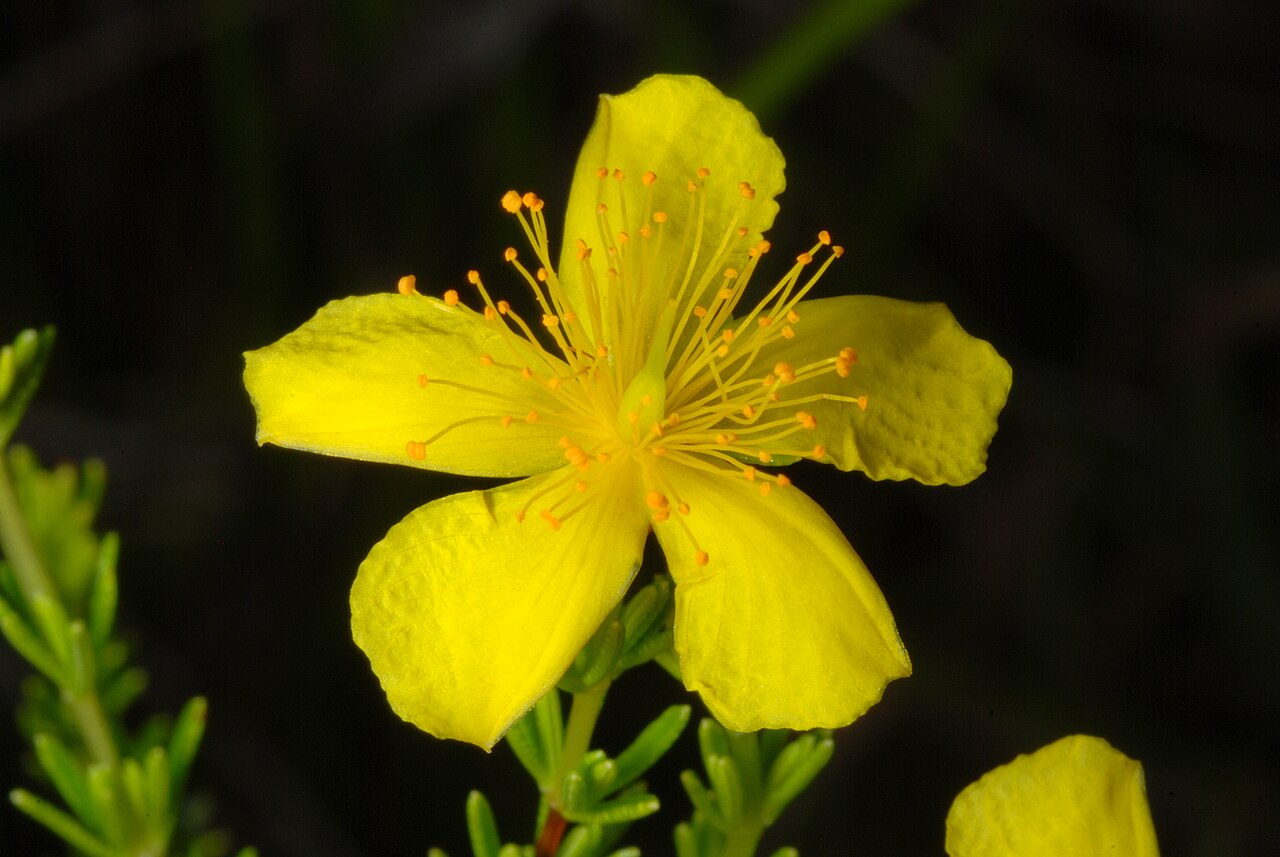
Hypericum tenuifolium, known as Atlantic St. John’s-Wort and sometimes as sandhill St. John’s-wort, is a low, wiry shrub of dry, sandy ground on the southeastern Coastal Plain. It rarely grows taller than knee height. Its stems are crowded with tiny, needle-like leaves, and from late spring into summer they carry bright yellow flowers about half an inch to three-quarters of an inch across, each with a brush of golden stamens. The plant belongs to the St. John’s-wort family (Hypericaceae, included in Clusiaceae by USDA PLANTS) and is one of the shrubby St. John’s-worts in the group botanists call section Myriandra.
Many older field guides and state floras list this species as Hypericum reductum, and USDA PLANTS keeps that name as a synonym. The name tenuifolium means “slender-leaved”, a good description of a plant that looks more like a small heath or a dwarf rosemary than a typical St. John’s-wort when it is not in flower. It grows in sandhills, scrub, dry pine flatwoods and coastal dunes, often in the bare sand between clumps of wiregrass and saw palmetto.
For gardeners, Atlantic St. John’s-wort is a tough little shrub for hot, dry, sandy sites where little else looks good in summer. It is native to Florida according to the Atlas of Florida Plants, and USDA PLANTS records it from North Carolina to Florida and Alabama. This guide covers identification, range, growing conditions and its value for bees and other wildlife.
Identification
Atlantic St. John’s-wort is easiest to recognize by its combination of very small, crowded, needle-like leaves, a low, sprawling or mat-forming habit, and yellow five-petaled flowers with many stamens. Several other shrubby St. John’s-worts grow in the same region, so check the leaves and habitat as well as the flowers.
Stems & Habit
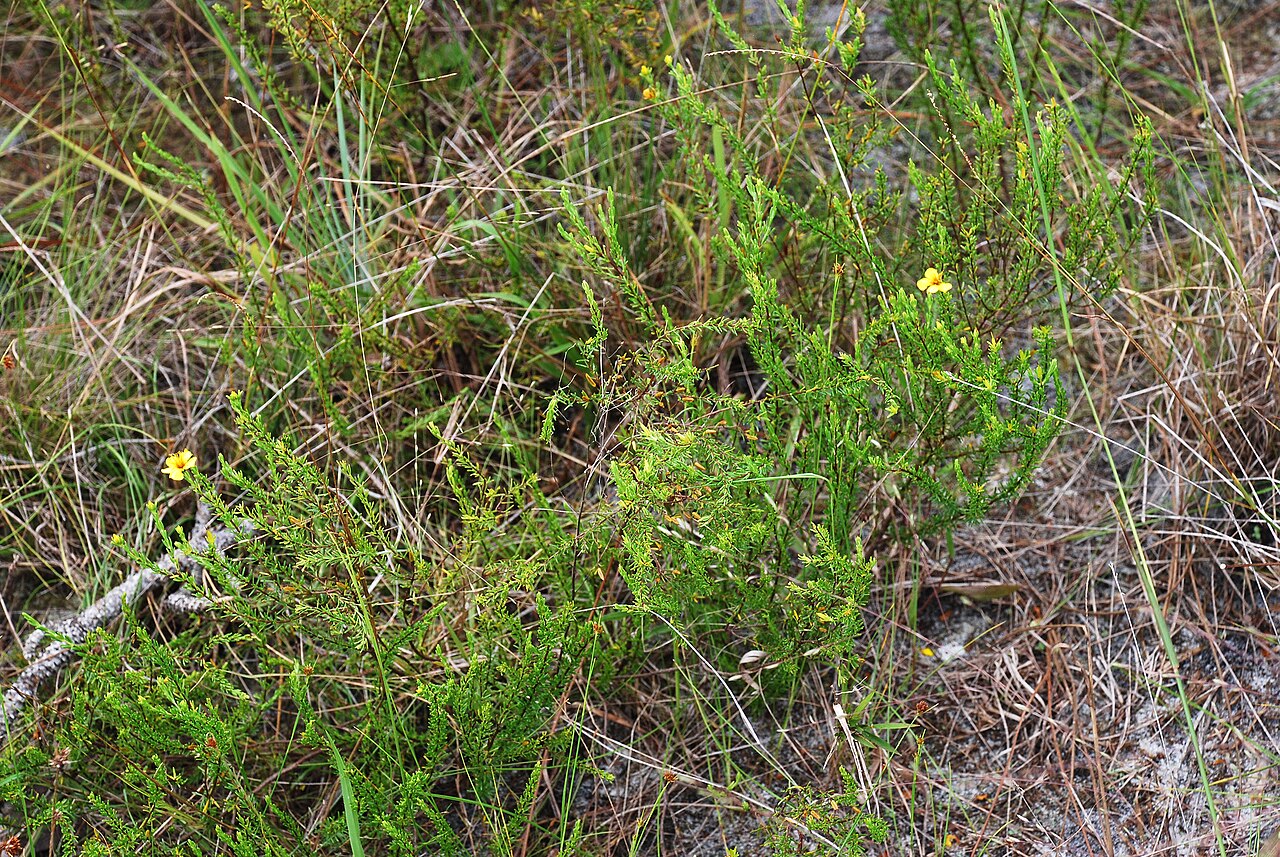
This is a low subshrub or small shrub, usually 4 to 20 inches tall. Plants branch heavily from a woody base, and older plants often sprawl or form loose mats a foot or two across, with the tips of the branches turning upward. Older stems have reddish-brown bark that peels in thin strips, a trait shared with many of its shrubby relatives. Young twigs are slightly two-edged.
Leaves
The leaves are narrow and needle-like, mostly 1/4 to 1/2 inch long, with the edges rolled under. They are crowded along the stems and often have clusters of even smaller leaves in their axils, which gives the branches a bushy, bottlebrush look. They are bright to dark green and evergreen or nearly so in Florida. Held up to the light, the leaves show tiny translucent dots, the oil glands typical of St. John’s-worts.
Flowers
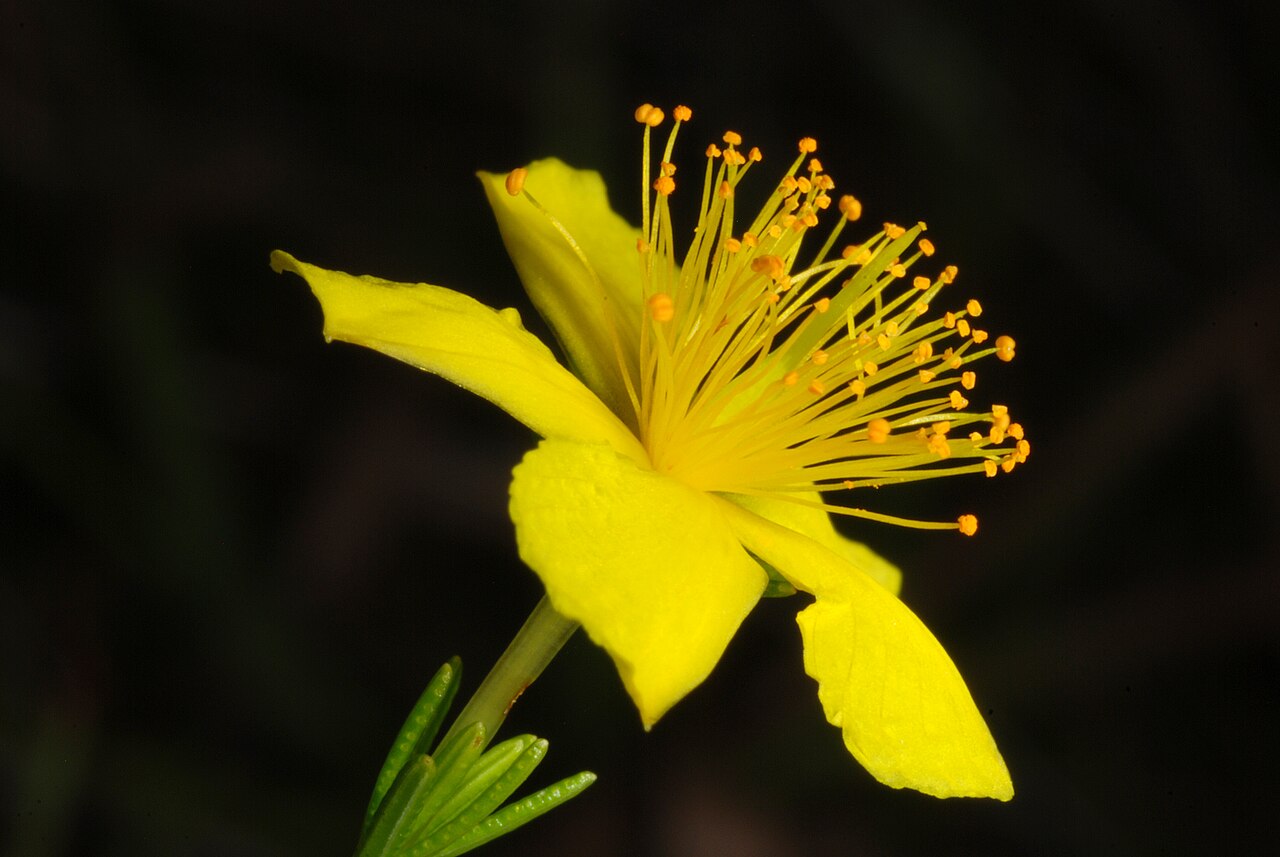
The flowers are borne singly or in small clusters at the tips of the branches. Each has five bright yellow petals that spread to form a flower roughly 1/2 to 3/4 inch across, five small green sepals, and a dense brush of many stamens with orange-yellow anthers. Flowers open in the morning and last only a day, but a healthy plant produces them over many weeks. Bloom peaks from late spring through summer, and in Florida plants may carry scattered flowers into fall.
Fruit & Seeds
After flowering, each flower forms a small, egg-shaped capsule about 1/4 inch long, topped by the persistent styles. It turns brown as it ripens and splits to release many tiny, dark seeds. Dried capsules often stay on the plant into winter.
Similar Species
Peelbark St. John’s-wort (H. fasciculatum) has similar needle-like leaves but is a taller, upright shrub of wet pond margins and flatwoods. Sandhill St. John’s-wort of the Piedmont and fall-line sandhills (H. lloydii) is very similar and some sources apply the same common name to both. Taller shrubby species such as Myrtleleaf St. John’s-Wort and Roundpod St. John’s-Wort have broader, flat leaves. Fourpetal St. John’s-Wort has four petals rather than five.
Quick Facts
| Scientific Name | Hypericum tenuifolium Pursh (syn. H. reductum) |
| Family | Clusiaceae per USDA PLANTS (often placed in Hypericaceae, the St. John’s-wort family) |
| Plant Type | Low evergreen subshrub or small shrub |
| Mature Height | 4–20 in |
| Mature Spread | 1–2 ft; sprawling or mat-forming |
| Growth Rate | Moderate |
| Sun Exposure | Full sun |
| Water Needs | Low; drought tolerant once established |
| Soil Type | Dry, well-drained sand |
| Soil pH | Acidic, about 4.5–6.5 |
| Bloom Time | Late spring through summer (about April–July); scattered flowers later in Florida |
| Flower Color | Bright yellow |
| Fall Color | None; foliage stays green or turns slightly bronze in cold weather |
| Fruit | Small brown capsule with many tiny seeds |
| Deer Resistant | Generally yes; St. John’s-worts are seldom browsed |
| USDA Hardiness Zones | 7b–10 |
Native Range
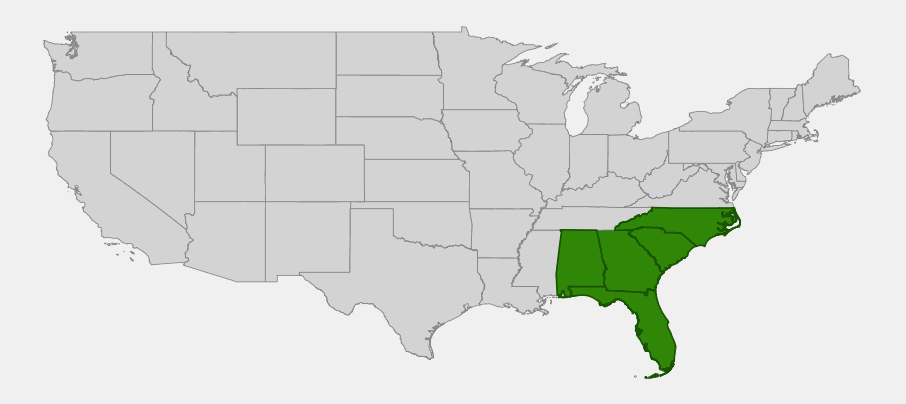
Atlantic St. John’s-wort is a Coastal Plain species. USDA PLANTS and the Lady Bird Johnson Wildflower Center record it from five states: North Carolina, South Carolina, Georgia, Florida and Alabama. Within that range it is a plant of the outer and middle Coastal Plain, where deep, sandy soils left by ancient shorelines and dunes support sandhills, scrub and dry pinelands.
In Florida, the Atlas of Florida Plants lists it as native. It grows in dry, sandy habitats of the Panhandle and north and central Florida and on the coastal dunes, and it is less frequent toward the southern end of the peninsula. It is most often found in sandhills with longleaf pine and turkey oak, in sand pine and oak scrub, in dry flatwoods, and on stabilized back dunes. It also turns up in old fields, road shoulders and firebreaks on sandy soil, where competition is light.
Like many sandhill and scrub plants, it is adapted to frequent, low-intensity fire. Fire burns back the twiggy tops, and the plant resprouts from its woody base and roots. Where fire is excluded for many years and taller shrubs and trees close in, it becomes scarce.
📋 Regional plant lists featuring Atlantic St. John’s-Wort: North & South Florida · Alabama, Georgia & Mississippi · North & South Carolina
Growing & Care Guide
Atlantic St. John’s-wort is easy to grow if you give it what it gets in the wild: full sun, very well-drained sand and little fuss. It is a good choice for dry, sunny Florida and Coastal Plain gardens, sandy slopes and coastal yards. It is not often sold, so look for it at native plant nurseries and native plant society sales, and buy nursery-grown plants rather than digging them from the wild.
Light
Plant it in full sun. In shade the stems stretch, the plant thins out, and flowering drops off sharply.
Soil & Water
It needs sharply drained, sandy soil that is low in nutrients and acidic to slightly acidic. Heavy clay, rich garden loam and constantly moist soil lead to root rot. Water new plants regularly for the first few weeks until they root in. After that, normal rainfall is enough, even in hot, dry spells. Do not fertilize; extra nutrients make plants floppy and short-lived.
Planting Tips
Set plants out in fall, winter or early spring so roots establish before summer heat. Space them 12 to 24 inches apart to form a low, loose ground cover, or tuck single plants among grasses and wildflowers in a sandhill-style planting. Avoid thick organic mulch around the crown. A thin layer of pine straw or bare sand is better.
Pruning & Maintenance
Little care is needed. If plants become leggy after a few years, cut them back by about half in late winter. This mimics the effect of fire and encourages dense new growth and more flowers. Pull weeds by hand while plants are young. Older plants are short-lived in some gardens, so let a few seedlings grow to replace them.
Propagation
Seed is the easiest method. Collect ripe brown capsules in late summer or fall and sow the tiny seed on the surface of a sandy mix, since it needs light to germinate. Softwood cuttings taken in late spring or early summer also root readily under mist or a clear cover.
Landscape Uses
- Sandhill and scrub gardens: a natural companion for wiregrass, gopher apple, blazing stars and golden asters
- Dry, sunny ground cover: for sandy slopes, road edges and hot, reflective spots where turf struggles
- Coastal landscapes: on stabilized back dunes and sandy yards near the coast, within its native range
- Pollinator gardens: its pollen-rich flowers attract native bees through the summer
- Habitat restoration: in fire-managed sandhills and scrub, using locally sourced, nursery-grown plants
Wildlife & Ecological Value
Atlantic St. John’s-wort is a small plant, but in the open sand of a sandhill or scrub it adds cover, flowers and seed where resources are scarce.
For Pollinators
St. John’s-wort flowers have no nectar. Instead they offer large amounts of pollen from their many stamens. Bumblebees, sweat bees, and other native bees visit the flowers to collect it, often buzzing the stamens to shake pollen loose. Hover flies also feed on the pollen.
For Birds
The tiny seeds are of minor value to birds compared with grasses and larger-seeded plants, but the low, twiggy shrubs give cover to ground-feeding birds of sandhills and scrub, such as Bachman’s sparrows and towhees.
For Mammals
The foliage contains bitter compounds and is seldom eaten by deer. Small mammals and gopher tortoises live in the same habitats, and the plant forms part of the low groundcover that shelters them.
Ecosystem Role
It is part of the diverse groundcover of fire-maintained longleaf pine sandhills and scrub, some of the most species-rich and threatened plant communities in the Southeast. It resprouts quickly after fire and helps hold loose sand on dunes and sandy slopes.
Cultural & Historical Uses
Frederick Pursh described Hypericum tenuifolium in 1814 in his flora of North America. Later botanists described the low, sprawling plants of the Coastal Plain as Hypericum reductum, and that name was widely used through the twentieth century. Modern treatments, including USDA PLANTS and the Atlas of Florida Plants, use H. tenuifolium and list H. reductum as a synonym.
St. John’s-worts take their name from the European Hypericum perforatum, which blooms around St. John’s Day in late June and has a long history in folk medicine. There is little record of specific traditional uses for this small native species. Do not use it as a substitute for the European herb, and do not eat or brew it.
Today it is valued mainly by native plant gardeners and land managers who work with sandhills and scrub. In restoration plantings it is one of many small shrubs and wildflowers that help rebuild the diverse groundcover of longleaf pine ecosystems.
Frequently Asked Questions
Is Atlantic St. John’s-wort the same as Hypericum reductum?
Yes. Hypericum reductum is an older name for the same plant. USDA PLANTS and the Atlas of Florida Plants now use Hypericum tenuifolium and list H. reductum as a synonym.
How tall does Atlantic St. John’s-wort get?
Usually 4 to 20 inches. It is a low, much-branched shrub that often sprawls or forms loose mats 1 to 2 feet across.
Does it need watering?
Only while it gets established. Once rooted in, it handles drought well on sandy soil. Overwatering and heavy soil are more likely to kill it than dry weather.
Is it invasive like common St. John’s-wort?
No. The weedy St. John’s-wort of pastures and roadsides in much of North America is the European Hypericum perforatum. Atlantic St. John’s-wort is a native Coastal Plain shrub that stays small and does not spread aggressively.
When does it bloom?
Mainly from late spring through summer, roughly April to July. In Florida, plants may continue to produce scattered flowers later in the year.

Looking for a nursery that carries Atlantic St. John’s-Wort?
Browse our native plant nursery directory: Alabama · Florida & Georgia · North Carolina · South Carolina