
Carolina Desert-Thorn (Lycium carolinianum)
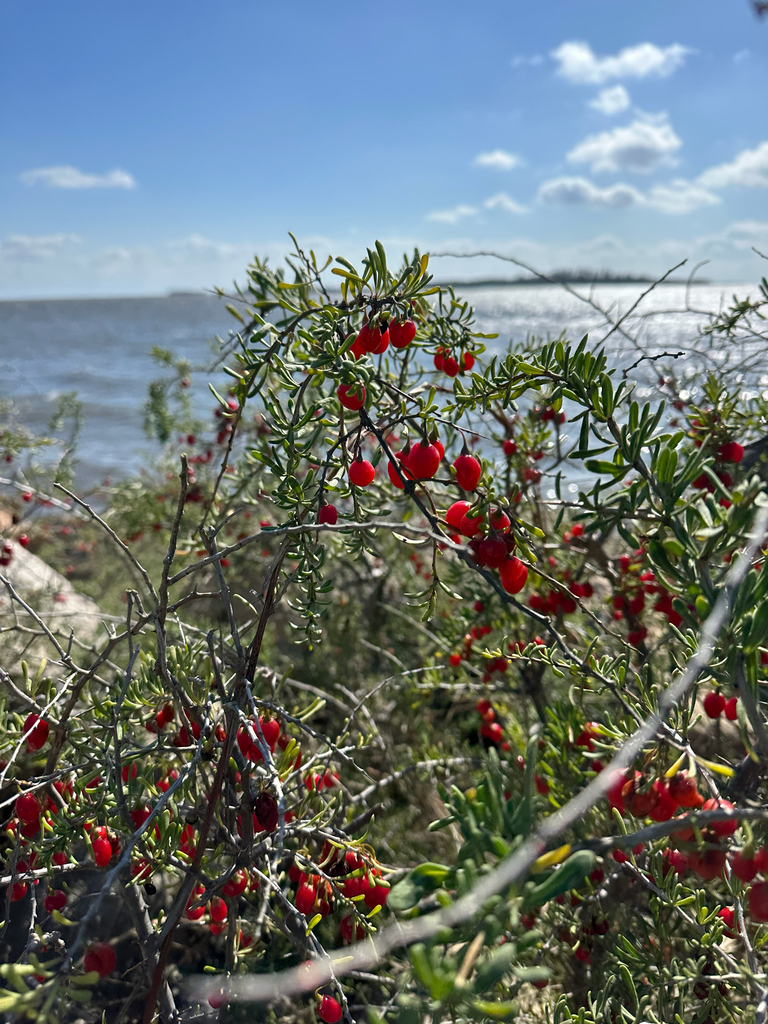
Carolina Desert-Thorn (Lycium carolinianum), also known as Carolina wolfberry and, in Florida, christmasberry, is a spiny, salt-tolerant shrub of coastal marshes and shores in the southeastern United States. It is a member of the nightshade family (Solanaceae) and a close relative of the goji berry. Its arching gray stems carry small, fleshy, club-shaped leaves, pale lavender to blue flowers through the warm months, and bright red berries that ripen in fall and early winter.
The name christmasberry is shared with a completely different Florida plant, Christmasberry (Crossopetalum ilicifolium), a low, holly-leaved shrub of the bittersweet family that grows in pine rocklands. The two are unrelated and look nothing alike up close; using the name Carolina desert-thorn or Carolina wolfberry, or the scientific name, avoids confusion.
Carolina desert-thorn is best known among naturalists as a vital winter food for the endangered whooping crane on the Texas coast. For gardeners on the coast it is a tough, salt-tolerant shrub for marsh edges, shoreline buffers and wildlife plantings. This guide covers how to identify it, where it grows and how to grow it.
Identification
Carolina desert-thorn is easy to spot in a coastal marsh once you know its combination of features: a spiny, sprawling shrub with succulent leaves, small blue to lavender flowers and shiny red berries.
Growth Form
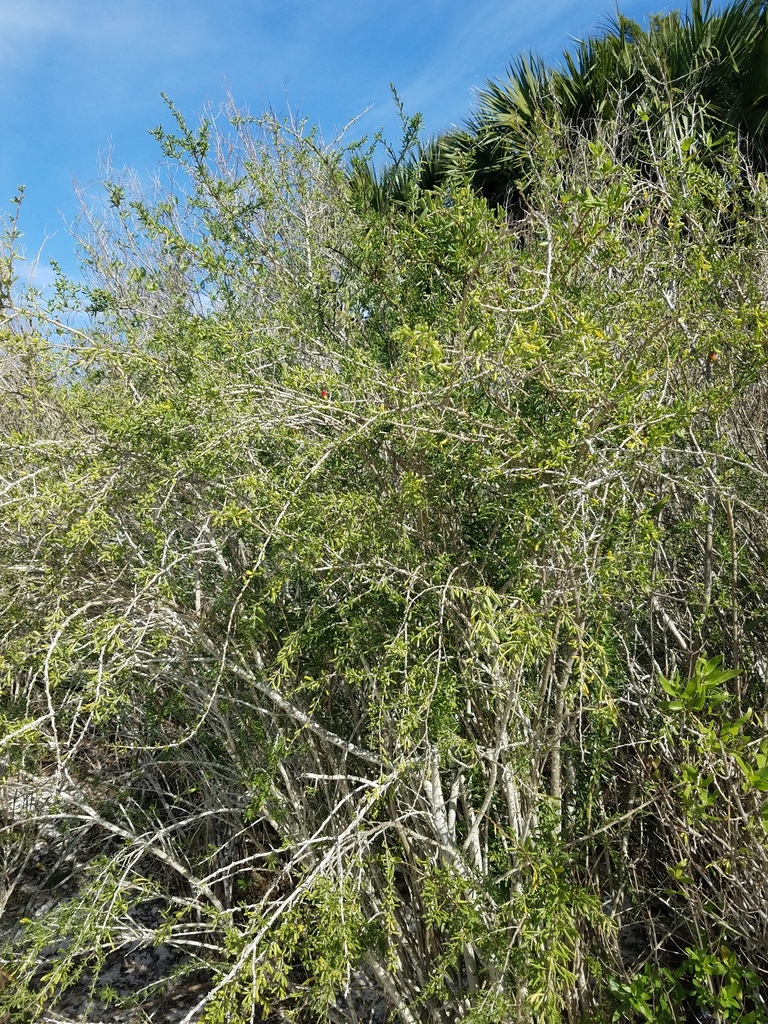
It is a loosely branched, often sprawling shrub with erect to arching or leaning stems up to about 6 feet long. The branches are pale gray and stiff, and many short side twigs end in sharp spines. Plants often grow in tangled clumps, and stems that touch the ground can root.
Leaves
The leaves are small (usually under an inch long), thick and succulent, nearly round in cross-section and club-shaped, broadening toward the tip. They grow alternately or in small clusters on short spurs along the stems. They are gray-green to bright green and may drop during drought or cold, then regrow quickly.
Flowers
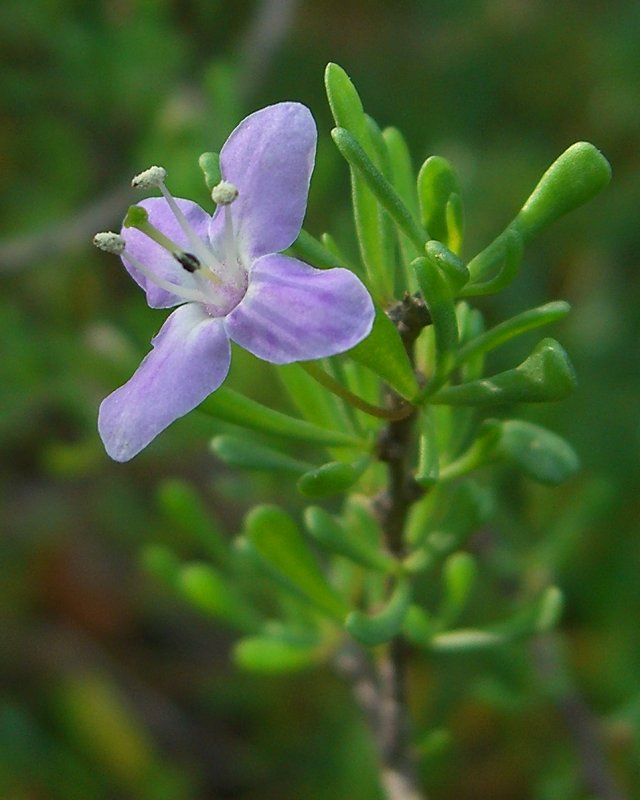
The flowers are about 1/4 to 1/2 inch across, borne singly in the leaf axils. Each has a short tube and usually four (occasionally five) spreading lobes in pale lavender, blue or purple, often with darker veins and a paler center, and the stamens protrude from the tube. The Lady Bird Johnson Wildflower Center gives a bloom season of April through October, and some flowers can appear at almost any time in mild winters.
Fruit
The fruit is a glossy, bright red, egg-shaped berry about 1/4 to 1/2 inch long, holding many small seeds. Berries ripen mainly from late summer into winter, often while the plant is still flowering. Look-alikes include the other American wolfberries, such as Wolfberry (Lycium berlandieri) of Texas brushlands, which has flat leaves and grows in drier, inland sites.
Quick Facts
| Scientific Name | Lycium carolinianum |
| Family | Solanaceae (nightshade family) |
| Plant Type | Spiny, semi-succulent shrub |
| Mature Height | 2–6 ft |
| Mature Spread | 3–6 ft; sprawling clumps |
| Growth Rate | Moderate |
| Sun Exposure | Full sun to part shade |
| Water Needs | Moderate to high; moist, often brackish soil, but tolerates dry spells |
| Soil Type | Coastal sand, shell, marl, loam or clay; salt tolerant |
| Soil pH | Neutral to alkaline (about 6.5–8.5) |
| Bloom Time | April–October; sporadically in mild winters |
| Flower Color | Pale lavender to blue-purple |
| Fall Color | None; leaves may drop in drought or cold |
| Fruit | Glossy red berry, 1/4–1/2 in, ripening late summer to winter |
| Deer Resistant | Somewhat; spiny, but browsed by deer |
| USDA Hardiness Zones | 8–11 |
Native Range
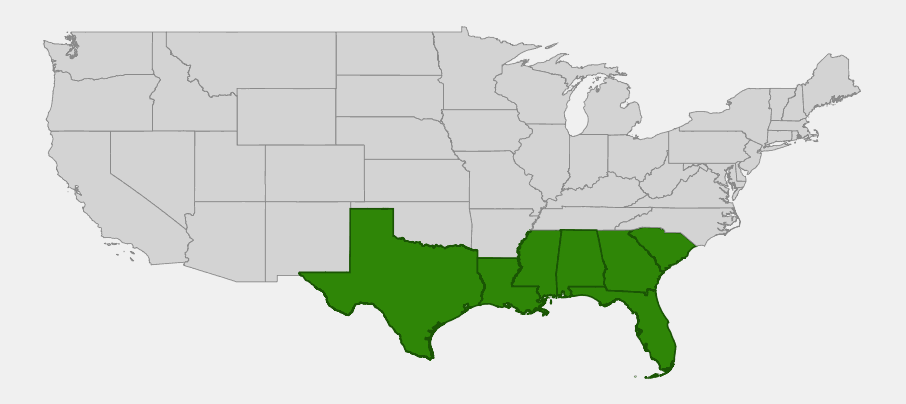
Carolina desert-thorn is a shrub of the southern Atlantic and Gulf coasts. USDA PLANTS records it in seven states: South Carolina, Georgia, Florida, Alabama, Mississippi, Louisiana and Texas, and the Lady Bird Johnson Wildflower Center describes its native distribution as the Coastal Plain from South Carolina to Texas. Beyond the United States it also grows on the Gulf coast of northeastern Mexico.
In Florida it is found along both coasts and through the Florida Keys, including Everglades National Park. It is a plant of the high marsh, the zone at the upper edge of salt and brackish marshes that floods only during high tides and storms, and of shell mounds, coastal hammocks, mangrove edges, salt flats, ditches and the landward sides of dunes.
Its most famous population is in the salt marshes of Aransas National Wildlife Refuge on the central Texas coast, the winter home of the only self-sustaining wild flock of whooping cranes. Research there found that wolfberry fruit can provide a large share of the cranes’ energy early in the winter, so the health of these marshes, and the freshwater inflows that sustain them, matters to the cranes’ survival.
📋 Regional plant lists featuring Carolina Desert-Thorn: North & South Florida · Alabama, Georgia & Mississippi · North & South Carolina · Arkansas, Louisiana, Eastern Oklahoma & Eastern Texas · South & West Texas
Growing & Care Guide
Carolina desert-thorn is a specialist of salty, sunny coastal ground, and it is most useful in gardens and restorations right on the coast. It is occasionally available from native nurseries in Florida and on the Gulf Coast, and it is easy to grow from seed.
Light
Full sun gives the best flowering and fruiting; it tolerates part shade at the edge of hammocks and mangroves.
Soil & Water
It grows in sand, shell, marl and even heavy clay, and it tolerates salt spray, saline soil and occasional tidal flooding. In the wild it is usually in moist, often brackish soil near the high tide line, but once established it also tolerates dry periods, shedding leaves and regrowing them after rain. In a freshwater garden setting, give it a sunny, well-drained but not droughty spot.
Planting Tips
Use it at the upper edge of a living shoreline, along a brackish ditch or retention pond, or in a coastal wildlife hedge, spaced about 3 to 4 feet apart. Its spines make it a good barrier, but keep it away from paths. Plant it with other salt-tolerant natives such as saltwort, sea oxeye and salt grass, which share its high-marsh niche.
Pruning & Maintenance
Little care is needed. Wear gloves when handling it because of the spiny twigs. Cut back long, sprawling stems in late winter after the birds have finished the berries, if you need to keep it in bounds. Stems that touch the ground may root and widen the clump.
Propagation
Propagate from seed, which the Lady Bird Johnson Wildflower Center suggests collecting from ripe berries in fall and cleaning by mashing and rinsing the pulp away. Sow fresh seed in a sandy mix. Cuttings and rooted layers from stems that have touched the ground also work.
Landscape Uses
- Living shorelines and marsh-edge restoration: a natural shrub for the high marsh zone above the tide line
- Coastal wildlife gardens: fall and winter berries for birds and other wildlife
- Salt-tolerant barriers: a spiny, low-maintenance hedge for salty, windy sites
- Pollinator plantings: a long season of small blue flowers for bees and other insects
- Brackish ditches and ponds: tolerates saline soil and periodic flooding
Wildlife & Ecological Value
Carolina desert-thorn has outsized importance for coastal wildlife, above all for one of North America’s rarest birds.
For Pollinators
The small tubular flowers provide nectar and pollen over a long season and are visited by bees and other insects. The Lady Bird Johnson Wildflower Center lists it as a nectar source for insects.
For Birds
The red berries are eaten by many birds. Most notably, they are a major winter food of endangered whooping cranes at Aransas National Wildlife Refuge in Texas, alongside blue crabs and clams; studies there found wolfberry fruit can supply roughly a fifth to half of the cranes’ energy intake early in the wintering period. Other marsh and shoreline birds also take the fruit, and the spiny tangles give cover to small birds.
For Mammals
The Lady Bird Johnson Wildflower Center notes browsing by deer and raccoons, and other mammals of the marsh edge also eat the fallen fruit.
Ecosystem Role
As one of the few woody plants of the high marsh, it adds structure to a zone dominated by grasses and succulents. Its fruit production depends on rainfall and marsh salinity; drought and reduced freshwater inflows can cut the berry crop, which in turn affects the wildlife that relies on it.
Cultural & Historical Uses
Thomas Walter, a planter-botanist on the Santee River in South Carolina, described Lycium carolinianum in his Flora Caroliniana of 1788. The genus name Lycium goes back to an ancient Greek name for a thorny shrub from Lycia in Asia Minor, and the genus includes the goji berry (Lycium barbarum) of Asia as well as many wolfberries and desert-thorns of the American Southwest.
The common names vary by region. In Florida it is usually called christmasberry, for the red berries that ripen around the holidays; in Texas, Carolina wolfberry; and USDA PLANTS uses Carolina desert-thorn. The fruit of goji and some American wolfberries is edible, but as with many nightshade-family plants, it is best not to eat wild berries unless you are certain of their identity and safety.
For conservationists, Carolina wolfberry is part of the story of the whooping crane’s recovery from about 15 birds in the 1940s. Researchers at Aransas have studied wolfberry growth and fruit production as one measure of the food available to the cranes.
Frequently Asked Questions
Is Carolina desert-thorn the same as christmasberry?
In Florida, yes: christmasberry is a common local name for Lycium carolinianum. But the same name is used for Crossopetalum ilicifolium, an unrelated low shrub of south Florida pine rocklands. Use the scientific name to be sure which plant you mean.
Why is it important to whooping cranes?
Endangered whooping cranes that winter on the Texas coast eat large amounts of its red berries early in the winter, along with blue crabs and clams. Studies at Aransas National Wildlife Refuge found the fruit can provide a large share of their energy at that time.
Can it grow away from the coast?
It is adapted to salty coastal soils but can be grown in ordinary sunny, well-drained garden soil within its climate range. It is most valuable, and usually healthiest, in coastal sites where it has little competition.
Are the berries edible?
It is related to the goji berry, and some sources describe the fruit as edible, but it belongs to the nightshade family. Do not eat wild berries unless you are certain of their identity; leaving them for birds is the better choice.
Does it tolerate salt water?
Yes. It grows naturally at the upper edge of salt and brackish marshes and tolerates salt spray, saline soil and occasional tidal flooding.

Looking for a nursery that carries Carolina Desert-Thorn?
Browse our native plant nursery directory: Alabama · Florida & Georgia · Louisiana & Mississippi · South Carolina & Texas