
Texas Bindweed (Convolvulus equitans)
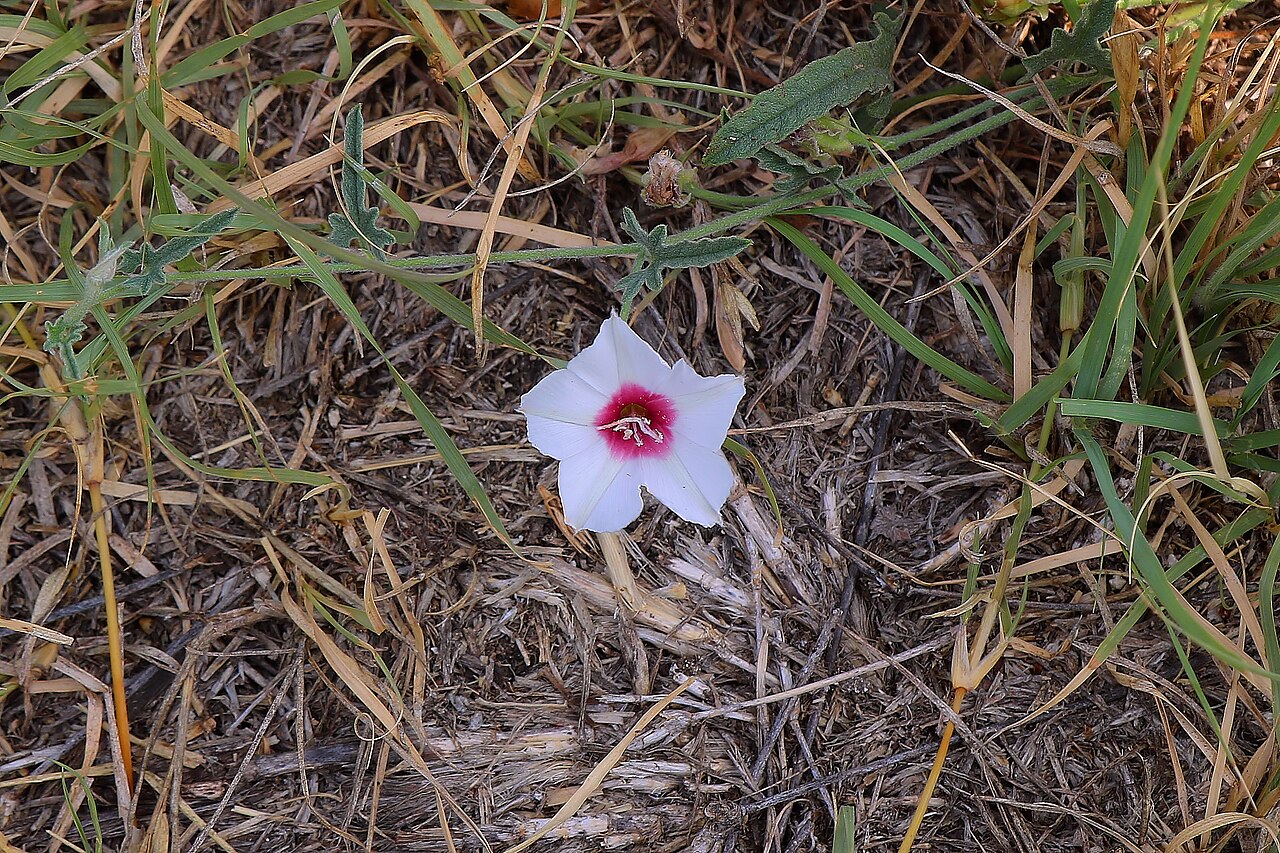
Convolvulus equitans, known as Texas Bindweed, is a trailing and twining native wildflower of prairies, grasslands, rocky slopes and roadsides in the southern Great Plains and Southwest. Its slender, grayish-hairy stems run along the ground or wind through grasses and shrubs for up to about 6 feet, and from spring through fall they carry white to pale pink, morning-glory-like flowers, usually with a striking deep red or purple center.
It belongs to the morning glory family (Convolvulaceae), and it is closely related to the infamous field bindweed (Convolvulus arvensis), a Eurasian weed that is among the most troublesome invasive plants in North American farmland and gardens. Texas bindweed is a different, native species with a much gentler habit. The Lady Bird Johnson Wildflower Center describes it as a “non-aggressive climber” with pretty, morning-glory-like flowers.
Texas bindweed is common in Texas, where it is found in prairies and disturbed areas in all but the eastern edge of the state, and it ranges north to Kansas and Colorado and west to Arizona, Utah and California, as well as into Mexico. This guide shows how to recognize it, how to tell it from field bindweed, and how to use it in dry, naturalistic gardens.
Identification
Texas bindweed is easy to recognize when it is in flower: low, gray-green trailing stems with variable, often lobed leaves and white funnel-shaped flowers with a dark red eye. Learning to separate it from field bindweed matters, because one is a native wildflower and the other a serious weed.
Stems
Plants grow from a perennial root (some plants behave as annuals) and produce several slender stems that trail along the ground or twine around grasses, fences and low shrubs. Stems are usually 1 to 6 feet long and covered with fine, flattened, grayish hairs that give the whole plant a silvery or gray-green look.
Leaves
The leaves are alternate, 1 to 3 inches long, and remarkably variable. Some are narrow and oblong with wavy or toothed edges, others are arrow- or halberd-shaped with spreading basal lobes, and many have coarse teeth or shallow lobes along the sides. All are covered with soft gray hairs. Field bindweed leaves, by contrast, are smooth or nearly hairless, bright green and more regularly arrowhead-shaped.
Flowers
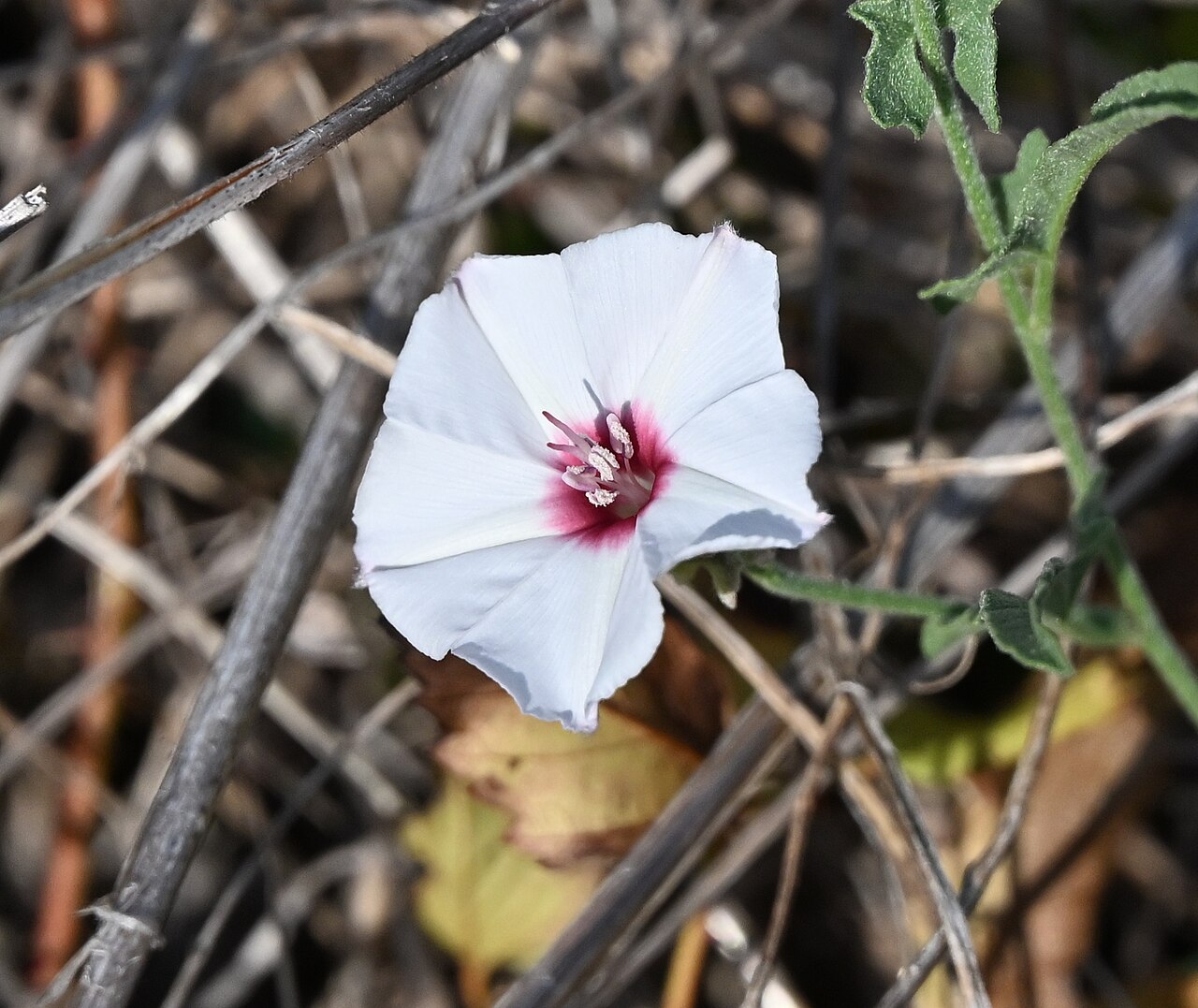
Flowers grow singly or in small groups on stalks from the leaf axils. Each is a funnel or shallow trumpet about ¾ to 1¼ inches across, with five fused petals forming a slightly five-angled rim. They are white to pale pink, usually with a deep red, maroon or purple center, though the eye is sometimes faint or missing. Small bracts sit on the flower stalk below the sepals. Blooms open in the morning and close by afternoon, and the plant flowers from April to October.
Field bindweed flowers are white to pink, often with pinkish stripes on the outside, but they lack the dark red center, and the plants are smooth rather than gray-hairy.
Fruit & Seeds
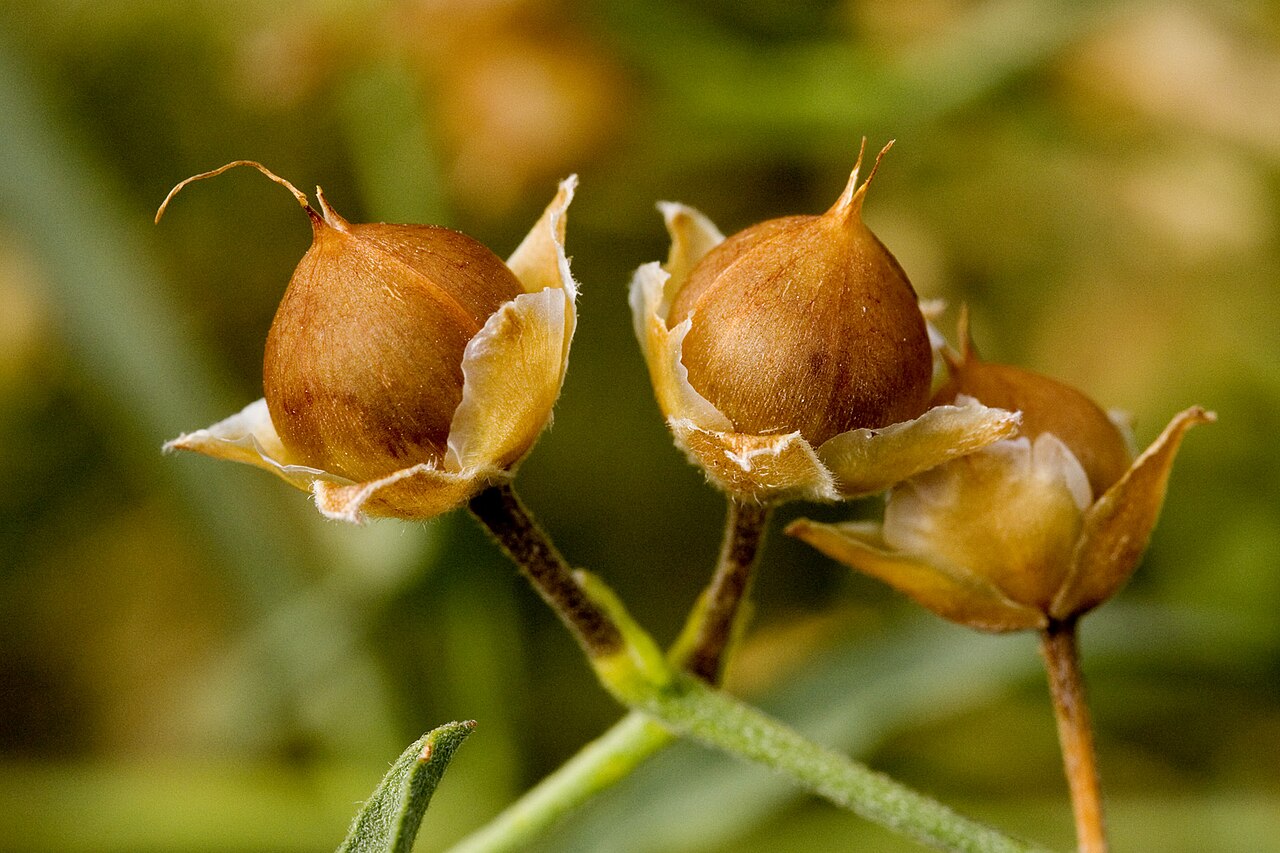
Each flower produces a round, smooth, papery capsule about ¼ inch across, held in a cup of persistent sepals. When ripe it turns tan to brown and splits to release 2 to 4 dark, hard, roughened seeds. The seeds can lie dormant in the soil for some time, so plants often reappear after soil disturbance or rain.
Quick Facts
| Scientific Name | Convolvulus equitans (syn. C. hermannioides) |
| Family | Convolvulaceae (morning glory family) |
| Plant Type | Trailing or twining perennial vine (sometimes annual) |
| Mature Height | Low; trailing stems 1–6 ft long |
| Mature Spread | 2–6 ft |
| Growth Rate | Moderate to fast |
| Sun Exposure | Full sun to partial shade |
| Water Needs | Low; drought tolerant |
| Soil Type | Sandy, loamy, clay or rocky, well-drained soil; tolerates caliche |
| Soil pH | About 6.5–8.5 |
| Bloom Time | April–October |
| Flower Color | White to pale pink with a red to purple center |
| Fall Color | None |
| Fruit | Small round capsule with 2–4 seeds |
| Deer Resistant | Moderately; occasionally browsed |
| USDA Hardiness Zones | 6–10 |
Native Range
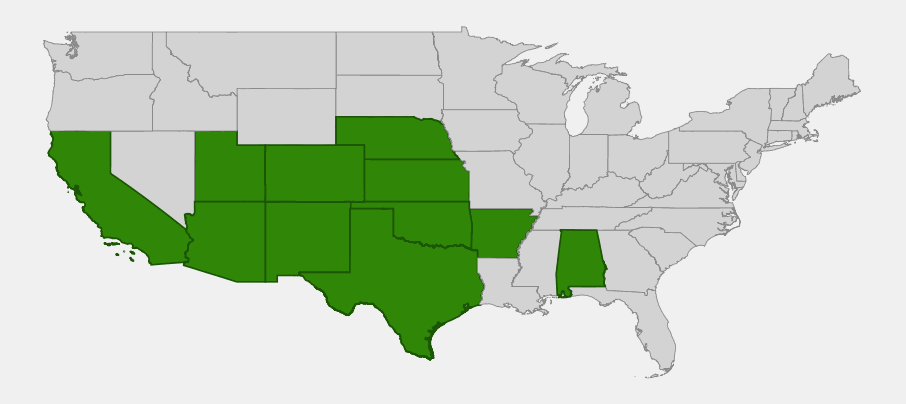
Texas bindweed is native to the southern Great Plains, the Southwest and Mexico. The Lady Bird Johnson Wildflower Center calls it common in prairies and disturbed areas of all but the eastern edge of Texas and notes that it also ranges to Kansas, Colorado, Arizona and Mexico. USDA PLANTS records it in 11 states, including Oklahoma, New Mexico, Utah, California and Arkansas, along with outlying records from Nebraska and Alabama.
Its heartland is Texas and Oklahoma, where it grows across the Blackland Prairie, the Edwards Plateau, the Rolling Plains, the High Plains and the Trans-Pecos. Westward it extends through the grasslands and desert scrub of New Mexico and Arizona, onto the Colorado Plateau in Utah and Colorado, and into southern California. At the eastern edge of its range, in Arkansas and beyond, it is uncommon.
Typical habitats include shortgrass and mixed-grass prairie, desert grassland, mesquite savanna, rocky limestone slopes, canyon bottoms, roadsides, field edges and vacant lots. It tolerates poor, dry soils and often appears in openings created by grazing, mowing or other disturbance.
📋 Regional plant lists featuring Texas Bindweed: Idaho, Eastern Oregon & Eastern Washington · Nebraska, Kansas & Eastern Colorado · Utah & Western Colorado · Arizona & New Mexico · Alabama, Georgia & Mississippi
Growing & Care Guide
Texas bindweed is rarely sold, but it often appears on its own in dry, sunny yards and meadows within its range. Rather than pulling it as a weed, consider leaving it: it is a native, non-aggressive plant that adds delicate flowers to dry ground for months. Just be sure you have the native and not field bindweed.
Light
Full sun to partial shade. The Lady Bird Johnson Wildflower Center lists part shade as suitable, and in hot desert areas plants often grow in the light shade of shrubs and grasses. Flowering is heaviest in sun.
Soil & Water
It grows in dry, well-drained soils of almost any texture, including sand, clay, rocky limestone and caliche. Once established it needs no watering in most of its range. Overwatering and rich soil only favor weedy competitors.
Planting Tips
Grow it from seed, sown in spring or fall on bare or lightly vegetated ground. Nick or scarify the hard seeds, or soak them overnight, to improve germination. Let it trail among bunchgrasses, over rocks or along a low fence, where its stems have something to climb.
Pruning & Maintenance
Very little care is needed. Trim back stems that wander into paths or onto other plants. In meadows, an occasional mowing or burn keeps the open habitat it prefers. Seedlings that appear where they are not wanted are easy to pull while young.
Propagation
Propagate by seed, collected throughout summer as the capsules turn brown, as the Lady Bird Johnson Wildflower Center recommends. Scarify the seeds before sowing. Plants can also be started from root sections, but seed is simpler and more reliable.
Landscape Uses
- Dry meadows and prairie plantings: a delicate trailing flower among bunchgrasses
- Xeriscapes and rock gardens: drought tolerant and thrives in poor soil
- Pollinator gardens: flowers visited by bees from spring to fall
- Naturalistic lawns and roadsides: tolerates mowing and disturbance
- Erosion control on dry slopes: trailing stems help cover bare ground
Wildlife & Ecological Value
Texas bindweed is a small plant, but its long bloom season makes it a steady resource for pollinators on dry grasslands and roadsides.
For Pollinators
The open, funnel-shaped flowers are visited by native bees, including sweat bees, small carpenter bees and specialist bees that collect pollen from morning glories and bindweeds. Flies, beetles and small butterflies also visit. Because the flowers open in the morning and close by afternoon, most visits happen in the cooler morning hours.
For Birds
Quail, doves and other ground-feeding birds eat the hard seeds, which fall near the plant. The trailing stems offer little cover, but they are part of the diverse forb layer that supports insects eaten by grassland birds.
For Mammals
Deer, rabbits and livestock occasionally browse the foliage, and small rodents eat the seeds. It is not a major forage plant.
Ecosystem Role
Texas bindweed is an early colonizer of bare and disturbed soil in prairies and grasslands, where its trailing stems help shade the soil and reduce erosion. It persists in mowed and grazed areas, and it provides native flowering cover where invasive weeds might otherwise move in.
Cultural & Historical Uses
The species was described by the English botanist George Bentham in the nineteenth century. The genus name Convolvulus comes from the Latin convolvere, to twine or roll together, describing the twining stems typical of the genus. Older references sometimes call this plant Convolvulus hermannioides, a name now treated as a synonym.
In Mexico it is known as campanilla herida; campanilla, little bell, is a name used for many small bell- or funnel-shaped flowers. Records of traditional uses are limited, and some members of the morning glory family contain compounds that are harmful if eaten, so it should not be used as food or medicine.
Texas bindweed is a good example of a native plant often overlooked because of its resemblance to a notorious weed. Learning to tell it apart from field bindweed lets gardeners and land managers keep a useful native wildflower while controlling the invasive species.
Frequently Asked Questions
Is Texas bindweed invasive?
No. It is a native wildflower of the southern Plains and Southwest, and the Lady Bird Johnson Wildflower Center describes it as a non-aggressive climber. It is often mistaken for field bindweed, which is an invasive Eurasian weed.
How can I tell Texas bindweed from field bindweed?
Texas bindweed has gray-hairy stems and leaves, variable often-lobed leaves, and white to pale pink flowers usually with a deep red or purple center. Field bindweed is smooth and bright green, with arrowhead-shaped leaves and white to pink flowers without the dark center.
When does Texas bindweed bloom?
From April to October. The flowers open in the morning and close by early afternoon, and plants keep producing new flowers through the season.
Does Texas bindweed need water?
No. It is drought tolerant and grows in dry, poor soils. Extra water and fertilizer mostly help weeds compete with it.
Is Texas bindweed good for pollinators?
Yes. Native bees, including some that specialize on morning-glory-family flowers, visit its flowers, and its long bloom season provides a steady supply of pollen and nectar.

Looking for a nursery that carries Texas Bindweed?
Browse our native plant nursery directory: Alabama, Arizona & Arkansas · California · Colorado · Kansas · Nebraska, New Mexico & Oklahoma · Texas & Utah