
Canada Clearweed (Pilea pumila)
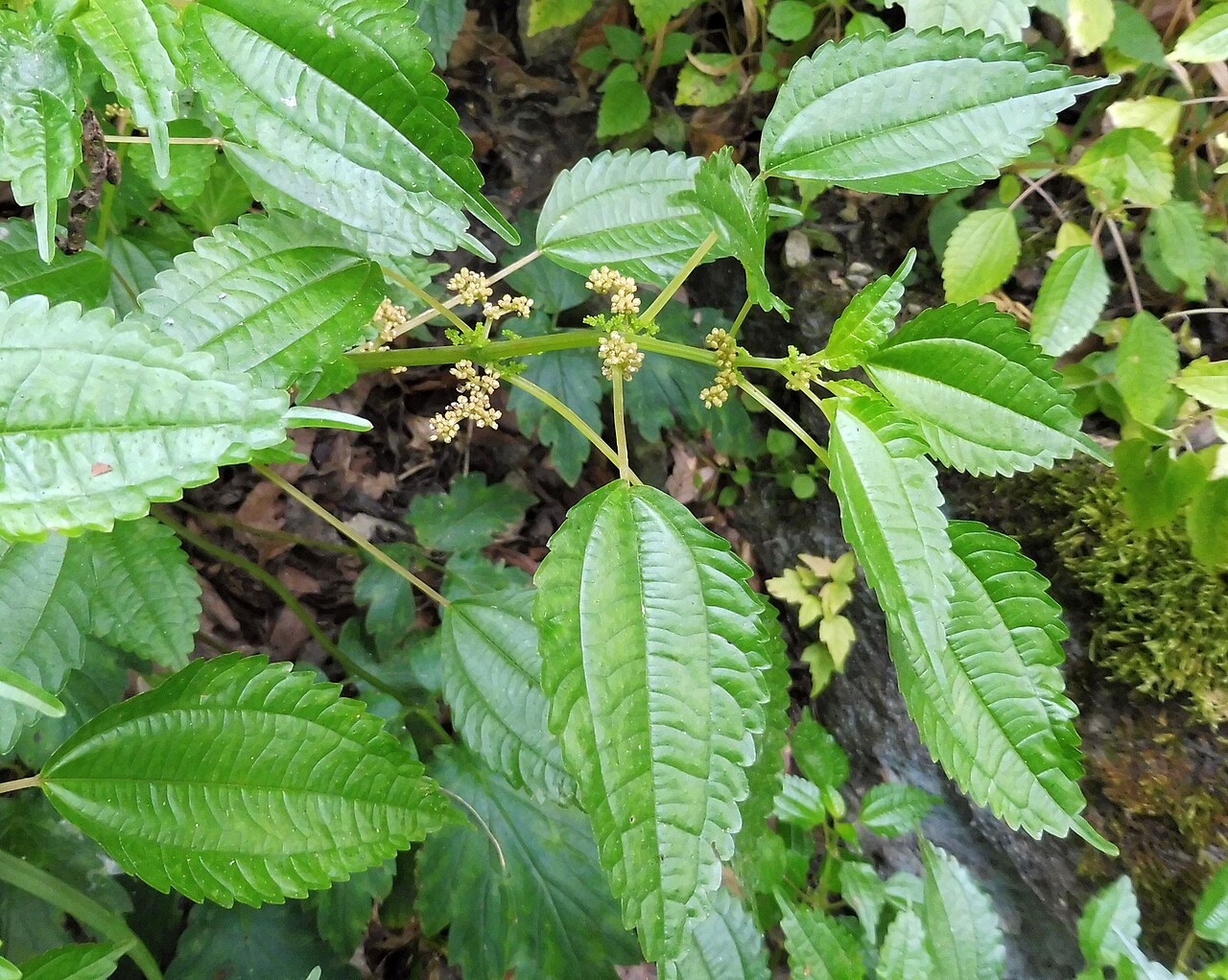
Pilea pumila, known as Canada Clearweed (USDA: Canadian clearweed), clearweed or richweed, is a small annual of the nettle family (Urticaceae) that grows in moist, shady places throughout eastern North America. Its most remarkable feature is its stem: smooth, succulent and so watery that it looks almost translucent, as if it were made of green glass. Unlike its relatives the stinging nettle and wood nettle, clearweed has no stinging hairs and is completely harmless to touch.
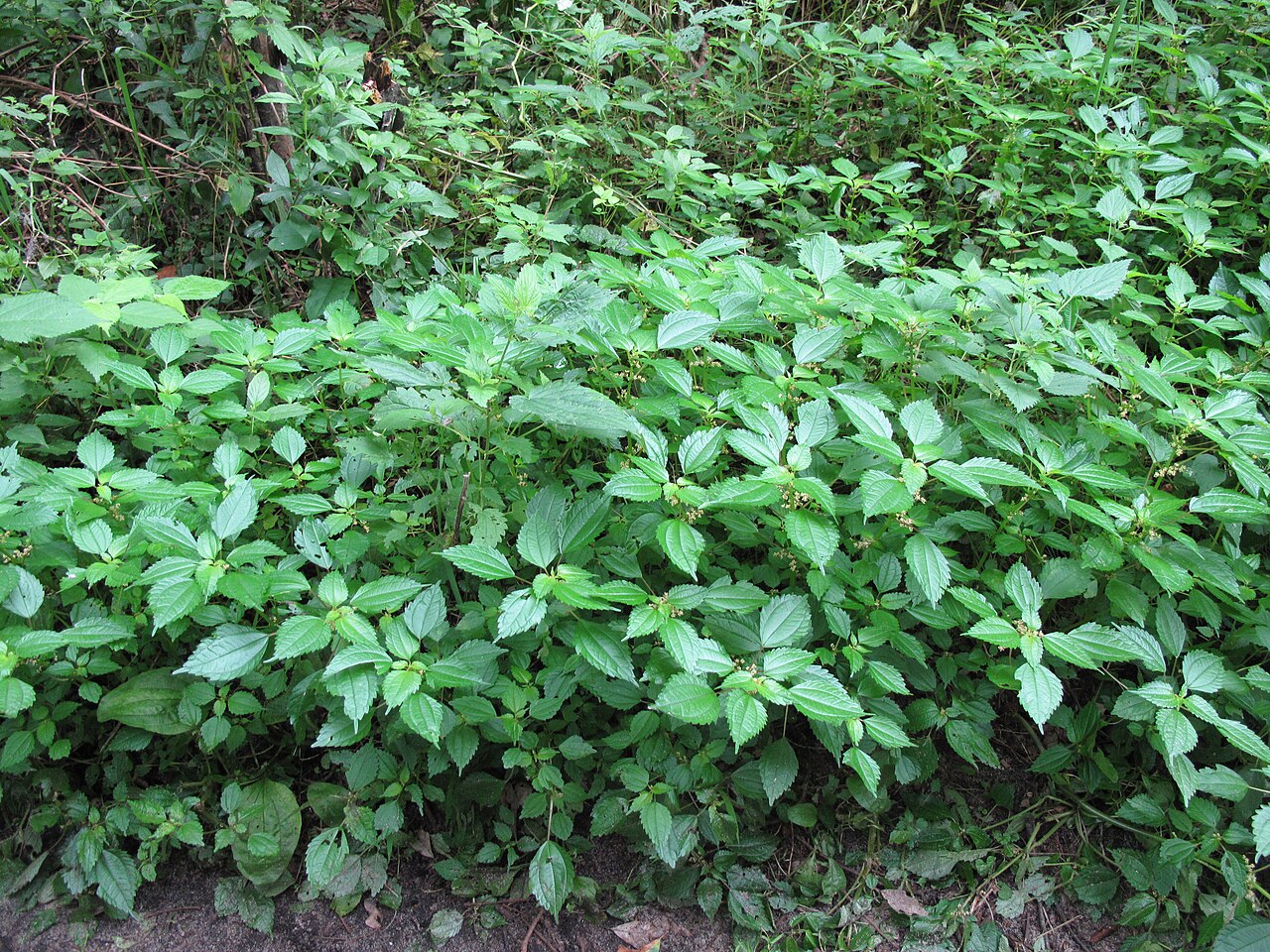
Clearweed is usually 6 inches to 2 feet tall, with opposite, glossy, coarsely toothed leaves and small clusters of greenish flowers in the leaf axils from mid-summer to early fall. It favors rich, damp soil in floodplain forests, along shaded streams and seeps, at the bases of moist cliffs and in shady, disturbed spots such as trail edges and old logging roads. Where conditions suit it, it can form a continuous green carpet across the forest floor by late summer.
Although it is easy to overlook as just another green “weed,” clearweed is a genuine native wildflower with a broad range, from Nova Scotia and Quebec west to the Dakotas and south to Florida and Texas, and it also grows in eastern Asia. It is a caterpillar food plant for several nettle-feeding butterflies, and it makes an easy, self-sowing groundcover for wet shade. This guide explains how to recognize it and how to use it in a native garden.
Identification
The combination of a translucent, watery stem, opposite toothed leaves with three main veins, and the absence of stinging hairs identifies clearweed. Several nettle-family plants grow in the same habitats, so compare them carefully.
Stems
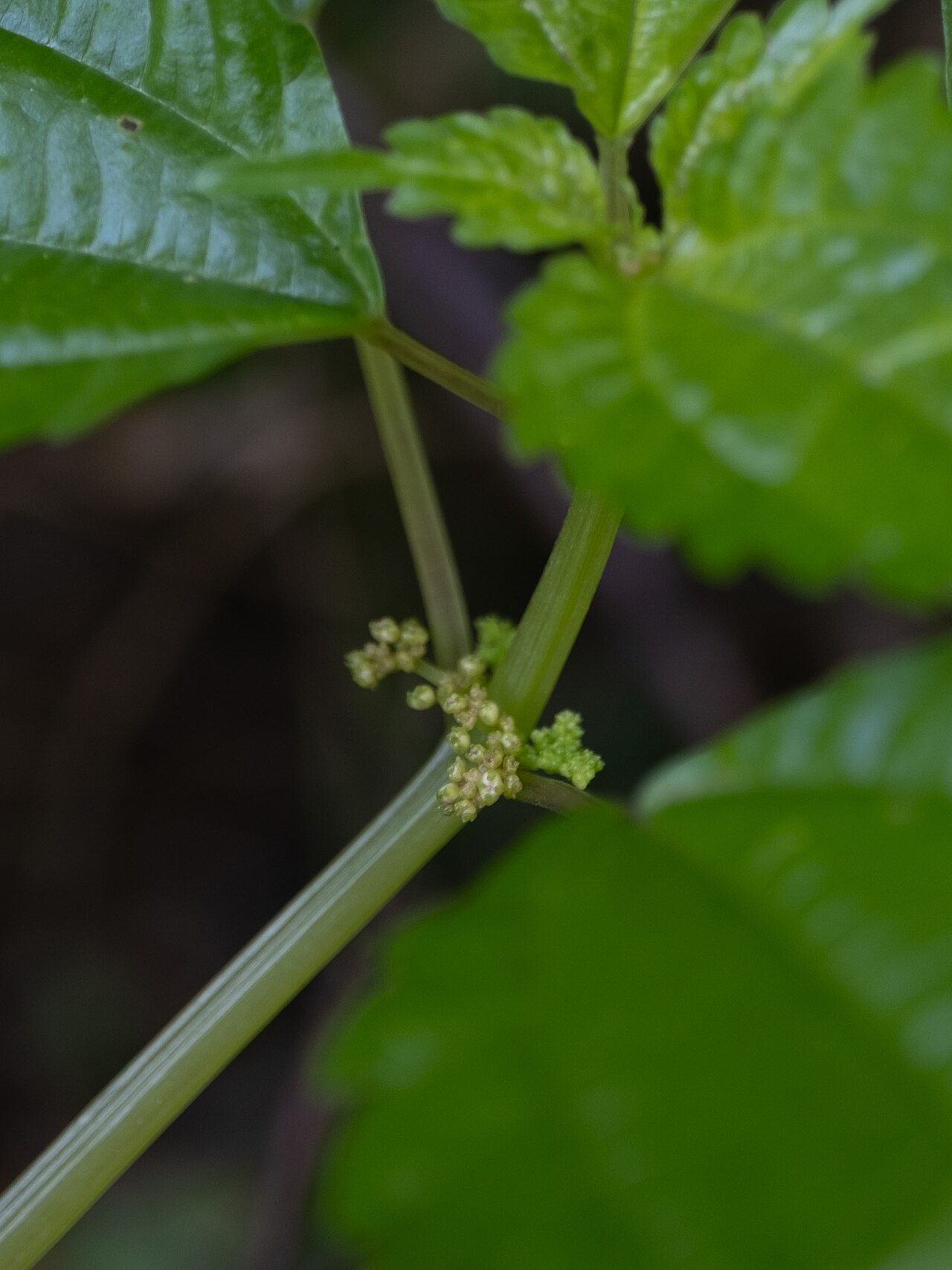
The stems are smooth, hairless and very succulent, light green to reddish green, and noticeably translucent when held up to the light. They usually branch only a little and are 6 to 24 inches tall, occasionally taller in rich soil. Because they are full of water, they are easily crushed, and the whole plant collapses with the first hard frost. Illinois Wildflowers notes that its translucency has made it useful in biology classes to show how plants carry water from roots to leaves.
Leaves
The leaves are opposite, ovate, ¾ to 4 inches long, thin and hairless, with coarsely toothed edges and a pointed tip. They have a prominent central vein and two strong side veins that arise near the base, giving them a three-veined look. The upper surface is green to dark green and often shiny, and the lower surface is paler. Leaf stalks are long, often an inch or more.
Flowers
From mid-summer to early fall, small, curved clusters of tiny greenish-white to greenish-yellow flowers grow from the axils of the upper leaves, usually shorter than the leaf stalks. Male and female flowers are separate, often on the same plant. They have no petals and no scent, and they are pollinated by wind. Male flowers have four stamens that spring open suddenly to toss pollen into the air.
Fruit & Seeds
Each female flower produces a tiny, flattened achene, green or pale with darker markings. The seeds are small enough to be carried by wind and water, and they lie in the soil until conditions are right, so clearweed can reappear in the same patch year after year.
Similar Species
Lesser clearweed (Pilea fontana) is very similar but has less translucent stems and black achenes; it grows mainly in wetlands and fens. Wood Nettle and Stinging Nettle have stinging hairs and opaque stems. False Nettle is a perennial with hairier, opaque stems and its flowers in long, spike-like clusters. Young Jewelweed also has watery, translucent stems but its leaves are alternate and it bears orange flowers.
Quick Facts
| Scientific Name | Pilea pumila (L.) A. Gray |
| Family | Urticaceae (nettle family) |
| Plant Type | Annual herb; non-stinging member of the nettle family |
| Mature Height | 6–24 in (occasionally to about 28 in) |
| Mature Spread | 6–12 in; forms dense colonies by self-seeding |
| Growth Rate | Fast |
| Sun Exposure | Part shade to full shade |
| Water Needs | High; moist to wet soil |
| Soil Type | Rich, moist loam, alluvial soil and humus; tolerates disturbed soil |
| Soil pH | About 5.5–7.5 (slightly acidic to slightly alkaline) |
| Bloom Time | July–October |
| Flower Color | Greenish white to greenish yellow (inconspicuous) |
| Fall Color | None; plants collapse at first hard frost |
| Fruit | Tiny flattened achene, green with darker markings |
| Deer Resistant | Moderately; not a preferred browse |
| USDA Hardiness Zones | Annual; grows wild in zones 3–9 |
Native Range
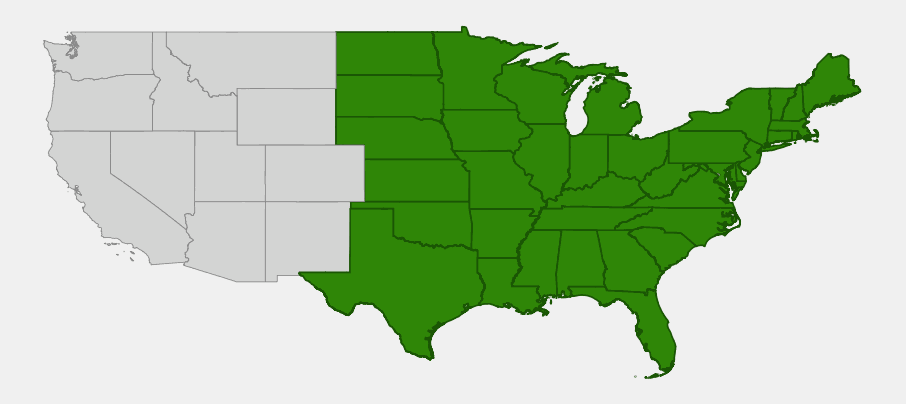
Canada clearweed has a wide range in eastern and central North America. USDA PLANTS records it as native in 37 states and the District of Columbia, from Maine and Vermont west to Minnesota and the Dakotas, south to Florida, and west to Nebraska, Kansas, Oklahoma and Texas. In Canada it grows in Ontario, Quebec, New Brunswick, Nova Scotia and Prince Edward Island. The species also occurs in eastern Asia, including China, Korea and Japan.
It is most common in the Midwest, the Ohio and Mississippi valleys, the Appalachians and the Northeast, wherever rich, damp forests and stream corridors are found. At the edges of its range it becomes more local: on the Great Plains it is limited to wooded river valleys in the eastern Dakotas, Nebraska and Kansas, in Texas it grows mainly in the eastern forests, and in Florida it is found in the northern counties.
Clearweed’s habitats include floodplain and bottomland forests, rich mesic woods, shaded stream banks, seeps and springs, wooded swamps, the bases of moist cliffs and shaded ravines. It also readily colonizes moist, disturbed ground in shade, such as trail edges, woodland roads, logged areas and shady gardens.
📋 Regional plant lists featuring Canada Clearweed: North & South Florida · Alabama, Georgia & Mississippi · North & South Carolina · Maryland, Virginia & West Virginia · Kentucky & Tennessee · Arkansas, Louisiana, Eastern Oklahoma & Eastern Texas · Illinois, Iowa & Missouri · Ohio & Indiana · Nebraska, Kansas & Eastern Colorado · North Dakota, South Dakota & Western Minnesota · Michigan, Wisconsin & Eastern Minnesota · New York, Pennsylvania & Northern New Jersey · Delaware, Southern New Jersey & Long Island · Connecticut, Massachusetts & Rhode Island · New Hampshire, Maine & Vermont
Growing & Care Guide
Canada clearweed is rarely sold, but it is very easy to grow and often appears on its own in shady, moist gardens. Rather than weeding it out, many native gardeners now let it fill gaps in wet shade, where it serves as a living mulch and supports native butterflies.
Light
Part shade to full shade. Clearweed thrives under trees and on the north side of buildings. In sun it wilts quickly unless the soil stays wet.
Soil & Water
Grow it in rich, moist to wet soil with plenty of organic matter. It does well in rain gardens, along shady streams and ponds, and in low spots that stay damp. It does not tolerate drought; in dry spells, plants wilt and may die early. No fertilizer is needed.
Planting Tips
Because it is an annual, clearweed is usually established from seed. Scatter seed in fall on moist, bare soil in shade, or move a few seedlings in spring from an existing patch, keeping the root ball intact. Once established, it reseeds every year. Use it to fill spaces among ferns, sedges and spring ephemerals, which go dormant by summer just as clearweed takes over.
Pruning & Maintenance
No pruning is needed. If it spreads farther than you want, pull seedlings in early summer; the shallow roots come up easily. Leave plants in place in fall so they can drop seed, then let the frost-killed stems decay into the soil.
Propagation
Seed is the only method. Collect the tiny achenes in early fall, or simply let plants self-sow. Seeds germinate in spring after a cold, moist winter, so fall sowing outdoors works best.
Landscape Uses
- Living mulch in wet shade: fills gaps among ferns and woodland wildflowers in summer
- Rain gardens and stream banks: shaded, moist edges where few annuals grow
- Butterfly gardens: caterpillar food plant for nettle-feeding butterflies
- Education: its translucent stems show how water moves through a plant
- Floodplain restoration: part of the native herb layer of bottomland forests
Wildlife & Ecological Value
Clearweed is not showy, and its wind-pollinated flowers attract few insects. Its foliage, however, feeds a surprising number of animals.
For Pollinators
The flowers are pollinated by wind and offer no nectar, so clearweed does little for bees. Its greater value is as a larval host. According to Illinois Wildflowers, caterpillars of Milbert’s tortoiseshell, eastern comma, question mark and red admiral butterflies feed on its foliage, as they do on other members of the nettle family. Because clearweed does not sting, it is an easy way to provide nettle-family host plants in a garden. The larvae of a tiny moth, the beautiful cosmopterix (Cosmopterix pulchrimella), mine its leaves.
For Birds
Ground-feeding birds such as sparrows and juncos may eat the small seeds, and the caterpillars and other insects on the plant provide food for songbirds. Dense patches offer low cover for ground-nesting and foraging birds in moist forests.
For Mammals
Clearweed is not an important food for mammals. Deer occasionally browse it, and dense patches provide cover for small animals along streams.
Ecosystem Role
As a fast-growing annual of moist forest floors, clearweed quickly covers bare soil after floods and disturbance, helping hold silt and leaf litter in place. Its soft, water-rich tissues decompose rapidly in fall, returning nutrients to the soil. It is part of the summer herb layer that follows the spring ephemerals in rich eastern forests.
Cultural & Historical Uses
Linnaeus described this plant in 1753 as Urtica pumila, placing it with the stinging nettles, and Asa Gray later moved it to Pilea. The genus name comes from the Latin pileus, a felt cap, referring to the shape of a sepal that covers the fruit in some species. Pumila means dwarf. Although the genus Pilea is mostly tropical and includes popular houseplants such as the Chinese money plant and aluminum plant, clearweed is one of the few species native to temperate North America.
The common name clearweed comes from the translucent stems, and richweed refers to the rich, moist soil where it grows. There is little reliable record of medicinal or food use, so the plant is best appreciated for its ecological value rather than as a remedy.
For botanists, clearweed is a useful indicator plant: abundant patches usually signal moist, nutrient-rich soil and a healthy forest floor. It is also one of the easiest native plants for showing children how plants drink water, since colored water placed at the base of a cut stem can be seen moving up through it.
Frequently Asked Questions
Does Canada clearweed sting?
No. Although it belongs to the nettle family, clearweed has no stinging hairs and is completely safe to touch. That is one of the easiest ways to tell it from wood nettle and stinging nettle.
Is clearweed a weed?
It is a native annual that often appears on its own in moist, shady gardens, so some people treat it as a weed. It is not invasive, it pulls out easily, and it supports several native butterflies, so many native gardeners leave it in place.
Why are clearweed stems see-through?
The stems are very succulent and thin-walled, with little fiber or pigment, so light passes through them easily. That watery structure is also why the plants collapse after the first hard frost.
Is clearweed a perennial?
No. Canada clearweed is an annual. Each plant lives for one season, but it reseeds so reliably that patches return in the same place every year.
Which butterflies use clearweed?
Illinois Wildflowers lists Milbert’s tortoiseshell, eastern comma, question mark and red admiral as butterflies whose caterpillars feed on clearweed, along with other nettle-family plants.

Looking for a nursery that carries Canada Clearweed?
Browse our native plant nursery directory: Alabama & Arkansas · Connecticut, Delaware, Florida & Georgia · Illinois, Indiana, Iowa & Kansas · Kentucky, Louisiana, Maine, Maryland, Massachusetts, Michigan, Minnesota, Mississippi & Missouri · Nebraska, New Hampshire, New Jersey, New York, North Carolina, North Dakota, Ohio & Oklahoma · Pennsylvania, Rhode Island, South Carolina, South Dakota, Tennessee, Texas, Vermont & Virginia · West Virginia & Wisconsin