American Stinging Nettle (Urtica dioica ssp. gracilis)
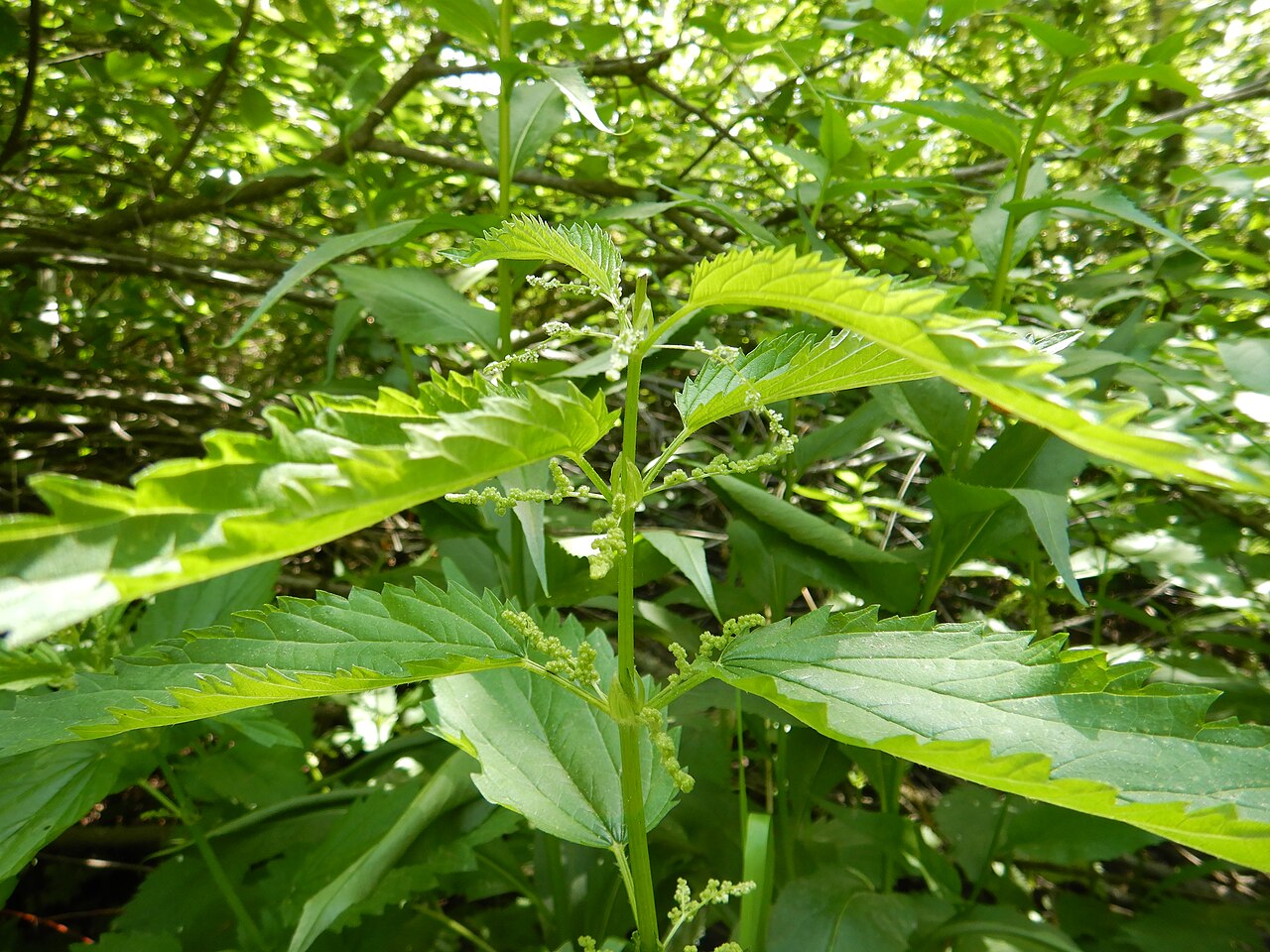
Urtica dioica ssp. gracilis, commonly called American Stinging Nettle (also sold as tall nettle or California nettle), is the subspecies of stinging nettle that is native to North America. It is easy to confuse with the familiar European stinging nettle, Urtica dioica ssp. dioica, which was introduced from Europe and has since naturalized across much of the continent — the two look almost identical to a casual glance, and most wild “stinging nettle” patches people encounter are actually a mix of the native and introduced subspecies growing side by side.
American stinging nettle is a coarse, upright, rhizomatous perennial herb, typically 3 to 7 feet tall, found in moist, nutrient-rich soil along streambanks, floodplains, woodland edges, and other disturbed-but-fertile ground throughout most of the continental United States and Canada, from the Pacific Northwest and Rocky Mountains across the Midwest to New England and the mid-Atlantic. Like all nettles, every part of the plant above ground is armed with stinging hairs that inject an irritating mix of chemicals on contact.
This plant stings on contact. Brushing bare skin against the leaves or stems causes an immediate burning, itching rash that can last anywhere from a few minutes to several hours. Always wear long sleeves, long pants, and gloves when working near nettle patches, and keep children and pets away from established stands. The sting is a defense mechanism, not a sign of toxicity — heat destroys the stinging compounds, which is why nettle greens must be thoroughly cooked or dried before any contact with skin or mouth; this page does not provide cooking instructions.
Identification
American stinging nettle is a native wildflower in both conservation and restoration contexts, but anyone encountering it should identify it by the stinging hairs first, before getting close enough to examine other features.
Growth Form
The plant grows as an upright, unbranched to sparsely branched perennial herb, usually 3 to 7 feet tall, arising each spring from a persistent network of yellow, spreading rhizomes. Stands often form dense colonial patches where the rhizomes have had several years to spread, especially in rich, moist, partly shaded soil.
Stems & Stinging Hairs
Stems are four-angled (square in cross-section), green to purplish, and — like the leaves — covered in stinging hairs (trichomes) as well as softer, non-stinging hairs. Each stinging hair acts like a tiny hypodermic needle: the brittle silica tip breaks off on contact with skin, injecting a mix of histamine, formic acid, and other irritants that cause the characteristic burning rash. The reaction is uncomfortable but not dangerous for most people, though a few individuals develop a more severe, longer-lasting reaction.
Leaves
Leaves are opposite, 2 to 6 inches long, narrowly to broadly ovate with a pointed tip and coarsely saw-toothed (serrate) margins. Both leaf surfaces bear stinging hairs, with the undersides typically more densely armed than the tops. American stinging nettle (ssp. gracilis) tends to have narrower, more tapered leaves than the introduced European subspecies, though the two overlap enough in appearance that flowering and fruiting structures are usually needed for a confident identification.
Flowers & Fruit
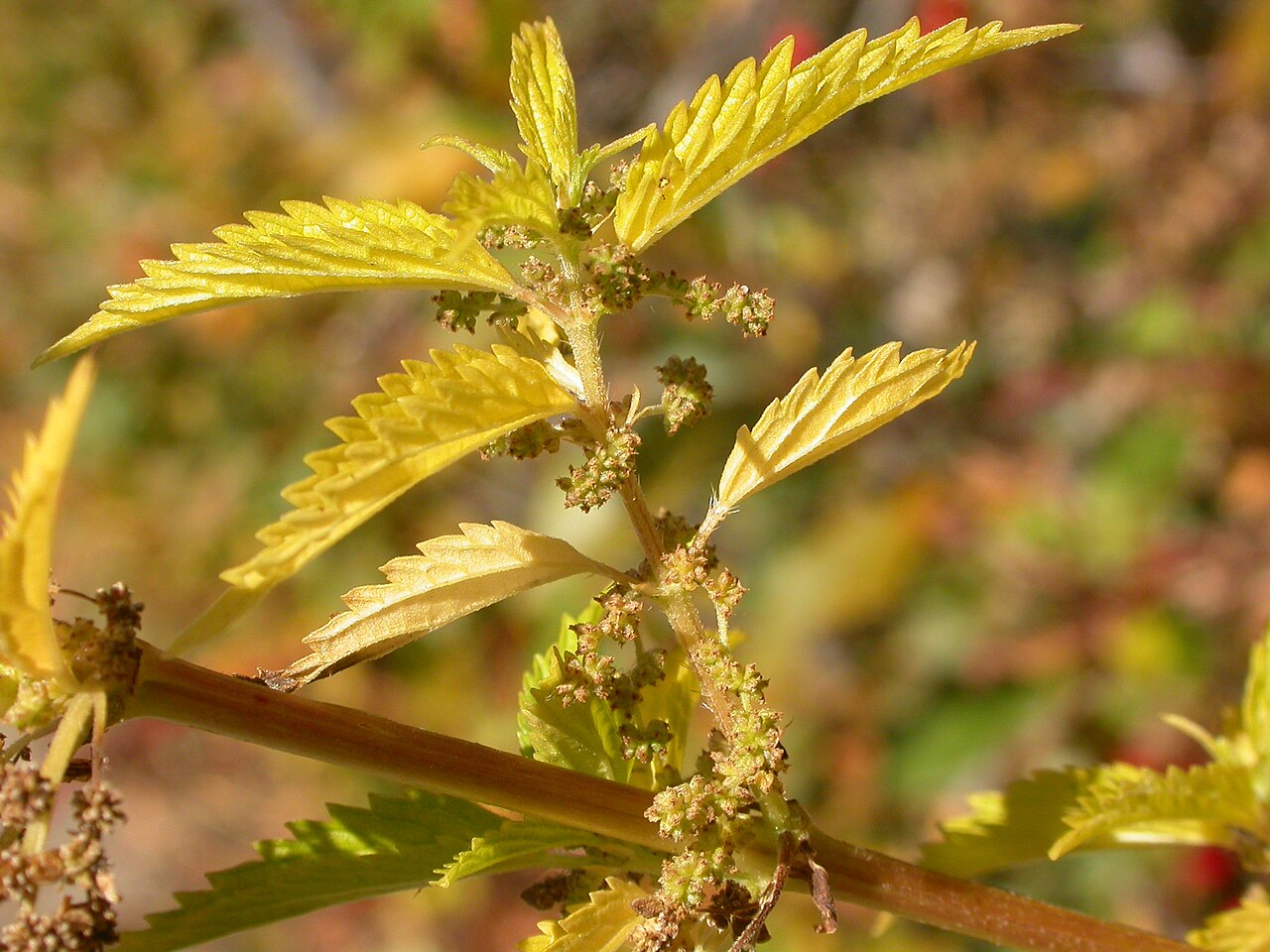
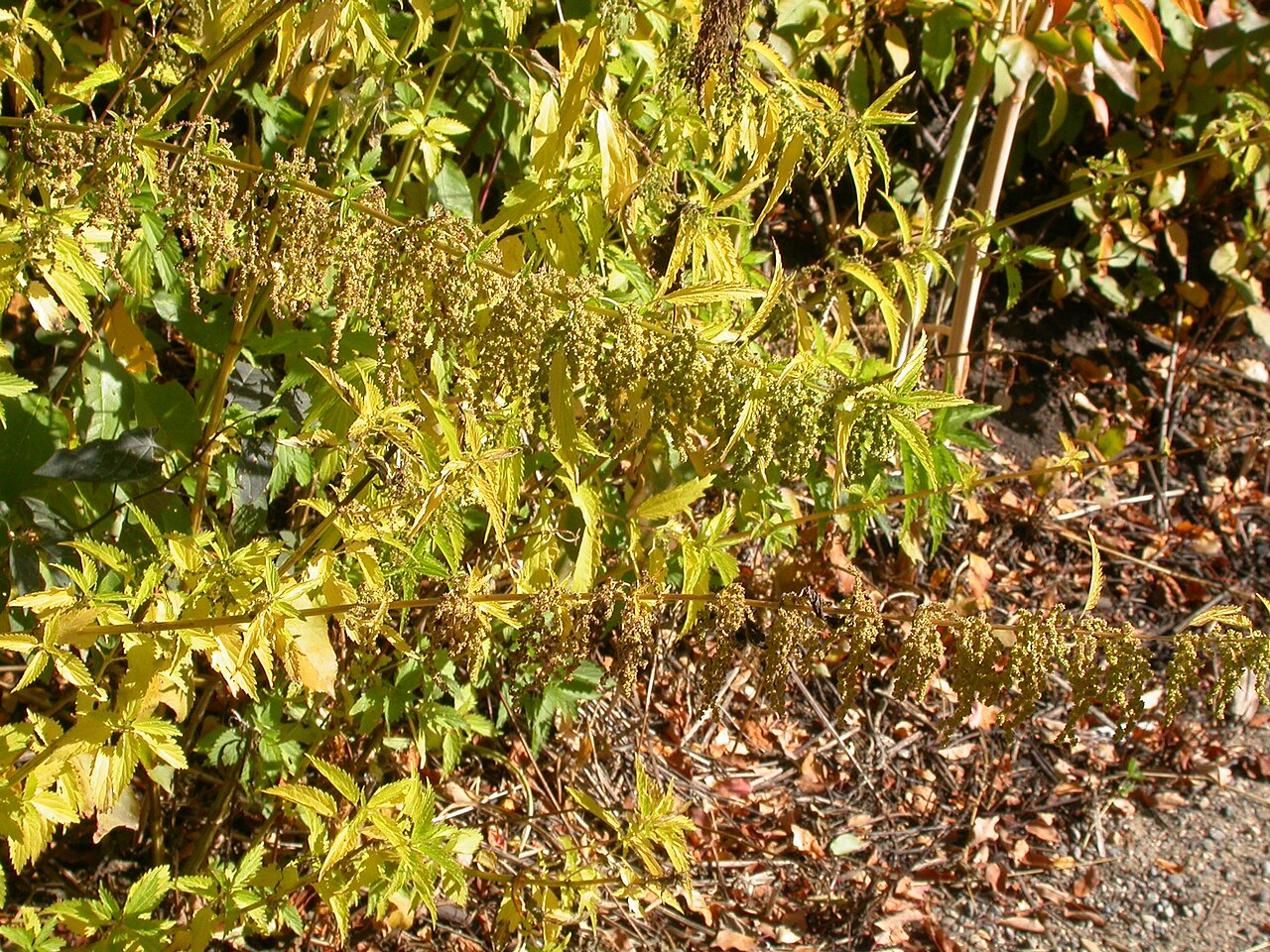
Nettle is dioecious, meaning individual plants bear either male or female flowers, not both. Both sexes produce small, greenish, inconspicuous flowers in branched, drooping clusters that hang from the leaf axils in the upper half of the plant, blooming from early to late summer. Female clusters become noticeably larger and more pendulous as tiny achenes (one-seeded fruits) mature. The flowers are wind-pollinated and offer little visual interest compared to the plant’s foliage and overall form.
Quick Facts
| Scientific Name | Urtica dioica ssp. gracilis |
| Family | Urticaceae (Nettle) |
| Plant Type | Herbaceous rhizomatous perennial |
| Mature Height | 3–7 ft |
| Mature Spread | Spreads by rhizome into colonial patches |
| Growth Rate | Fast in rich, moist soil |
| Sun Exposure | Part Shade to Shade (tolerates more sun with steady moisture) |
| Water Needs | Moderate to high; prefers consistently moist soil |
| Soil Type | Rich, moist, nitrogen-rich loam |
| Soil pH | Neutral to slightly alkaline |
| Bloom Time | June – August |
| Flower Color | Greenish, inconspicuous |
| Fall Color | Yellow-green, dies back to the ground |
| Fruit | Tiny dry achenes on female plants |
| Deer Resistant | Yes — stinging hairs deter browsing |
| USDA Hardiness Zones | 3–9 |
Native Range
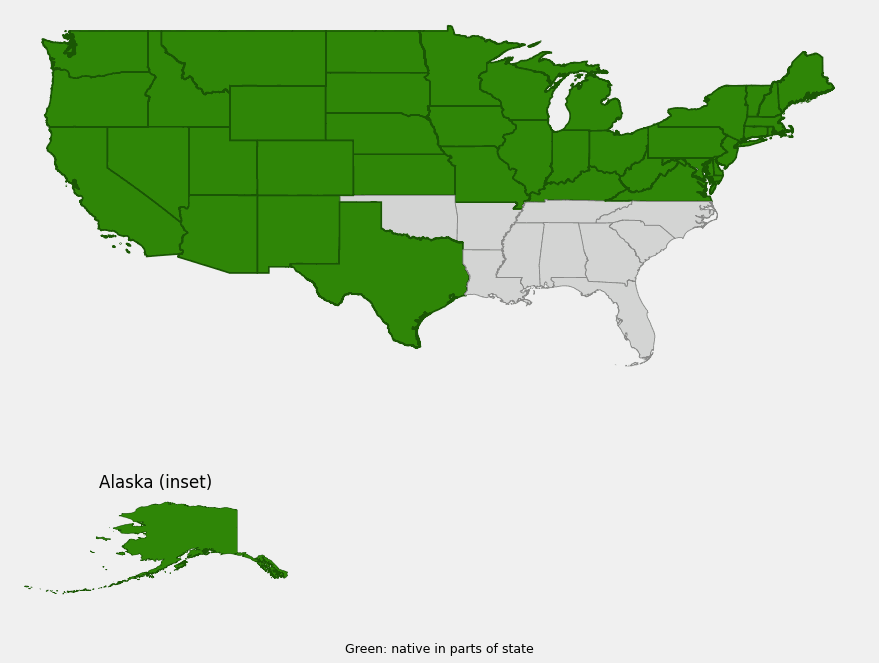
American stinging nettle is native across most of the continental United States and Canada, including the Pacific Northwest, California, the Rocky Mountain states, the Great Plains, the Upper Midwest and Great Lakes, and the Northeast and mid-Atlantic, as well as Alaska. It is generally absent as a native plant from the Deep South and Gulf Coast states, where nettle patches are more often the introduced European subspecies.
Because the native and introduced subspecies overlap so broadly and hybridize where they meet, botanists distinguish them mainly by hair density and stalk length rather than by range alone — the native subspecies tends to have fewer stinging hairs mixed with more soft hairs, and shorter flower-cluster stalks. In practice, most wild nettle patches across the northern two-thirds of the country include native plants, introduced plants, or a blend of both.
Within its range, American stinging nettle favors moist, fertile, partly shaded ground: streambanks, floodplain forests, wet meadow edges, and seasonally disturbed soil where nutrients are abundant. It is a true wetland-edge and woodland-edge native, not a dryland species.
📋 Regional plant lists featuring American Stinging Nettle: Alaska · Western Oregon & Western Washington · Idaho, Eastern Oregon & Eastern Washington · Montana & Wyoming · Utah & Western Colorado · Arizona & New Mexico · Nebraska, Kansas & Eastern Colorado · North Dakota, South Dakota & Western Minnesota · Michigan, Wisconsin & Eastern Minnesota · Illinois, Iowa & Missouri · Ohio & Indiana · Kentucky & Tennessee · Arkansas, Louisiana, Eastern Oklahoma & Eastern Texas · Maryland, Virginia & West Virginia · New York, Pennsylvania & Northern New Jersey · Delaware, Southern New Jersey & Long Island · Connecticut, Massachusetts & Rhode Island · New Hampshire, Maine & Vermont
Growing & Care Guide
American stinging nettle is not a typical ornamental garden plant, but it has a place in native plant gardens, restoration plantings, and wildlife habitat projects where its ecological value — especially to butterflies — outweighs the need to handle it carefully.
Light
Nettle grows best in part shade to full shade, the conditions found along wooded streambanks and woodland edges. It will tolerate more sun if soil moisture stays consistently high, but dries out and declines quickly in hot, sunny, or drought-prone sites.
Soil & Water
Give nettle rich, moist, nitrogen-fertile soil — it is, in fact, a classic indicator of fertile ground. Consistent moisture is essential; this is not a drought-tolerant species. Streambank, floodplain, or low, slightly poorly drained garden soil suits it well.
Planting Tips
Plant nettle only where its vigorous, spreading rhizomes and sting are acceptable — along the back of a restoration planting, in a dedicated butterfly-habitat bed, or in a naturalized wet corner away from paths and play areas. Because it spreads aggressively by rhizome in good soil, give it room to roam or plan to manage its edges. Always wear gloves when handling live plants or transplanting divisions.
Pruning & Maintenance
Nettle dies back to the ground each winter and needs no pruning beyond an optional late-winter cutback of old stalks before new growth emerges. Mowing or cutting the patch periodically through the season can keep it in bounds in a managed garden setting; wear protective clothing for any maintenance work.
Landscape Uses
Because of its sting, nettle is a specialty plant for specific purposes rather than a general-purpose landscape plant:
- Butterfly habitat gardens — essential larval host for several native butterflies
- Riparian and floodplain restoration plantings
- Wet meadow or woodland-edge naturalizing in out-of-the-way areas
- Pollinator and wildlife habitat projects prioritizing ecological function over ornamental appeal
Wildlife & Ecological Value
Despite — or really because of — its defensive sting, American stinging nettle is a quietly important native plant for wildlife, especially insects that have evolved around its chemistry.
For Pollinators & Butterflies
Nettle is a larval host plant for several native butterflies, including red admirals, eastern commas, question marks, and milbert’s tortoiseshells, whose caterpillars feed on the leaves largely unbothered by the stinging hairs. Because the flowers are wind-pollinated rather than insect-pollinated, nettle offers little direct nectar value, but its role as a caterpillar host makes it a cornerstone plant for butterfly-focused native gardens.
For Birds
Seed-eating songbirds feed on the small achenes in late summer and fall, and the dense foliage provides cover for ground-feeding birds along streambanks and woodland edges.
Ecosystem Role
As a nitrogen-loving perennial, nettle often marks naturally fertile soil and helps stabilize streambanks and floodplain edges with its spreading rhizome mat. Its dense colonial growth also provides structural cover for small wildlife in riparian corridors.
Cultural & Historical Uses
Nettle fiber and foliage have a long history of use by Indigenous peoples and later settlers across North America and Eurasia. Historically, the tough inner bark fibers of nettle stems were processed into cordage, nets, and textiles by many Indigenous nations, a use documented from the Pacific Northwest to the Great Lakes. Dried and processed properly, nettle fiber was valued for its strength, similar in historical use to flax or hemp fiber.
Nettle also has a long history as a cooked green and as a traditional dye plant in various cultures, with young spring growth historically gathered and thoroughly cooked to neutralize the stinging compounds before eating. This page describes that history for context; it is not a guide to foraging, cooking, or any medicinal use, and readers should not attempt to handle or consume wild nettle without proper identification, protective equipment, and preparation knowledge.
Today, American stinging nettle is more often encountered — and avoided — along trails and streambanks than deliberately used, though interest in native fiber plants and butterfly gardening has renewed some attention to its historical and ecological roles.
Frequently Asked Questions
How do I tell native American stinging nettle from the introduced European nettle?
The two subspecies are very similar and often grow together. Botanists typically separate them by hair density and the length of the stalks on the flower clusters; for most gardeners, the practical takeaway is simply that most northern wild nettle patches contain native plants, introduced plants, or both, and that either way the sting and ecological value are similar.
How do I treat a nettle sting?
Avoid rubbing the area, which can drive the stinging hairs in further. Most reactions fade within a few hours on their own. Heat is what neutralizes the stinging compounds — this is why nettle must be thoroughly cooked before it is ever eaten — but that applies to preparing the plant, not to first aid for a fresh sting on skin.
Is stinging nettle invasive?
Within its native range, American stinging nettle is a native plant, not an invasive one, though it spreads aggressively by rhizome in rich, moist soil and can dominate a patch of ground over time. The introduced European subspecies, by contrast, has naturalized widely and can behave more weedily in disturbed sites.
Why would I plant something that stings?
Nettle is a key host plant for several native butterfly caterpillars, so a managed patch in an out-of-the-way corner of a wildlife garden can meaningfully support butterfly populations. It is not a plant for high-traffic areas, play spaces, or anywhere bare skin is likely to brush against it.
Does nettle have showy flowers?
No. The flowers are small, greenish, and wind-pollinated, grown for ecological function rather than ornamental appeal. Gardeners interested in nettle are typically motivated by its wildlife value, not its bloom.

Looking for a nursery that carries American Stinging Nettle?
Browse our native plant nursery directory: Alaska & Arizona · Washington · Oregon · California · Nevada, New Mexico, North Dakota, Nebraska, Ohio, New York, New Jersey & New Hampshire · Idaho, Kansas, Iowa, Illinois & Indiana · Montana, Minnesota, Missouri, Michigan, Maryland, Kentucky, Massachusetts & Maine · Wyoming, Wisconsin & West Virginia · Utah, South Dakota, Texas, Pennsylvania, Virginia, Rhode Island & Vermont · Colorado, Delaware & Connecticut