
Bladder Sedge (Carex intumescens)
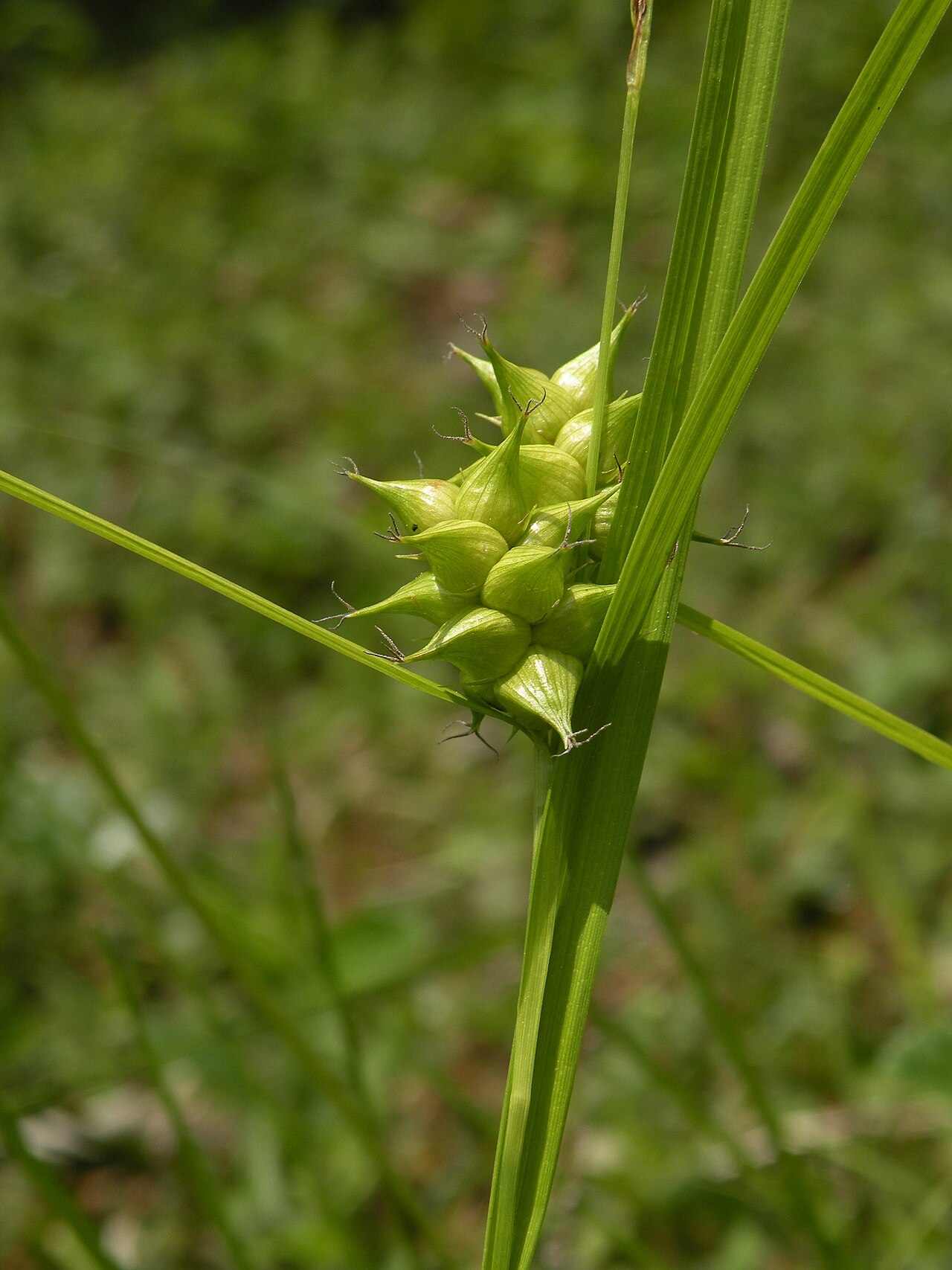
Carex intumescens, known as Bladder Sedge or greater bladder sedge (the USDA PLANTS name), is a native perennial sedge of moist and wet forests in eastern North America. It forms loose clumps of bright green, grass-like leaves 1 to 3 feet tall. In late spring and summer it produces its unmistakable seed heads: small clusters of large, inflated, pointed sacs that spread like a starburst or a tiny medieval mace.
Those sacs are perigynia, the papery envelopes that surround each seed in a sedge. In bladder sedge they are unusually large, up to about ¾ inch long, swollen and shiny. The species name intumescens means “swelling,” and the plant is also known as shining bur sedge. Its striking fruit makes it one of the easiest sedges to recognize and one of the most ornamental for shade gardens.
Bladder sedge grows in floodplain forests, swamps, wet woods, stream banks and moist hollows, often in shade and on acidic soils. It is a reliable, adaptable plant for wet, shady spots where lawn grass fails, and its semi-evergreen foliage, seeds and cover are useful to wildlife. This guide covers how to identify it, where it grows and how to use it in the garden.
Identification
Sedges can be hard to tell apart, but bladder sedge stands out because of its few, very large, inflated perigynia. Its closest look-alike is Gray’s sedge, which also has big, mace-like seed heads.
Growth Habit
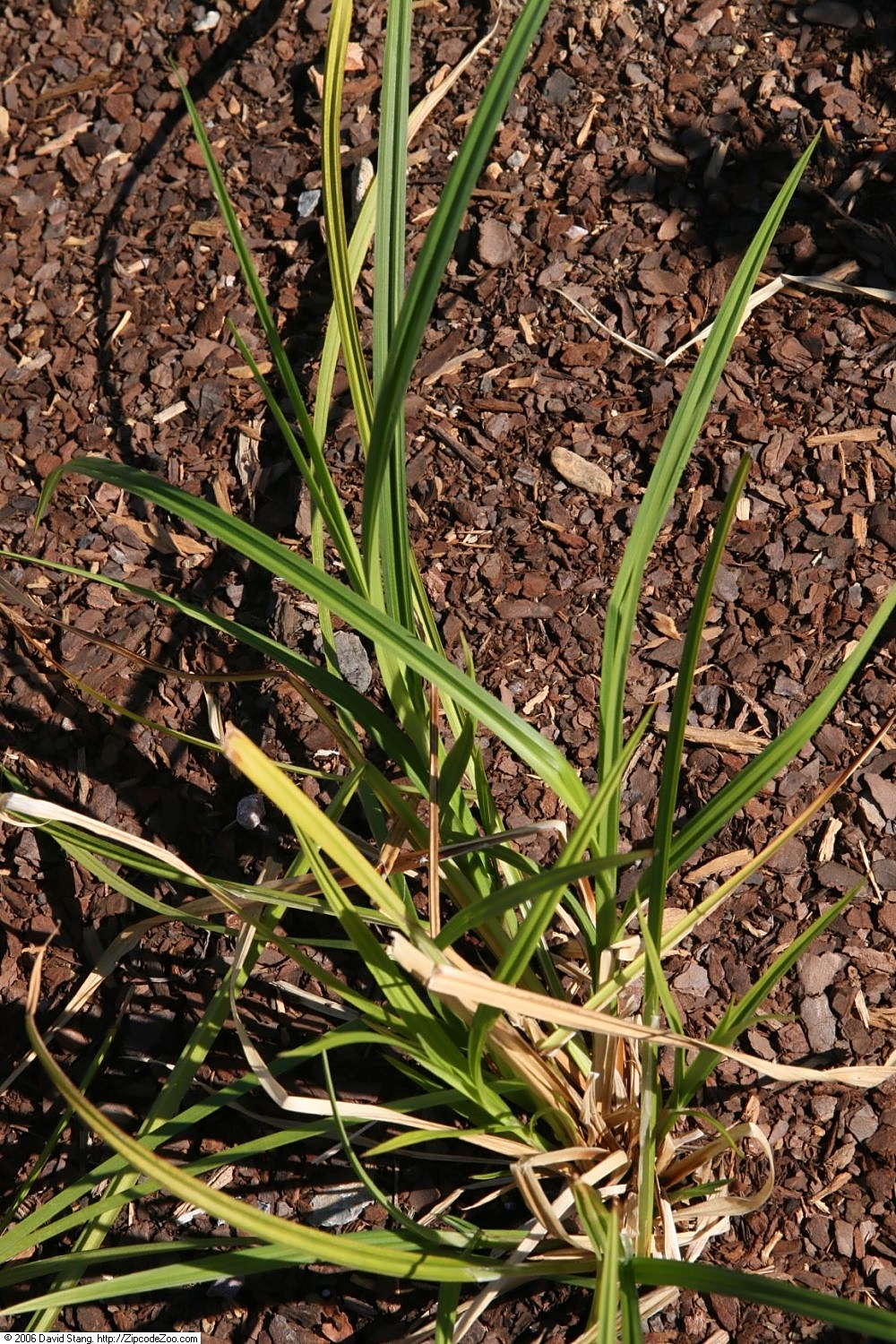
Bladder sedge grows in loose tufts from short rhizomes, with triangular flowering stems 1 to 3 feet tall. The plant forms individual clumps rather than a solid mat, though clumps can be close together in good conditions.
Leaves
The leaves are flat, bright to medium green, and about ⅛ to ⅜ inch wide, with fine, rough edges. They arch out from the base of the clump and often stay green into winter in milder climates, so the plant is semi-evergreen. Leaf-like bracts extend beyond the seed heads.
Flowers & Spikes
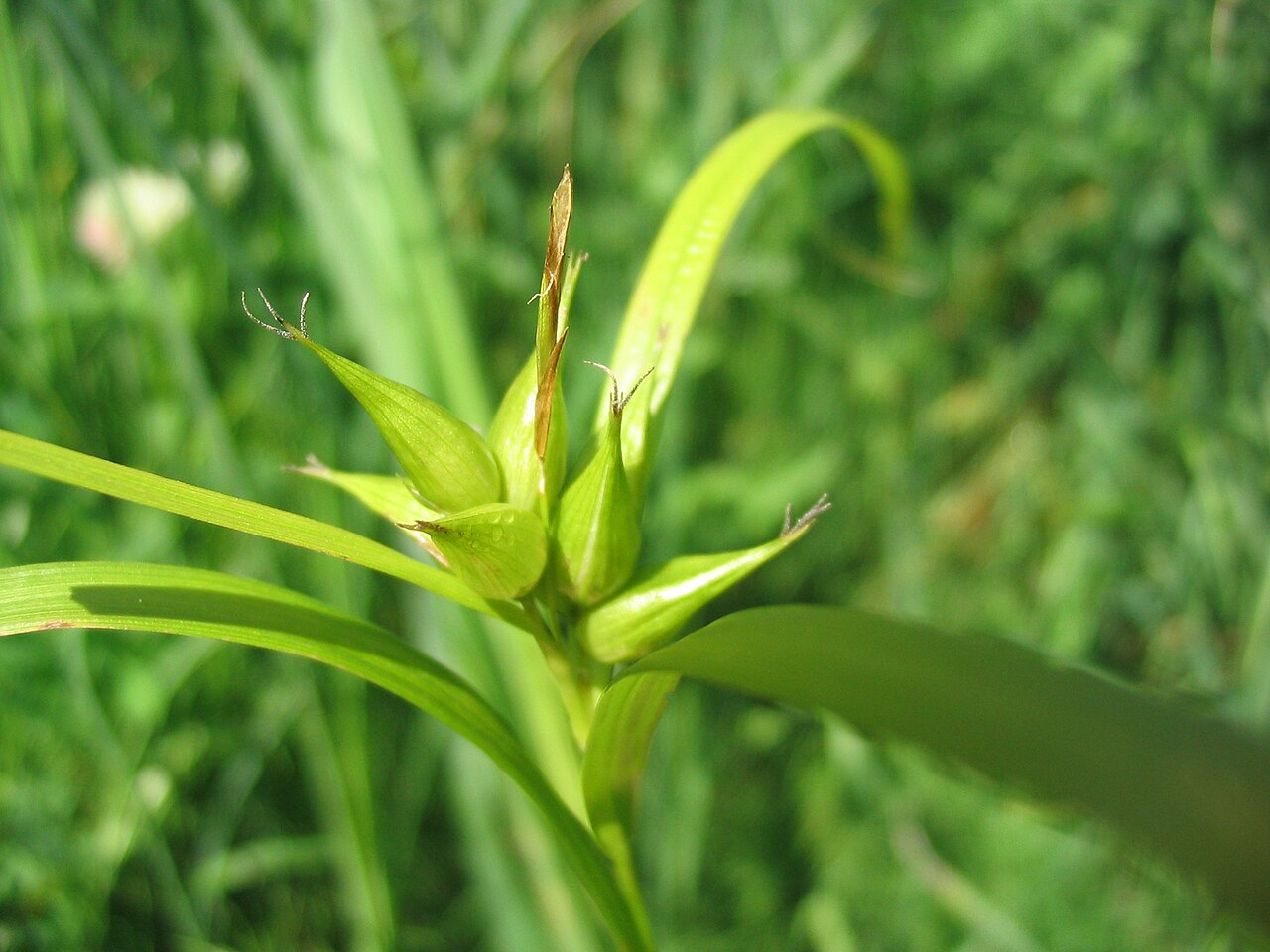
As in most Carex, male and female flowers are in separate spikes on the same stem. A slender, stalked male spike of pale, scale-covered flowers sits at the top. Below it are usually one to three female spikes, each holding only a few to about a dozen large perigynia. Flowering begins in spring, and the seed heads develop from late spring into summer.
Perigynia & Seeds
The perigynia are the key feature. Each one is about ½ to ¾ inch long, egg-shaped and inflated, smooth and shiny, with many fine veins and a long, tapering beak ending in two small teeth. They spread outward in a loose, star-like cluster. Inside each is a single small, three-sided achene. The perigynia turn from bright green to straw-brown as they ripen in summer.
Similar Species
Gray’s sedge (Carex grayi) has larger, more numerous perigynia (often 15 to 35) arranged in a near-perfect sphere, like a spiked ball, while bladder sedge typically has fewer perigynia in a looser, irregular starburst. Hop sedge (Carex lupulina) has long, dense, cylindrical spikes of many perigynia. Botanists also separate these species by the shape of the achene.
Quick Facts
| Scientific Name | Carex intumescens |
| Family | Cyperaceae (sedge family) |
| Plant Type | Perennial clump-forming sedge |
| Mature Height | 1–3 ft |
| Mature Spread | 1–2 ft |
| Growth Rate | Moderate |
| Sun Exposure | Partial shade to full shade; sun with constant moisture |
| Water Needs | High; moist to wet soil |
| Soil Type | Moist to wet, humus-rich loam, muck or sand |
| Soil pH | About 4.5–7.0 (acidic to near neutral) |
| Bloom Time | May–June; perigynia mature June–September |
| Flower Color | Inconspicuous; green to straw-colored |
| Fall Color | Semi-evergreen; may yellow in cold winters |
| Fruit | Large, inflated, beaked perigynia in a star-shaped cluster |
| Deer Resistant | Yes; sedges are rarely browsed heavily |
| USDA Hardiness Zones | 3–9 |
Native Range
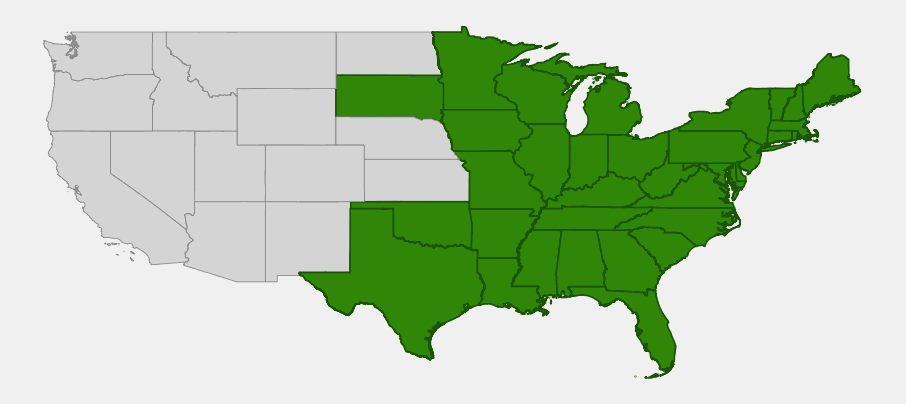
Bladder sedge is widespread in eastern North America. USDA PLANTS records it as native in more than 30 states and the District of Columbia, from Maine and Minnesota south to northern Florida and west to Iowa, Missouri, Oklahoma and eastern Texas. In Canada it ranges from Manitoba and Ontario east to Quebec, the Maritime provinces and Newfoundland and Labrador.
It is most common in the Northeast, the Great Lakes region and the Appalachians, and in floodplain and swamp forests of the Southeast. At the western edge of its range it is local in eastern Oklahoma and eastern Texas. There is also an outlying population in the Black Hills of western South Dakota, far from the main range, where herbarium specimens document it in moist woods.
USDA PLANTS also lists Wyoming, but we found no herbarium specimens or documented records from that state, so we have left it off this range description and the map.
📋 Regional plant lists featuring Bladder Sedge: New York, Pennsylvania & Northern New Jersey · Ohio & Indiana · Michigan, Wisconsin & Eastern Minnesota · Kentucky & Tennessee · Connecticut, Massachusetts & Rhode Island · New Hampshire, Maine & Vermont · Maryland, Virginia & West Virginia · Delaware, Southern New Jersey & Long Island · Illinois, Iowa & Missouri · Alabama, Georgia & Mississippi · North & South Florida · North & South Carolina · Arkansas, Louisiana, Eastern Oklahoma & Eastern Texas · North Dakota, South Dakota & Western Minnesota
Growing & Care Guide
Bladder sedge is an easy, adaptable native sedge for moist, shady places. It is well suited to rain gardens, woodland edges, stream banks and the wet corners of a yard, and its unusual seed heads make it more ornamental than most sedges.
Light
Grow it in partial to full shade. It tolerates more sun if the soil stays consistently moist, but in hot, dry sun the leaves scorch and turn yellow.
Soil & Water
Bladder sedge prefers moist to wet, organic soil and tolerates seasonal flooding and saturated ground. It handles acidic soils well and grows in clay, loam or sand as long as moisture is reliable. It is not drought tolerant, so water during dry spells in its first year and in sunnier spots.
Planting Tips
Plant plugs or potted plants in spring or fall, 12 to 18 inches apart for a groundcover effect. Group several plants together, since one clump can look sparse. Combine it with ferns, cardinal flower, jewelweed and other wetland and woodland plants.
Pruning & Maintenance
Little maintenance is needed. In late winter you can cut back or comb out old, tattered leaves before new growth starts. Leave the seed heads in place through summer for their ornamental value and to let the plant reseed. Mulching with shredded leaves helps retain moisture.
Propagation
Divide established clumps in spring or early fall. Seed can be sown outdoors in fall. It germinates best after a period of cold, moist stratification and needs moist soil. Bladder sedge often reseeds modestly in suitable sites.
Landscape Uses
- Rain gardens and bioswales: tolerates periodic flooding and saturated soil, especially in shade
- Woodland and shade gardens: a textural, semi-evergreen accent with unusual seed heads
- Stream banks and pond edges: helps stabilize moist soil along wooded shorelines
- Wetland and floodplain restoration: a native groundcover for wet forest restoration within its range
- Lawn alternative in wet shade: grouped plants fill damp, shady areas where turf struggles
Wildlife & Ecological Value
Sedges are a foundation of wetland and forest-floor ecosystems, and bladder sedge is no exception. It provides food and cover for many animals throughout the year.
For Pollinators
Bladder sedge is wind-pollinated and offers little nectar. Sedges are, however, important caterpillar food plants for several native butterflies of wooded wetlands, including satyrs such as the Appalachian brown and eyed brown, which feed on Carex species in shady, wet habitats.
For Birds
The seeds, enclosed in their buoyant perigynia, are eaten by wild turkeys, ruffed grouse, wood ducks and other waterfowl, as well as sparrows and other songbirds. The clumps provide cover for ground-foraging and ground-nesting birds in moist woods.
For Mammals
Small mammals use the clumps for cover and eat some seeds. Deer rarely browse sedges heavily, which helps bladder sedge persist in forests with high deer numbers.
Ecosystem Role
As a common sedge of forested wetlands and floodplains, bladder sedge helps hold soil, slow runoff and stabilize stream banks. The air-filled perigynia float, and they can be carried by water to new sites along streams and floodplains.
Cultural & Historical Uses
English botanist Edward Rudge described Carex intumescens in the early 1800s from North American specimens. The name has been stable since then, though some authors have recognized varieties based on perigynium size and number. The genus Carex is one of the largest in the flowering plants, with roughly 2,000 species worldwide and several hundred in North America.
Bladder sedge has been a teaching plant for generations of botany students. Its large perigynia make it easy to see how a sedge seed is enclosed in its sac, and it is often one of the first sedges people learn to recognize. The old saying “sedges have edges” applies here too: its flowering stems are triangular in cross-section.
In recent years native-plant gardeners have taken a greater interest in sedges as lawn alternatives and groundcovers. Bladder sedge, with its tolerance of wet shade and distinctive seed heads, has become more widely available from native plant nurseries in the eastern United States.
Frequently Asked Questions
How do I tell bladder sedge from Gray’s sedge?
Both have large, inflated perigynia. Gray’s sedge has many (often 15 to 35) perigynia arranged in a near-perfect sphere, while bladder sedge usually has fewer in a looser, star-like cluster. Their achenes also differ, which botanists use for a definite identification.
Does bladder sedge grow in standing water?
It tolerates seasonal flooding and saturated soil but generally prefers moist to wet ground rather than permanent standing water. It is ideal for rain gardens, swales and wet woodland edges.
Is bladder sedge evergreen?
It is semi-evergreen. The leaves often stay green into winter, especially in milder climates, but may turn yellow or tattered in cold winters. New growth appears in spring.
Can bladder sedge grow in sun?
Yes, if the soil stays consistently moist. In dry, sunny sites the leaves scorch, so it does best in partial to full shade.
Is bladder sedge good for wildlife?
Yes. Birds such as wild turkeys, grouse and waterfowl eat the seeds, sedges are host plants for butterflies such as the Appalachian brown, and the clumps provide cover for small animals.

Looking for a nursery that carries Bladder Sedge?
Browse our native plant nursery directory: Alabama & Arkansas · Connecticut, Delaware, Florida & Georgia · Illinois, Indiana & Iowa · Kentucky, Louisiana, Maine, Maryland, Massachusetts, Michigan, Minnesota, Mississippi & Missouri · New Hampshire, New Jersey, New York, North Carolina, Ohio & Oklahoma · Pennsylvania, Rhode Island, South Carolina, South Dakota, Tennessee, Texas, Vermont & Virginia · West Virginia & Wisconsin