
Pointed-Leaved Tick-Trefoil (Desmodium glutinosum)
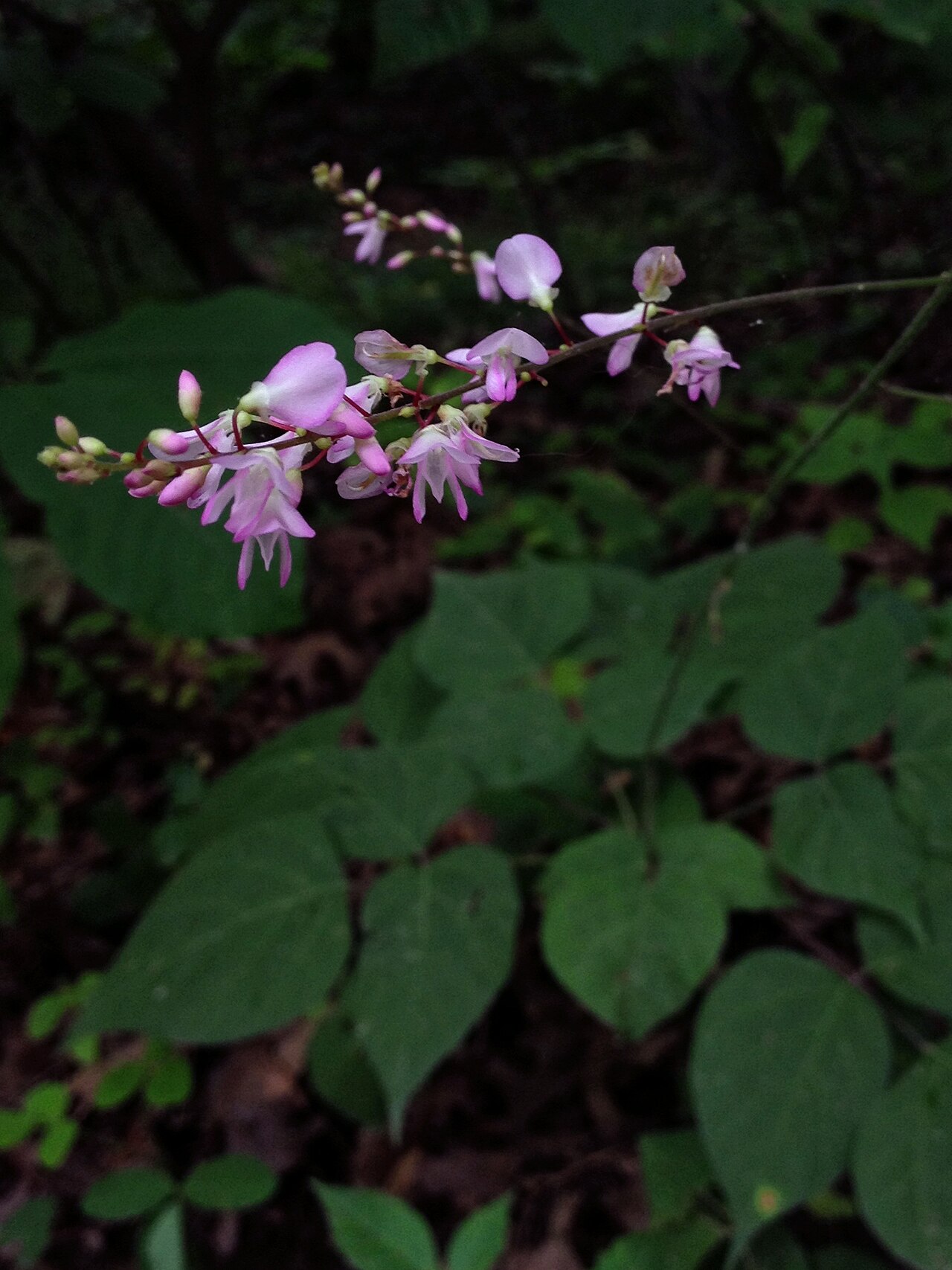
Desmodium glutinosum, known as Pointed-Leaved Tick-Trefoil (USDA: pointedleaf ticktrefoil), large tick-trefoil or clustered-leaf tick-trefoil, is a woodland wildflower of the pea family (Fabaceae) found across most of eastern North America. It is easy to recognize by its growth form: a short stem ends in a tight, whorl-like cluster of broad, three-parted leaves, and from the center of that cluster rises a slender, nearly leafless flower stalk carrying small pink pea flowers in summer. Many botanists now place it in the genus Hylodesmum, as Hylodesmum glutinosum.
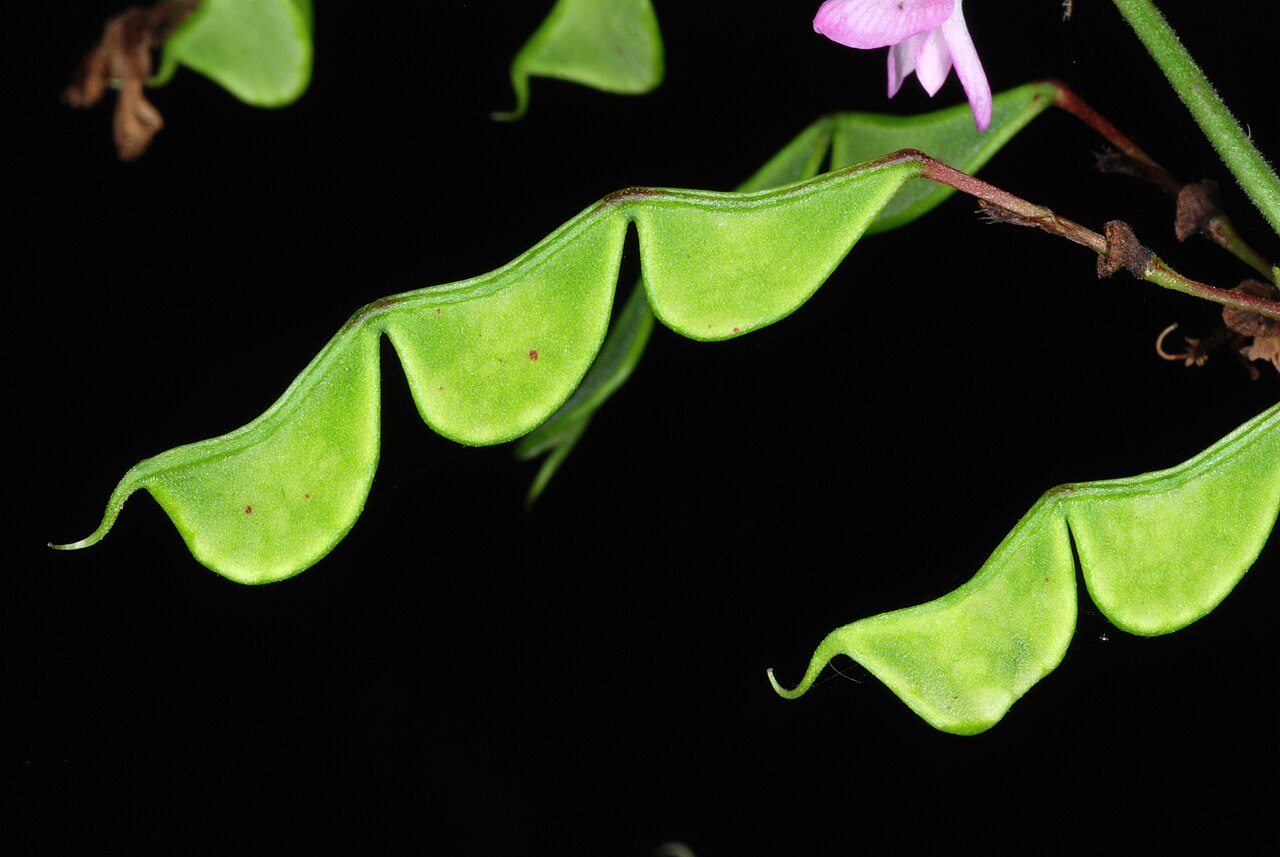
The common name refers to two features. “Pointed-leaved” describes the long, tapering tips of its leaflets, and “tick-trefoil” combines the three-part leaves (trefoil) with the seed pods, which break into small, flat segments covered in hooked hairs that cling to socks, trousers and fur like ticks. Hikers in eastern woods know these “beggar’s lice” well by late summer.
Pointed-leaved tick-trefoil grows from Nova Scotia, Quebec and Ontario south to Florida, and west to the Dakotas, Nebraska, Kansas, Oklahoma and Texas. It is a plant of rich and rocky deciduous woods, woodland edges and trails, and it is one of the few tick-trefoils that does well in shade. This guide covers how to identify it, where it grows and how to use it in a woodland garden.
Identification
Most tick-trefoils have leaves scattered along a leafy stem. Pointed-leaved tick-trefoil, with its leaves bunched together in a single cluster and its flower stalk rising from the middle, is one of the easiest to identify.
Stem & Leaves
A single erect stem 1 to 2 feet tall ends in a pseudo-whorl of five or six spreading leaves. Each leaf has a long stalk (1½ to 5 inches) and three leaflets. The leaflets are broadly ovate, 2 to 5 inches long, with smooth edges and long, narrow, pointed tips; the end leaflet is larger and on a longer stalk than the side leaflets. The upper surface is medium to dark green and nearly hairless, and the underside is paler and slightly hairy along the veins.
Flowers
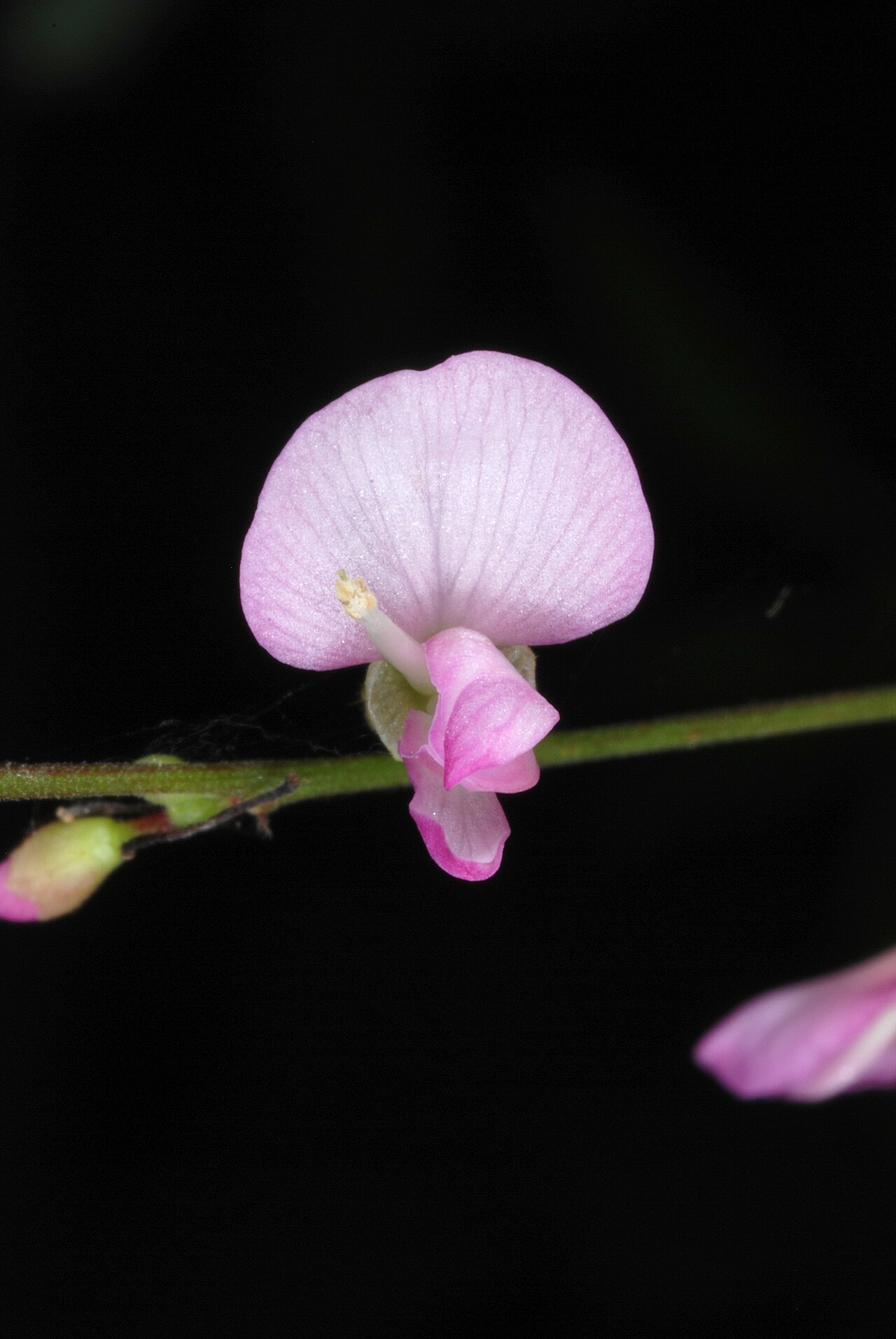
From the center of the leaf cluster rises a narrow flowering stalk (raceme) 1 to 2 feet long, so the whole plant can reach about 3½ feet. The stalk is covered with short, stiff, sometimes sticky hairs, which explain the species name glutinosum (“sticky”). Small pea-shaped flowers up to ⅓ inch long are scattered along it, light pink to rosy pink, with a banner, two wings and a keel. Flowering lasts one to two months in summer, mainly June through August, with only a few flowers open at a time.
Fruit
The flowers are followed by flat, jointed pods (loments) ½ to 1½ inches long, divided into one to four segments. Each segment has a nearly straight or slightly concave upper edge and a rounded lower edge and holds a single kidney-shaped seed. The pod surfaces are covered with tiny hooked hairs, and the segments break apart easily and stick to passing animals and people. A short stalk (stipe) about ¼ inch long attaches the pod to the flower stalk.
Roots
The plant grows from a taproot and does not spread by rhizomes. Like most legumes, its roots host nitrogen-fixing bacteria.
Similar Species
Naked-flowered tick-trefoil (Desmodium nudiflorum, also Hylodesmum nudiflorum) also has its leaves in a terminal cluster, but its flowering stalk usually rises separately from the base of the plant, not from the leaf cluster, and its leaflets are less pointed. Showy Tick-Trefoil and Panicled Tick-Trefoil have leaves spread along a leafy stem and grow in sunnier, more open habitats.
Quick Facts
| Scientific Name | Desmodium glutinosum (Muhl. ex Willd.) Alph. Wood (syn. Hylodesmum glutinosum, Desmodium acuminatum) |
| Family | Fabaceae (pea family) |
| Plant Type | Herbaceous perennial wildflower from a taproot |
| Mature Height | 1–2 ft leafy stem; to about 3½ ft in flower |
| Mature Spread | 1–2 ft |
| Growth Rate | Moderate |
| Sun Exposure | Part sun to shade |
| Water Needs | Medium; moist to dry-mesic soil |
| Soil Type | Loamy woodland soil with organic matter; tolerates clay-loam and rocky soil |
| Soil pH | About 5.5–7.5 (slightly acidic to slightly alkaline) |
| Bloom Time | June–August |
| Flower Color | Light pink to rosy pink |
| Fall Color | Leaves turn yellowish before dying back |
| Fruit | Flat, jointed pod (loment) with hooked hairs |
| Deer Resistant | No; deer browse tick-trefoils readily |
| USDA Hardiness Zones | 3–9 |
Native Range
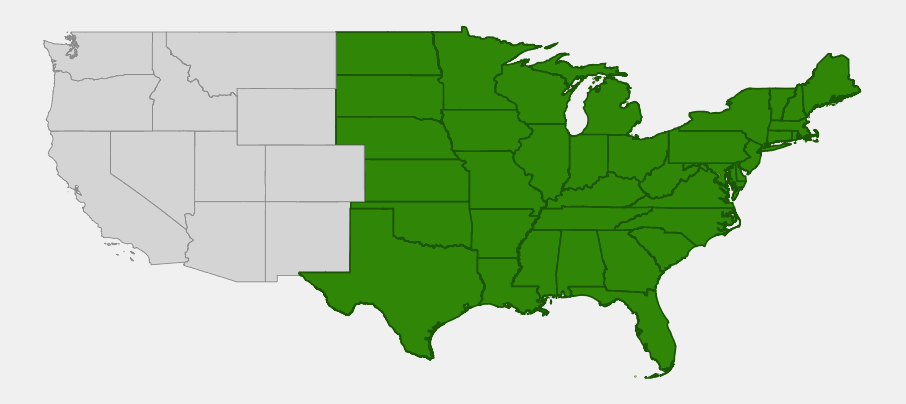
Pointed-leaved tick-trefoil has one of the widest ranges of any eastern woodland legume. USDA PLANTS records it as native in 37 states and the District of Columbia, from Maine, Vermont and New Hampshire west to Minnesota and the Dakotas, south through the Appalachians and Ohio Valley to Florida, and west to Nebraska, Kansas, Oklahoma and eastern Texas. In Canada it grows in Ontario, Quebec, New Brunswick and Nova Scotia.
It is common through most of the eastern deciduous forest, from the Northeast and Great Lakes to the southern Appalachians and Ozarks. At the edges of its range it becomes more local: in the Dakotas, Nebraska and Kansas it is limited to wooded river valleys and ravines in the east, in Texas to the eastern woodlands, and in Florida to the northern counties.
Its typical habitats are rich and rocky deciduous woods, including oak-hickory and maple-beech forests, wooded slopes and ravines, woodland borders and the edges of trails and roads through forest. It grows in both high-quality woodlands and disturbed, second-growth woods.
📋 Regional plant lists featuring Pointed-Leaved Tick-Trefoil: North & South Florida · Alabama, Georgia & Mississippi · North & South Carolina · Maryland, Virginia & West Virginia · Kentucky & Tennessee · Arkansas, Louisiana, Eastern Oklahoma & Eastern Texas · Illinois, Iowa & Missouri · Ohio & Indiana · Nebraska, Kansas & Eastern Colorado · North Dakota, South Dakota & Western Minnesota · Michigan, Wisconsin & Eastern Minnesota · New York, Pennsylvania & Northern New Jersey · Delaware, Southern New Jersey & Long Island · Connecticut, Massachusetts & Rhode Island · New Hampshire, Maine & Vermont
Growing & Care Guide
Pointed-leaved tick-trefoil is an easy, long-lived plant for shady gardens and woodland restorations. Its handsome leaf clusters add texture all summer, and it is one of the few native legumes that thrive in shade.
Light
Part sun to medium shade. It does well under deciduous trees and at woodland edges. In deep shade it grows but flowers sparsely, and in full sun the leaves may scorch in hot summers.
Soil & Water
Plant it in loamy, humus-rich woodland soil that is moist to moderately dry. It tolerates clay-loam and rocky soils and moderate dry spells once established. As a nitrogen-fixing legume it does not need fertilizer.
Planting Tips
Plant container-grown seedlings in spring or fall, about 18 inches apart. Because of its taproot, it does not transplant well once established, so choose a permanent spot. Place it a few feet back from paths and patios if you want to avoid the clinging seed pods in late summer.
Pruning & Maintenance
Little care is needed. Cut the flowering stalks after bloom if you want to prevent sticky seeds on clothes and pets, or leave them for wildlife. Remove the dead foliage in late winter or let it decompose in place. Deer and rabbits may browse it heavily; protect young plants where browsing pressure is high.
Propagation
Collect the pod segments when they turn brown in late summer or fall. The seeds have hard coats, so scarify them lightly (rub them with sandpaper) and soak them before sowing, or sow them outdoors in fall. Seedlings develop a taproot quickly, so grow them in deep pots and plant them out young.
Landscape Uses
- Woodland gardens: attractive leaf clusters and pink flower sprays in summer shade
- Woodland restoration: understory planting in oak-hickory and mixed deciduous forests
- Wildlife gardens: seeds for ground birds and foliage for insects
- Shade borders: a native legume that adds texture among ferns and woodland wildflowers
- Soil improvement: nitrogen-fixing roots enrich poor woodland soils
Wildlife & Ecological Value
Pointed-leaved tick-trefoil supports a range of insects, birds and mammals in eastern forests.
For Pollinators
The flowers are visited mainly by bees, especially bumble bees and other long-tongued bees that can open the pea-type flowers. Illinois Wildflowers cites Robertson’s observation of a sweat bee, Lasioglossum versatum, collecting pollen. Tick-trefoils as a group are caterpillar food plants for several butterflies and skippers, including cloudywings, hoary edge and eastern tailed-blue, though these are more often found on species of sunny prairies and savannas than on this shade-loving species.
For Birds
Wild turkeys, northern bobwhite and other ground-feeding birds eat tick-trefoil seeds, and the plants’ insects feed woodland songbirds.
For Mammals
White-tailed deer, rabbits and groundhogs browse tick-trefoil foliage, which is high in protein. The hooked pod segments are carried away on the fur of deer, raccoons, foxes and other mammals.
Ecosystem Role
As a legume, pointed-leaved tick-trefoil works with root bacteria to fix atmospheric nitrogen, enriching woodland soils. Its seeds are dispersed by animals that brush against the plants, which allows it to colonize new woodland openings and trailsides. It also hosts specialized insects, including aphids, thrips and leaf-mining beetles that feed on tick-trefoils.
Cultural & Historical Uses
The species was first described in the early 1800s from specimens collected by Gotthilf Heinrich Ernst Muhlenberg, a Pennsylvania Lutheran minister and botanist, and published by Carl Ludwig Willdenow as a species of Hedysarum. It was later moved to Desmodium, and in 2000 the Japanese botanist Hiroyoshi Ohashi and R.R. Mill placed it in the new genus Hylodesmum, which means “woodland Desmodium.” Both names are in current use; USDA PLANTS lists it as Desmodium glutinosum.
The genus name Desmodium comes from the Greek desmos, a band or chain, referring to the chain of jointed seed pods. The hooked pod segments have given tick-trefoils folk names like beggar’s lice, sticktights and hitchhikers, and their clinging habit is a familiar late-summer nuisance for hikers and dog owners.
Tick-trefoils have long been valued by wildlife managers as food for deer and game birds. Pointed-leaved tick-trefoil, with its tolerance for shade, is especially useful in restoring the understory of eastern forests.
Frequently Asked Questions
Why do tick-trefoil seeds stick to clothes?
The flat pod segments are covered with tiny hooked hairs that act like Velcro. They break off and cling to fur and clothing, which helps spread the seeds to new places.
Is pointed-leaved tick-trefoil the same as Hylodesmum glutinosum?
Yes. Some botanists place it in the genus Hylodesmum, while USDA PLANTS and many state floras keep it in Desmodium. It is also listed in older books as Desmodium acuminatum.
Does it grow in shade?
Yes. Unlike most tick-trefoils, which prefer sunny prairies and savannas, this species is adapted to the partial shade of deciduous woods.
Will it spread in my garden?
It grows from a taproot and does not spread by rhizomes. It self-seeds modestly, mainly by seeds carried on animals and clothing.
How do I tell it from naked-flowered tick-trefoil?
In pointed-leaved tick-trefoil, the flowering stalk rises from the center of the leaf cluster. In naked-flowered tick-trefoil, the flowering stalk usually rises from the base of the plant, separate from the leafy stem.

Looking for a nursery that carries Pointed-Leaved Tick-Trefoil?
Browse our native plant nursery directory: Alabama & Arkansas · Connecticut, Delaware, Florida & Georgia · Illinois, Indiana, Iowa & Kansas · Kentucky, Louisiana, Maine, Maryland, Massachusetts, Michigan, Minnesota, Mississippi & Missouri · Nebraska, New Hampshire, New Jersey, New York, North Carolina, North Dakota, Ohio & Oklahoma · Pennsylvania, Rhode Island, South Carolina, South Dakota, Tennessee, Texas, Vermont & Virginia · West Virginia & Wisconsin