
White Twisted-Stalk (Streptopus amplexifolius)
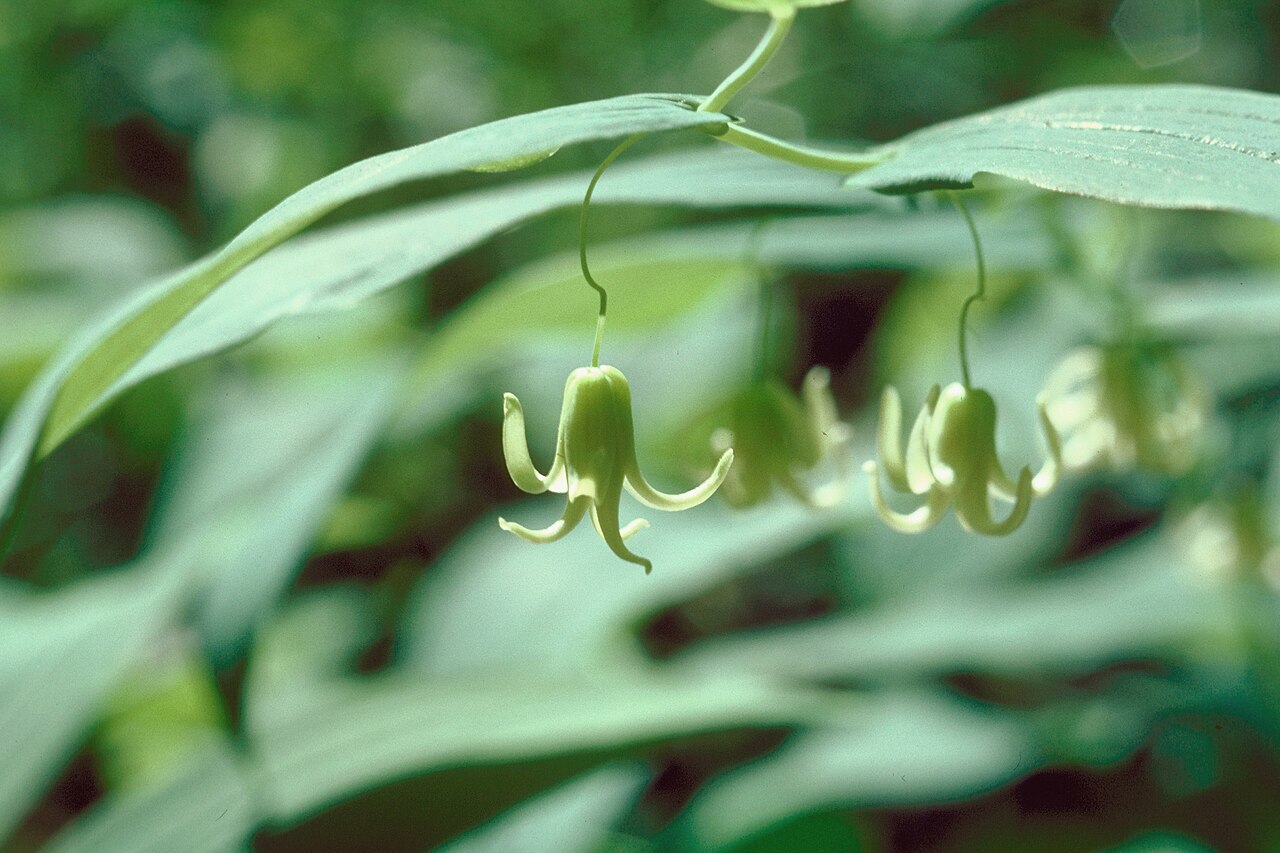
Streptopus amplexifolius, known as White Twisted-Stalk (USDA: claspleaf twistedstalk), is a graceful woodland perennial of cool, moist forests across northern North America, Europe and Asia. It belongs to the lily family (Liliaceae) and is also called clasping-leaved twisted-stalk and white mandarin. The plant grows 1 to 3 feet tall from a short rhizome, with arching, branched, zigzag stems lined with smooth, pointed leaves whose bases wrap around the stem.
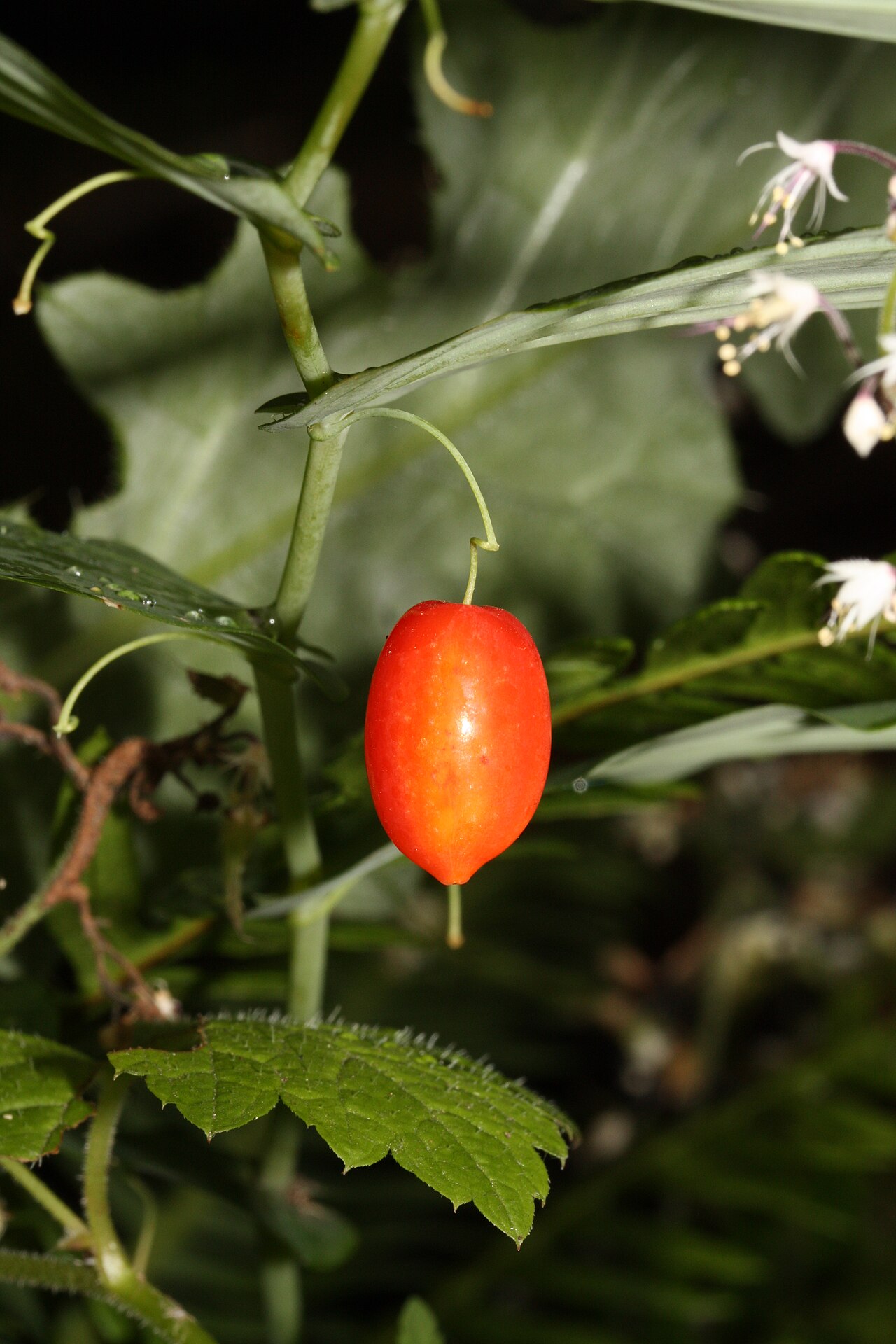
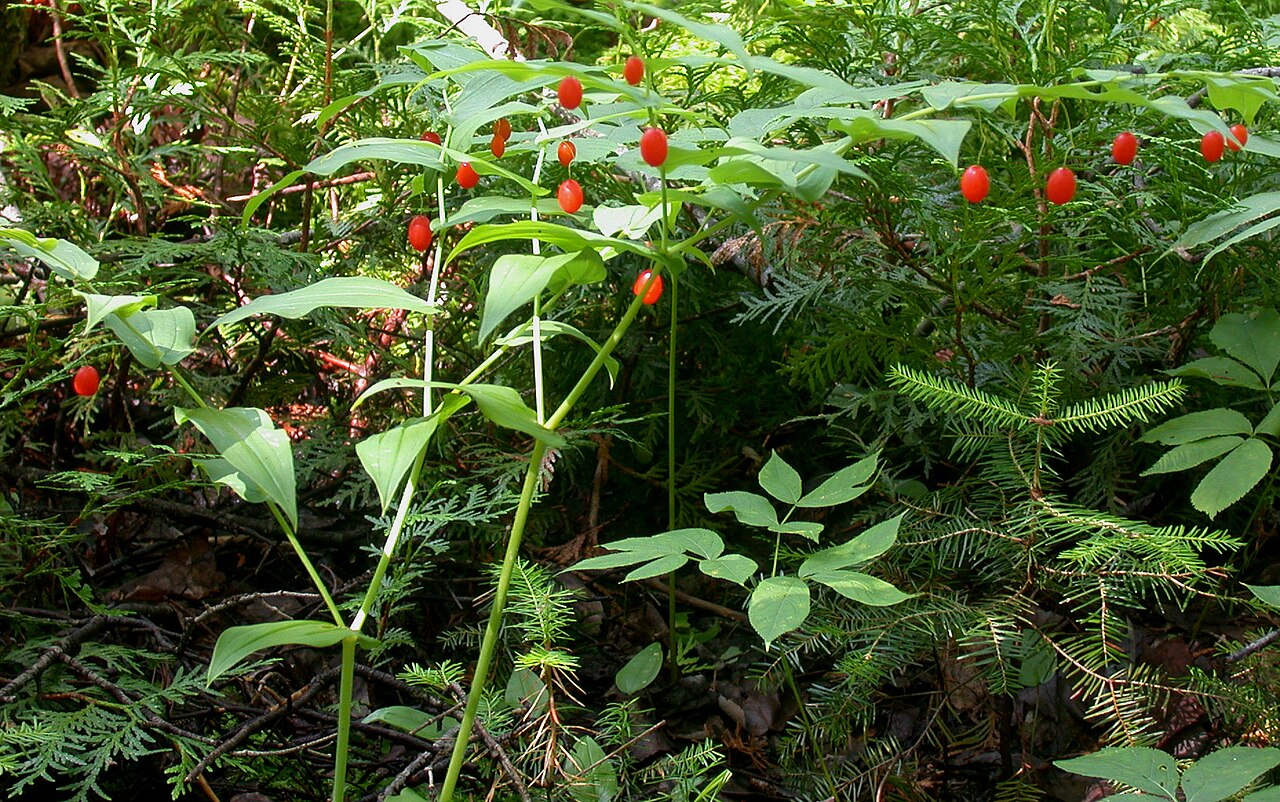
Its most charming features are hidden beneath the leaves. In late spring and early summer, small greenish white, bell-shaped flowers hang from each leaf joint on a thread-thin stalk with a distinct kink or twist partway along it, the feature behind the names twisted-stalk and Streptopus (“twisted foot”). By midsummer the flowers have become glossy, oblong red berries that dangle in a row under the stems like small lanterns.
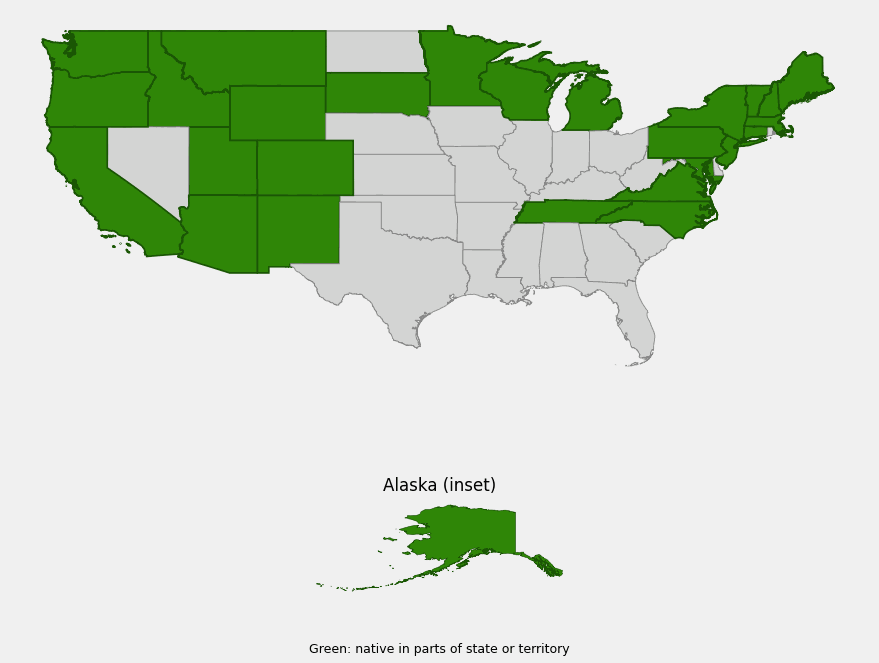
In the United States it grows from Alaska and the Pacific Northwest through the Rocky Mountains to Arizona and New Mexico, across the northern Great Lakes and New England, and south in the Appalachian mountains. For gardeners in cool regions it is a refined plant for shady, moist woodland gardens. The berries and the young shoots should not be eaten casually: see the safety notes below.
Identification
White twisted-stalk looks a bit like a Solomon’s seal or false Solomon’s seal at first glance. Lift a stem and look underneath: the single flowers or berries on kinked stalks, one at each leaf, are the giveaway.
Stems & Growth Habit
The plant rises from a short, thick rhizome. Each stem is 1 to 3 feet tall (occasionally taller in rich western forests), smooth above but often with a few stiff hairs near the base, and usually branched once or twice. The stems bend slightly at each leaf, giving them a zigzag outline, and the whole plant arches gracefully to one side.
Leaves
The leaves are alternate, 2 to 5 inches long, oval to lance-shaped with a pointed tip and many parallel veins. Their bases are heart-shaped and clasp the stem, wrapping partly around it, which is the meaning of amplexifolius (“clasping leaves”). They are bright green above and paler, often with a whitish bloom, beneath.
Flowers
From May to July, a single flower (sometimes two) hangs from the stem beneath each leaf on a slender stalk about 1 inch long. Each stalk bends sharply or twists near the middle, so the flower dangles straight down. The flowers are about 1/2 inch long, bell-shaped, greenish white to creamy white, with six tepals whose tips curl strongly backward.
Fruit & Seeds
Each flower becomes an oblong, juicy berry about 1/2 inch long. The berries ripen from green to bright red (rarely yellow or orange) in mid to late summer and hang in a row beneath the leaves. They are translucent enough that the seeds can sometimes be seen inside, and contain several pale seeds.
Look-alikes
Rosy twisted-stalk (Streptopus lanceolatus, also called S. roseus) is shorter, usually unbranched, with rose-pink flowers on straight stalks and leaves that do not clasp the stem. Solomon’s Seal has flowers in pairs or clusters and blue-black berries. Fairy bells (Prosartes) have flowers at the branch tips. Before flowering, young shoots can be confused with the highly toxic Green False Hellebore, which has broad, strongly pleated leaves.
Safety Note
USDA and the Lady Bird Johnson Wildflower Center note that the berries are considered mildly poisonous: toxicity is low, but they are suspected of containing cardiac glycosides like some related plants. The berries are also widely reported to have a strong laxative effect. Do not eat them, and keep them away from small children and pets. Never forage the young shoots, which can easily be mistaken for deadly false hellebore (Veratrum) growing in the same places.
Quick Facts
| Scientific Name | Streptopus amplexifolius |
| Family | Liliaceae (lily family) |
| Plant Type | Rhizomatous herbaceous perennial |
| Mature Height | 1–3 ft |
| Mature Spread | 1–2 ft; slowly forms small clumps |
| Growth Rate | Slow |
| Sun Exposure | Part shade to full shade |
| Water Needs | Medium to high; constantly moist soil |
| Soil Type | Rich, humusy loam; woodland soil |
| Soil pH | About 5.0–7.0 (acidic to neutral) |
| Bloom Time | May–July |
| Flower Color | Greenish white to creamy white |
| Fall Color | Leaves yellow before dying back |
| Fruit | Oblong red berry, about 1/2 in; mildly toxic |
| Deer Resistant | No; deer and elk browse the foliage |
| USDA Hardiness Zones | 2–7 |
Native Range
White twisted-stalk has an enormous range across the cooler parts of the Northern Hemisphere, including the mountains of Europe and eastern Asia. In North America USDA PLANTS lists it as native in Alaska, Canada, Greenland, Saint Pierre and Miquelon and the lower 48 states, and records it from 27 states. In Canada it grows from Yukon, the Northwest Territories and British Columbia east across the Prairie Provinces to Ontario, Quebec, the Maritimes, Newfoundland and Labrador.
In the West it is common in moist forests from Alaska south through Washington, Oregon and Idaho to northern California, and through the Rocky Mountains of Montana, Wyoming, Colorado and Utah to the high mountains of Arizona and New Mexico. A separate population grows in the Black Hills of South Dakota. In the East it ranges from Minnesota, Wisconsin and Michigan across New York and New England, and south along the Appalachians in Pennsylvania and New Jersey, with outlying records in the cool, high mountains of Maryland, Virginia, North Carolina and Tennessee, where it is uncommon.
It grows in cool, moist, shady places: streambanks, seeps, wet ravines, rich coniferous and mixed forests, alder and willow thickets, avalanche chutes and moist subalpine meadows. In the southern parts of its range it is found only at high elevations.
📋 Regional plant lists featuring White Twisted-Stalk: New York, Pennsylvania & Northern New Jersey · Idaho, Eastern Oregon & Eastern Washington · Montana & Wyoming · Michigan, Wisconsin & Eastern Minnesota · Kentucky & Tennessee · Utah & Western Colorado · Connecticut, Massachusetts & Rhode Island · New Hampshire, Maine & Vermont · Maryland, Virginia & West Virginia · Delaware, Southern New Jersey & Long Island · Arizona & New Mexico · Alaska · North & South Carolina · North Dakota, South Dakota & Western Minnesota · Western Oregon & Western Washington · California & Nevada
Growing & Care Guide
White twisted-stalk is easy to please in the right place and difficult anywhere else. It wants what it has in the wild: shade, cool summers and soil that never dries out. Buy nursery-propagated plants or grow it from seed; never dig it from the wild, especially in states where it is rare.
Light
Plant it in part shade to full shade. Dappled shade under trees or the north side of a building is ideal. In cool, cloudy northern and coastal gardens it tolerates a little morning sun, but hot afternoon sun scorches the leaves.
Soil & Water
It needs rich, loose, humusy soil that stays evenly moist, such as leaf mold or forest soil over loam. Slightly acidic to neutral soil suits it. Water deeply in dry spells; it is not drought tolerant and will go dormant early or decline if the soil dries out. A streamside, the edge of a shady pond or a moist woodland bed is ideal. It struggles in regions with hot, humid summers.
Planting Tips
Plant rhizome divisions or potted plants in spring or early fall, setting the rhizome about 1 inch deep. Space plants 12 to 18 inches apart. Mulch with shredded leaves to keep the soil cool and moist. It pairs well with ferns, foamflower and other shade-loving lilies, and the hanging flowers and berries are best seen on a slope or at the edge of a path where you can look up at them.
Pruning & Maintenance
Little care is needed. Leave the stems standing until the berries are gone and the foliage dies back in fall, then let the leaves decompose in place. Top-dress with leaf mold each year. Protect young plants from slugs, which can damage the emerging shoots in spring.
Propagation
Divide established clumps in early spring or fall, keeping a growing bud on each piece of rhizome. Seed is slow: clean the seeds from ripe berries and sow them fresh outdoors. Germination often takes two winters, and seedlings take several years to flower.
Landscape Uses
- Shade and woodland gardens: arching stems and dangling flowers and berries under trees
- Streamside and pond-edge plantings: for cool, shady, consistently moist soil
- Fern gardens: a graceful companion to lady fern and other moisture-loving ferns
- Northern native landscapes: for cool-summer gardens in the North, mountains and Pacific Northwest
- Habitat restoration: in moist forest understory and riparian plantings within its range
Wildlife & Ecological Value
White twisted-stalk is a typical member of the cool, moist forest understory, offering nectar in early summer and fruit later in the season.
For Pollinators
The hanging bell-shaped flowers are visited mainly by bees, including bumblebees, which cling to the flowers from below to reach the nectar and pollen.
For Birds
Grouse and songbirds such as thrushes eat the red berries and disperse the seeds. The plants also add cover in the forest understory.
For Mammals
Bears, small mammals and other wildlife eat the berries. Deer and elk browse the leaves and stems.
Ecosystem Role
It is part of the herb layer of moist forests and streambanks, where its rhizomes help hold soil. Its fruits are part of the summer food supply for wildlife, and the plant is a sign of cool, moist, undisturbed forest conditions.
Cultural & Historical Uses
The genus name Streptopus comes from Greek words meaning “twisted foot,” for the kinked flower stalks, and amplexifolius means “clasping leaves.” The juicy berries have earned it local names such as watermelon berry and cucumber berry for their mild, watery taste, and in some places it is called scootberry, a nod to their laxative effect.
Indigenous peoples of Alaska and the Pacific Northwest knew the plant well. Some groups ate the berries in small amounts or used the plant in traditional medicine, while others regarded the berries as poisonous and avoided them. Because of the possible toxicity, the laxative effect and the danger of confusing young shoots with false hellebore, it is not a plant for foraging today.
Botanists divide the species into several varieties across its huge range, including western and eastern North American forms and Asian varieties not native to North America. For gardeners and naturalists, all share the same distinctive clasping leaves and twisted flower stalks.
Frequently Asked Questions
Are white twisted-stalk berries edible?
They are not recommended. USDA and the Lady Bird Johnson Wildflower Center list the berries as mildly poisonous, and they are widely reported to act as a strong laxative. Keep them away from children and pets.
Why is it called twisted-stalk?
Each hanging flower is attached to the stem by a thin stalk with a sharp kink or twist partway along it. The genus name Streptopus means “twisted foot.”
How do I tell it from Solomon’s seal?
Look under the leaves. Twisted-stalk has single flowers or red berries on kinked stalks, and its leaves clasp the stem. Solomon’s seal has flowers in pairs or clusters on straight stalks and blue-black berries.
Can I grow white twisted-stalk in my garden?
Yes, if you can give it shade, rich humusy soil and steady moisture. It does best in cool-summer regions within or near its native range and struggles in hot, humid summers.
Is white twisted-stalk rare?
It is common in the West and the North, but it is uncommon at the southern edge of its range in the Appalachians. Buy nursery-propagated plants and never dig it from the wild.

Looking for a nursery that carries White Twisted-Stalk?
Browse our native plant nursery directory: Alaska & Arizona · California · Colorado & Connecticut · Idaho · Maine, Maryland, Massachusetts, Michigan, Minnesota & Montana · New Hampshire, New Jersey, New Mexico, New York & North Carolina · Oregon · Pennsylvania, South Dakota, Tennessee, Utah, Vermont & Virginia · Washington · Wisconsin & Wyoming