
Maryland Meadowbeauty (Rhexia mariana)
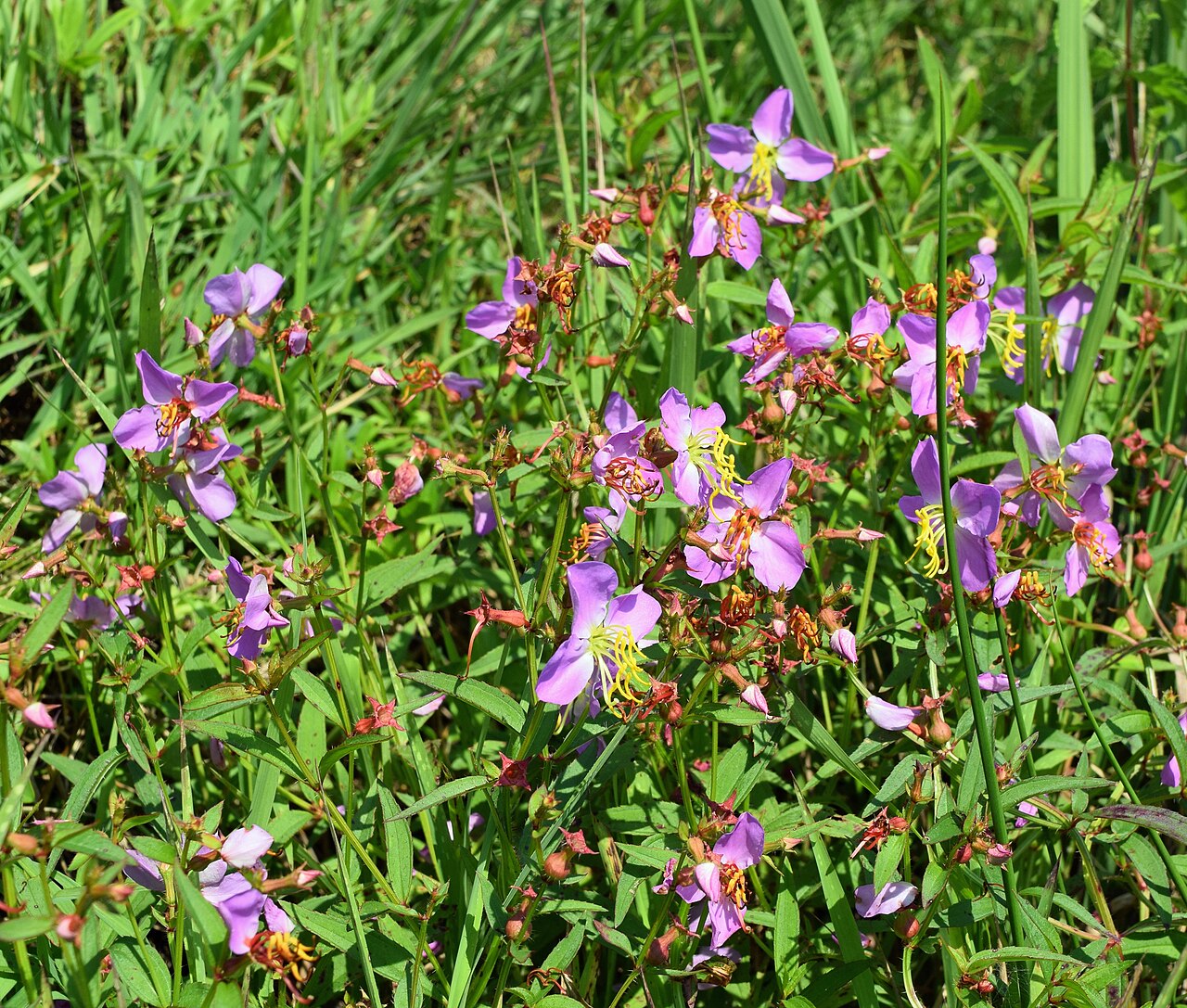
Rhexia mariana, known as Maryland Meadowbeauty (USDA: Maryland meadowbeauty), is a charming wetland wildflower of the eastern and southern United States. It is also called pale meadowbeauty and dull meadow-pitchers. It belongs to the melastome family (Melastomataceae), a mostly tropical family in which the meadowbeauties are the best-known native representatives in the United States. The plant is a perennial 1 to 2 1/2 feet tall, with slender, hairy stems and pairs of narrow, distinctly veined leaves.
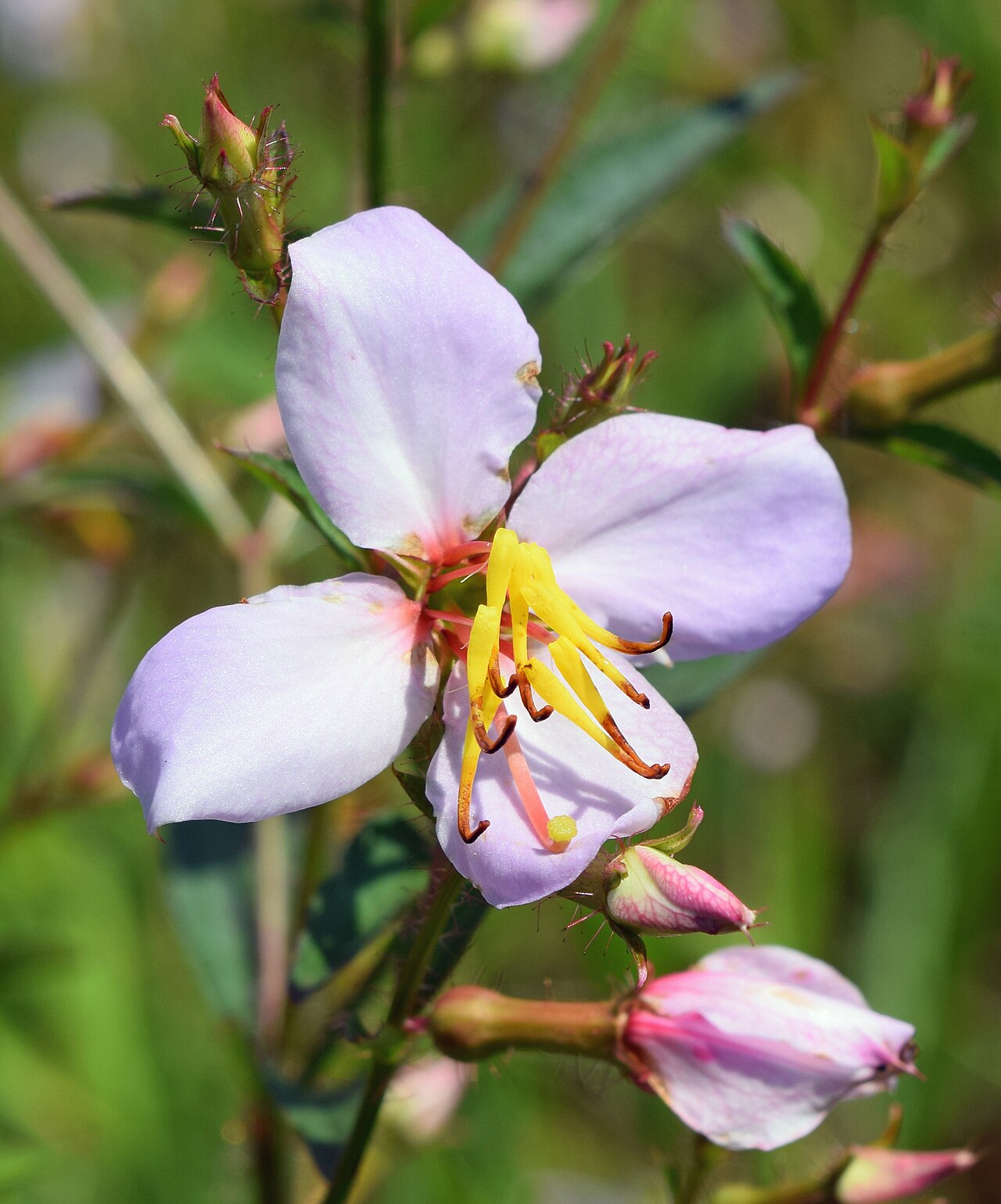
From late spring through late summer it bears flowers about 1 to 2 inches across, with four broad, pale pink to lavender (sometimes white or deep rose) petals and eight long, curved, bright yellow anthers that look like little hooks. The flowers open in the morning and drop their petals by the afternoon, but new ones open daily for weeks. After flowering, the base of each flower swells into a small urn- or jug-shaped capsule, a distinctive feature of all meadowbeauties.
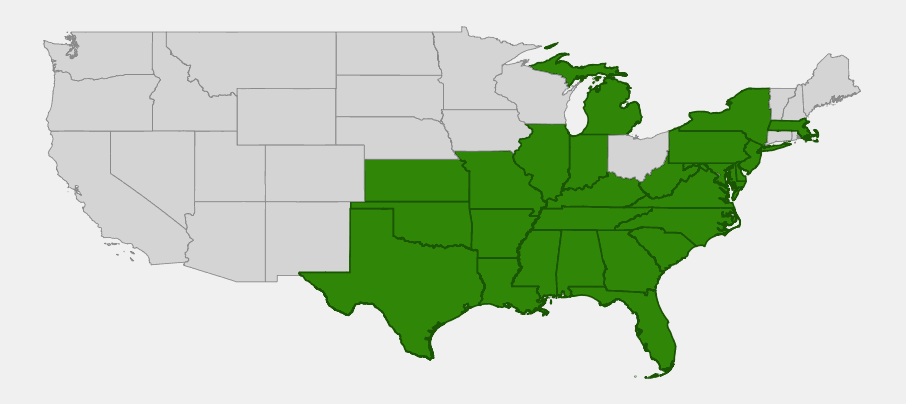
Maryland meadowbeauty grows in sunny, wet, acidic places: wet meadows, savannas, pine flatwoods, bog edges, pond shores and roadside ditches. It is the most widespread meadowbeauty, ranging from Massachusetts and New York to Florida, and west to Kansas, Oklahoma and Texas. It spreads by underground runners into small colonies and is a lovely plant for rain gardens, bog gardens and wet meadow plantings.
Identification
Meadowbeauties are easy to recognize as a group by their four petals, eight curved yellow anthers and urn-shaped fruits. Maryland meadowbeauty is told from the others mainly by its narrow leaves, rounded stems and usually pale flowers.
Stems & Growth Habit
The plant grows from slender, spreading roots that sprout new stems, so it often forms loose colonies. The stems are 1 to 2 1/2 feet tall, branched above, roughly round or slightly four-sided in cross-section, and covered with spreading, glandular hairs.
Leaves
The leaves are opposite, narrowly elliptic to lance-shaped, 1 to 2 1/2 inches long and up to about 1/2 inch wide, with a few fine teeth along the edges. Each leaf has three prominent veins running lengthwise, a classic melastome feature. Both surfaces are sparsely hairy.
Flowers
From about May to September, flowers open at the tops of the stems in loose clusters. Each is 1 to 2 inches across, with four broad, slightly asymmetrical petals that are usually pale pink to lavender, sometimes white (var. exalbida) or deeper rose-purple (var. purpurea). The eight stamens have long, curved, bright yellow anthers that open by a pore at the tip.
Fruit & Seeds
The base of the flower, the hypanthium, becomes an urn-shaped capsule about 1/2 inch long with a narrow neck and four short lobes at the top, covered in glandular hairs. It is often compared to a little jug or pitcher. Inside are many tiny, curved seeds, which spill out when the dry capsule is shaken.
Look-alikes
Meadow Beauty (Rhexia virginica, Virginia meadowbeauty) has broader leaves, deeper rose-magenta flowers and a square stem with small wings on the angles and two flat faces, while Maryland meadowbeauty has a rounder stem with unequal faces. Yellow meadowbeauty (R. lutea) of the Gulf Coastal Plain has yellow petals. Several other southern meadowbeauties are distinguished by leaf shape, stem hairs and the shape of the capsule neck.
Safety & Conservation
Meadowbeauties are not known to be toxic, and the leaves of some species have been eaten in salads, though they are not a recommended food. Maryland meadowbeauty is common in much of the South but rare at the edges of its range in the Northeast and Midwest, where it is protected in some states. Buy nursery-grown plants or seed and never dig it from the wild.
Quick Facts
| Scientific Name | Rhexia mariana |
| Family | Melastomataceae (melastome family) |
| Plant Type | Herbaceous perennial; spreads by runners |
| Mature Height | 1–2.5 ft |
| Mature Spread | 1–2 ft; forms loose colonies |
| Growth Rate | Moderate |
| Sun Exposure | Full sun to part shade |
| Water Needs | High; moist to wet soil |
| Soil Type | Wet sand, sandy loam, peaty soils |
| Soil pH | About 4.5–6.5 (acidic) |
| Bloom Time | May–September |
| Flower Color | Pale pink to lavender, sometimes white or rose |
| Fall Color | Leaves may turn reddish |
| Fruit | Urn-shaped capsule with many tiny seeds |
| Deer Resistant | Moderately; occasionally browsed |
| USDA Hardiness Zones | 5–10 |
Native Range
Maryland meadowbeauty is native to the eastern and south-central United States. USDA PLANTS records it in 25 states and the District of Columbia. On the Atlantic Coastal Plain it ranges from eastern Massachusetts, Long Island and New Jersey south through Delaware, Maryland, Virginia and the Carolinas to Florida. Across the South it grows from Georgia, Alabama and Mississippi to Louisiana, Arkansas, Oklahoma and East Texas.
In the interior it reaches north up the Mississippi and Ohio valleys to Tennessee, Kentucky, West Virginia, southern Indiana, southern Illinois, Missouri and southeastern Kansas, with an outlying record in Michigan. Pennsylvania and New York records are mostly from the Coastal Plain and nearby lowlands. It is common in the Southeast but uncommon to rare at its northern and western limits.
It grows in open, sunny, wet sites with acidic, often sandy soil: wet meadows and prairies, pine flatwoods and savannas, seepage slopes, bog and pond margins, low fields, wet roadsides and ditches. Like many savanna wildflowers, it benefits from fire or mowing that keeps shrubs and trees from shading it out.
📋 Regional plant lists featuring Maryland Meadowbeauty: New York, Pennsylvania & Northern New Jersey · Ohio & Indiana · Michigan, Wisconsin & Eastern Minnesota · Kentucky & Tennessee · Nebraska, Kansas & Eastern Colorado · Connecticut, Massachusetts & Rhode Island · New Hampshire, Maine & Vermont · Maryland, Virginia & West Virginia · Delaware, Southern New Jersey & Long Island · Illinois, Iowa & Missouri · Alabama, Georgia & Mississippi · North & South Florida · North & South Carolina · Arkansas, Louisiana, Eastern Oklahoma & Eastern Texas
Growing & Care Guide
Maryland meadowbeauty is easy to grow in a sunny, wet spot with acidic soil, and it rewards you with a long season of delicate pink flowers. It is offered by native plant nurseries, especially in the Southeast. Buy nursery-grown plants or seed; never dig it from the wild.
Light
Full sun produces the most flowers and the most compact plants. It tolerates light or part shade, especially in the hot South, but flowers less in deep shade.
Soil & Water
Give it consistently moist to wet, acidic soil, such as sandy loam or peaty sand. It thrives in soil that is wet in spring and stays damp through summer and tolerates brief flooding. It does not tolerate long drought or alkaline soil. Avoid fertilizer and rich compost, which favor weeds and taller competitors.
Planting Tips
Plant in spring in a rain garden, bog garden, pond edge, wet meadow or low spot that stays moist. Space plants about 12 inches apart; they will spread into a loose patch. Combine with low sedges, pitcher plants in a bog garden, or other wet-meadow wildflowers that will not shade it out.
Pruning & Maintenance
Little care is needed. Cut back dead stems in late winter. In meadow plantings, an occasional late-winter mowing or burn (where allowed) helps keep shrubs and tall grasses from crowding it. Keep the soil from drying out in summer droughts.
Propagation
Divide established colonies or separate rooted runners in early spring. The seeds are tiny: surface-sow them on moist, acidic potting mix in fall or after a few weeks of cold, moist stratification, keep them constantly damp, and grow the seedlings on in pots, since they are slow at first.
Landscape Uses
- Rain gardens: sunny, acidic, consistently moist basins and swales
- Bog gardens: a colorful companion to pitcher plants and sundews
- Wet meadow and savanna restoration: in sunny, sandy wetlands within its range
- Pond and stream edges: along the wet margins of acid ponds and ditches
- Pollinator gardens: a pollen source for buzz-pollinating native bees
Wildlife & Ecological Value
Meadowbeauties have a special relationship with bees, and their colonies add color and food to sunny wetlands for months.
For Pollinators
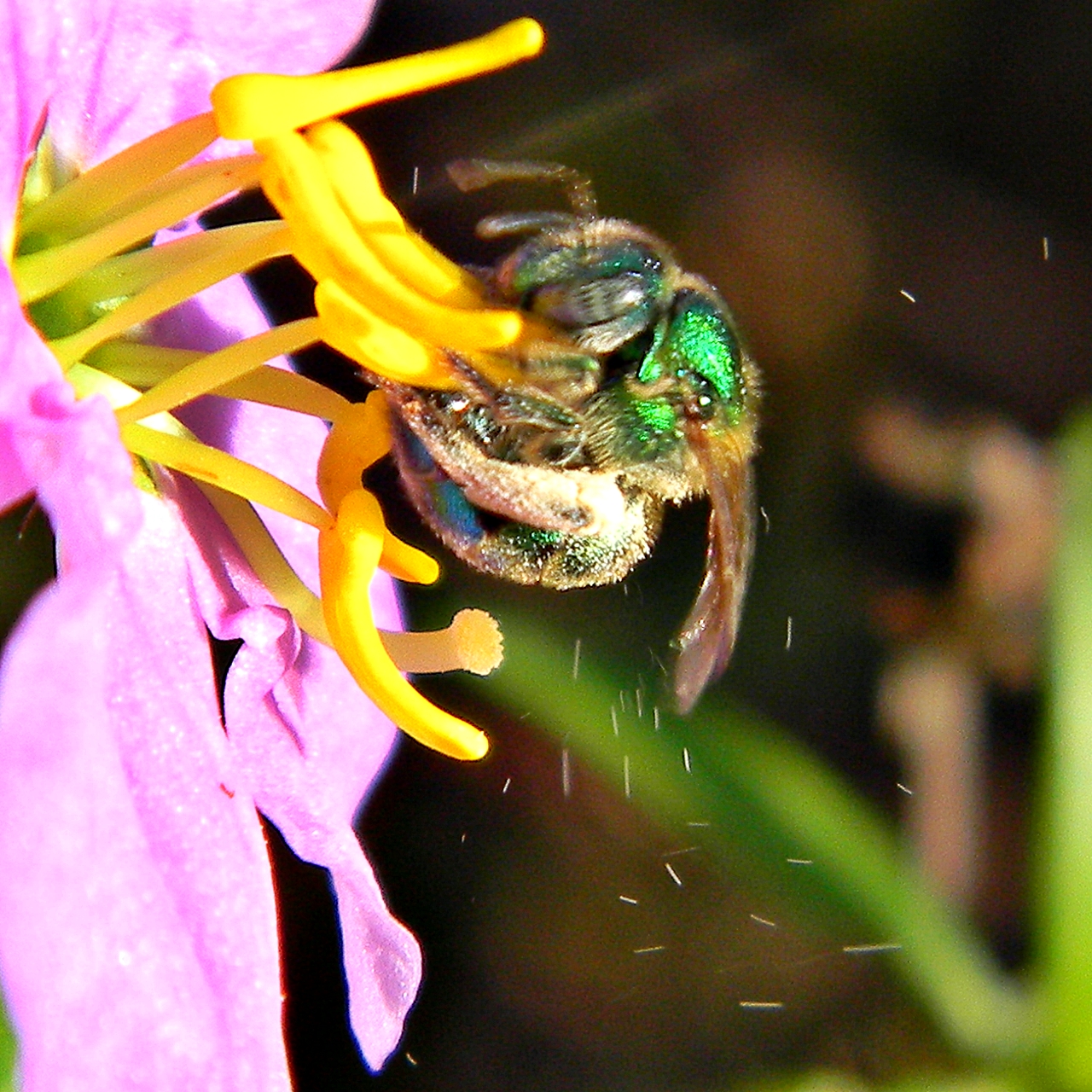
The flowers offer no nectar, only pollen, which is locked inside anthers that open by a tiny pore. Bumblebees, sweat bees and other native bees collect it by buzz pollination: they grab the anthers and vibrate their flight muscles, shaking the pollen out. Honeybees cannot buzz-pollinate, so meadowbeauties depend on native bees.
For Birds
The seeds are tiny and of little food value for birds. Meadowbeauty colonies form part of the open wet meadows and savannas used by ground-nesting and wading birds.
For Mammals
Deer and rabbits occasionally browse the leaves and flowers. The plant generally recovers by sending up new shoots from its runners.
Ecosystem Role
Maryland meadowbeauty is a characteristic plant of sunny, acidic wetlands that are maintained by fire, flooding or mowing. It supports a diverse community of native bees. Its presence is a sign of an open wet meadow or savanna that has not been overtaken by shrubs.
Cultural & Historical Uses
The common name meadow-pitchers refers to the urn-shaped fruit, which looks like a tiny jug. The genus name Rhexia was used by ancient writers for an unknown plant and was later applied to this genus by Linnaeus, and the species name mariana means “of Maryland,” where early botanists collected it.
Meadowbeauties are the northernmost members of the melastome family, a large group of mostly tropical plants that includes the princess flower (Tibouchina) and thousands of species in tropical forests. The three-veined leaves and the hooked anthers of meadowbeauties are typical of the whole family.
Maryland meadowbeauty is a familiar summer flower of Southern roadside ditches and savannas. Some Indigenous peoples and early settlers reportedly used the leaves of meadowbeauties as a salad green, and the tubers of some species have a mildly sweet taste, but they are not a recommended food today.
Frequently Asked Questions
How do I tell Maryland meadowbeauty from Virginia meadowbeauty?
Maryland meadowbeauty usually has paler pink flowers, narrower leaves and a stem with unequal sides. Virginia meadowbeauty has deeper rose-magenta flowers, broader leaves and a square stem with four equal, slightly winged sides.
Why do the petals fall off so quickly?
Each flower opens in the morning and usually drops its petals by afternoon or the next day. Fresh flowers open almost every day for weeks, so the plant stays in bloom.
Does Maryland meadowbeauty need wet soil?
Yes. It needs consistently moist to wet, acidic soil and full sun to part shade. It does well in rain gardens, bog gardens and pond edges but not in dry garden beds.
Does Maryland meadowbeauty spread?
It spreads slowly by underground runners and forms loose colonies, but it is not aggressive.
What pollinates meadowbeauties?
Native bees, especially bumblebees and sweat bees, which use buzz pollination to shake pollen out of the anthers. The flowers have no nectar.

Looking for a nursery that carries Maryland Meadowbeauty?
Browse our native plant nursery directory: Alabama & Arkansas · Delaware, Florida & Georgia · Illinois, Indiana & Kansas · Kentucky, Louisiana, Maryland, Massachusetts, Michigan, Mississippi & Missouri · New Jersey, New York, North Carolina & Oklahoma · Pennsylvania, South Carolina, Tennessee, Texas & Virginia · West Virginia