
Bog Wintergreen (Pyrola asarifolia)
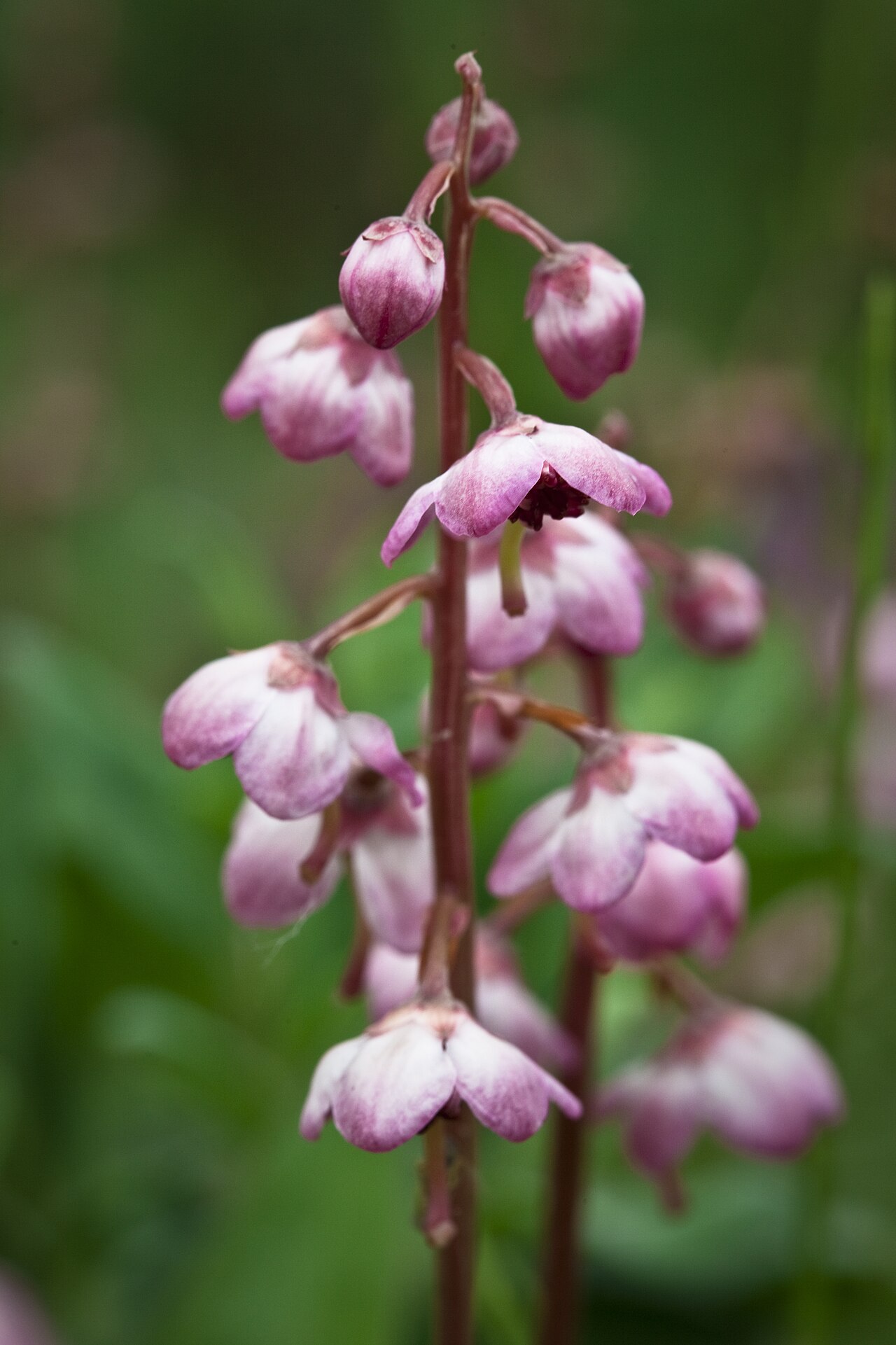
Pyrola asarifolia, known as Bog Wintergreen (USDA: liverleaf wintergreen; also pink wintergreen or pink pyrola), is a small evergreen wildflower of moist northern and mountain forests across North America. It belongs to the heath family (Ericaceae), in the wintergreen group once placed in its own family, Pyrolaceae.
It forms low colonies of glossy, leathery, rounded leaves that stay green through winter. In summer it sends up leafless reddish stalks 6 to 16 inches tall, hung with 5 to 25 nodding, waxy, pink to rose-red flowers, each with a long, curved style poking out beneath it. It grows in damp, mossy coniferous and mixed forests, cedar swamps, bogs, fens and shady streambanks, from Alaska and Newfoundland south to New England, the Great Lakes and the high mountains of the West.
Like other wintergreens, bog wintergreen depends heavily on mycorrhizal fungi in the soil, which supply it with part of its food. That makes it very difficult to grow and almost impossible to transplant. It is best enjoyed in the wild; never dig wild plants.
Identification
Look for a low rosette of shiny, rounded, leathery evergreen leaves on long stalks, and in summer a leafless reddish stalk with nodding pink flowers that each have a long, curved style, in damp shady forests and wetlands.
Stems & Habit
Bog wintergreen is a low evergreen perennial that spreads by slender underground rhizomes, forming loose colonies. The leaves form a basal rosette. The flowering stalk (scape) is leafless except for a few small scales and is usually 6 to 16 inches (15 to 40 cm) tall, often reddish.
Leaves
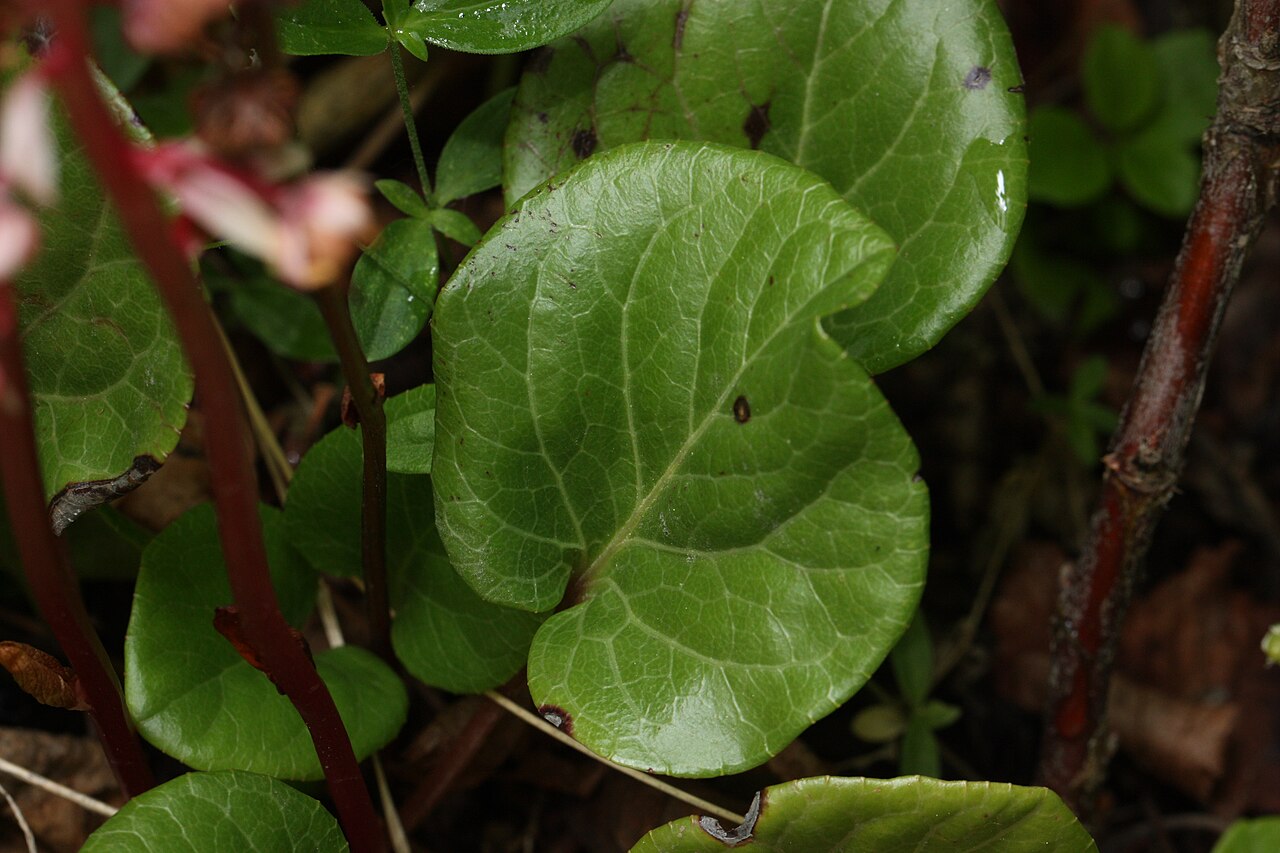
The leaves are round to kidney- or heart-shaped, about 1 to 3 inches long, thick, leathery and glossy dark green above, often purplish beneath, with smooth or slightly wavy edges. The leaf stalks are as long as or longer than the blades. The leaves last through winter.
Flowers
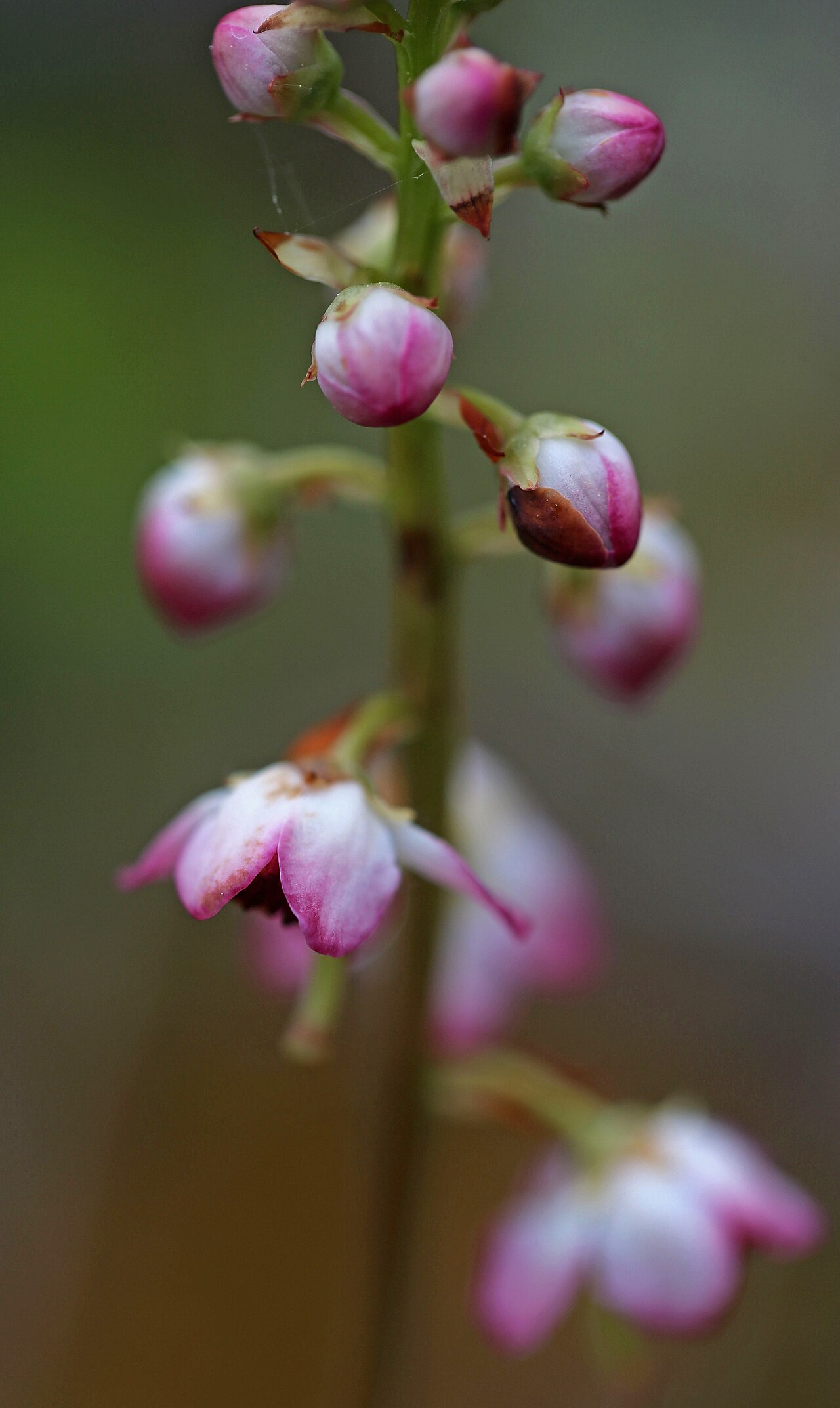
The flowers hang in a loose, elongated raceme of 5 to 25 at the top of the stalk. Each is cup-shaped, nodding, about 1/2 inch across, with five waxy petals that are pale pink to deep rose-red. The style is long, bent downward and curved upward at the tip, sticking out well beyond the petals. Bloom time is June to August.
Fruit & Seeds
The fruit is a small, rounded, five-parted capsule that turns brown and stays on the stalk with the style still attached. It releases huge numbers of dust-like seeds that rely on soil fungi to germinate.
Look-alikes
Shinleaf (Shinleaf, P. elliptica) and American wintergreen (American Wintergreen, P. americana) have white or greenish-white flowers. One-sided wintergreen (One-Sided Wintergreen) has greenish-white flowers all on one side of the stalk. Pipsissewa (Pipsissewa) has narrow, toothed leaves on a short woody stem. Bog wintergreen is the only common North American pyrola with pink to red flowers.
Quick Facts
| Scientific Name | Pyrola asarifolia |
| Family | Ericaceae (heath family); formerly Pyrolaceae |
| Plant Type | Evergreen perennial wildflower; partly mycoheterotrophic |
| Mature Height | 6–16 in in flower; leaves 2–4 in |
| Mature Spread | Slowly spreading colonies |
| Growth Rate | Slow |
| Sun Exposure | Partial to full shade |
| Water Needs | Moderate to high; constantly moist soil |
| Soil Type | Moist, humus-rich or mossy soils; often calcareous |
| Soil pH | About 5.5–7.5 |
| Bloom Time | June–August |
| Flower Color | Pale pink to rose red |
| Fall Color | None; evergreen |
| Fruit | Small round capsule with dust-like seeds |
| Deer Resistant | Occasionally browsed |
| USDA Hardiness Zones | 2–7 |
Native Range
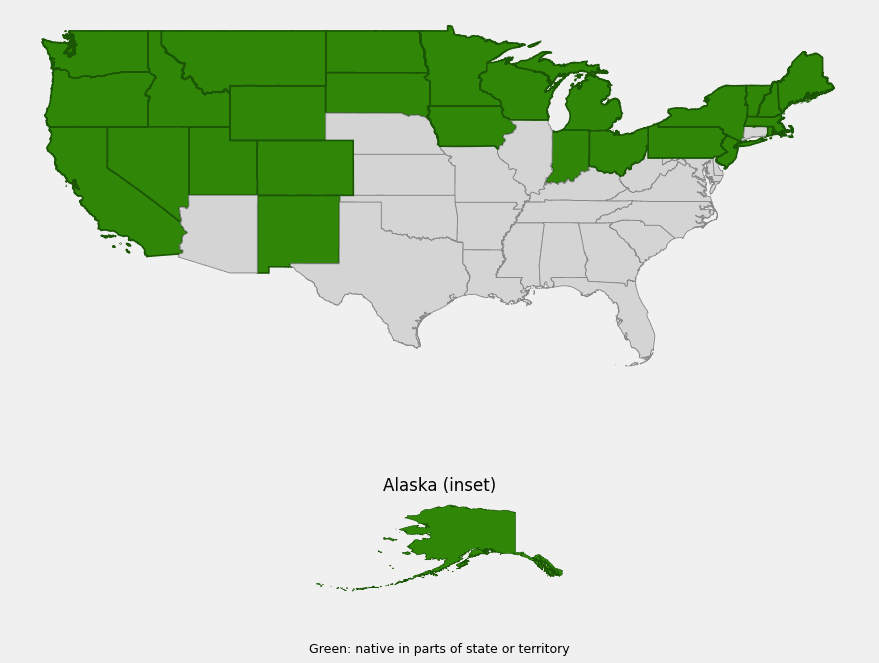
Bog wintergreen is one of the most widespread wintergreens in North America. USDA PLANTS lists it as native in Alaska and in 26 states of the lower 48: California, Colorado, Idaho, Indiana, Iowa, Maine, Massachusetts, Michigan, Minnesota, Montana, Nevada, New Hampshire, New Jersey, New Mexico, New York, North Dakota, Ohio, Oregon, Pennsylvania, Rhode Island, South Dakota, Utah, Vermont, Washington, Wisconsin and Wyoming. It also grows in every Canadian province and in the Yukon and Northwest Territories.
In the West it is common in the Cascades, Olympics, Sierra Nevada and Rocky Mountains, south to New Mexico. In the East it follows the boreal forest across Canada and the northern states, south to northern New England, New York, Pennsylvania and the Great Lakes region. Records from Indiana, Iowa, Ohio, New Jersey, Rhode Island and Massachusetts are rare and scattered at the southern edge of its range.
It grows in cool, moist, shady places: damp coniferous and mixed forests, cedar and spruce swamps, fens and bog edges, shaded streambanks, wet meadows and seeps, often on mossy, nutrient-rich or limy soils.
📋 Regional plant lists featuring Bog Wintergreen: New York, Pennsylvania & Northern New Jersey · Idaho, Eastern Oregon & Eastern Washington · Ohio & Indiana · Montana & Wyoming · Michigan, Wisconsin & Eastern Minnesota · Utah & Western Colorado · Connecticut, Massachusetts & Rhode Island · New Hampshire, Maine & Vermont · Delaware, Southern New Jersey & Long Island · Illinois, Iowa & Missouri · Alaska · North Dakota, South Dakota & Western Minnesota · Western Oregon & Western Washington · California & Nevada
Growing & Care Guide
Bog wintergreen is not a practical garden plant. It relies on a partnership with specific soil fungi for part of its nutrition, so it rarely survives transplanting and is very hard to raise from seed. If you have it on your property, the best care is to protect the shady, moist habitat where it already grows.
Light
Partial to full shade, under conifers or mixed forest, as in the wild.
Soil & Water
It needs constantly moist, humus-rich, mossy soil with an intact community of mycorrhizal fungi, usually under conifers. Avoid disturbing the soil, adding fertilizer or letting the site dry out.
Planting Tips
Do not dig plants from the wild: transplants almost always die because the fungal connections are broken. If it already grows on your land, keep foot traffic, raking and soil disturbance to a minimum and leave the forest litter in place.
Pruning & Maintenance
None needed. Leave the evergreen leaves and seed stalks alone. Control invasive plants that could crowd it out.
Propagation
The dust-like seeds need the right soil fungi to germinate, and seedlings grow very slowly. Botanic gardens have occasionally raised plants by sowing seed on moss with soil from existing colonies, but home propagation is rarely successful.
Landscape Uses
- Woodland habitat protection: an indicator of healthy moist forest soils
- Wildflower viewing: pink summer flowers in shady forests
- Native plant study: an example of plants that depend on fungi
- Wetland conservation: part of cedar swamp, fen and bog plant communities
- Natural areas: leave in place in shaded, moist woodland
Wildlife & Ecological Value
Bog wintergreen is a small but characteristic part of the forest floor in cool, moist northern and mountain forests.
For Pollinators
The nodding flowers are visited mainly by bumblebees, which shake pollen from the anthers by buzzing, as they do on blueberries and other heath relatives. Some flies and small bees also visit.
For Birds
Grouse and other ground-feeding birds may eat the leaves and capsules, and the low evergreen foliage gives some cover on the forest floor.
For Mammals
Deer, elk and moose occasionally browse the evergreen leaves, especially in winter. Small mammals use the forest floor where it grows.
Ecosystem Role
It takes part in an underground network of mycorrhizal fungi linked to surrounding trees and draws some of its carbon from those fungi, a lifestyle called partial mycoheterotrophy. Its presence often indicates undisturbed, moist forest soils.
Cultural & Historical Uses
The genus name Pyrola means “little pear,” from the pear-like shape of the leaves of some species. The species name asarifolia means “with leaves like Asarum,” the wild gingers, which also have rounded, heart-shaped leaves. The USDA name liverleaf wintergreen refers to the shape and color of the leaves.
Wintergreens of the genus Pyrola contain arbutin and related compounds, and several Native peoples of North America used them as medicines, for example as poultices for sores and swellings. They are not the source of wintergreen flavoring, which comes from Checkerberry.
Research on Pyrola has shown that these green, leafy plants still get a significant share of their carbon from fungi, making them a link between ordinary green plants and fully mycoheterotrophic relatives such as pinesap and Indian pipe.
Frequently Asked Questions
Why is it called wintergreen?
Its leathery leaves stay green all winter. It is not the plant that gives wintergreen flavoring.
Can I grow bog wintergreen in my garden?
Rarely. It depends on specific soil fungi for part of its food, so it almost never survives transplanting and is very hard to grow from seed. Protect it where it already grows.
Where does bog wintergreen grow?
In moist, shady forests, cedar swamps, fens, bogs and streambanks from Alaska and Canada south to New England, the Great Lakes and the western mountains.
How can I tell it from other wintergreens?
It is the common North American pyrola with pink to rose-red flowers. Its relatives have white or greenish flowers.
Is bog wintergreen rare?
It is common across much of its range but rare at the southern edges, such as in Indiana, Iowa, Ohio, New Jersey and southern New England.

Looking for a nursery that carries Bog Wintergreen?
Browse our native plant nursery directory: Alaska · California · Colorado · Idaho, Indiana & Iowa · Maine, Massachusetts, Michigan, Minnesota & Montana · Nevada, New Hampshire, New Jersey, New Mexico, New York, North Dakota & Ohio · Oregon · Pennsylvania, Rhode Island, South Dakota, Utah & Vermont · Washington · Wisconsin & Wyoming