
Nodding Trillium (Trillium cernuum)
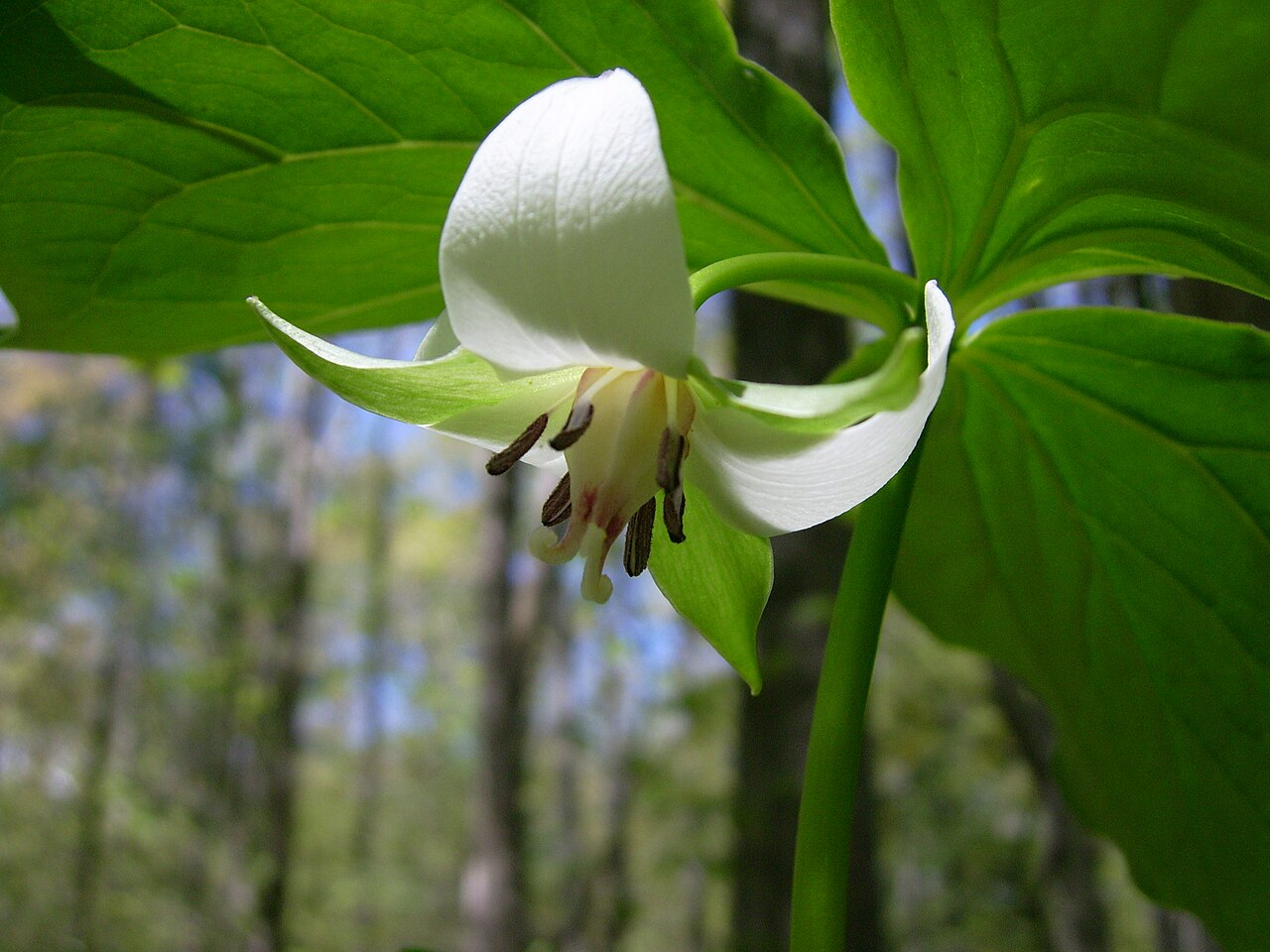
Trillium cernuum, known as Nodding Trillium (USDA: whip-poor-will flower), is a spring woodland wildflower of cool, moist forests in the northern United States and Canada. Like other trilliums it has its parts in threes: a single whorl of three broad leaves on an unbranched stem, and one flower with three green sepals and three petals. It belongs to the trillium and bunchflower family (Melanthiaceae), although older books place trilliums in the lily family.
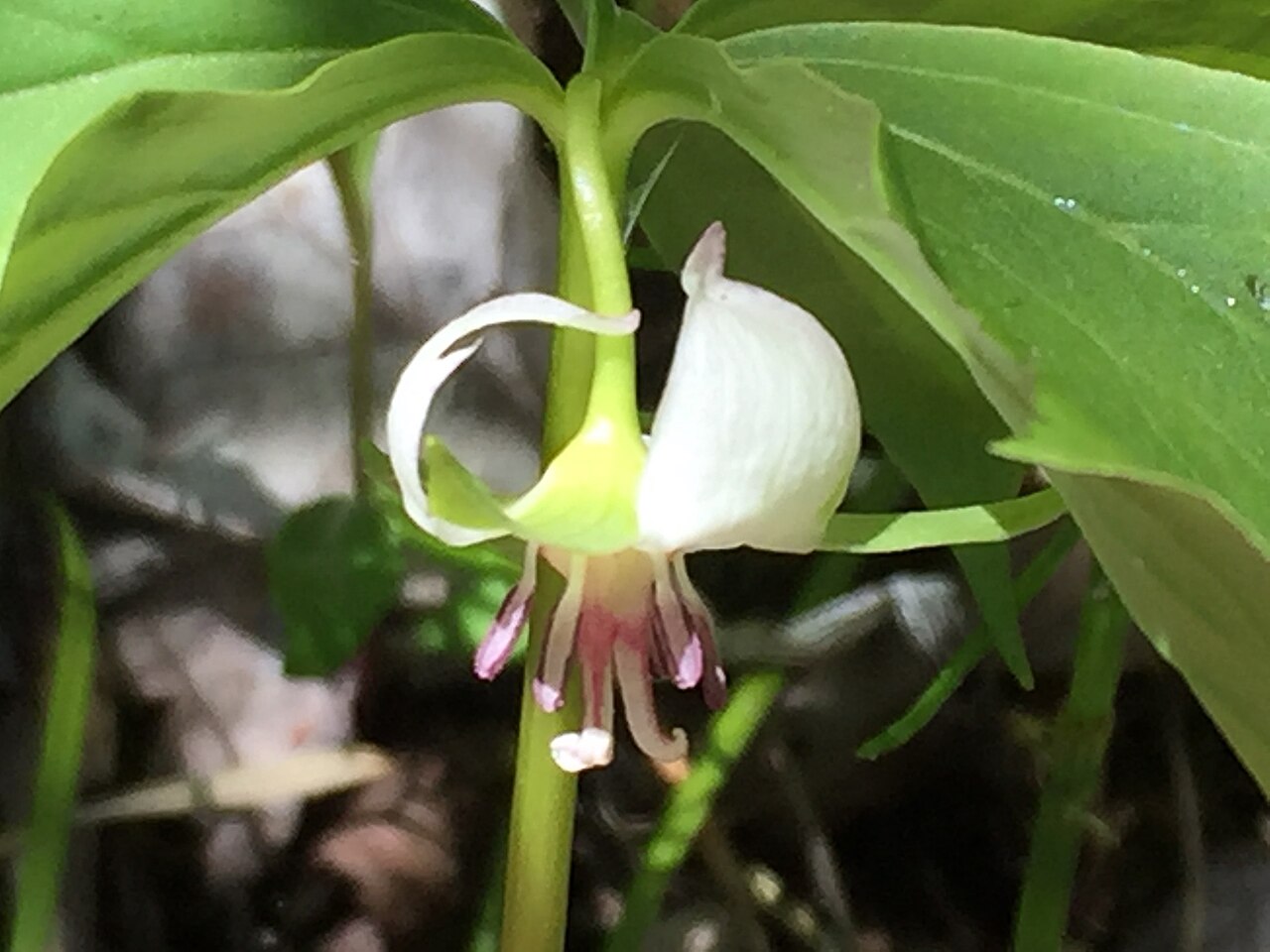
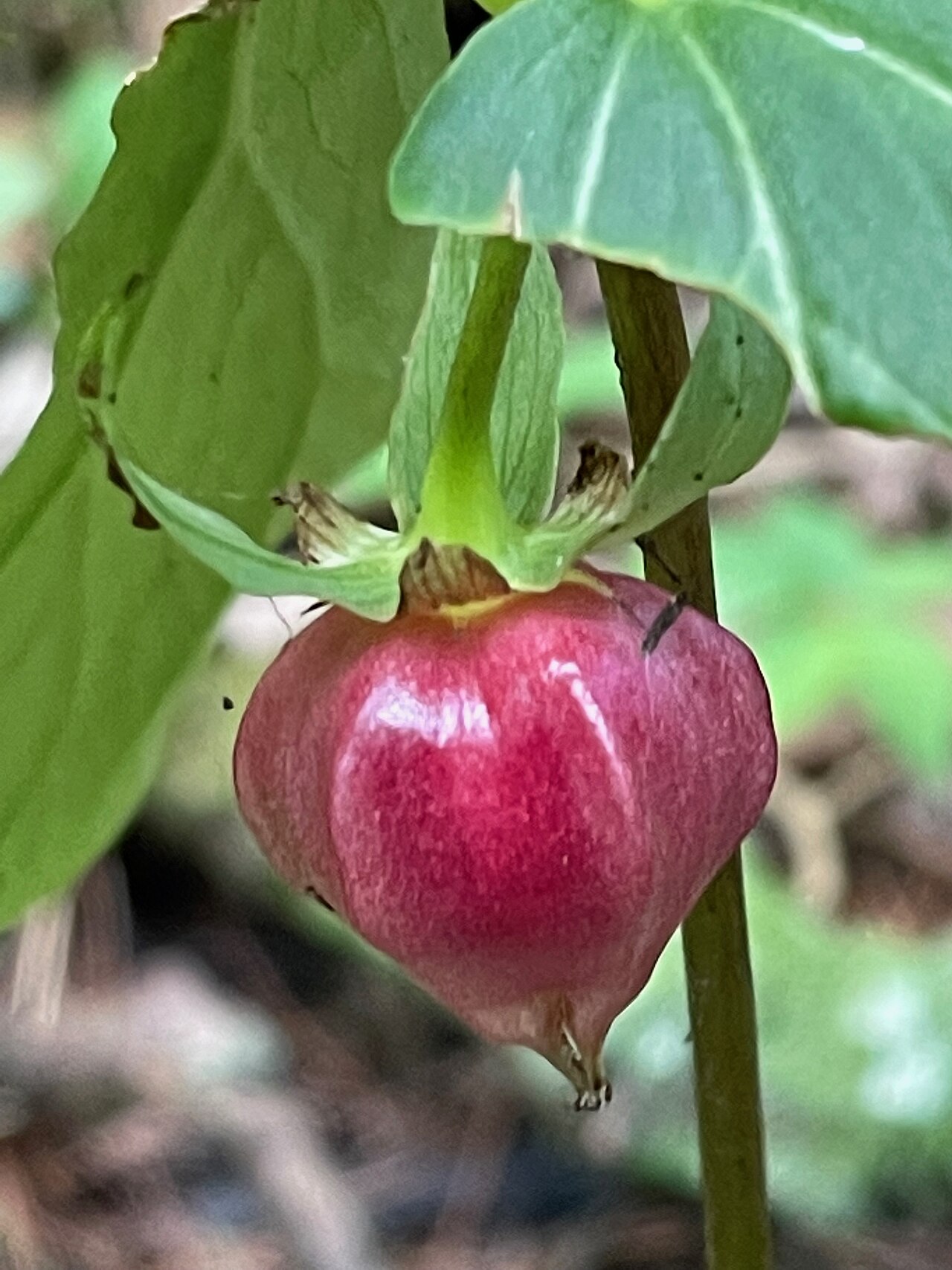
What sets nodding trillium apart is the way it hides its flower. The flower stalk curves sharply downward, so the white bloom, with its strongly swept-back petals and pinkish-purple anthers, hangs beneath the leaves. Many people walk right past it. It blooms in May and June, a little later than most other northern trilliums, and the flower ripens into a reddish-purple berry by midsummer.
Nodding trillium grows from Newfoundland and the Maritime provinces west to Saskatchewan, and in the United States from Maine to the Dakotas, south to the Mid-Atlantic states. Like all trilliums it grows slowly and many years can pass between seed and first flower, and wild plants are often dug illegally for sale. Never dig trilliums from the wild. Buy only nursery-propagated plants from reputable native plant growers.
Identification
In leaf, nodding trillium looks like other white trilliums. To identify it, lift a leaf and look for a flower hanging below on a down-curved stalk, then check the anthers and the shape of the petals.
Stem & Leaves
A single unbranched stem 8 to 20 inches tall rises from a short underground rhizome. At the top is a whorl of three broad, diamond-shaped to roundish leaves, each about 2 to 4 inches long, with a pointed tip and a very short stalk or none. The leaves are plain green, never mottled.
Flowers
The single flower hangs on a stalk 1/2 to 1 1/2 inches long that bends downward, so the flower sits below or at the level of the leaves. The three petals are white, rarely pinkish, about 1/2 to 1 inch long, wavy-edged and strongly curled back. The six stamens are short, with pinkish-purple to lavender anthers about as long as their filaments. The flower has a faint scent. Bloom time is mainly May and June.
Fruit & Seeds
The ovary swells into a fleshy, somewhat six-sided berry about 1/2 to 3/4 inch long that turns red to reddish-purple in July and August. The seeds carry small oily appendages (elaiosomes) that attract ants, which carry the seeds away.
Look-alikes
Bent trillium (T. flexipes) of the Midwest also has a white flower that may droop, but its creamy-white anthers are longer than their filaments, its petals are flatter and its flower stalk is usually longer. White-flowered forms of red trillium (T. erectum) have dark ovaries and hold the flower out to the side. White trillium (T. grandiflorum) has a large, upright flower held well above the leaves. Southern nodding trillium (T. rugelii) replaces this species in the southern Appalachians.
Safety & Conservation
Trilliums are not considered seriously poisonous, but they are not food plants and should not be eaten. Nodding trillium is common in parts of its northern range but is rare and protected in several states near the southern edge of its range. Picking the leaves or flower can starve or kill the plant, since the three leaves are its only source of food for the year. Never dig wild plants; buy only nursery-propagated trilliums.
Quick Facts
| Scientific Name | Trillium cernuum |
| Family | Melanthiaceae (trillium and bunchflower family) |
| Plant Type | Herbaceous perennial spring wildflower from a rhizome |
| Mature Height | 8–20 in |
| Mature Spread | 6–12 in; slowly forms small clumps |
| Growth Rate | Slow |
| Sun Exposure | Part shade to full shade |
| Water Needs | Medium to high; consistently moist soil |
| Soil Type | Rich, humusy loam; moist woodland soil |
| Soil pH | Slightly acidic to neutral (about 5.0–7.0) |
| Bloom Time | May–June |
| Flower Color | White (rarely pinkish), with pinkish-purple anthers |
| Fall Color | None; leaves die back by late summer |
| Fruit | Red to reddish-purple berry, July–August |
| Deer Resistant | No; deer browse trilliums heavily |
| USDA Hardiness Zones | 3–7 |
Native Range
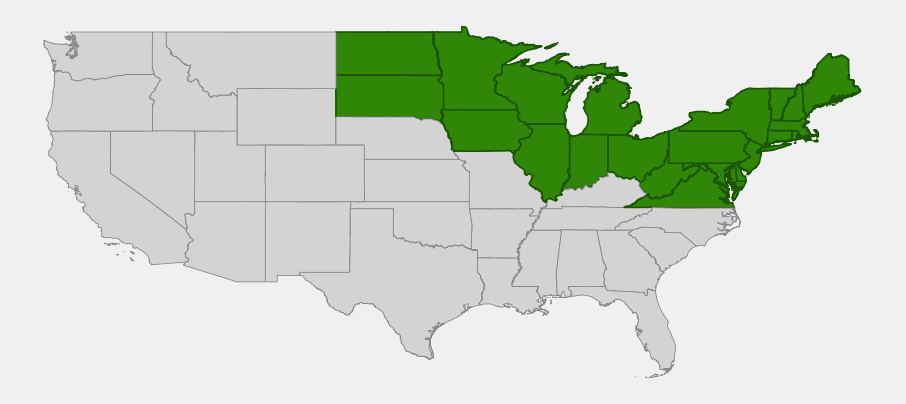
Nodding trillium is a northern species. USDA PLANTS lists it as native in Canada, the lower 48 states and Saint Pierre and Miquelon, with records from 22 states. In Canada it grows from Newfoundland, Nova Scotia, Prince Edward Island and New Brunswick west through Quebec, Ontario and Manitoba to Saskatchewan.
In the United States it ranges from Maine and New England west across New York, Pennsylvania and the Great Lakes states to Minnesota, Iowa and the eastern Dakotas, and south to New Jersey, Delaware, Maryland, Virginia and West Virginia. It is most common in the northern forests of New England, New York, Michigan, Wisconsin and Minnesota. Farther south and west, in states such as Iowa, Illinois, Indiana, Ohio, the Dakotas and the Mid-Atlantic, it is local or rare, and some of these populations are scattered outliers.
Its habitats are cool and moist: rich deciduous and mixed woods, swampy woods, cedar and hemlock forests, ravines and stream banks, and wooded wetland edges. In North Dakota it reaches the western edge of its range in moist wooded areas in the northern part of the state.
📋 Regional plant lists featuring Nodding Trillium: New York, Pennsylvania & Northern New Jersey · Ohio & Indiana · Michigan, Wisconsin & Eastern Minnesota · Connecticut, Massachusetts & Rhode Island · New Hampshire, Maine & Vermont · Maryland, Virginia & West Virginia · Delaware, Southern New Jersey & Long Island · Illinois, Iowa & Missouri · North Dakota, South Dakota & Western Minnesota
Growing & Care Guide
Nodding trillium is a rewarding plant for a shady, moist woodland garden in the North, though it is slow and best appreciated up close. Buy only nursery-propagated plants. Many trilliums sold cheaply are dug from the wild, which depletes wild populations; ask the seller how the plants were produced.
Light
Give it part shade to full shade under deciduous trees, with spring sun before the canopy leafs out. Avoid hot afternoon sun, which scorches the leaves.
Soil & Water
Plant it in deep, humus-rich, moist soil, such as a woodland loam amended with leaf mold. It tolerates wetter soil than many trilliums and does well near a stream or in a damp shady corner, but the soil should not be stagnant. Water during spring and early summer dry spells.
Planting Tips
Plant dormant rhizomes in late summer or early fall, about 2 to 4 inches deep, with the bud pointing up. Container plants can go in during spring. Group several together 8 to 12 inches apart, near a path or on a slope where you can see under the leaves. Combine with ferns, wild ginger, foamflower and other spring woodland plants.
Pruning & Maintenance
Leave the leaves alone until they yellow and die back naturally, since they feed the rhizome for next year. Mulch with shredded leaves each fall. Protect plants from deer and rabbits with fencing or repellents if needed, and do not let aggressive groundcovers crowd them.
Propagation
Trilliums are slow from seed. Collect ripe berries from cultivated plants in late summer, clean the seeds and sow them fresh outdoors; they usually need two winters before they sprout, and seedlings take five or more years to flower. Established clumps can be divided carefully in late summer when the rhizome has made more than one growing point.
Landscape Uses
- Woodland gardens: a subtle spring flower for moist shade under deciduous trees
- Shade and fern gardens: pairs well with ferns, wild ginger and foamflower
- Streamside plantings: tolerates the damp soil along shady creeks
- Native wildflower collections: a distinctive trillium with a hidden, nodding flower
- Forest restoration: an indicator of rich, undisturbed northern woods
Wildlife & Ecological Value
Nodding trillium is part of the spring flora of northern forests, and like other trilliums it depends on animals both to pollinate its flowers and to move its seeds.
For Pollinators
The faintly scented, downward-facing flowers are visited by bees, including small native bees and bumble bees active in cool spring weather. The hanging position may protect pollen from rain.
For Birds
Some birds may eat the ripe berries, but birds are not considered the main seed dispersers.
For Mammals
White-tailed deer browse trilliums heavily, and repeated browsing is a major cause of trillium decline in many northern forests. Small mammals may eat the fruit.
Ecosystem Role
The seeds bear oily elaiosomes that ants carry back to their nests. The ants eat the appendage and discard the seed underground, effectively planting it. Healthy trillium populations are often a sign of a forest with moderate deer numbers and an undisturbed, humus-rich forest floor.
Cultural & Historical Uses
The genus name Trillium refers to the plant’s parts in threes, and the species name cernuum is Latin for “nodding” or “drooping,” a reference to the hanging flower. Carl Linnaeus described the species in 1753, making it one of the first trilliums named in botany.
The USDA name, whip-poor-will flower, links its blooming time to the return of the eastern whip-poor-will to northern forests in late spring. Other old names include nodding wake-robin, a name shared with other trilliums that bloom as robins return.
Native peoples of eastern North America used several trilliums in traditional medicine, and the roots of some species were known as “birthroot.” Today trilliums are better known as symbols of the spring woods, and the conservation of wild trilliums, which are slow-growing and easily harmed by picking, digging and overbrowsing, is a concern in many states.
Frequently Asked Questions
Why can’t I see the flower on my nodding trillium?
The flower stalk bends downward, so the flower hangs beneath the three leaves. Lift a leaf gently or look from below to see it.
Is it safe to dig nodding trillium from the woods?
No. Trilliums are slow-growing, transplant poorly and are protected in some states. Digging harms wild populations. Buy nursery-propagated plants from reputable native plant growers.
If I pick the flower, will the plant survive?
Picking the flower usually takes the leaves too, and the plant then has nothing to make food with for the rest of the year. It may die or not bloom for years. Enjoy it in place.
How is nodding trillium different from bent trillium?
Nodding trillium has short pinkish-purple anthers and strongly recurved petals, and its flower hangs below the leaves on a short stalk. Bent trillium has longer creamy anthers, flatter petals and usually a longer flower stalk.
How long does nodding trillium take to bloom from seed?
Usually five years or more. The seeds need two winters to germinate, and the young plants grow slowly before reaching flowering size.

Looking for a nursery that carries Nodding Trillium?
Browse our native plant nursery directory: Connecticut & Delaware · Illinois, Indiana & Iowa · Maine, Maryland, Massachusetts, Michigan & Minnesota · New Hampshire, New Jersey, New York, North Dakota & Ohio · Pennsylvania, Rhode Island, South Dakota, Vermont & Virginia · West Virginia & Wisconsin