
Spring Blue-Eyed Mary (Collinsia verna)
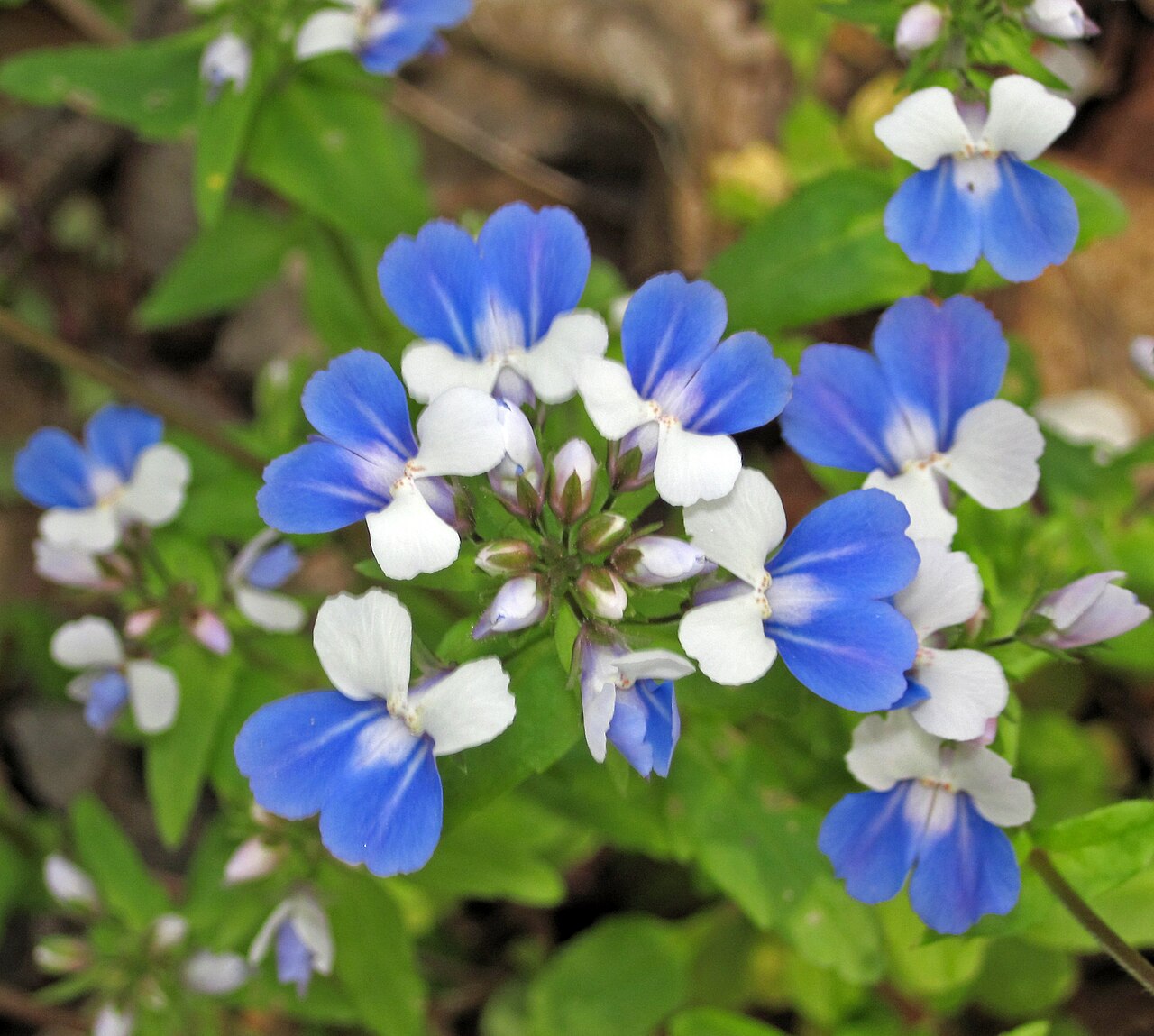
Collinsia verna, known as Spring Blue-Eyed Mary or simply blue-eyed Mary, is a native winter annual wildflower of rich, moist woods and floodplains in the eastern and central United States. It belongs to the plantain family (Plantaginaceae), though older books place it in the figwort family (Scrophulariaceae). It is the only Collinsia native to the eastern half of the continent; its many relatives grow in the West.
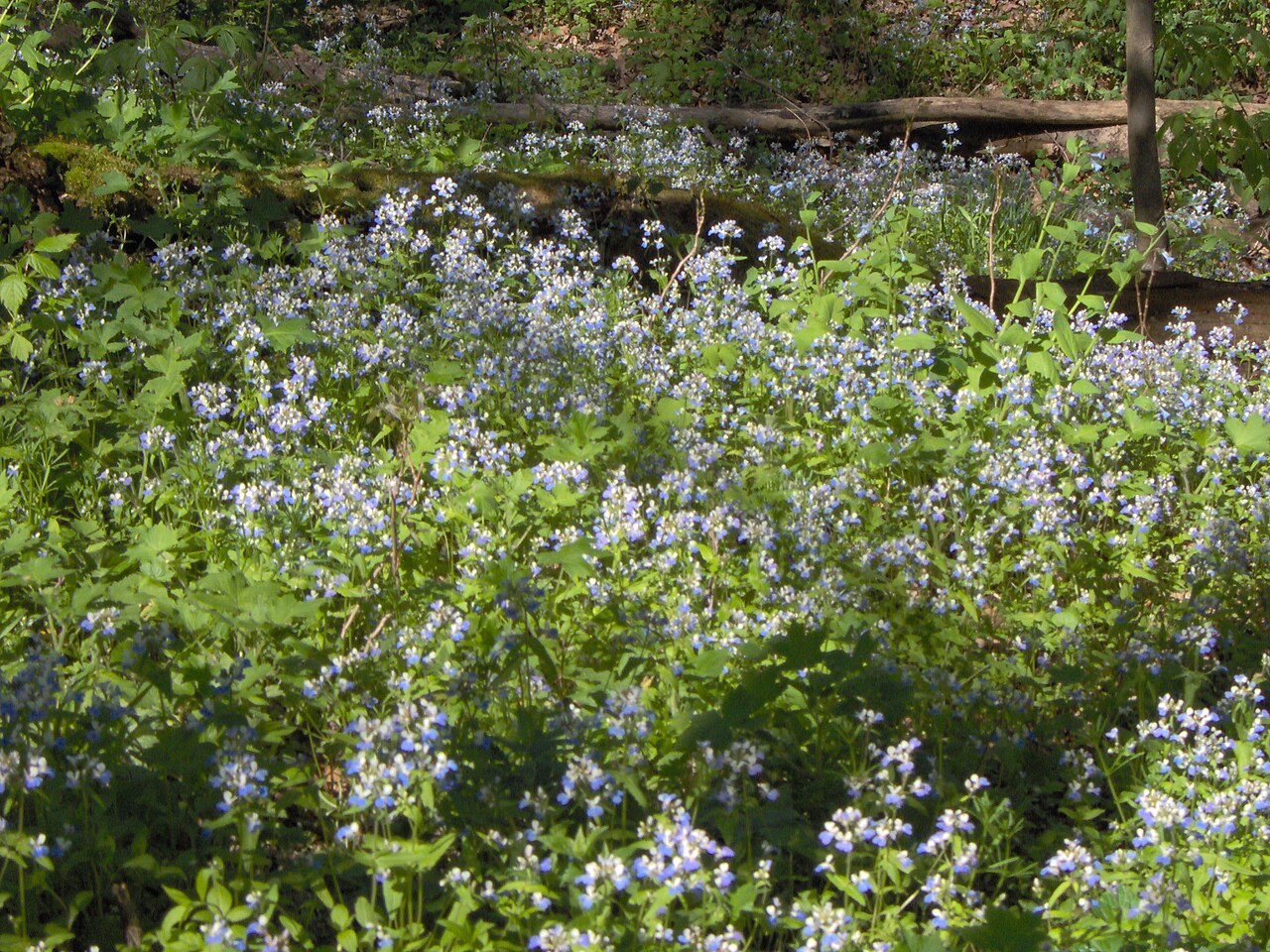
In April and May, slender stems 6 to 18 inches tall carry whorls of small, two-lipped flowers. Each flower has a white upper lip and a bright blue lower lip, a combination that makes it one of the most distinctive spring wildflowers of the Ohio Valley. Where conditions suit it, the plants grow so thickly that the woodland floor turns blue and white for a few weeks.
Spring blue-eyed Mary germinates in fall, overwinters as a small seedling, blooms in spring and dies by early summer after shedding its seed. It is common in parts of Ohio, Indiana, Kentucky and Pennsylvania but rare or gone at the edges of its range. It can be grown from seed in a moist, shady woodland garden, where it reseeds year after year.
Identification
Look for spring blue-eyed Mary in moist, rich woods and floodplains from April to early June. The two-colored flowers, white above and blue below, held in whorls on slender stems, identify it.
Growth Habit
Plants are delicate, upright to leaning winter annuals, usually 6 to 18 inches tall (occasionally up to 2 feet), with a single weak stem or a few branches from the base. The stems are slender and somewhat hairy. Seedlings appear in fall and overwinter as small rosettes on the forest floor.
Leaves
The leaves are opposite. The lower ones are small, round to oval and stalked; the stem leaves are larger, about 1 to 2 inches long, oval to triangular-lance-shaped, stalkless or clasping, with a few shallow teeth or wavy edges. The foliage is soft and bright green.
Flowers
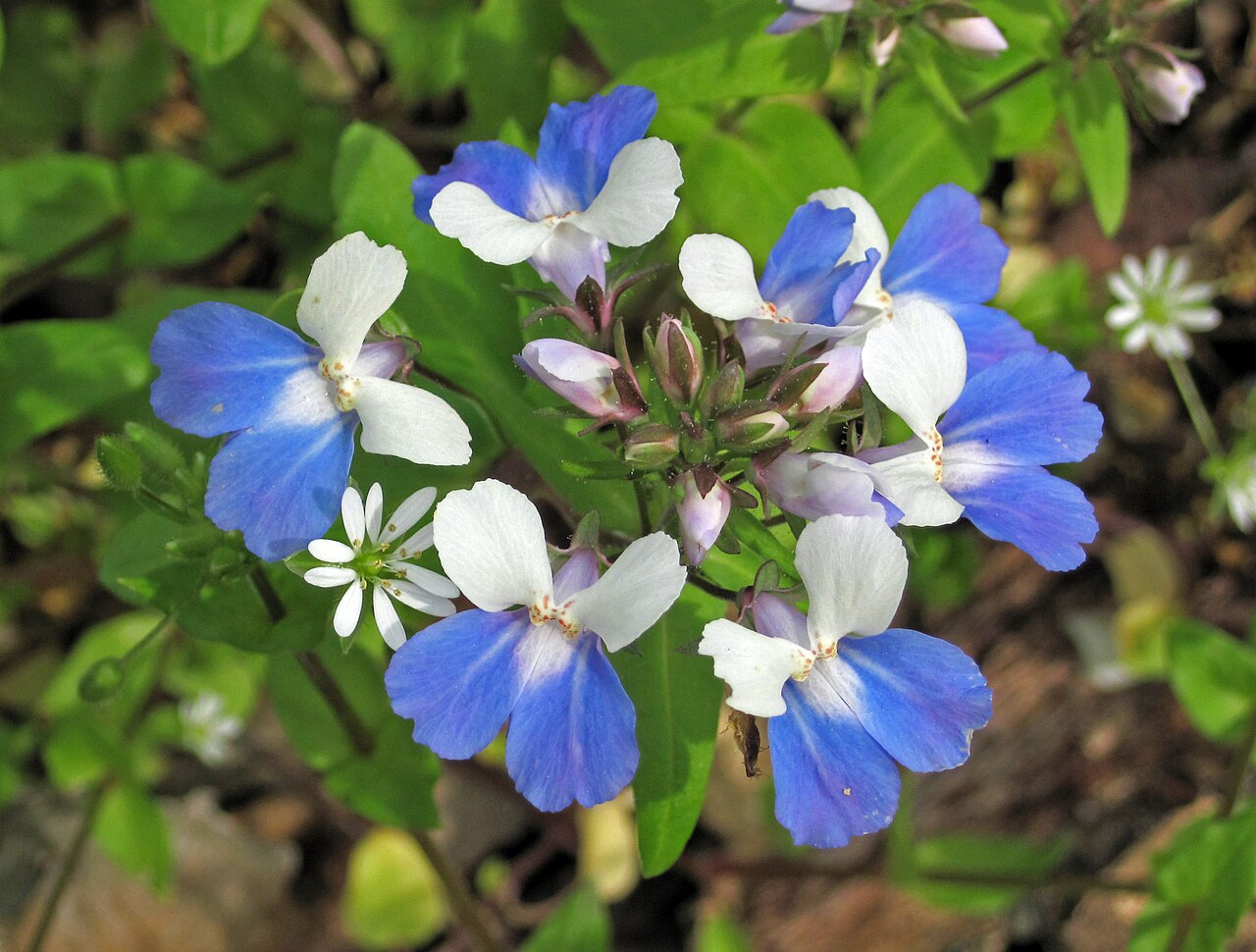
From April to early June, flowers appear in whorls of four to six at the upper leaf joints, each on a slender stalk. Each flower is about 1/2 inch long and two-lipped. The upper lip has two white (sometimes pale lavender) lobes, and the lower lip has three lobes, two bright blue side lobes and a middle lobe folded into a keel that hides the stamens and style, much like a pea flower.
Fruit & Seeds
Each flower produces a small, round capsule with a few relatively large seeds. The seeds ripen and drop in late spring or early summer, lie dormant through summer heat, and germinate in fall.
Look-alikes
Small-flowered blue-eyed Mary (Collinsia parviflora) is a western and northern species with much smaller flowers about 1/4 inch long. Ground ivy (Glechoma hederacea) has small violet flowers but square stems, a mint scent and creeping habit. Speedwells (Veronica) have flat, four-lobed flowers rather than two-lipped ones. No other eastern wildflower has the same white-over-blue two-lipped flowers.
Quick Facts
| Scientific Name | Collinsia verna |
| Family | Plantaginaceae (plantain family); formerly Scrophulariaceae |
| Plant Type | Winter annual wildflower |
| Mature Height | 6–18 in (rarely to 2 ft) |
| Mature Spread | 3–6 in per plant; forms carpets from seed |
| Growth Rate | Fast; completes its life cycle from fall to early summer |
| Sun Exposure | Part shade to shade (sun in spring before tree leaves open) |
| Water Needs | Medium to high; moist soil |
| Soil Type | Rich, moist loam or alluvial soil high in organic matter |
| Soil pH | About 6.0–7.5 (slightly acidic to neutral) |
| Bloom Time | April–early June |
| Flower Color | White upper lip, bright blue lower lip |
| Fall Color | None; plants die back by early summer |
| Fruit | Small round capsule with a few seeds |
| Deer Resistant | Not well documented |
| USDA Hardiness Zones | 5–8 |
Native Range
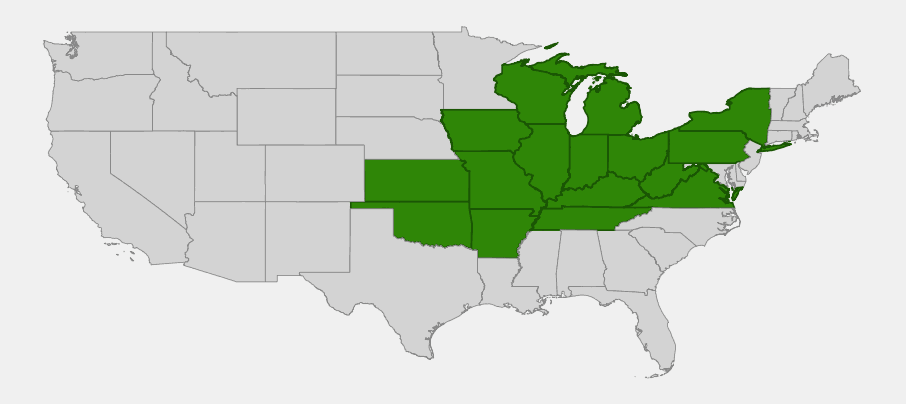
Spring blue-eyed Mary is native to the eastern and central United States. USDA PLANTS lists it as native in the lower 48 states and Canada and records it from 16 states: New York and Pennsylvania west through Ohio, Michigan, Indiana, Illinois, Wisconsin and Iowa to Missouri and Kansas, and south through West Virginia, Virginia, Kentucky and Tennessee to Arkansas and Oklahoma. It was also recorded historically from southern Ontario.
Its stronghold is the Ohio Valley, where it is common in rich woods of Ohio, Indiana, Kentucky and western Pennsylvania. Toward the edges of its range it is rare. NatureServe ranks it as critically imperiled (S1) in Arkansas, Iowa, Kansas, Oklahoma, Tennessee and Virginia, historical (not seen in decades) in New York, and extirpated in Wisconsin and Ontario. Outlying records in these states are scattered and small.
Typical habitats are moist, rich deciduous woods, floodplain and bottomland forests, wooded stream terraces and the lower slopes of ravines. It favors deep, fertile, often alluvial soils with plenty of leaf litter, and it is most abundant where the spring sun reaches the forest floor before the trees leaf out.
📋 Regional plant lists featuring Spring Blue-Eyed Mary: New York, Pennsylvania & Northern New Jersey · Ohio & Indiana · Michigan, Wisconsin & Eastern Minnesota · Kentucky & Tennessee · Nebraska, Kansas & Eastern Colorado · Maryland, Virginia & West Virginia · Delaware, Southern New Jersey & Long Island · Illinois, Iowa & Missouri · Arkansas, Louisiana, Eastern Oklahoma & Eastern Texas
Growing & Care Guide
Spring blue-eyed Mary is easy to grow from seed if you give it moist, rich woodland soil and leave it alone to reseed. Seed is sold by several Midwestern native seed companies. Because it is a winter annual, it must be sown in late summer or fall, not spring. Never dig plants from the wild; they will not survive transplanting.
Light
Give it part shade to shade under deciduous trees, where it gets spring sun before the canopy closes. It does poorly in full summer sun, but that matters little because the plant has finished its life cycle by early summer.
Soil & Water
It needs rich, moist, well-drained soil high in organic matter, such as woodland loam or alluvial soil. Keep a layer of fallen leaves in place to hold moisture. It tolerates brief spring flooding but not soil that dries out in fall and spring when seedlings are growing.
Planting Tips
Scatter fresh seed in late summer or early fall on bare, moist soil or thin leaf litter under trees, and rake it in lightly. Seedlings appear in fall and bloom the next spring. Sow generously in one area to start a colony, and pair it with spring ephemerals and ferns that will cover the ground after it dies back.
Pruning & Maintenance
Do not deadhead or clean up the dying plants; the seeds must ripen and fall for next year. Avoid heavy mulch, which smothers seedlings, and avoid disturbing the soil in fall. Pull aggressive weeds such as garlic mustard, which competes for the same space.
Propagation
Propagate only from seed. Sow freshly ripened seed outdoors in summer or early fall; the seed needs a warm summer period followed by cool fall temperatures to germinate. Established colonies reseed themselves reliably.
Landscape Uses
- Woodland gardens: a carpet of blue and white flowers in spring
- Spring ephemeral plantings: mixes with bluebells, phlox and toothworts
- Pollinator gardens: early-season food for bumblebees and mason bees
- Floodplain restoration: herb layer for rich bottomland woods
- Shade borders: fills bare ground under deciduous trees in spring
Wildlife & Ecological Value
Spring blue-eyed Mary flowers early, when queen bumblebees and other early bees badly need food.
For Pollinators
The Xerces Society notes it has special value to native bees. Bumblebees, mason bees (Osmia), other long-tongued bees and bee flies visit the flowers. Like a pea flower, the lower lip has a keel that hides the stamens and style, and a bee landing on it pushes the keel down and gets dusted with pollen.
For Birds
Spring blue-eyed Mary is not a significant food plant for birds, but its colonies are part of the rich herb layer that supports the insects many woodland birds feed to their young.
For Mammals
Wildlife use is not well documented. Small mammals may eat some seeds, and deer may browse the plants in heavily browsed woods.
Ecosystem Role
As a winter annual, it uses the bright, moist window of early spring on the forest floor, then dies back before summer. Large colonies stabilize floodplain soils in spring and indicate rich, relatively undisturbed woodland. It declines where invasive plants such as garlic mustard and bush honeysuckle take over.
Cultural & Historical Uses
The genus Collinsia was named by Thomas Nuttall in 1817 in honor of Zaccheus Collins, a Philadelphia naturalist and patron of botany. The species name verna means of spring.
The common name blue-eyed Mary is old and its origin is uncertain. It probably refers to the bright blue lower lip of the flower, and the same name is used in Europe for the unrelated Omphalodes verna.
In parts of Ohio, Indiana and Kentucky, spring blue-eyed Mary colonies are famous wildflower displays. Preserves such as the Bluebell Preserve in Athens, Ohio, protect carpets of it alongside Virginia bluebells, and spring wildflower walks are timed to its bloom.
Frequently Asked Questions
Is spring blue-eyed Mary an annual?
Yes. It is a winter annual. Seeds germinate in fall, seedlings overwinter, the plants bloom in spring, and they die by early summer after shedding seed.
When should I sow blue-eyed Mary seed?
In late summer or early fall, on moist, bare soil under deciduous trees. Spring sowing usually fails because the seed needs fall temperatures to germinate.
Where does spring blue-eyed Mary grow?
It grows in rich, moist woods and floodplains of the eastern and central United States, mostly in the Ohio Valley and nearby states.
Is spring blue-eyed Mary rare?
It is common in the Ohio Valley but rare at the edges of its range. NatureServe ranks it as critically imperiled in several states, historical in New York, and extirpated in Wisconsin and Ontario.
What pollinates blue-eyed Mary?
Mainly bumblebees, mason bees and other long-tongued bees, which push down the keel-shaped lower lip to reach the nectar and pollen.

Looking for a nursery that carries Spring Blue-Eyed Mary?
Browse our native plant nursery directory: Arkansas · Illinois, Indiana, Iowa & Kansas · Kentucky, Michigan & Missouri · New York, Ohio & Oklahoma · Pennsylvania, Tennessee & Virginia · West Virginia & Wisconsin